
Introduction
The pharmaceutical industry is one of the most regulated, technologically advanced, and quality-driven industries in the world. It plays a critical role in safeguarding public health by developing, manufacturing, and distributing safe, effective, and high-quality medicines.
Every year, thousands of graduates from B.Pharm, M.Pharm, Pharm.D, Biotechnology, Microbiology, Chemistry, Pharmaceutical Engineering, and Life Sciences enter the pharmaceutical workforce with dreams of building successful careers. However, many freshers quickly realize that academic excellence alone is not enough to succeed in the highly regulated pharmaceutical environment.
A significant gap exists between classroom education and real-world industrial expectations. While academic institutions provide strong theoretical foundations, pharmaceutical companies seek professionals who understand Good Manufacturing Practices (GMP), compliance requirements, documentation systems, quality culture, and digital technologies.
As a result, many freshers face challenges during the initial years of employment, including difficulty adapting to industrial processes, understanding regulatory expectations, handling documentation, and navigating career paths.
This article explores the major challenges faced by freshers in the pharmaceutical industry and provides practical solutions to help them become industry-ready professionals and accelerate career growth.
Understanding the Academia-Industry Gap
One of the primary reasons freshers struggle is the disconnect between academic learning and industrial operations.
Academic institutions focus on:
- Pharmaceutical sciences
- Drug formulations
- Chemistry
- Pharmacology
- Microbiology
- Research principles
However, pharmaceutical companies emphasize:
- GMP compliance
- Documentation practices
- Data Integrity
- Manufacturing operations
- Quality systems
- Validation
- Regulatory compliance
- Digital technologies
Freshers often enter the workforce with strong theoretical knowledge but limited understanding of practical pharmaceutical operations.
Bridging this gap is essential for long-term career success.
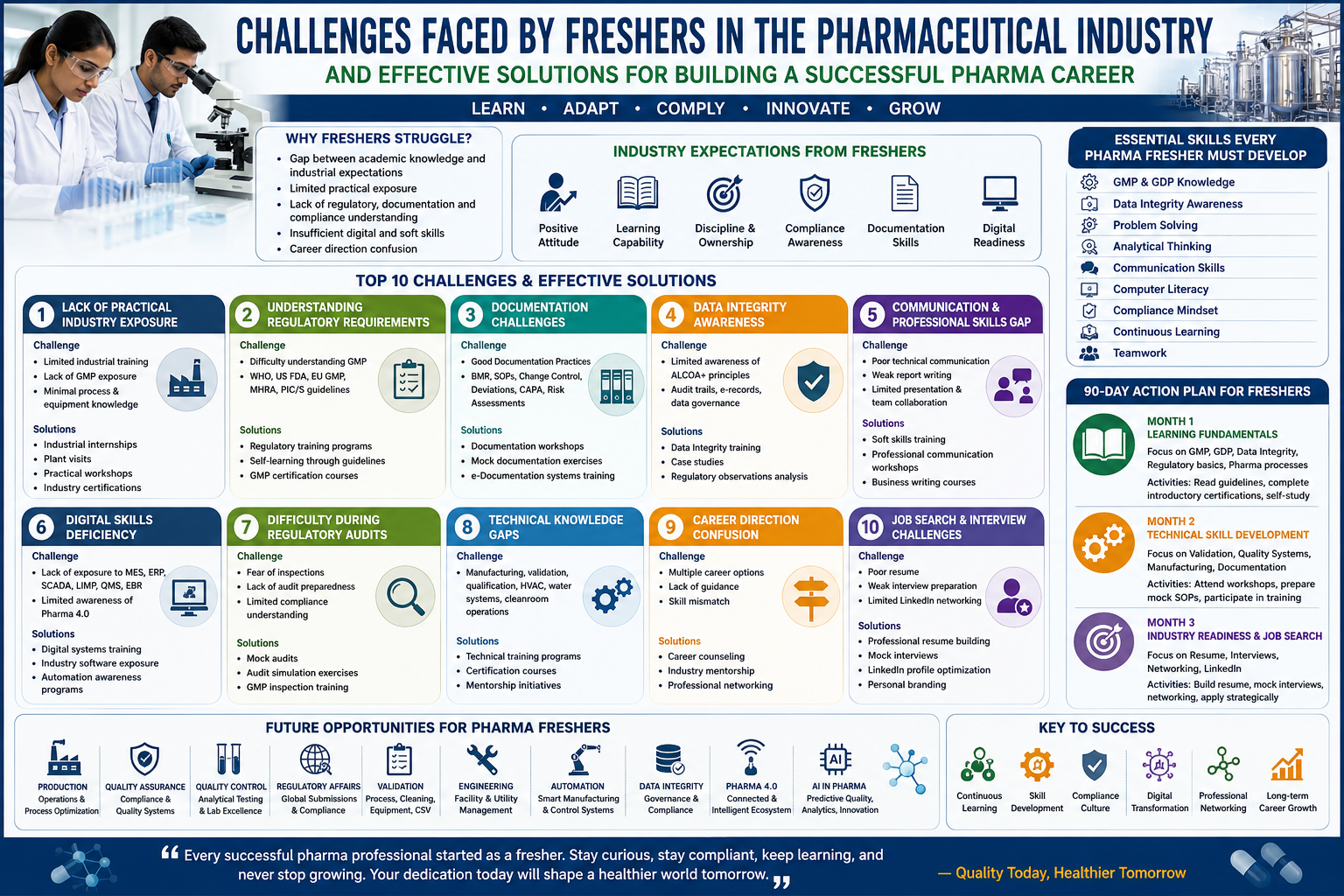
1. Lack of Practical Industry Exposure
Challenge
Many fresh graduates have limited exposure to actual pharmaceutical manufacturing environments.
Common gaps include:
- Limited industrial internships
- Lack of exposure to GMP-compliant facilities
- Minimal understanding of manufacturing operations
- Little familiarity with pharmaceutical equipment
- Limited awareness of shop-floor activities
As a result, freshers often struggle to connect theoretical concepts with practical applications.
Real-World Example
A graduate may understand tablet formulation theory but may never have observed:
- Granulation
- Compression
- Coating
- Packaging operations
inside a commercial manufacturing facility.
Solutions
Industrial Internships
Students should pursue internships in:
- Manufacturing plants
- Quality laboratories
- Regulatory departments
- Engineering departments
Plant Visits
Industrial visits provide practical exposure to:
- Production processes
- Equipment operation
- Cleanroom practices
- Quality systems
Practical Workshops
Participate in hands-on workshops covering:
- Tablet manufacturing
- Sterile operations
- Equipment qualification
- Validation exercises
Industry Certifications
Obtain certifications in:
- GMP
- Validation
- Quality Systems
- Data Integrity
2. Understanding Regulatory Requirements
Challenge
The pharmaceutical industry operates under strict global regulations.
Freshers often find it difficult to understand:
- WHO GMP
- US FDA regulations
- EU GMP requirements
- MHRA expectations
- PIC/S guidelines
Regulatory terminology can appear overwhelming to new professionals.
Why This Matters
Failure to comply with regulations can lead to:
- Product recalls
- Warning letters
- Import alerts
- Business disruptions
Therefore, regulatory awareness is essential from day one.
Solutions
Regulatory Training Programs
Enroll in courses focused on:
- GMP fundamentals
- Pharmaceutical regulations
- Inspection readiness
Self-Learning
Study guidance documents from:
- WHO
- US FDA
- EMA
- MHRA
- PIC/S
Certification Programs
Complete GMP certification courses to strengthen compliance understanding.
3. Documentation Challenges
Challenge
Documentation is the backbone of pharmaceutical compliance.
Freshers frequently struggle with:
- Good Documentation Practices (GDP)
- SOP writing
- Batch Manufacturing Records (BMR)
- Batch Packaging Records (BPR)
- Change Control
- Deviations
- CAPA
- Risk Assessments
Many graduates have never prepared regulatory-compliant documents before entering industry.
Industry Reality
A common saying in pharma is:
“If it isn’t documented, it didn’t happen.”
Solutions
Documentation Workshops
Conduct practical training on:
- SOP creation
- BMR review
- Deviation reporting
Mock Documentation Exercises
Practice creating:
- Investigation reports
- CAPA plans
- Change controls
Electronic Documentation Training
Gain exposure to:
- eQMS
- Electronic Batch Records
- Digital workflows
4. Data Integrity Awareness
Challenge
Data Integrity has become one of the most critical focus areas during regulatory inspections.
Many freshers have limited knowledge of:
- ALCOA+ principles
- Audit trails
- Electronic records
- Electronic signatures
- Data governance
Why It Matters
Several regulatory warning letters are issued due to Data Integrity failures.
Solutions
Data Integrity Training
Understand:
- Attributable
- Legible
- Contemporaneous
- Original
- Accurate
and additional ALCOA+ principles.
Regulatory Case Studies
Study actual FDA warning letters and inspection observations.
Digital Systems Awareness
Learn how data is generated, stored, reviewed, and protected.
5. Communication and Professional Skills Gap
Challenge
Technical competence alone does not guarantee success.
Many freshers face difficulties in:
- Professional communication
- Technical writing
- Presentation delivery
- Team collaboration
- Cross-functional interaction
Industry Impact
Poor communication can lead to:
- Misunderstandings
- Documentation errors
- Delayed investigations
- Compliance issues
Solutions
Soft Skills Development
Improve:
- Verbal communication
- Listening skills
- Interpersonal effectiveness
Business Writing Courses
Learn:
- Email etiquette
- Technical report writing
- Professional correspondence
Presentation Training
Develop confidence in presenting technical information.
6. Digital Skills Deficiency
Challenge
The pharmaceutical industry is rapidly moving toward Pharma 4.0.
Many freshers lack exposure to:
- Manufacturing Execution Systems (MES)
- Enterprise Resource Planning (ERP)
- SCADA
- Laboratory Information Management Systems (LIMS)
- Electronic Quality Management Systems (eQMS)
- Electronic Batch Records (EBR)
Solutions
Digital Systems Training
Understand digital manufacturing workflows.
Automation Awareness Programs
Learn:
- Process automation
- Digital quality systems
- Smart manufacturing
Software Familiarization
Gain introductory exposure to:
- SAP
- TrackWise
- LabWare
- Wonderware
- Siemens systems
7. Difficulty During Regulatory Audits
Challenge
Regulatory inspections often create anxiety among fresh employees.
Common concerns include:
- Fear of auditors
- Lack of confidence
- Limited inspection experience
- Uncertainty about compliance expectations
Solutions
Mock Audits
Participate in simulated inspections.
GMP Inspection Training
Learn:
- Auditor expectations
- Interview techniques
- Inspection etiquette
Observation Handling Exercises
Practice responding to audit observations professionally.
8. Technical Knowledge Gaps
Challenge
Freshers often have limited understanding of:
Manufacturing Operations
- Granulation
- Compression
- Coating
- Packaging
Validation
- Process Validation
- Cleaning Validation
- Analytical Validation
Qualification
- DQ
- IQ
- OQ
- PQ
Utilities
- HVAC systems
- Water systems
- Compressed air systems
Cleanroom Operations
- Environmental monitoring
- Contamination control
- Gowning practices
Solutions
Technical Training Programs
Attend specialized pharmaceutical training.
Certification Courses
Gain expertise in:
- Validation
- Engineering
- Manufacturing systems
Mentorship Programs
Learn from experienced professionals.
9. Career Direction Confusion
Challenge
The pharmaceutical industry offers numerous career paths.
Freshers often struggle to decide between:
- Production
- QA
- QC
- Regulatory Affairs
- Validation
- Engineering
- R&D
- Supply Chain
- Automation
Solutions
Career Counseling
Understand strengths and interests.
Industry Mentorship
Seek guidance from experienced professionals.
Professional Networking
Connect with industry experts through LinkedIn and professional associations.
10. Job Search and Interview Challenges
Challenge
Many freshers fail to effectively market their skills.
Common issues include:
- Poor resumes
- ATS incompatibility
- Weak interview preparation
- Limited networking
Solutions
Professional Resume Building
Create ATS-friendly resumes highlighting:
- Skills
- Projects
- Certifications
- Internships
Mock Interviews
Practice technical and HR interviews.
LinkedIn Optimization
Develop a strong professional profile.
Personal Branding
Regularly share industry-related content.
Essential Skills Every Pharma Fresher Must Develop
To become industry-ready, every fresher should focus on developing:
Technical Skills
- GMP Knowledge
- GDP Knowledge
- Data Integrity Awareness
- Validation Concepts
- Quality Systems Understanding
Professional Skills
- Communication
- Problem Solving
- Analytical Thinking
- Teamwork
- Leadership Potential
Digital Skills
- MS Office
- Excel Analytics
- ERP Systems
- MES
- Digital Documentation
Behavioral Skills
- Discipline
- Integrity
- Accountability
- Compliance Mindset
- Continuous Learning
Industry Expectations from Freshers
Pharmaceutical companies generally do not expect freshers to know everything.
However, they expect:
Positive Attitude
A willingness to learn and improve.
Compliance Awareness
Understanding the importance of quality and patient safety.
Documentation Discipline
Attention to detail in recording activities.
Adaptability
Ability to work in dynamic environments.
Digital Readiness
Comfort with technology and automation.
Professional Conduct
Respect for procedures and organizational culture.
90-Day Action Plan for Freshers
Month 1: Learning Fundamentals
Focus Areas:
- GMP
- GDP
- Data Integrity
- Pharmaceutical manufacturing basics
- Regulatory awareness
Activities:
- Read GMP guidelines
- Complete introductory certifications
- Study pharmaceutical processes
Month 2: Technical Skill Development
Focus Areas:
- Validation
- Quality systems
- Manufacturing operations
- Documentation
Activities:
- Attend workshops
- Prepare mock SOPs
- Participate in technical training
Month 3: Industry Readiness and Job Search
Focus Areas:
- Resume optimization
- Interview preparation
- LinkedIn networking
Activities:
- Create ATS-friendly resume
- Attend mock interviews
- Build professional network
- Apply strategically
Future Opportunities for Pharma Freshers
The future pharmaceutical workforce will require both compliance expertise and digital capabilities.
Emerging career opportunities include:
Production
Manufacturing operations and process optimization.
Quality Assurance
Compliance, quality systems, and audit readiness.
Quality Control
Analytical testing and laboratory excellence.
Regulatory Affairs
Global regulatory submissions and compliance.
Validation
Equipment, process, cleaning, and computerized systems validation.
Engineering
Facility and utility management.
Automation
Smart manufacturing and process control.
Computer System Validation (CSV)
Digital system compliance.
Data Integrity
Governance and compliance assurance.
Pharma 4.0
Connected manufacturing ecosystems.
Digital Quality Systems
Electronic quality management platforms.
Artificial Intelligence in Pharma
Predictive quality, analytics, process optimization, and compliance automation.
The professionals who combine pharmaceutical knowledge with digital skills will have significant career advantages in the coming decade.
Conclusion
Entering the pharmaceutical industry is both exciting and challenging. While fresh graduates often encounter obstacles such as limited practical exposure, regulatory complexity, documentation requirements, technical skill gaps, and career uncertainty, these challenges can be successfully overcome through structured learning, industry exposure, continuous skill development, and professional networking.
The modern pharmaceutical industry values professionals who demonstrate compliance awareness, data integrity, technical competence, digital readiness, and a commitment to continuous improvement. Organizations increasingly seek individuals who understand not only pharmaceutical science but also quality systems, automation, digital transformation, and patient-centric manufacturing practices.
For freshers, the key to success lies in adopting a lifelong learning mindset, embracing GMP culture, developing strong documentation and communication skills, and staying aligned with emerging trends such as Pharma 4.0, Artificial Intelligence, Data Integrity, and Digital Quality Systems.
Remember, every successful pharmaceutical leader once started as a fresher. With the right attitude, continuous learning, professional discipline, and industry-focused skill development, today’s graduates can become tomorrow’s quality leaders, manufacturing experts, validation specialists, regulatory professionals, and innovators shaping the future of healthcare.
The pharmaceutical industry offers immense opportunities for those who are prepared to learn, adapt, and grow. Invest in your skills, build your network, stay compliant, embrace digital transformation, and your pharmaceutical career journey will be both rewarding and impactful.
About the Author
Ramesh Palav is a GxP Compliance and Computer System Validation (CSV) professional with experience in pharmaceutical manufacturing, quality systems, data integrity, and digital transformation. He is passionate about helping organizations adopt compliant, efficient, and practical digital solutions while maintaining regulatory expectations and patient safety.