
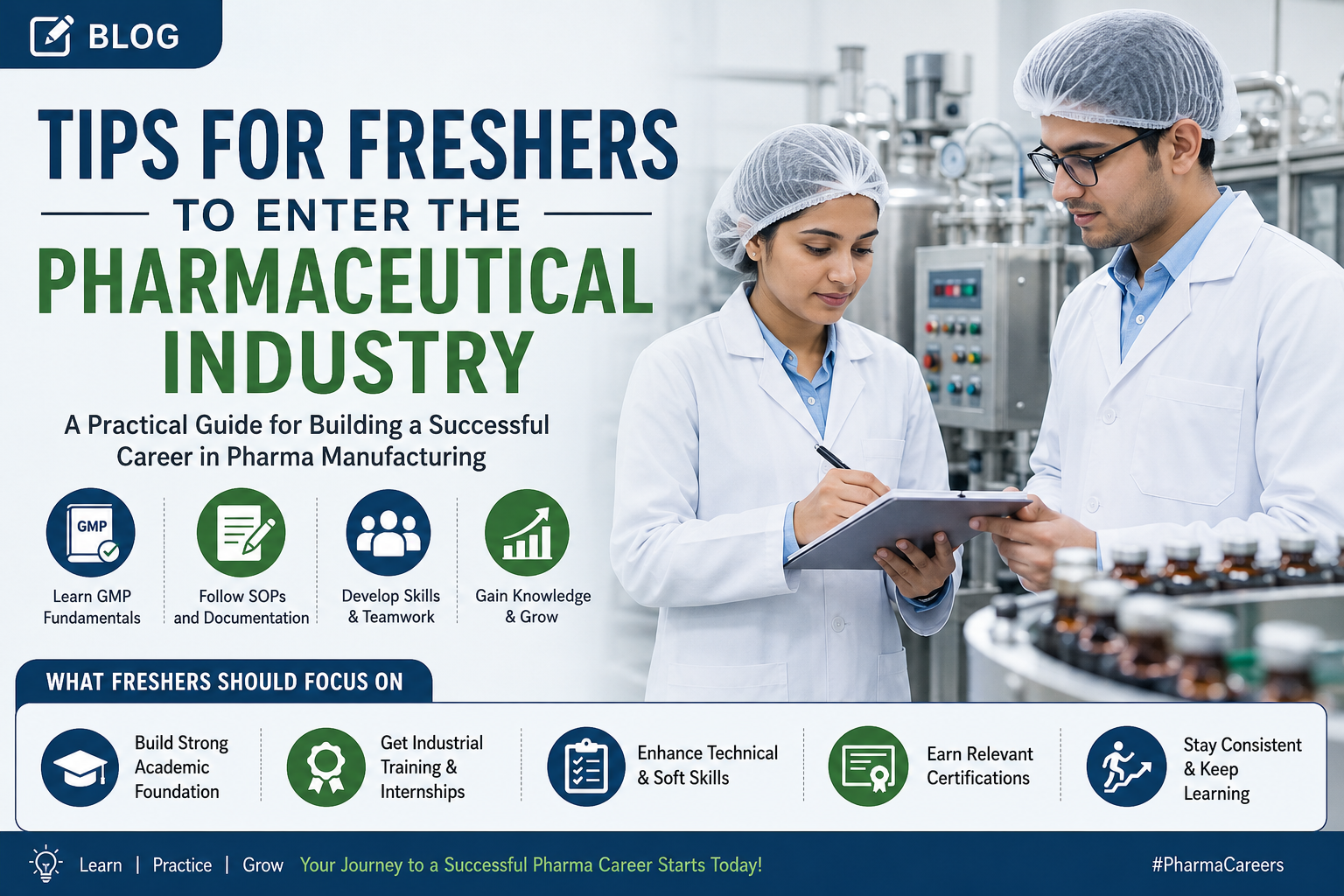
Introduction
The pharmaceutical industry is one of the fastest-growing and most stable industries globally. It plays a critical role in healthcare by developing, manufacturing, and distributing medicines that improve and save lives. With continuous advancements in drug development, biotechnology, automation, regulatory compliance, and global healthcare demand, the pharmaceutical sector offers vast career opportunities for freshers from pharmacy, life sciences, biotechnology, microbiology, and engineering backgrounds.
For students and fresh graduates, entering the pharmaceutical industry can feel challenging due to high competition and increasing industry expectations. Companies today seek candidates who not only possess academic qualifications but also demonstrate practical understanding of Good Manufacturing Practices (GMP), documentation systems, quality standards, and pharmaceutical operations.
The good news is that the pharmaceutical industry offers excellent opportunities for motivated freshers who are willing to learn, build technical skills, and gain practical exposure. Whether your interest lies in production, quality assurance, quality control, microbiology, validation, regulatory affairs, engineering, or research, there are numerous career paths available.
This article provides practical and professional guidance for freshers who want to successfully enter the pharmaceutical industry, improve employability, prepare for interviews, and build a strong foundation for long-term career growth.
Understanding the Pharmaceutical Industry
Before entering the industry, freshers should understand the major divisions within pharmaceutical manufacturing.
Major Departments in Pharmaceutical Companies
Production / Manufacturing
Responsible for manufacturing tablets, capsules, injectables, syrups, ointments, and other dosage forms according to approved procedures.
Quality Assurance (QA)
Ensures compliance with GMP regulations, documentation systems, investigations, validations, audits, and quality management systems.
Quality Control (QC)
Performs testing of raw materials, in-process samples, finished products, and stability samples using analytical instruments.
Microbiology
Handles environmental monitoring, sterility testing, microbial analysis, and contamination control activities.
Validation
Ensures that equipment, systems, processes, cleaning procedures, and utilities consistently perform as intended.
Regulatory Affairs
Manages regulatory submissions, product registrations, and compliance with global regulatory requirements.
Engineering and Maintenance
Maintains equipment, utilities, HVAC systems, water systems, and manufacturing infrastructure.
Warehouse and Dispensing
Handles material storage, inventory control, dispensing operations, and material movement.
Understanding these departments helps freshers identify the most suitable career path based on their interests and educational background.
Why the Pharmaceutical Industry is a Good Career Option for Freshers
The pharmaceutical industry offers several advantages for fresh graduates:
Strong Industry Growth
The global pharmaceutical market continues to grow due to increasing healthcare demand, chronic diseases, aging populations, and technological advancements.
Job Stability
Medicines are essential products, making the pharmaceutical industry relatively stable even during economic uncertainties.
Global Career Opportunities
Experienced pharma professionals can work in regulated markets such as the US, Europe, Middle East, and other international regions.
Multiple Career Paths
Freshers can build careers in:
- Manufacturing
- QA/QC
- Regulatory affairs
- Validation
- Research and development
- Clinical research
- Pharmacovigilance
- Engineering
- Supply chain management
Continuous Learning
The industry constantly evolves with new regulations, technologies, and manufacturing practices, providing excellent learning opportunities.
Essential Skills Required for Pharma Freshers
Academic knowledge alone is not enough to succeed in the pharmaceutical industry. Employers expect freshers to possess both technical and soft skills.
GMP Knowledge
Understanding Good Manufacturing Practices (GMP) is one of the most important requirements for pharma freshers.
Freshers should understand:
- Basic GMP principles
- Documentation practices
- Hygiene requirements
- SOP compliance
- Data integrity basics
- Quality systems
Candidates with GMP awareness are often preferred during recruitment.
Communication Skills
Strong communication skills help employees:
- Interact professionally
- Understand instructions
- Participate in meetings
- Handle documentation
- Work effectively in teams
Freshers should improve both verbal and written communication.
Documentation Practices
Documentation is extremely important in pharmaceutical manufacturing.
Freshers should understand:
- Good Documentation Practices (GDP)
- Recording entries properly
- Avoiding overwriting
- Error correction methods
- Batch documentation basics
Attention to Detail
Even small mistakes in pharmaceutical manufacturing can affect product quality and patient safety. Companies value candidates who are careful, disciplined, and detail-oriented.
Teamwork
Pharmaceutical manufacturing involves coordination between departments such as production, QA, QC, warehouse, engineering, and microbiology.
Freshers should learn how to collaborate effectively.
Problem-Solving Ability
Employers prefer candidates who can think logically and help resolve operational issues professionally.
SOP Understanding
Standard Operating Procedures (SOPs) are essential documents in pharmaceutical operations.
Freshers should understand:
- Why SOPs are important
- How SOPs are followed
- Importance of procedural compliance
Basic Pharmaceutical Process Knowledge
Freshers should understand basic manufacturing processes such as:
- Granulation
- Compression
- Coating
- Capsule filling
- Sterile manufacturing basics
- Mixing and blending
- Packaging operations
Resume Preparation for Pharma Freshers
A professional resume creates the first impression during recruitment.
Many freshers lose opportunities because of poorly written resumes.
Important Sections in a Pharma Resume
Personal Information
Include:
- Full name
- Contact number
- Professional email address
- LinkedIn profile (optional)
Career Objective
Write a short, professional objective focused on learning and career growth.
Example:
“Motivated B.Pharm graduate seeking an opportunity in pharmaceutical manufacturing where I can apply GMP knowledge, technical skills, and problem-solving abilities to contribute to quality pharmaceutical operations.”
Educational Qualifications
Mention:
- Degree/diploma
- University/college
- Passing year
- Percentage or CGPA
Academic Projects
Include relevant projects related to:
- Formulation development
- Analytical studies
- Validation
- Microbiology
- Pharmaceutical technology
Industrial Training / Internship
Mention:
- Company name
- Department
- Duration
- Key learnings
Technical Skills
Examples:
- GMP awareness
- SOP understanding
- Documentation practices
- HPLC basics
- Calibration basics
- Validation concepts
- MS Office knowledge
Certifications
Include relevant certifications such as:
- GMP training
- QA/QC training
- Regulatory affairs course
- Validation course
Achievements
Mention:
- Academic awards
- Poster presentations
- Conferences
- Competitions
Resume Formatting Tips
Keep the Resume Professional
Use:
- Clean formatting
- Professional fonts
- Proper spacing
- Consistent headings
Keep It Short
Freshers should ideally maintain a 1–2 page resume.
Use Industry Keywords
ATS-friendly resumes should include keywords such as:
- GMP
- SOP
- QA
- QC
- Pharmaceutical manufacturing
- Documentation
- Validation
- Data integrity
Avoid Spelling Mistakes
Grammar and spelling errors create a poor impression.
Use Bullet Points
Bullet points improve readability.
Common Resume Mistakes
Freshers should avoid:
- Using unprofessional email addresses
- Including irrelevant information
- Writing lengthy paragraphs
- Copy-pasting generic objectives
- Adding false experience
- Poor formatting
- Grammatical errors
Sample Pharma Fresher Resume Structure
- Personal Information
- Career Objective
- Educational Qualifications
- Internship / Industrial Training
- Technical Skills
- Certifications
- Academic Projects
- Achievements
- Declaration
Interview Preparation for Pharma Freshers
Proper interview preparation significantly increases hiring chances.
Common Pharma Interview Questions
General Questions
- Tell me about yourself.
- Why do you want to join the pharmaceutical industry?
- What are your strengths and weaknesses?
- Why should we hire you?
GMP Questions
- What is GMP?
- Why is GMP important?
- What are Good Documentation Practices?
- What is SOP?
Production Questions
- Explain granulation.
- What is compression?
- What is line clearance?
- What is cross-contamination?
QA Questions
- What is deviation?
- What is CAPA?
- What is change control?
QC Questions
- What is HPLC?
- Difference between calibration and validation?
- What is assay?
Microbiology Questions
- What is environmental monitoring?
- What is sterility testing?
- What is microbial contamination?
HR Interview Preparation Tips
Dress Professionally
Wear formal attire for interviews.
Maintain Positive Body Language
- Maintain eye contact
- Sit confidently
- Avoid nervous gestures
Improve Communication Skills
Practice speaking clearly and confidently.
Research the Company
Understand:
- Company products
- Manufacturing facilities
- Regulatory approvals
- Company values
Important Topics Freshers Should Study
Before interviews, freshers should revise:
- GMP concepts
- SOP compliance
- Data integrity
- Documentation practices
- Manufacturing processes
- QA/QC basics
- Pharmaceutical terminology
- Regulatory basics
Importance of GMP Knowledge
What is GMP?
Good Manufacturing Practices (GMP) are regulatory guidelines that ensure pharmaceutical products are consistently produced and controlled according to quality standards.
GMP helps ensure:
- Product safety
- Product quality
- Product efficacy
- Patient protection
Why GMP is Important
Failure to follow GMP can result in:
- Product recalls
- Regulatory observations
- Contamination
- Patient risk
- Financial losses
Therefore, companies prioritize candidates with GMP understanding.
Good Documentation Practices (GDP)
Documentation is considered the backbone of pharmaceutical compliance.
Freshers should know:
- Write clearly and legibly
- Use permanent ink
- Record entries immediately
- Avoid blank spaces
- Correct errors properly
- Never overwrite data
Hygiene and Gowning Practices
Personnel hygiene is critical in pharmaceutical manufacturing.
Freshers should understand:
- Hand sanitization
- Proper gowning procedures
- Cleanroom behavior
- Use of PPE
- Contamination prevention
Contamination Control
Pharmaceutical products must be protected from contamination.
Freshers should understand:
- Cross-contamination
- Dust control
- Environmental monitoring
- Cleaning procedures
- Material segregation
SOP Compliance
Employees must strictly follow approved SOPs during operations.
Non-compliance may result in:
- Deviations
- Product quality issues
- Regulatory observations
Data Integrity Awareness
Data integrity means data should be:
- Accurate
- Complete
- Consistent
- Reliable
Freshers should understand ALCOA principles:
- Attributable
- Legible
- Contemporaneous
- Original
- Accurate
Internships and Industrial Training
Industrial exposure plays a major role in employability.
Why Internships Are Important
Internships help freshers:
- Understand industrial operations
- Gain practical exposure
- Learn GMP implementation
- Build confidence
- Improve employability
Recommended Internship Areas
Production
Learn manufacturing operations and equipment handling.
QA
Learn documentation systems and compliance practices.
QC
Gain exposure to analytical instruments and testing procedures.
Microbiology
Understand sterility and environmental monitoring.
Validation
Learn equipment and process qualification activities.
Warehouse
Understand dispensing, material movement, and inventory control.
What Freshers Should Learn During Training
During internships, freshers should focus on:
- GMP practices
- SOP handling
- Batch documentation
- Equipment operation basics
- Line clearance
- Quality systems
- Safety procedures
How to Find Internships
Freshers can search through:
- College placement cells
- Pharma company websites
- Job portals
- Professional networking
- Industrial contacts
Certifications That Improve Employability
Certifications strengthen resumes and improve technical knowledge.
Useful Certifications
GMP Certification
Provides understanding of pharmaceutical compliance systems.
QA/QC Training
Improves quality system knowledge.
Regulatory Affairs Courses
Helpful for documentation and regulatory careers.
Validation Training
Introduces qualification and validation concepts.
Data Integrity Training
Important for regulated manufacturing environments.
Industrial Automation Basics
Useful for modern manufacturing facilities.
Career Opportunities for Freshers
Production Trainee
Responsibilities:
- Manufacturing operations
- Equipment handling
- Batch execution
- Documentation
QA Executive
Responsibilities:
- Documentation review
- Line clearance
- Investigations
- Compliance monitoring
QC Analyst
Responsibilities:
- Sample testing
- Instrument handling
- Analytical documentation
Microbiology Analyst
Responsibilities:
- Environmental monitoring
- Sterility testing
- Microbial analysis
Validation Executive
Responsibilities:
- Equipment qualification
- Process validation
- Cleaning validation
Regulatory Affairs Associate
Responsibilities:
- Regulatory documentation
- Product registrations
- Submission support
Warehouse Executive
Responsibilities:
- Material handling
- Dispensing
- Inventory management
Common Mistakes Freshers Should Avoid
Lack of GMP Understanding
Many candidates attend interviews without basic GMP knowledge.
Poor Resume Quality
Unprofessional resumes reduce interview opportunities.
Weak Communication Skills
Communication gaps negatively affect interview performance.
Lack of Interview Preparation
Technical preparation is essential for pharma recruitment.
Ignoring Documentation Practices
Documentation errors are taken seriously in pharmaceutical companies.
Unprofessional Behavior
Late arrivals, poor dressing, and lack of confidence create negative impressions.
Future Growth Opportunities in Pharma
The pharmaceutical industry offers excellent long-term growth.
Manufacturing Growth Path
Production Trainee → Production Officer → Executive → Manager → Plant Head
QA/QC Career Growth
QA/QC Trainee → Executive → Senior Executive → Manager → Quality Head
Validation Careers
Validation Executive → Senior Validation Engineer → Validation Manager
Regulatory Affairs Careers
RA Associate → Executive → Regulatory Manager → Global Regulatory Lead
Research and Development
R&D professionals work on formulation development and innovation.
Clinical Research
Clinical research offers opportunities in trials, monitoring, and drug safety.
Tips for Long-Term Success in the Pharmaceutical Industry
Freshers should continuously:
- Improve technical knowledge
- Stay updated with GMP regulations
- Build communication skills
- Gain practical experience
- Develop professionalism
- Learn documentation systems
- Attend industry training programs
Consistency and discipline are key to long-term career growth.
Conclusion
Entering the pharmaceutical industry as a fresher may appear challenging initially, but with the right preparation, technical knowledge, and professional attitude, it is entirely achievable. The pharmaceutical sector offers stable careers, continuous learning opportunities, global exposure, and long-term professional growth.
Freshers should focus on building strong GMP knowledge, improving communication skills, understanding documentation practices, gaining industrial exposure, and preparing thoroughly for interviews. Practical training, certifications, and continuous learning significantly improve employability and confidence.
The pharmaceutical industry values professionals who demonstrate discipline, integrity, attention to detail, and commitment to quality. By developing these qualities early in their careers, freshers can successfully build rewarding and impactful careers in pharmaceutical manufacturing and healthcare.
A successful pharmaceutical career begins with learning, consistency, and a willingness to grow. With proper preparation and determination, freshers can confidently enter the industry and contribute to the production of safe, effective, and high-quality medicines for patients worldwide.
About the Author
Ramesh Palav is a pharmaceutical manufacturing professional with 21+ years of experience in Oral Solid Dosage manufacturing, production operations, GMP compliance, qualification, validation, QMS and operational excellence. Through Pharma Manufacturing Hub, he shares practical industry knowledge with pharmaceutical professionals, students and manufacturing leaders.
Published on :18/07/2026