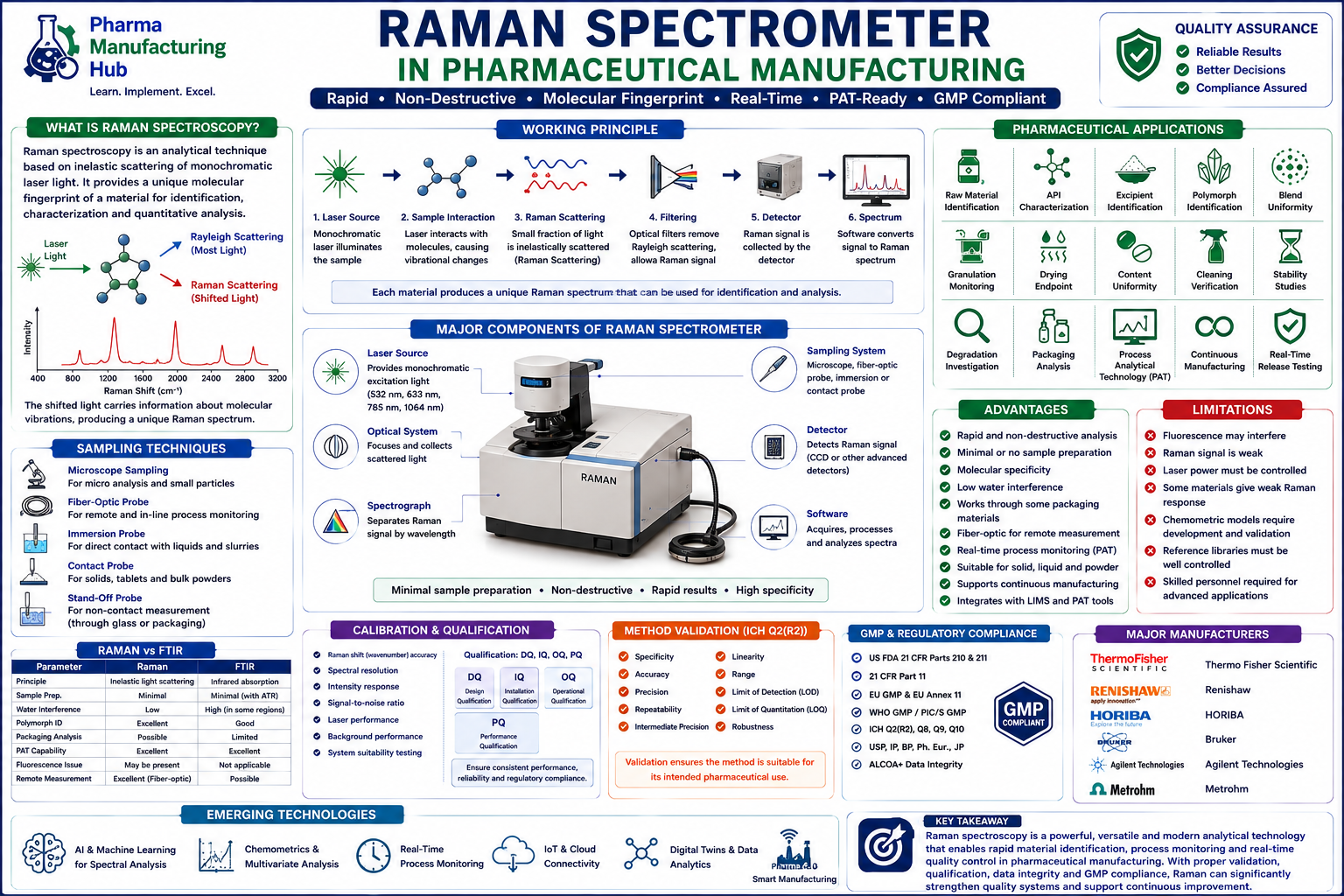
Raman Spectroscopy is an increasingly important analytical technology in modern pharmaceutical manufacturing. It provides rapid, non-destructive chemical identification and quantitative analysis of pharmaceutical materials with minimal or no sample preparation. Raman spectroscopy is particularly valuable for raw material identification, API characterization, polymorph identification, blend uniformity, process monitoring, and Process Analytical Technology (PAT).
As pharmaceutical manufacturing moves toward real-time quality monitoring and Pharma 4.0, Raman spectroscopy is becoming an important tool for implementing Quality by Design (QbD), continuous manufacturing, real-time release testing (RTRT), and data-driven process control.
What is Raman Spectroscopy?
Raman spectroscopy is a molecular spectroscopic technique based on the inelastic scattering of monochromatic light, usually from a laser.
When laser light interacts with molecules, most photons undergo elastic Rayleigh scattering. A very small fraction undergoes inelastic scattering, known as Raman scattering. The resulting change in photon energy corresponds to molecular vibrational transitions.
The Raman spectrum therefore provides a molecular fingerprint that can be used for:
- Material identification
- Chemical characterization
- Quantitative analysis
- Polymorph differentiation
- Process monitoring
- Contamination investigation
Unlike FTIR, Raman spectroscopy is often particularly useful for aqueous systems and can analyze samples through certain transparent packaging materials.
Working Principle
The basic Raman workflow is:
Laser Source → Sample Interaction → Raman Scattering → Optical Filtering → Detector → Spectral Processing → Identification/Quantification
A laser illuminates the sample. Most of the scattered light has the same frequency as the incident laser and is classified as Rayleigh scattering. A very small portion experiences an energy shift because of interaction with molecular vibrations.
This shifted light is collected by the optical system and passed through filters that remove the intense Rayleigh component. The remaining Raman signal is directed toward a detector.
The instrument software processes the detected signal and generates a Raman spectrum, generally represented as intensity versus Raman shift in cm⁻¹.
The spectrum can then be compared against a validated reference library or used with chemometric models for quantitative analysis.
Major Components of a Raman Spectrometer
1. Laser Source
The laser provides the excitation radiation required to generate Raman scattering.
Common excitation wavelengths include:
- 532 nm
- 633 nm
- 785 nm
- 1064 nm
The choice of wavelength depends on the sample and application. Longer wavelengths can reduce fluorescence interference for some pharmaceutical materials.
2. Sampling System
Raman systems can use:
- Microscope objectives
- Fiber-optic probes
- Immersion probes
- Contact probes
- Stand-off configurations
This flexibility allows Raman to be used both in laboratories and directly in manufacturing processes.
3. Optical Filters
Raman instruments require highly effective optical filtering to remove intense Rayleigh-scattered light while transmitting the weaker Raman signal.
4. Spectrograph
The spectrograph separates the Raman signal according to wavelength or Raman shift.
5. Detector
Common detector technologies include CCD and other specialized semiconductor detectors. Detector selection depends on wavelength, sensitivity, spectral range, and application.
6. Software
Modern Raman software provides:
- Spectrum acquisition
- Library searching
- Spectral comparison
- Chemometric analysis
- Quantitative modeling
- Method management
- Audit trails
- Electronic records
- Report generation
Raman vs FTIR
| Parameter | Raman | FTIR |
|---|---|---|
| Basic Principle | Inelastic light scattering | Infrared absorption |
| Sample Preparation | Often minimal | Often minimal with ATR |
| Water Interference | Generally low | Can be significant in some regions |
| Packaging Analysis | Often possible | More limited depending on material |
| Polymorph Differentiation | Excellent for many materials | Useful |
| Fluorescence | Can interfere | Generally not applicable |
| PAT Applications | Excellent | Excellent |
| Remote Measurement | Excellent with fiber optics | Possible with suitable accessories |
Raman and FTIR are complementary technologies rather than direct replacements for one another. The appropriate technique should be selected according to the analytical objective and validated method.
Pharmaceutical Applications
Raw Material Identification
Raman spectroscopy can rapidly identify:
- APIs
- Excipients
- Lubricants
- Polymers
- Coating materials
This makes it useful for incoming material verification and warehouse material identification.
API Characterization
Raman spectra provide information about molecular structure and chemical environment and can support API characterization.
Polymorph Identification
Different polymorphic forms may produce different Raman spectra. Raman can therefore support solid-state characterization and polymorph monitoring.
For definitive solid-state characterization, Raman may be combined with techniques such as XRPD, DSC, and FTIR.
Blend Uniformity
Raman spectroscopy can be used to monitor blend homogeneity and evaluate the distribution of API within powder blends.
This can be particularly valuable during formulation development and process validation.
Granulation and Drying
With appropriate probe-based systems and validated chemometric models, Raman can support real-time monitoring of manufacturing processes.
Potential applications include:
- Moisture monitoring
- API concentration monitoring
- Endpoint determination
- Process trend monitoring
Content Uniformity
Raman-based analytical approaches can support non-destructive or minimally destructive assessment of pharmaceutical dosage forms where scientifically validated.
Cleaning Verification
Raman may support residue identification and cleaning investigations when the analyte provides an appropriate Raman response and the method is validated for the intended purpose.
Raman Spectroscopy and PAT
One of the greatest advantages of Raman technology is its ability to support Process Analytical Technology (PAT).
A fiber-optic Raman probe can be installed directly into a manufacturing process, allowing continuous or near-real-time monitoring without repeatedly removing samples for laboratory analysis.
Applications may include:
- Blend monitoring
- Granulation monitoring
- Drying endpoint determination
- API concentration monitoring
- Continuous manufacturing
- Real-time process control
This can reduce dependence on conventional offline testing and support a more proactive quality strategy.
Major Raman Manufacturers
Leading manufacturers and technology providers include:
- Thermo Fisher Scientific
- Renishaw
- HORIBA
- Bruker
- Agilent Technologies
- Metrohm
- B&W Tek
Representative product families vary from compact laboratory Raman instruments to high-performance Raman microscopes and process Raman systems.
When selecting a Raman system, pharmaceutical organizations should evaluate:
- Laser wavelength
- Spectral range
- Resolution
- Sensitivity
- Detector technology
- Probe compatibility
- Chemometric software
- Library capabilities
- 21 CFR Part 11 functionality
- LIMS integration
- PAT capability
- Service and qualification support
Calibration and Qualification
Raman systems require appropriate performance verification and calibration.
Typical checks may include:
- Raman shift/wavenumber accuracy
- Spectral resolution
- Intensity response
- Signal-to-noise ratio
- Laser performance
- Wavelength stability
- Background performance
A regulated pharmaceutical Raman system may undergo:
DQ → IQ → OQ → PQ
Computerized components should also be appropriately assessed through a risk-based validation approach.
Method Validation
For quantitative or release-related applications, Raman methods should be validated according to their intended purpose.
Relevant characteristics may include:
- Specificity
- Accuracy
- Precision
- Repeatability
- Intermediate precision
- Linearity
- Range
- Robustness
- Detection capability
- Quantification capability
For qualitative identification, particular attention should be given to:
- Reference library suitability
- Spectral match criteria
- Specificity
- Sample presentation
- Method robustness
Chemometric models should be developed, validated, controlled, and periodically reviewed when used for quantitative prediction.
GMP and Data Integrity
Raman systems used in regulated pharmaceutical environments should comply with applicable GMP and computerized-system requirements.
Important controls include:
- Unique user identification
- Role-based access
- Controlled analytical methods
- Audit trails
- Electronic records
- Electronic signatures where applicable
- Secure data storage
- Backup and recovery
- Change control
- Periodic review
Relevant requirements may include:
- FDA 21 CFR Parts 210 & 211
- FDA 21 CFR Part 11
- EU GMP
- EU Annex 11
- WHO GMP
- PIC/S GMP
- ICH Q2(R2)
- ICH Q8
- ICH Q9
- ICH Q10
- Applicable USP, IP, BP, and Ph. Eur. requirements
Data should comply with ALCOA+ principles.
Advantages
Raman spectroscopy provides several important benefits:
- Rapid analysis
- Minimal sample preparation
- Non-destructive analysis
- Excellent molecular specificity
- Low water interference
- Ability to analyze through some packaging materials
- Fiber-optic remote measurement
- Excellent PAT capability
- Suitable for real-time process monitoring
- Supports automation and continuous manufacturing
Limitations
Important limitations include:
- Fluorescence can interfere with Raman signals.
- Raman scattering is inherently weak.
- Laser power must be controlled to avoid sample damage.
- Some materials produce weak Raman responses.
- Chemometric models require appropriate development and validation.
- Reference libraries must be properly controlled.
- Skilled personnel may be required for advanced applications.
Emerging Technologies
Raman spectroscopy is rapidly evolving through integration with AI, machine learning, chemometrics, IoT, and Pharma 4.0.
Emerging applications include:
- AI-assisted spectral identification
- Automated library matching
- Predictive process monitoring
- Real-time release testing
- Continuous manufacturing
- Digital twins
- Remote instrument monitoring
- Automated anomaly detection
- PAT-based process control
- Cloud-connected analytical laboratories
AI and machine learning can analyze large Raman datasets and identify subtle spectral changes that may be difficult to detect using conventional approaches. However, AI-generated models must remain appropriately validated, controlled, and governed within the pharmaceutical quality system.
Raman in OSD Manufacturing
| OSD Manufacturing Area | Potential Raman Application |
|---|---|
| Raw Material Receipt | Material identification |
| Dispensing | Material verification |
| Blending | Blend uniformity |
| Granulation | Process monitoring |
| Drying | Moisture/endpoint monitoring |
| Compression | Product characterization |
| Coating | Process monitoring |
| Finished Product | Identification/content assessment |
| Stability | Degradation investigation |
| Continuous Manufacturing | Real-time monitoring |
| PAT | Process control |
Conclusion
Raman Spectroscopy has become an important analytical technology for modern pharmaceutical manufacturing because it combines rapid molecular identification with minimal sample preparation and the potential for real-time, non-destructive process monitoring.
Its applications extend from raw material identification and API characterization to polymorph analysis, blend uniformity, granulation, drying, PAT, and continuous manufacturing. When supported by appropriate qualification, calibration, method validation, chemometric model control, data integrity, and GMP procedures, Raman spectroscopy can significantly strengthen pharmaceutical quality systems.
The combination of fiber-optic sampling, PAT integration, AI-assisted analysis, machine learning, and Pharma 4.0 connectivity is transforming Raman from a conventional laboratory instrument into an intelligent process-monitoring platform. For pharmaceutical QC analysts, QA professionals, production engineers, validation specialists, analytical scientists, auditors, and students, understanding Raman spectroscopy is increasingly important for implementing modern, science-based pharmaceutical manufacturing and quality control strategies.