Fourier Transform Infrared Spectroscopy (FTIR) is one of the most widely used analytical techniques in pharmaceutical manufacturing for the identification, characterization, and quality evaluation of raw materials, APIs, excipients, intermediates, and finished pharmaceutical products. Because FTIR can rapidly provide a molecular fingerprint of a material, it is particularly valuable for raw material identification, incoming material verification, investigation of unknown substances, cleaning verification, and analytical method development.
FTIR is widely used in pharmaceutical quality control laboratories because it requires relatively little sample preparation, provides rapid results, and can identify chemical functional groups based on their characteristic infrared absorption bands.
What is FTIR?
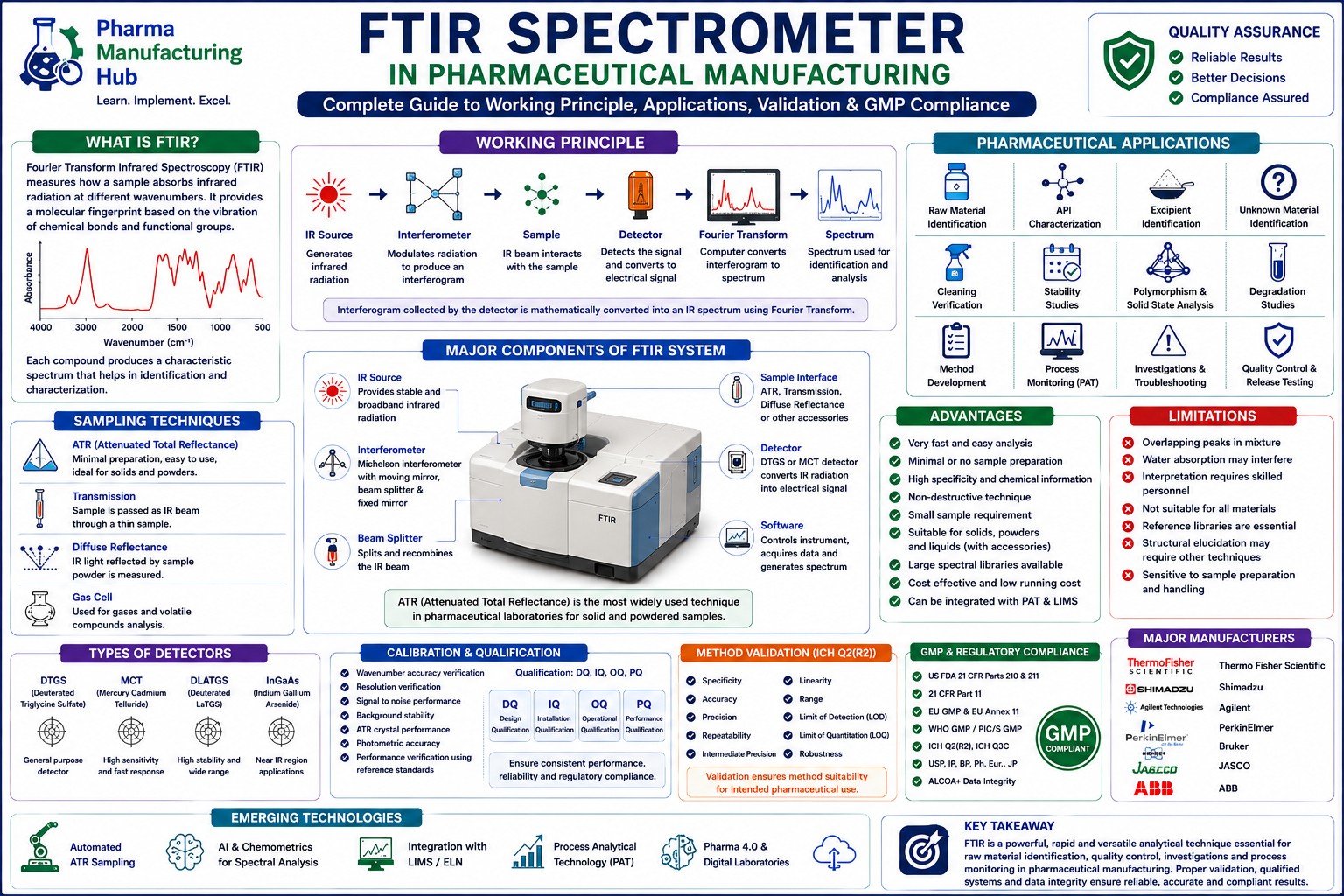
FTIR stands for Fourier Transform Infrared Spectroscopy. It is an analytical technique that measures how a sample absorbs infrared radiation at different wavelengths or wavenumbers.
When infrared radiation interacts with a molecule, specific chemical bonds absorb energy and undergo vibrational transitions. Different functional groups absorb infrared radiation at characteristic frequencies, producing a unique spectral pattern known as a fingerprint spectrum.
The resulting spectrum can be compared with a reference standard or pharmacopoeial library to determine the identity of the material.
FTIR is particularly useful because the infrared spectrum contains information about:
- Functional groups
- Chemical bonds
- Molecular structure
- Material identity
- Contamination
- Degradation
- Polymorphic differences
Working Principle of FTIR
The basic FTIR workflow is:
Infrared Source → Interferometer → Sample → Detector → Fourier Transform → Spectrum → Identification/Analysis
Unlike conventional dispersive infrared instruments, FTIR instruments use an interferometer, typically a Michelson interferometer, to collect infrared information across a broad spectral range.
The infrared source emits radiation that enters the interferometer. The interferometer modulates the radiation and produces an interference pattern known as an interferogram. The infrared beam then interacts with the sample, and the detector measures the resulting signal.
The instrument’s computer applies a mathematical Fourier Transform to convert the interferogram into a conventional infrared spectrum.
The resulting spectrum is generally displayed as absorbance or transmittance versus wavenumber (cm⁻¹).
Major Components of an FTIR System
A pharmaceutical FTIR spectrometer consists of several critical components.
1. Infrared Source
The source generates broadband infrared radiation.
Common sources include:
- Globar source
- Ceramic infrared source
- Silicon carbide source
The source must provide stable infrared energy over the required spectral range.
2. Interferometer
The interferometer is the central optical component of an FTIR instrument.
It generally contains:
- Beam splitter
- Fixed mirror
- Moving mirror
The interferometer creates the interference pattern required for Fourier Transform processing.
3. Beam Splitter
The beam splitter divides and recombines the infrared radiation.
Different beam splitter materials may be selected depending on the spectral region being analyzed.
4. Sample Interface
Common sampling techniques include:
- ATR
- Transmission
- Diffuse Reflectance
- Gas cells
Attenuated Total Reflectance (ATR) is particularly popular in pharmaceutical laboratories because it requires minimal sample preparation.
5. Detector
The detector converts infrared radiation into an electrical signal.
Common detector technologies include:
- DTGS
- MCT
MCT detectors generally provide higher sensitivity and faster response for appropriate applications.
6. Software
Modern FTIR software provides:
- Spectrum acquisition
- Library searching
- Spectral comparison
- Peak identification
- Quantitative analysis
- Method management
- Reporting
- Audit trails
- Electronic records
ATR-FTIR in Pharmaceutical Laboratories
ATR-FTIR has become one of the most convenient FTIR techniques for pharmaceutical raw material identification.
In ATR, the infrared beam enters a crystal with a high refractive index. When the beam undergoes total internal reflection, an evanescent wave interacts with the sample surface.
Common ATR crystal materials include:
- Diamond
- Zinc selenide (ZnSe)
- Germanium
Advantages of ATR
- Minimal sample preparation
- Rapid analysis
- Small sample requirement
- Easy cleaning
- Suitable for powders and solids
- Excellent for raw material identification
This makes ATR-FTIR particularly useful for high-throughput incoming material testing.
Pharmaceutical Applications
FTIR has numerous applications throughout pharmaceutical manufacturing.
Raw Material Identification
FTIR can identify:
- APIs
- Excipients
- Polymers
- Lubricants
- Coating materials
The sample spectrum is compared against an approved reference spectrum or validated library.
API Characterization
FTIR helps characterize functional groups and confirm chemical identity during development and quality control.
Excipient Identification
Common pharmaceutical excipients such as:
- Lactose
- Microcrystalline cellulose
- Starch
- Magnesium stearate
- Povidone
can be evaluated using FTIR fingerprinting.
Cleaning Verification
FTIR can support investigation and, where scientifically justified, cleaning verification by detecting characteristic chemical residues.
Unknown Material Identification
During deviations, laboratory investigations, or manufacturing incidents, FTIR can help identify unknown powders, residues, or contaminants.
Stability Studies
Changes in characteristic spectral bands may indicate:
- Chemical degradation
- Oxidation
- Hydrolysis
- Structural changes
Polymorphism and Solid-State Characterization
FTIR can contribute to characterization of different solid forms and molecular interactions, although complementary techniques such as XRPD or DSC may be required for definitive polymorph characterization.
Major FTIR Manufacturers
Leading analytical instrument manufacturers serving pharmaceutical laboratories include:
- Thermo Fisher Scientific
- Shimadzu
- Agilent Technologies
- PerkinElmer
- Bruker
- JASCO
- ABB
Representative product families include Thermo Scientific Nicolet FTIR systems, Shimadzu IRSpirit/IRXross platforms, Agilent Cary FTIR systems, PerkinElmer Spectrum systems, and Bruker Alpha/Vertex platforms.
Instrument selection should consider spectral range, resolution, detector, ATR configuration, software capabilities, library compatibility, regulatory features, service support, and application requirements rather than selecting a model based solely on brand.
Calibration and Qualification
Reliable FTIR performance requires routine calibration and performance verification.
Important checks may include:
- Wavenumber accuracy
- Resolution
- Signal-to-noise performance
- Background stability
- Detector performance
- Spectral repeatability
Pharmaceutical FTIR systems may undergo:
DQ → IQ → OQ → PQ
where:
- DQ: Design Qualification
- IQ: Installation Qualification
- OQ: Operational Qualification
- PQ: Performance Qualification
Reference materials and certified standards should be used according to the instrument manufacturer’s recommendations and approved laboratory procedures.
FTIR Method Validation
The validation strategy depends on the intended use of the FTIR method.
For quantitative or release-testing methods, applicable validation characteristics may include:
- Specificity
- Accuracy
- Precision
- Repeatability
- Intermediate precision
- Linearity
- Range
- Robustness
For qualitative identification methods, specificity, selectivity, repeatability, reference spectrum suitability, and library-match criteria are particularly important.
Method validation should follow applicable pharmacopoeial requirements and current regulatory expectations, including relevant principles of ICH Q2(R2).
GMP and Data Integrity
FTIR systems used in regulated laboratories should be incorporated into the pharmaceutical quality system.
Important GMP controls include:
- Approved SOP
- Qualified instrument
- Current calibration status
- Controlled reference standards
- Trained analysts
- Validated methods
- Instrument logbook
- Maintenance records
- Audit trail review
- Controlled user access
- Data backup and retention
Computerized FTIR systems should be appropriately assessed for compliance with:
- FDA 21 CFR Part 11
- EU Annex 11
- ALCOA+ data integrity principles
Electronic spectra, raw data, processed results, reference libraries, audit trails, and reports should remain attributable, legible, contemporaneous, original, accurate, complete, consistent, enduring, and available.
Advantages of FTIR
FTIR offers several important advantages:
- Very rapid analysis
- Minimal sample preparation
- Excellent material identification capability
- Non-destructive or minimally destructive options
- Small sample requirement
- High chemical specificity
- Large spectral libraries
- ATR compatibility
- Easy operation
- Suitable for raw material identification
- Supports automated workflows
- Can be integrated with laboratory data systems
Limitations
FTIR also has limitations:
- Mixtures may produce complex overlapping spectra.
- Water can interfere with certain infrared regions.
- Some materials require specialized sampling techniques.
- Spectral interpretation requires trained personnel.
- Identification depends on appropriate reference standards or validated libraries.
- FTIR alone may not provide definitive structural identification for every unknown substance.
Therefore, FTIR results may need confirmation using techniques such as HPLC, GC-MS, Raman spectroscopy, NMR, DSC, or XRPD, depending on the analytical question.
Emerging Technologies
FTIR is increasingly becoming part of the Pharma 4.0 laboratory environment.
Modern systems can incorporate:
- Automated ATR sampling
- Robotic sample handling
- Automated spectral library searching
- AI-assisted spectral interpretation
- chemo metric analysis
- Remote instrument monitoring
- LIMS integration
- Electronic laboratory workflows
- Automated material identification
- Real-time process monitoring
FTIR can also be integrated with Process Analytical Technology (PAT) for real-time monitoring of pharmaceutical manufacturing processes. Combined with chemometrics and machine learning, infrared spectroscopy can potentially monitor material attributes and support real-time process decisions.
FTIR in OSD Manufacturing
For Oral Solid Dosage manufacturing, FTIR can support multiple operations:
| Manufacturing Area | FTIR Application |
|---|---|
| Raw Material Receipt | Identity confirmation |
| Dispensing | Material verification |
| Granulation | Material characterization |
| Blending | Investigation and characterization |
| Compression | Product/material investigation |
| Coating | Polymer and coating material identification |
| Finished Product | Identity testing |
| Stability | Degradation investigation |
| Cleaning | Residue investigation |
| Deviation Investigation | Unknown material identification |
Conclusion
Fourier Transform Infrared Spectroscopy (FTIR) is a powerful and versatile analytical technique that plays an important role in pharmaceutical quality control, raw material identification, research and development, investigation, and process monitoring. Its ability to generate a unique molecular fingerprint makes it particularly valuable for rapid identification of APIs and excipients.
The introduction of ATR-FTIR has further simplified pharmaceutical testing by reducing sample preparation and enabling rapid analysis of powders, solids, and other materials. Proper instrument qualification, calibration, method validation, reference library control, analyst training, and data integrity practices are essential for reliable GMP application.
As pharmaceutical laboratories move toward automation, AI-assisted spectral interpretation, chemometrics, PAT, LIMS integration, and Pharma 4.0, FTIR is evolving from a conventional laboratory identification tool into a connected and intelligent analytical technology. For QC analysts, QA professionals, validation engineers, production personnel, auditors, and pharmaceutical students, understanding FTIR’s scientific principles, instrumentation, applications, validation, and regulatory requirements is essential for maintaining modern pharmaceutical quality systems and supporting the manufacture of safe, effective, and consistent medicines.