The UV–Visible Spectrophotometer (UV–Vis Spectrophotometer) is one of the most important analytical instruments used in pharmaceutical manufacturing and quality control laboratories. It provides a rapid, accurate, and cost-effective method for identifying and quantifying pharmaceutical compounds, making it indispensable for ensuring product quality, regulatory compliance, and patient safety. From raw material testing to finished product analysis, UV–Visible spectroscopy supports nearly every stage of the pharmaceutical manufacturing process.
What is a UV–Visible Spectrophotometer?
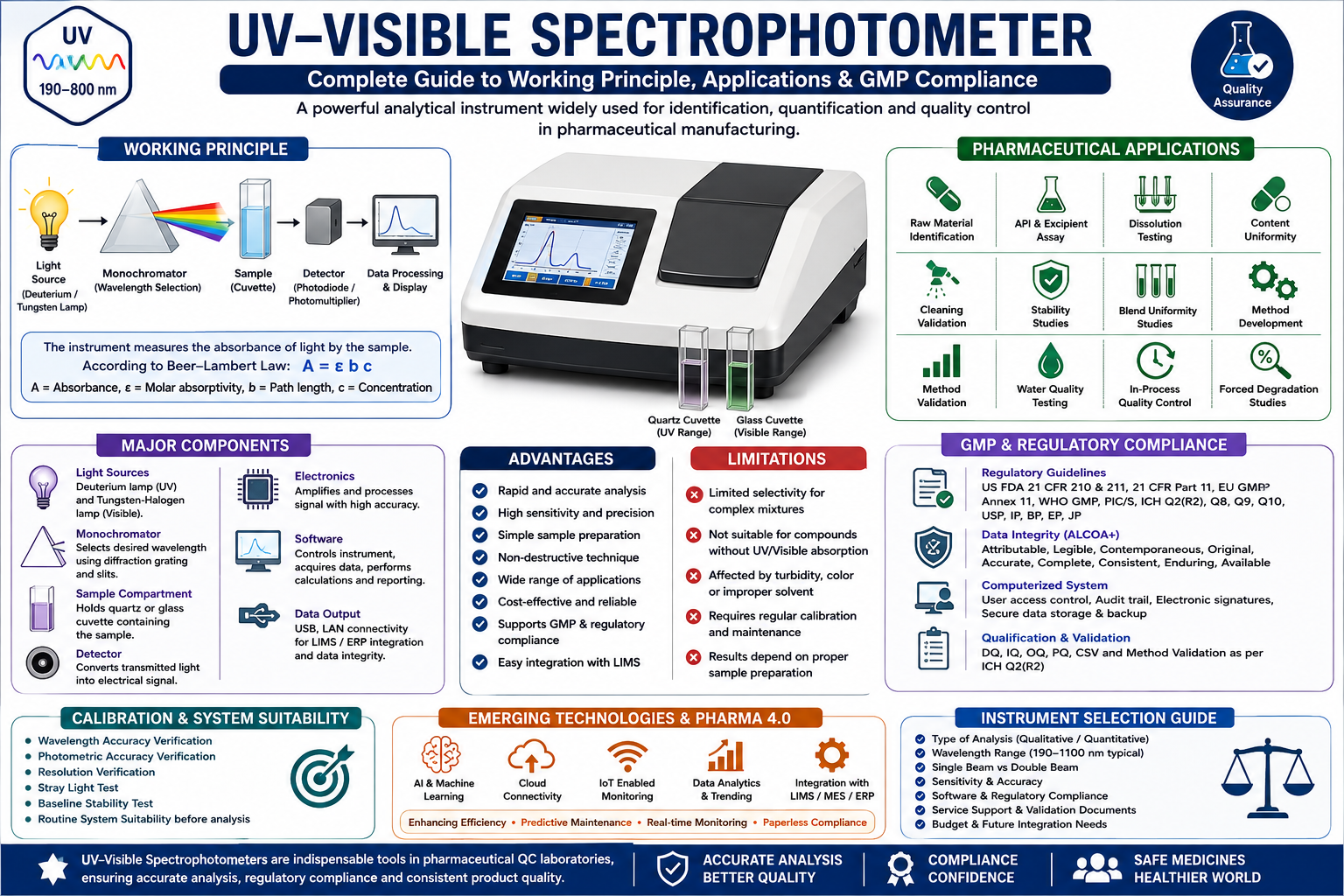
A UV–Visible Spectrophotometer is an analytical instrument that measures the amount of ultraviolet (190–400 nm) and visible (400–800 nm) light absorbed by a sample. When light passes through a solution containing a pharmaceutical compound, specific wavelengths are absorbed while the remaining light passes through. The instrument measures this absorbance, which is directly related to the concentration of the substance according to the Beer–Lambert Law.
The Beer–Lambert Law is expressed as:
A = εbc
Where:
- A = Absorbance
- ε = Molar absorptivity
- b = Path length of the cuvette
- c = Concentration of the analyte
This principle enables accurate quantitative analysis of pharmaceutical samples with excellent precision and repeatability.
Working Principle
The operation of a UV–Visible Spectrophotometer begins with a light source that emits ultraviolet and visible light. A monochromator separates the light into individual wavelengths, allowing the desired wavelength to pass through the sample. The sample, placed in a quartz or glass cuvette, absorbs part of the light depending on its chemical composition. The transmitted light reaches a detector, which converts it into an electrical signal. The instrument’s software processes the signal and displays absorbance, transmittance, or concentration.
Modern double-beam instruments split the light into reference and sample beams, improving accuracy by compensating for fluctuations in light intensity.
Major Components
A UV–Visible Spectrophotometer consists of several precision components:
- Light Sources: Deuterium lamp for UV range and Tungsten-Halogen lamp for visible range.
- Monochromator: Uses diffraction gratings or prisms to isolate specific wavelengths.
- Entrance and Exit Slits: Control the bandwidth of light.
- Sample Holder: Holds quartz or glass cuvettes containing the sample.
- Detector: Photodiode or photomultiplier tube converts transmitted light into an electrical signal.
- Microprocessor & Software: Processes data, generates reports, and supports audit trails and electronic records.
These components work together to deliver accurate and reproducible analytical results.
Pharmaceutical Applications
UV–Visible Spectrophotometers are extensively used across pharmaceutical manufacturing and quality control laboratories for:
- Identification of Active Pharmaceutical Ingredients (APIs)
- Assay of raw materials and finished products
- Dissolution testing
- Content uniformity testing
- Cleaning validation
- Stability studies
- Blend uniformity analysis
- Method development and validation
- Forced degradation studies
- Water quality testing
- In-process quality control (IPQC)
Due to their speed and simplicity, UV–Visible methods are often preferred for routine quality control where high-throughput analysis is required.
Major Manufacturers
Several globally recognized manufacturers provide pharmaceutical-grade UV–Visible Spectrophotometers, including:
- Shimadzu
- Agilent Technologies
- Thermo Fisher Scientific
- PerkinElmer
- JASCO
- Analytik Jena
- Hitachi High-Tech
- Labindia Instruments
These companies offer a wide range of single-beam, double-beam, scanning, and high-performance spectrophotometers with advanced software, touchscreen interfaces, and regulatory compliance features.
Calibration and Qualification
Routine calibration is essential to ensure reliable analytical performance. Key calibration activities include:
- Wavelength accuracy verification
- Photometric accuracy verification
- Stray light testing
- Resolution testing
- Baseline stability verification
In regulated pharmaceutical laboratories, UV–Visible Spectrophotometers undergo comprehensive qualification:
- Design Qualification (DQ)
- Installation Qualification (IQ)
- Operational Qualification (OQ)
- Performance Qualification (PQ)
Regular preventive maintenance, system suitability testing, and computerized system validation further ensure consistent instrument performance.
GMP and Regulatory Compliance
UV–Visible Spectrophotometers must comply with international pharmaceutical regulations, including:
- US FDA 21 CFR Parts 210 & 211
- FDA 21 CFR Part 11
- EU GMP Volume 4
- EU Annex 11
- WHO GMP
- PIC/S GMP
- ICH Q2(R2), Q8, Q9, and Q10
- USP, IP, BP, EP, and JP requirements
Modern instruments provide electronic records, audit trails, user authentication, electronic signatures, and secure data storage to meet global data integrity expectations based on ALCOA+ principles.
Advantages
UV–Visible Spectrophotometers offer several advantages:
- Rapid and non-destructive analysis
- High analytical accuracy
- Excellent repeatability
- Simple sample preparation
- Low operating cost
- Suitable for routine quality control
- Wide range of pharmaceutical applications
- Supports method validation and stability studies
- Easy integration with Laboratory Information Management Systems (LIMS)
Limitations
Despite their versatility, UV–Visible Spectrophotometers have some limitations:
- Limited selectivity for complex mixtures without prior separation.
- Not suitable for compounds that do not absorb UV or visible light.
- Results may be affected by sample turbidity, colored impurities, or improper solvent selection.
- Requires regular calibration and qualified operators to maintain accuracy.
Emerging Technologies
Modern UV–Visible Spectrophotometers are increasingly integrated with Artificial Intelligence (AI), Internet of Things (IoT), and Pharma 4.0 technologies. Advanced software can automatically monitor instrument performance, perform trend analysis, generate audit-ready reports, and integrate with enterprise systems such as LIMS, MES, and ERP. Cloud connectivity and predictive diagnostics further enhance laboratory efficiency and regulatory compliance.
Conclusion
The UV–Visible Spectrophotometer remains one of the most essential analytical instruments in pharmaceutical manufacturing. Its ability to provide fast, accurate, and reliable qualitative and quantitative analysis makes it indispensable for quality control, research and development, dissolution testing, cleaning validation, and stability studies. By combining robust analytical performance with modern software, regulatory compliance, and digital connectivity, UV–Visible Spectrophotometers play a vital role in maintaining product quality, ensuring GMP compliance, and supporting the production of safe and effective pharmaceutical products.