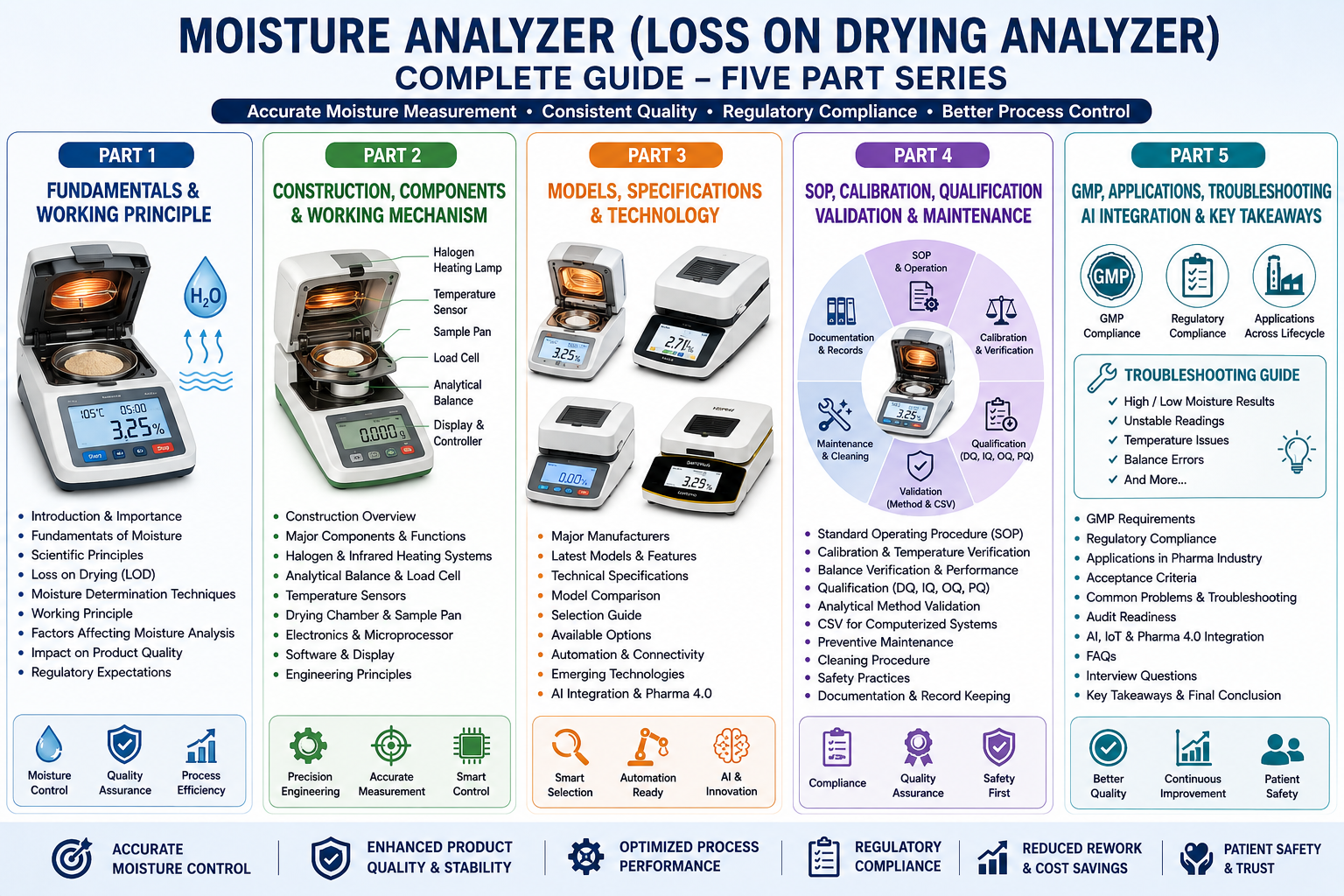
Overview
Moisture content is one of the most critical quality parameters in pharmaceutical manufacturing because it directly affects product stability, flow properties, compressibility, hardness, friability, dissolution, microbial growth, chemical degradation, packaging integrity, and shelf life. Accurate determination of moisture content is essential for ensuring consistent product quality, process control, and compliance with pharmacopeial and regulatory requirements.
A Moisture Analyzer, commonly referred to as a Loss on Drying (LOD) Analyzer, is a precision analytical instrument used to determine the percentage of moisture present in raw materials, granules, powders, intermediates, tablets, capsules, and finished pharmaceutical products. Modern moisture analyzers employ halogen heating, infrared heating, or other controlled drying technologies combined with high-precision analytical balances to provide rapid, accurate, and reproducible moisture measurements.
Moisture analyzers are extensively used in Research & Development (R&D), Incoming Material Testing, Granulation, Drying, Compression, Coating, In-Process Quality Control (IPQC), Finished Product Testing, Stability Studies, Process Validation, Cleaning Validation, and Technology Transfer. They play a crucial role in controlling manufacturing processes and ensuring that products consistently meet predefined quality specifications.
Today’s advanced moisture analyzers feature touchscreen interfaces, programmable drying methods, automatic endpoint detection, statistical analysis, audit trails, electronic records, barcode integration, LIMS connectivity, and compliance with 21 CFR Part 11 and EU Annex 11, making them indispensable tools in modern GMP-compliant pharmaceutical laboratories.
Part 1: Introduction, Fundamentals, Scientific Principles, Loss on Drying (LOD), Moisture Determination Techniques, and Working Principle
1. Introduction
What is Moisture Content?
Moisture content is the amount of water or volatile matter present in a pharmaceutical material. It is generally expressed as:
- Percentage by Weight (% w/w)
- Percentage by Mass
- Moisture Loss During Drying
Moisture may exist as:
- Free Moisture
- Bound Moisture
- Adsorbed Moisture
- Absorbed Moisture
- Structural Water (Water of Crystallization)
Understanding the type of moisture is essential for selecting the appropriate analytical method.
What is a Moisture Analyzer?
A Moisture Analyzer is a laboratory instrument designed to determine the moisture content of pharmaceutical samples by measuring the weight loss that occurs during controlled heating.
The instrument continuously records:
- Initial sample weight
- Sample temperature
- Drying time
- Final sample weight
- Moisture percentage
- Drying curve
Most pharmaceutical laboratories use Loss on Drying (LOD) analyzers for routine moisture determination because they provide fast and reliable results.
Difference Between Moisture Analyzer and Karl Fischer Titrator
| Parameter | Moisture Analyzer (LOD) | Karl Fischer Titrator |
|---|---|---|
| Principle | Weight loss after heating | Chemical titration with Karl Fischer reagent |
| Moisture Measured | Water + volatile substances | Water only |
| Speed | Fast | Moderate |
| Sample Preparation | Simple | More complex |
| Typical Applications | Granules, tablets, powders | APIs, low-moisture samples, oils |
| Destructive Test | Yes | Yes |
| Accuracy for Trace Moisture | Moderate | Excellent |
Why Moisture Analysis is Important
Moisture content affects nearly every stage of pharmaceutical manufacturing.
Proper moisture control ensures:
- Stable granulation
- Good powder flow
- Uniform compressibility
- Consistent tablet hardness
- Reduced friability
- Uniform disintegration
- Predictable dissolution
- Better coating adhesion
- Improved stability
- Reduced microbial growth
- Longer shelf life
- Packaging compatibility
Poor moisture control can result in:
- Sticking and picking during compression
- Capping and lamination
- Variable tablet hardness
- Increased friability
- Chemical degradation
- Product instability
- Process interruptions
- Batch rejection
Importance in Oral Solid Dosage (OSD) Manufacturing
Moisture analysis is critical throughout the manufacturing lifecycle.
Raw Material Testing
Evaluate:
- API moisture
- Excipient moisture
- Hygroscopicity
- Supplier consistency
Granulation Process
Moisture measurement determines:
- Wet mass quality
- Drying endpoint
- Granule compressibility
- Blend uniformity
Compression Process
Proper moisture levels ensure:
- Uniform tablet formation
- Stable compression force
- Reduced sticking
- Consistent hardness
Coating Process
Moisture influences:
- Film adhesion
- Coating uniformity
- Drying efficiency
- Appearance
Finished Product Testing
Finished products are tested to verify moisture specifications before release.
Stability Studies
Moisture analysis monitors changes due to:
- Aging
- Packaging performance
- Environmental exposure
- Storage conditions
Importance During Manufacturing
| Manufacturing Stage | Purpose |
|---|---|
| Raw Material Testing | Verify incoming material quality |
| Wet Granulation | Optimize binder addition |
| Drying | Determine endpoint |
| Milling | Prevent over-drying |
| Blending | Maintain powder characteristics |
| Compression | Improve tablet quality |
| Coating | Optimize coating process |
| Finished Product Testing | Batch release |
| Stability Studies | Shelf-life evaluation |
Regulatory Importance
Moisture determination is recognized as an essential quality control activity under international pharmaceutical regulations.
Applicable regulations include:
- US FDA 21 CFR Parts 210 & 211
- 21 CFR Part 11
- EU GMP
- EU Annex 11
- WHO GMP
- PIC/S
- ICH Q2(R2)
- ICH Q8
- ICH Q9
- ICH Q10
- USP
- Indian Pharmacopoeia (IP)
- British Pharmacopoeia (BP)
- European Pharmacopoeia (Ph. Eur.)
- Japanese Pharmacopoeia (JP)
Impact on Product Quality
Moisture directly influences several Critical Quality Attributes (CQAs).
Chemical Stability
Excess moisture may:
- Accelerate hydrolysis
- Promote oxidation
- Reduce API potency
- Shorten shelf life
Physical Stability
Improper moisture levels can cause:
- Agglomeration
- Poor flow
- Segregation
- Soft granules
Mechanical Strength
Moisture significantly affects:
- Tablet hardness
- Friability
- Compression characteristics
Dissolution Performance
Moisture influences:
- Disintegration
- Drug release
- Bioavailability
Microbial Stability
High moisture increases the risk of:
- Microbial growth
- Mold contamination
- Product spoilage
2. Purpose of Moisture Analysis
The primary objective of moisture analysis is to determine whether a pharmaceutical material meets the approved moisture specification.
Additional purposes include:
- Monitoring drying processes
- Optimizing granulation
- Supporting process validation
- Evaluating product stability
- Monitoring storage conditions
- Supporting technology transfer
Product Attributes Evaluated
Moisture analysis provides information about:
- Moisture content
- Drying characteristics
- Drying rate
- Weight loss
- Process consistency
- Batch uniformity
- Product stability
3. Scientific Principles of Moisture Analysis
Fundamental Principle
Moisture analyzers determine moisture content by measuring the loss in sample weight during controlled heating.
The instrument compares:
- Initial sample weight
- Final sample weight
The difference represents the moisture or volatile matter removed during drying.
Loss on Drying (LOD)
Loss on Drying is one of the most widely used methods for moisture determination in pharmaceutical laboratories.
The LOD value is calculated using: LOD (%)=Initial WeightInitial Weight – Final Weight×100
Where:
- Initial Weight = Sample weight before heating
- Final Weight = Sample weight after drying
Physical Principle
Controlled heating causes evaporation of:
- Surface moisture
- Free water
- Bound water (partially)
- Volatile solvents (if present)
The analytical balance continuously measures weight reduction during drying.
Thermal Principle
The instrument applies controlled heat using:
- Halogen lamps
- Infrared heaters
- Quartz heaters
- Microwave systems (specialized applications)
Proper heating ensures complete drying without decomposing the sample.
Gravimetric Principle
Moisture analyzers operate on the gravimetric principle.
The analytical balance continuously measures:
- Weight loss
- Drying rate
- Moisture percentage
until the endpoint is reached.
Electronic Principle
Modern instruments employ:
- Precision load cells
- Temperature sensors
- Microprocessors
- Automatic endpoint algorithms
The system continuously calculates and displays moisture content.
Types of Moisture Determination
1. Loss on Drying (LOD)
Most common pharmaceutical technique.
Advantages:
- Simple
- Rapid
- Cost-effective
2. Karl Fischer Titration
Preferred for:
- Low moisture samples
- Oils
- Hygroscopic APIs
- Water-specific determination
3. Infrared Drying
Uses infrared radiation to heat the sample.
Advantages:
- Rapid heating
- Uniform drying
- Good repeatability
4. Halogen Drying
Most widely used in pharmaceutical manufacturing.
Advantages:
- Fast response
- Uniform temperature
- Excellent precision
- High reproducibility
Factors Affecting Moisture Analysis
Sample Factors
- Particle size
- Sample weight
- Moisture distribution
- Volatile substances
- Sample homogeneity
Instrument Factors
- Temperature accuracy
- Balance calibration
- Heating uniformity
- Airflow
- Drying program
Environmental Factors
- Laboratory humidity
- Ambient temperature
- Air currents
- Vibration
Operator Factors
- Sample placement
- Sample amount
- Method selection
- Cleaning practices
4. Working Principle of Moisture Analyzer
Modern moisture analyzers perform moisture determination through a sequence of controlled operations.
Step 1 – Sample Preparation
A representative sample is placed uniformly on the sample pan.
Uniform distribution promotes consistent heating and drying.
Step 2 – Initial Weighing
The integrated analytical balance accurately measures the initial sample weight.
Step 3 – Controlled Heating
The heating system raises the sample temperature according to the selected drying method.
Heat causes moisture to evaporate.
Step 4 – Continuous Weight Measurement
The balance continuously measures weight loss during drying.
The instrument automatically calculates moisture percentage.
Step 5 – Endpoint Detection
The analyzer determines the endpoint using programmed criteria such as:
- Stable weight
- Time-based endpoint
- Rate-of-weight-loss endpoint
Step 6 – Result Display
The instrument displays:
- Moisture %
- Dry weight %
- Initial weight
- Final weight
- Drying time
- Temperature profile
Advanced systems also provide trend graphs and statistical summaries.
Factors Affecting Measurement Accuracy
Accurate moisture determination depends on:
- Proper calibration
- Uniform sample distribution
- Correct drying temperature
- Appropriate sample size
- Instrument cleanliness
- Stable laboratory environment
- Validated analytical method
Relationship Between Moisture and Other Tablet Quality Attributes
| Quality Attribute | Effect of Moisture |
|---|---|
| Powder Flow | High moisture may reduce flowability due to agglomeration |
| Compressibility | Moisture influences granule bonding and tablet formation |
| Hardness | Moisture affects tablet strength and compression characteristics |
| Friability | Improper moisture may increase tablet breakage |
| Disintegration | Excessive or insufficient moisture may alter disintegration time |
| Dissolution | Moisture can influence drug release characteristics |
| Stability | High moisture accelerates chemical degradation and microbial growth |
Common Causes of Incorrect Moisture Results
- Incorrect drying temperature
- Improper sample size
- Uneven sample distribution
- Instrument calibration overdue
- Dirty sample pan
- Drafts or vibration
- Volatile solvents interfering with LOD
- Inappropriate endpoint settings
Benefits of Routine Moisture Monitoring
- Improved batch consistency
- Optimized drying process
- Better compression performance
- Enhanced product stability
- Reduced manufacturing deviations
- Lower rejection rates
- Stronger process capability
- Support for Continued Process Verification (CPV)
- Compliance with GMP and regulatory requirements
Part 2: Construction, Components, Functional Description, Halogen Moisture Analyzer, Infrared Moisture Analyzer, Heating Systems, Analytical Balance, Temperature Sensors, Drying Chamber, Electronics, and Engineering Principles
5. Construction of a Moisture Analyzer
Overview
A Moisture Analyzer, also known as a Loss on Drying (LOD) Analyzer, is a precision analytical instrument that combines a high-precision analytical balance with a controlled heating system to determine the moisture content of pharmaceutical samples by measuring weight loss during drying.
Modern pharmaceutical moisture analyzers are designed to provide:
- High measurement accuracy
- Uniform heating
- Fast drying
- Automatic endpoint detection
- Real-time moisture calculation
- Statistical analysis
- Electronic record generation
- Regulatory compliance
The construction integrates mechanical, thermal, electronic, and software systems into a compact and GMP-compliant design.
General Construction Layout
                 ┌──────────────────────────┐
                 │     LCD / Touchscreen    │
                 └─────────────┬────────────┘
                               │
                    Microprocessor Controller
                               │
        ┌──────────────────────┼──────────────────────┐
        │                      │                      │
 Heating System         Analytical Balance      Temperature Sensor
        │                      │                      │
        └─────────────── Drying Chamber ──────────────┘
                               │
                        Sample Pan
                               │
                      Instrument Housing
5.1 Instrument Housing
Function
The housing supports all mechanical, electronic, and thermal components while protecting them from environmental influences such as dust, vibration, and accidental damage.
Construction Materials
Typically manufactured from:
- Stainless Steel (SS304)
- Stainless Steel (SS316)
- Powder-coated steel
- Engineering polymers (external panels)
- Heat-resistant composite materials
Design Features
- Corrosion resistant
- Smooth GMP-compliant finish
- Easy to clean
- Stable construction
- Heat insulated
- Compact footprint
5.2 Drying Chamber
The drying chamber is the core working area where the sample is heated.
Function
- Holds the sample during analysis
- Ensures uniform heat distribution
- Prevents heat loss
- Protects the balance from excessive heat
Construction
Typically consists of:
- Stainless-steel chamber
- Reflective inner surface
- Heat insulation
- Ventilation openings
- Transparent viewing window (model dependent)
5.3 Sample Pan
The sample pan supports the pharmaceutical sample during analysis.
Construction Materials
Generally manufactured from:
- Stainless Steel
- Aluminum (disposable pans)
- High-temperature alloys
Characteristics
- Lightweight
- Corrosion resistant
- Uniform heat transfer
- Easy replacement
- Chemically inert
Importance
Proper sample distribution on the pan ensures:
- Uniform drying
- Accurate moisture determination
- Repeatable results
5.4 Analytical Balance
The analytical balance continuously measures the sample weight throughout the drying process.
Function
- Initial weighing
- Continuous weight monitoring
- Final weight determination
- Moisture calculation
Typical Specifications
| Parameter | Typical Value |
|---|---|
| Capacity | 50–220 g |
| Readability | 0.001 g / 0.0001 g (model dependent) |
| Repeatability | ±0.001 g |
| Linearity | Manufacturer specified |
Advantages
- High precision
- Continuous measurement
- Automatic calculations
- Stable performance
5.5 Heating System
The heating system removes moisture from the sample.
Several technologies are available.
Halogen Heating System
The most widely used technology in pharmaceutical manufacturing.
Working Principle
A halogen lamp emits infrared radiation that rapidly heats the sample.
Advantages:
- Rapid heating
- Uniform temperature distribution
- Excellent repeatability
- Fast drying cycles
- High energy efficiency
Typical Temperature Range
30–200°C (model dependent)
Infrared Heating System
Infrared analyzers use infrared emitters instead of halogen lamps.
Advantages
- Gentle heating
- Uniform drying
- Reliable performance
- Lower thermal stress for some materials
Quartz Heating System
Quartz heaters provide:
- Fast response
- Stable heating
- High durability
Microwave Heating (Specialized Applications)
Used primarily for research and specialized applications.
Advantages:
- Extremely rapid drying
- Short analysis time
Limitations:
- Limited pharmaceutical routine use
- Requires careful method development
Heating Technology Comparison
| Heating Technology | Speed | Uniformity | Pharmaceutical Use |
|---|---|---|---|
| Halogen | Excellent | Excellent | Widely used |
| Infrared | Very Good | Very Good | Common |
| Quartz | Excellent | Excellent | Moderate |
| Microwave | Outstanding | Variable | Specialized |
5.6 Temperature Sensor
The temperature sensor continuously monitors the heating chamber.
Function
- Temperature feedback
- Heating control
- Overheating protection
- Method accuracy
Types
- RTD Sensors
- Thermocouples
- Digital temperature sensors
Importance
Accurate temperature control ensures:
- Reliable moisture determination
- Method reproducibility
- Sample protection
5.7 Load Cell
Modern moisture analyzers employ highly sensitive load cells.
Function
- Detect minute weight changes
- Convert mechanical force into electrical signals
- Provide continuous weight measurement
Advantages
- High sensitivity
- Excellent repeatability
- Long-term stability
5.8 Microprocessor Controller
The controller coordinates all instrument functions.
Functions
- Heating control
- Balance control
- Moisture calculation
- Endpoint determination
- Data storage
- Alarm management
- Communication
Statistical Calculations
Advanced controllers provide:
- Mean
- Standard deviation
- Moisture trend
- Drying curve
- Method comparison
5.9 LCD / Touchscreen Display
Modern analyzers provide:
- LCD display
- Color touchscreen
- Graphical interface
Display Information
- Moisture %
- Dry weight %
- Initial weight
- Final weight
- Temperature
- Drying time
- Method name
- Instrument status
5.10 Control Panel
Typical controls include:
- Start
- Stop
- Menu
- Method selection
- Temperature setting
- Time setting
- User login
5.11 Communication Interfaces
Advanced analyzers support:
- USB
- RS-232
- Ethernet
- Wi-Fi (premium models)
- Bluetooth (selected models)
Applications
- LIMS integration
- ERP connectivity
- Electronic Batch Records
- Laboratory printers
- Data export
5.12 Software
Modern pharmaceutical moisture analyzers include advanced software.
Features
- Method management
- User authentication
- Electronic signatures
- Audit trails
- Trend analysis
- Drying curves
- Statistical reports
- Automatic result calculation
- Data export
Software should support compliance with:
- FDA 21 CFR Part 11
- EU Annex 11
- ALCOA+
- GAMP 5
5.13 Power Supply
Typical options include:
- AC power
- Internal power regulation
- Surge protection
Electrical Protection
Modern systems include:
- Overload protection
- Overheating protection
- Voltage stabilization
- Fuse protection
6. Functional Description of Major Components
| Component | Function | Importance |
|---|---|---|
| Instrument Housing | Supports instrument | Mechanical stability |
| Drying Chamber | Sample heating | Uniform drying |
| Sample Pan | Holds sample | Uniform heat transfer |
| Analytical Balance | Weight measurement | Moisture calculation |
| Halogen Lamp | Sample heating | Fast drying |
| Infrared Heater | Uniform heating | Controlled drying |
| Temperature Sensor | Temperature monitoring | Method accuracy |
| Load Cell | Weight detection | Precision |
| Microprocessor | Instrument control | Automation |
| Display | Result presentation | User interface |
| Communication Ports | Data transfer | LIMS integration |
| Software | Data management | Regulatory compliance |
7. Types of Moisture Analyzers
7.1 Halogen Moisture Analyzer
Characteristics
- Most popular pharmaceutical system
- Fast heating
- Excellent repeatability
- High accuracy
Advantages
- Short analysis time
- Stable temperature
- Suitable for routine QC
7.2 Infrared Moisture Analyzer
Characteristics
- Infrared radiation
- Uniform heating
- Reliable performance
Applications
- APIs
- Powders
- Granules
- Tablets
7.3 Quartz Moisture Analyzer
Characteristics
- Quartz heating
- Rapid temperature response
- High durability
7.4 Microwave Moisture Analyzer
Characteristics
- Very rapid drying
- Specialized applications
- Advanced method development required
7.5 Hybrid Moisture Analyzers
Modern premium systems combine:
- Halogen heating
- Advanced software
- Automatic endpoint detection
- Statistical analysis
- Cloud connectivity
8. Engineering Design Considerations
Mechanical Design
Key requirements:
- Stable construction
- Low vibration
- Heat insulation
- Easy cleaning
- Corrosion resistance
Thermal Design
The heating system should provide:
- Uniform heat distribution
- Fast temperature stabilization
- Accurate temperature control
- Sample protection
Electronic Design
Modern analyzers include:
- High-resolution load cells
- Precision sensors
- Low-noise electronics
- Fast processors
- Stable power supply
Software Design
Software typically supports:
- Multi-level user access
- Audit trail
- Electronic signatures
- Method security
- Automatic backup
- Data encryption
Ergonomic Design
Modern instruments emphasize:
- Easy sample loading
- Touchscreen operation
- Compact footprint
- Simple maintenance
- Clear graphical interface
Moisture Analysis Workflow
Sample Preparation
        │
        ▼
Initial Weighing
        │
        ▼
Controlled Heating
        │
        ▼
Continuous Weight Monitoring
        │
        ▼
Automatic Endpoint Detection
        │
        ▼
Moisture Calculation
        │
        ▼
Result Display
        │
        ▼
Data Storage / Export
Advantages of Modern Moisture Analyzers
- Rapid moisture determination
- High analytical accuracy
- Excellent repeatability
- Automatic endpoint detection
- Digital documentation
- Statistical analysis
- User-friendly operation
- LIMS compatibility
- 21 CFR Part 11 support
- GMP-compliant design
Limitations
- High temperatures may volatilize compounds other than water, affecting LOD results.
- Method development is required for different pharmaceutical materials.
- Requires routine calibration and temperature verification.
- Balance sensitivity can be affected by vibration or drafts.
- Not suitable for distinguishing water from other volatile substances (Karl Fischer titration is preferred when water-specific determination is required).
Part 3: Major Manufacturers, Latest Models, Technical Specifications, Model Comparison, Available Options, Selection Guide, Automation, AI Integration, and Emerging Technologies
9. Major Manufacturers of Moisture Analyzers
Moisture analyzers are among the most frequently used analytical instruments in pharmaceutical quality control laboratories. Pharmaceutical manufacturers typically select instruments that provide:
- High analytical accuracy
- Fast drying performance
- Excellent repeatability
- Calibration traceability
- Qualification documentation (DQ/IQ/OQ/PQ support)
- 21 CFR Part 11 compliant software
- Global service support
- Reliable spare parts availability
- Long instrument life
The following manufacturers are widely recognized in pharmaceutical industries worldwide.
9.1 Mettler Toledo
Company Overview
Mettler Toledo is considered one of the global leaders in laboratory weighing and moisture analysis equipment.
Headquarters
- Columbus, Ohio, USA
- Global manufacturing and service network
Product Portfolio
- Moisture Analyzers
- Analytical Balances
- Precision Balances
- pH Meters
- Density Meters
- Titrators
Representative Models
| Model | Description |
|---|---|
| HC103 | Routine pharmaceutical moisture analysis |
| HC103P | High-performance moisture analyzer |
| HX204 | Premium halogen moisture analyzer |
| HS153 | High-speed analytical moisture analyzer |
Major Features
- Halogen heating technology
- One-step method development
- SmartCal™ performance verification
- Color touchscreen
- Real-time drying curve
- Automatic endpoint detection
- USB & Ethernet
- 21 CFR Part 11 compatible software
- LIMS integration
Best Applications
- QC Laboratories
- R&D
- Method Development
- Stability Studies
- Validation Laboratories
9.2 Sartorius
Company Overview
Sartorius manufactures premium laboratory instruments widely used throughout pharmaceutical manufacturing and biotechnology industries.
Headquarters
- Göttingen, Germany
Representative Models
| Model | Description |
|---|---|
| MA37 | Routine moisture analysis |
| MA160 | Advanced halogen moisture analyzer |
| MA100 | High-performance pharmaceutical model |
| LMA200PM | Infrared moisture analyzer |
Major Features
- Fast halogen heating
- Graphical touchscreen
- Method library
- Automatic endpoint
- User management
- Audit trail
- Data export
- 21 CFR Part 11 support
9.3 Shimadzu
Company Overview
Shimadzu manufactures highly reliable analytical instruments for pharmaceutical laboratories.
Headquarters
- Kyoto, Japan
Representative Models
| Model | Description |
|---|---|
| MOC63u | Halogen moisture analyzer |
| MOC120H | High-capacity model |
Advantages
- High weighing accuracy
- Stable heating control
- Easy method creation
- Reliable performance
- Compact footprint
9.4 OHAUS
Company Overview
OHAUS provides cost-effective laboratory weighing and moisture analysis solutions.
Headquarters
- USA
Representative Models
| Model | Description |
|---|---|
| MB23 | Entry-level routine analysis |
| MB90 | Advanced halogen moisture analyzer |
| MB120 | Premium pharmaceutical model |
Major Features
- Halogen heating
- LCD touchscreen
- Method storage
- USB interface
- Statistical reporting
9.5 Radwag
Headquarters
- Poland
Radwag specializes in precision weighing and moisture determination instruments.
Representative Models
- MA 50.X2
- MA 110.X2
- MA R Series
Advantages
- Excellent balance performance
- High-resolution weighing
- Advanced software
- Affordable pricing
9.6 Precisa
Headquarters
- Switzerland
Representative Models
- XM 60
- XM 66
Advantages
- Swiss engineering
- Excellent temperature control
- Stable weighing system
- Good repeatability
9.7 Adam Equipment
Headquarters
- United Kingdom
Representative Models
- PMB 53
- PMB 163
Advantages
- Budget-friendly
- Easy operation
- Compact design
- Suitable for routine laboratories
9.8 A&D Company
Headquarters
- Japan
Representative Models
- MX-50
- MF-50
- ML-50
Major Features
- Halogen heating
- Fast stabilization
- Automatic endpoint
- Statistical analysis
Global Manufacturer Comparison
| Manufacturer | Country | Market Position |
|---|---|---|
| Mettler Toledo | USA | Premium |
| Sartorius | Germany | Premium |
| Shimadzu | Japan | Premium |
| OHAUS | USA | Mid-Premium |
| Radwag | Poland | Mid-Premium |
| Precisa | Switzerland | Premium |
| A&D Company | Japan | Mid-Premium |
| Adam Equipment | UK | Budget–Mid |
10. Available Instrument Options
Moisture analyzers are available in multiple configurations depending on laboratory requirements.
Manual Loss on Drying (LOD)
Characteristics
- Conventional hot-air oven
- Analytical balance required
- Manual calculations
- Low cost
Applications
- Small laboratories
- Pharmacopoeial reference methods
- Validation studies
Semi-Automatic Moisture Analyzer
Provides:
- Automatic weighing
- Controlled heating
- Digital display
- Automatic calculations
Fully Automatic Halogen Moisture Analyzer
Features include:
- Automatic drying
- Automatic endpoint detection
- Moisture calculation
- Statistical reporting
- Method storage
Advanced Pharmaceutical Systems
Premium models provide:
- Touchscreen interface
- Method library
- Drying curve analysis
- Audit trails
- Electronic signatures
- Barcode integration
- LIMS connectivity
- Cloud synchronization
21 CFR Part 11 Compliant Systems
Support:
- Electronic records
- Electronic signatures
- Audit trail
- Password protection
- User management
- Secure data backup
11. Technical Specifications
Typical specifications for modern pharmaceutical moisture analyzers are shown below.
| Parameter | Typical Specification |
|---|---|
| Capacity | 50–220 g |
| Readability | 0.001 g / 0.0001 g |
| Moisture Readability | 0.01% |
| Heating Technology | Halogen / Infrared / Quartz |
| Temperature Range | 30–230°C (model dependent) |
| Temperature Adjustment | 1°C increments |
| Drying Modes | Standard, Rapid, Step, Gentle |
| Display | LCD / Touchscreen |
| Communication | USB, Ethernet, RS-232 |
| Method Storage | 100–500 methods (model dependent) |
| User Levels | Administrator, Supervisor, Analyst |
| Software | 21 CFR Part 11 optional |
| Operating Temperature | 15–35°C |
| Relative Humidity | 30–75% RH |
Specifications vary by manufacturer and model. Always refer to the manufacturer’s official documentation.
12. Comparison of Leading Manufacturers
| Manufacturer | Heating Technology | Automation | Software | Audit Trail | Price Category | Best Application |
|---|---|---|---|---|---|---|
| Mettler Toledo | Halogen | Excellent | Advanced | Yes | Premium | Global QC & Validation Labs |
| Sartorius | Halogen | Excellent | Advanced | Yes | Premium | R&D & Pharmaceutical QC |
| Shimadzu | Halogen | Very Good | Advanced | Yes | Premium | Routine QC & Development |
| OHAUS | Halogen | Very Good | Good | Optional | Mid-Premium | Routine Pharmaceutical QC |
| Radwag | Halogen | Good | Good | Optional | Mid-range | QC Laboratories |
| Precisa | Halogen | Very Good | Good | Optional | Premium | Stability & Validation |
| A&D Company | Halogen | Good | Good | Optional | Mid-range | Routine Testing |
| Adam Equipment | Halogen | Basic | Basic | No | Budget | Educational & Small Labs |
13. Selection Guide
Choosing the appropriate moisture analyzer depends on:
- Product type
- Moisture range
- Required accuracy
- Laboratory workload
- Regulatory requirements
- Automation needs
- Budget
Laboratory Throughput
| Daily Sample Volume | Recommended System |
|---|---|
| <20 samples | Basic Halogen Moisture Analyzer |
| 20–100 samples | Advanced Halogen Analyzer |
| 100–300 samples | Premium Automatic Analyzer |
| >300 samples | Networked High-Throughput System |
Application-Based Selection
| Application | Recommended Instrument |
|---|---|
| Raw Material Testing | Halogen Moisture Analyzer |
| Granulation | Halogen Analyzer |
| Stability Studies | Premium Analyzer |
| Validation Laboratory | Mettler Toledo / Sartorius |
| Routine QC | Shimadzu / OHAUS / Radwag |
| Small Laboratory | Adam Equipment |
Budget-Based Selection
| Budget | Recommended Manufacturers |
|---|---|
| Limited | Adam Equipment |
| Moderate | Radwag, OHAUS |
| High | Shimadzu |
| Premium | Mettler Toledo, Sartorius, Precisa |
Regulatory Environment
For laboratories inspected by:
- US FDA
- EMA
- MHRA
- PMDA
- TGA
Recommended features include:
- 21 CFR Part 11 compliance
- Audit trails
- Electronic signatures
- User management
- Secure electronic records
- LIMS compatibility
14. Emerging Technologies
Modern moisture analyzers are evolving rapidly with Pharma 4.0 and digital manufacturing.
Artificial Intelligence (AI)
AI applications include:
- Moisture trend analysis
- Predictive drying endpoint optimization
- Root cause analysis
- Intelligent alarm management
- Automated report generation
Internet of Things (IoT)
IoT-enabled analyzers provide:
- Remote monitoring
- Instrument health diagnostics
- Predictive maintenance
- Centralized quality dashboards
Cloud Connectivity
Cloud-based systems enable:
- Secure data backup
- Multi-site data sharing
- Remote review
- Centralized reporting
Machine Learning
Machine learning models correlate moisture content with:
- Drying time
- Granulation quality
- Compression performance
- Tablet hardness
- Friability
- Dissolution characteristics
This supports Quality by Design (QbD) and process optimization.
Digital Twin Technology
Digital twins simulate drying processes and moisture removal under different manufacturing conditions, reducing development time and supporting continuous improvement.
Automated Trending
Advanced software generates:
- Moisture trend charts
- Drying curves
- Statistical Process Control (SPC)
- Capability indices (Cp/Cpk)
- OOS/OOT alerts
- Historical comparison reports
Integration with Pharma 4.0
Modern analyzers integrate with:
- Laboratory Information Management Systems (LIMS)
- Manufacturing Execution Systems (MES)
- Enterprise Resource Planning (ERP)
- Electronic Laboratory Notebooks (ELN)
This improves traceability, workflow efficiency, and regulatory compliance.
Advantages of Modern Moisture Analyzers
- Rapid moisture determination
- High analytical accuracy
- Excellent repeatability
- Automatic endpoint detection
- Touchscreen operation
- Method storage and recall
- Electronic records and audit trails
- LIMS and ERP integration
- Reduced operator dependency
- GMP and regulatory compliance support
Limitations
- Loss on Drying measures moisture plus other volatile substances.
- Method optimization is required for different sample types.
- High temperatures may degrade heat-sensitive materials.
- Routine calibration and temperature verification are essential.
- Instrument performance can be affected by drafts, vibration, and improper sample preparation.
Part 4: Standard Operating Procedure (SOP), Calibration, Temperature Verification, Balance Verification, Qualification (DQ, IQ, OQ, PQ), Validation, Maintenance, Cleaning, Safety, and Documentation
15. Standard Operating Procedure (SOP)
15.1 Objective
To establish a standardized procedure for operating the Moisture Analyzer (Loss on Drying Analyzer) to accurately determine the moisture content of pharmaceutical materials while ensuring data accuracy, repeatability, traceability, GMP compliance, and operator safety.
15.2 Scope
This SOP applies to:
- Raw Material Testing
- API Analysis
- Excipient Testing
- Granulation
- Drying Process Monitoring
- Compression
- Tablet Manufacturing
- Capsule Manufacturing
- Finished Product Testing
- Stability Studies
- Process Validation
- Cleaning Validation
- Technology Transfer
- Research & Development
15.3 Responsibilities
| Department | Responsibility |
|---|---|
| QC Analyst | Perform moisture analysis and document results |
| QC Supervisor | Review and approve results |
| QA Department | Verify GMP compliance and documentation |
| Engineering | Preventive maintenance and repair |
| Calibration Team | Balance and temperature calibration |
| Validation Team | DQ, IQ, OQ & PQ |
| Production | Provide representative samples |
16. Pre-Operational Checks
Before starting the analysis, verify:
| Check | Acceptance Criteria |
|---|---|
| Instrument cleanliness | Clean and residue-free |
| Sample pan | Clean, dry, and undamaged |
| Heating chamber | Clean and free from residue |
| Balance | Zero reading verified |
| Temperature calibration | Current |
| Balance calibration | Current |
| Qualification status | Valid |
| Display | Functional |
| Printer/Data Interface | Functional (if applicable) |
17. Environmental Requirements
Moisture analysis should be carried out under controlled laboratory conditions.
| Parameter | Recommended Range |
|---|---|
| Laboratory Temperature | 20–25°C |
| Relative Humidity | 40–60% RH |
| Vibration | Minimal |
| Airflow | No direct drafts |
| Lighting | Adequate |
Environmental stability is essential because analytical balances are sensitive to vibration, temperature changes, and air currents.
18. Sample Preparation
Representative sampling is essential for reliable moisture determination.
The sample should:
- Be representative of the batch
- Be uniformly mixed
- Be free from contamination
- Reach laboratory temperature before testing
Proper sample preparation minimizes variability and improves repeatability.
Recommended Sample Size
Typical sample quantities range from 2–10 g, depending on:
- Material type
- Particle size
- Moisture level
- Instrument capacity
- Validated analytical method
The sample should be evenly distributed across the sample pan to ensure uniform drying.
19. Operating Procedure
Step 1 – Instrument Startup
- Switch ON the instrument.
- Allow the system to stabilize.
- Verify that no alarms are displayed.
- Confirm calibration validity.
Step 2 – User Login
For computerized systems:
- Log in using authorized credentials.
- Verify user permissions.
- Ensure audit trail functionality is enabled.
Step 3 – Prepare Sample Pan
- Clean the sample pan.
- Verify pan integrity.
- Place the empty pan on the balance.
Step 4 – Tare the Balance
Press TARE to set the balance to zero.
Verify stable zero before adding the sample.
Step 5 – Add Sample
Place the sample uniformly on the pan.
Avoid:
- Excessively thick sample layers
- Sample clumping
- Uneven distribution
Step 6 – Select Drying Method
Typical method parameters include:
| Parameter | Typical Setting* |
|---|---|
| Heating Temperature | Product-specific (e.g., 105°C for many LOD methods, if validated) |
| Drying Mode | Standard / Rapid / Step |
| Endpoint | Stable weight / Time / Rate of weight loss |
| Sample Weight | As per validated method |
*Always use the approved analytical method for the specific product.
Step 7 – Start Analysis
The instrument automatically:
- Records initial weight
- Begins controlled heating
- Continuously measures weight loss
- Calculates moisture content
Step 8 – Automatic Endpoint
The analyzer stops when the programmed endpoint is reached.
Depending on the validated method, this may be based on:
- Stable weight
- Time limit
- Weight loss rate
Step 9 – Result Review
Review:
- Moisture %
- Dry weight %
- Initial weight
- Final weight
- Drying time
- Temperature
- Drying curve (if available)
Step 10 – Documentation
Record:
- Product name
- Batch number
- Method number
- Instrument ID
- Sample weight
- Moisture %
- Dry weight %
- Analyst
- Date
- Reviewer approval
Electronic records should comply with applicable data integrity requirements.
20. Calibration
Objective
Calibration confirms that both the analytical balance and heating system operate within specified accuracy limits.
Why Calibration is Required
Calibration ensures:
- Accurate weighing
- Correct temperature control
- Reliable moisture determination
- Traceability
- Regulatory compliance
Calibration Frequency
| Activity | Frequency |
|---|---|
| Balance Verification | Daily or before use (as per SOP) |
| Temperature Verification | Monthly or as defined in SOP |
| Comprehensive Calibration | Every 6–12 months |
| After Repair | Before returning to service |
| After Relocation | Before routine use |
Balance Calibration
The balance should be calibrated using certified calibration weights traceable to national or international metrology standards (e.g., NABL, NIST, UKAS, or equivalent).
Typical calibration points include:
- 10 g
- 20 g
- 50 g
- 100 g
Acceptance criteria should follow the manufacturer’s specifications and the laboratory’s approved procedures.
Temperature Verification
Heating temperature should be verified using a certified temperature calibration kit or reference temperature sensor recommended by the instrument manufacturer.
Verify:
- Set temperature
- Actual temperature
- Uniformity
- Stability
Repeatability Verification
Perform multiple measurements on a stable reference material.
Acceptance:
Results should remain within the approved repeatability limits established by the laboratory and manufacturer.
Calibration Records
Maintain:
- Instrument ID
- Serial number
- Calibration date
- Calibration standard identification
- Results
- Acceptance criteria
- Reviewer approval
- Next due date
21. Performance Verification
Routine performance verification confirms continued instrument suitability between formal calibrations.
Typical checks include:
- Balance verification
- Temperature verification
- Moisture reference material testing
- Display verification
- Heating performance
- Drying time consistency
Some manufacturers provide certified performance verification materials (e.g., SmartCal™ or equivalent) to support routine verification.
22. Qualification
Qualification demonstrates that the instrument is suitable for its intended pharmaceutical application.
22.1 Design Qualification (DQ)
Confirm that the selected analyzer satisfies the User Requirement Specification (URS).
Typical DQ activities include:
- Vendor qualification
- Heating technology evaluation
- Balance performance review
- Software assessment
- Regulatory compliance evaluation
22.2 Installation Qualification (IQ)
Typical IQ Checklist
| Verification Item | Status |
|---|---|
| Instrument model | Verified |
| Serial number | Verified |
| Accessories | Available |
| Calibration certificates | Available |
| User manual | Available |
| Installation location | Approved |
| Environmental conditions | Acceptable |
22.3 Operational Qualification (OQ)
Typical OQ Tests
- Balance accuracy
- Temperature verification
- Repeatability
- Display functionality
- Method storage
- Communication interfaces
- User access control
- Audit trail verification
22.4 Performance Qualification (PQ)
PQ confirms consistent performance under routine laboratory conditions.
Typical PQ studies include:
- Different pharmaceutical materials
- Multiple analysts
- Repeatability
- Intermediate precision
- Long-term performance monitoring
23. Validation Considerations
Analytical Method Validation
Where applicable, evaluate:
- Accuracy
- Precision
- Repeatability
- Intermediate precision
- Specificity
- Robustness
- Measurement uncertainty
Computerized System Validation (CSV)
For software-controlled analyzers:
Validation documentation should include:
- User Requirement Specification (URS)
- Functional Specification (FS)
- Design Specification (DS)
- Risk Assessment
- IQ/OQ/PQ
- Traceability Matrix
- User Acceptance Testing (UAT)
Validation should align with GAMP 5 lifecycle principles.
24. GMP Documentation
Maintain the following controlled documents:
- Standard Operating Procedure (SOP)
- Instrument Logbook
- Calibration Procedure
- Calibration Certificates
- Temperature Verification Records
- Performance Verification Records
- IQ/OQ/PQ Protocols
- Qualification Reports
- Validation Reports
- Preventive Maintenance Records
- Breakdown Records
- Change Control
- Deviation Reports
- CAPA Records
- Audit Trail Reviews
- Backup and Restore Records
25. Preventive Maintenance
Daily
- Clean sample pan
- Clean heating chamber
- Verify balance zero
- Inspect display
- Check instrument status
Weekly
- Inspect heating element
- Verify chamber cleanliness
- Inspect power cable
- Review instrument logbook
Monthly
- Verify balance performance
- Verify heating temperature
- Inspect ventilation openings
- Check communication ports
Quarterly
- Review software performance
- Verify drying profiles
- Inspect chamber insulation
- Check safety systems
Annually
- Comprehensive calibration
- Preventive maintenance by qualified personnel
- Replacement of worn components (if required)
- Software updates (where applicable)
- Regulatory compliance review
26. Cleaning Procedure
Proper cleaning prevents contamination and ensures reliable analytical performance.
Cleaning Materials
- Lint-free cloth
- Purified water
- 70% IPA (if compatible with manufacturer recommendations)
- Neutral laboratory detergent (if required)
Avoid abrasive materials that may damage the sample pan or heating chamber.
Cleaning Frequency
| Component | Frequency |
|---|---|
| Sample Pan | After each analysis |
| Heating Chamber | Daily |
| Instrument Housing | Daily |
| Display | Daily |
| Ventilation Openings | Weekly |
Cleaning Verification
Confirm:
- No visible residue
- Clean sample pan
- Clean heating chamber
- Proper balance zero
- Normal instrument operation
27. Safety Precautions
Operator Safety
- Wear appropriate PPE.
- Avoid contact with hot sample pans immediately after analysis.
- Follow approved laboratory procedures.
Thermal Safety
- Heating chamber surfaces may remain hot after analysis.
- Allow sufficient cooling before cleaning or maintenance.
Electrical Safety
- Ensure proper grounding.
- Disconnect power before maintenance.
- Use only approved power supplies.
Chemical Safety
- Evaluate volatile or hazardous samples before analysis.
- Ensure adequate laboratory ventilation.
- Follow approved chemical handling procedures.
Ergonomic Safety
- Handle sample pans carefully.
- Avoid repetitive strain during high-volume testing.
- Position the instrument on a stable, vibration-free bench.
Part 5: GMP Requirements, Regulatory Compliance, Applications, Acceptance Criteria, Troubleshooting, Audit Readiness, AI Integration, FAQs, Interview Questions, Key Takeaways, and Final Conclusion
28. GMP Requirements for Moisture Analysis
Moisture determination is a Critical Quality Control (QC) and In-Process Quality Control (IPQC) activity in pharmaceutical manufacturing. Accurate moisture measurement ensures that raw materials, granules, intermediates, tablets, capsules, and finished products consistently meet predefined specifications established during product development and process validation.
A robust moisture analysis program is essential to maintain product quality, process consistency, stability, and regulatory compliance.
A GMP-compliant moisture analysis program should include:
- Qualified Moisture Analyzer (DQ, IQ, OQ & PQ)
- Approved Standard Operating Procedures (SOPs)
- Validated analytical methods
- Current calibration and performance verification status
- Controlled laboratory environmental conditions
- Certified reference standards
- Representative sampling procedures
- Trained analysts
- Complete documentation and traceability
- Investigation of Out-of-Specification (OOS) and Out-of-Trend (OOT) results
- Preventive maintenance program
- Computerized system validation (CSV), where applicable
- Routine audit trail review for computerized systems
Applicable Regulations and Guidelines
Moisture analysis should comply with:
- US FDA 21 CFR Parts 210 & 211
- 21 CFR Part 11 (Electronic Records & Electronic Signatures)
- EU GMP Volume 4
- EU Annex 11
- WHO GMP
- PIC/S Guide to GMP
- ICH Q2(R2) – Validation of Analytical Procedures
- ICH Q8 – Pharmaceutical Development
- ICH Q9 – Quality Risk Management
- ICH Q10 – Pharmaceutical Quality System
- USP General Chapters (where applicable to moisture determination)
- Indian Pharmacopoeia (IP)
- British Pharmacopoeia (BP)
- European Pharmacopoeia (Ph. Eur.)
- Japanese Pharmacopoeia (JP)
29. Data Integrity Requirements
Computerized moisture analyzers should comply with ALCOA+ principles to ensure complete, accurate, and traceable electronic records.
ALCOA+ Principles
| Principle | Requirement |
|---|---|
| Attributable | Results linked to the authorized analyst |
| Legible | Records remain readable throughout retention |
| Contemporaneous | Data recorded at the time of analysis |
| Original | Preserve original electronic records |
| Accurate | Results accurately represent the analysis |
| Complete | Include all relevant data, including repeats where justified |
| Consistent | Maintain chronological sequence |
| Enduring | Secure long-term storage |
| Available | Readily retrievable during audits and inspections |
21 CFR Part 11 Compliance
Modern moisture analyzers should provide:
- Unique user IDs
- Password-protected access
- Electronic signatures
- Secure audit trails
- Time-stamped records
- Role-based permissions
- Secure data storage
- Backup and recovery functionality
30. Applications of Moisture Analysis
Moisture analysis is performed throughout the pharmaceutical product lifecycle.
Raw Material Testing
Evaluate:
- API moisture content
- Excipient moisture
- Supplier consistency
- Material suitability
Granulation Process
Determine:
- Drying endpoint
- Granule quality
- Process consistency
- Moisture uniformity
Drying Operations
Monitor:
- Fluid Bed Dryer
- Tray Dryer
- Vacuum Dryer
- Rotary Dryer
to achieve the validated moisture endpoint.
Compression
Proper moisture content ensures:
- Uniform tablet formation
- Consistent hardness
- Reduced sticking and picking
- Improved compressibility
Coating
Moisture analysis supports:
- Film coating quality
- Drying optimization
- Product stability
Finished Product Testing
Verify compliance with approved moisture specifications before batch release.
Stability Studies
Monitor changes due to:
- Environmental exposure
- Packaging performance
- Shelf-life conditions
Process Validation
Demonstrate that manufacturing consistently produces material within established moisture specifications.
Cleaning Validation
Moisture analyzers may be used to assess residual moisture on cleaned equipment, where appropriate and supported by validated procedures.
31. Acceptance Criteria
Acceptance criteria are established during formulation development, analytical method validation, and process validation.
Typical examples include:
| Material | Typical Requirement* |
|---|---|
| API | Within approved specification |
| Excipient | Within supplier and pharmacopoeial specification |
| Wet Granules | Within validated drying endpoint |
| Dried Granules | Within approved process limits |
| Tablets | Within approved finished product specification |
| Capsules | Within approved finished product specification |
*Always follow the approved product specification and validated analytical method.
Relationship Between Moisture and Other Quality Attributes
| Quality Attribute | Influence of Moisture |
|---|---|
| Powder Flow | Excess moisture may reduce flowability through agglomeration |
| Compressibility | Moisture influences granule bonding and tablet formation |
| Tablet Hardness | Moisture affects compression characteristics |
| Friability | Improper moisture may increase tablet breakage |
| Disintegration | Moisture influences tablet breakup |
| Dissolution | Moisture affects drug release behavior |
| Stability | Excess moisture accelerates degradation and microbial growth |
32. Common Problems
1. High Moisture Results
Possible Causes
- Incomplete drying
- Incorrect drying temperature
- High environmental humidity
- Sample not representative
Impact
- Batch rejection
- Reduced stability
- Additional drying required
2. Low Moisture Results
Possible Causes
- Excessive drying temperature
- Over-drying
- Sample decomposition
- Volatile component loss
3. Poor Repeatability
Possible Causes
- Uneven sample distribution
- Variable sample size
- Dirty sample pan
- Drafts or vibration
- Balance instability
4. Temperature Errors
Possible causes include:
- Heater malfunction
- Sensor drift
- Incorrect calibration
- Blocked ventilation
5. Balance Errors
Possible causes include:
- Calibration overdue
- Mechanical shock
- Environmental vibration
- Improper leveling
33. Troubleshooting Guide
| Problem | Possible Cause | Root Cause | Corrective Action | Preventive Measure |
|---|---|---|---|---|
| High moisture values | Incomplete drying | Incorrect method parameters | Optimize drying program | Validate analytical method |
| Low moisture values | Overheating | Excessive drying temperature | Reduce temperature | Periodic method review |
| Unstable readings | Drafts or vibration | Poor installation environment | Relocate instrument | Environmental monitoring |
| Poor repeatability | Uneven sample distribution | Operator technique | Retrain analyst | SOP compliance |
| Balance drift | Calibration overdue | Balance instability | Calibrate balance | Routine verification |
| Temperature deviation | Heater or sensor fault | Temperature control failure | Service instrument | Preventive maintenance |
| Communication failure | Software or cable issue | Interface problem | Verify connection | Routine IT maintenance |
34. Audit Readiness
During GMP inspections, auditors commonly review:
Instrument Status
- Calibration labels
- Performance verification records
- IQ/OQ/PQ documentation
- Preventive maintenance history
- Instrument identification
Documentation
Inspectors typically expect:
- Approved SOPs
- Instrument logbook
- Calibration certificates
- Temperature verification records
- Qualification reports
- Validation reports
- Change control records
- Deviation reports
- CAPA records
- Audit trail reviews
- Backup records (computerized systems)
Data Integrity
Auditors verify:
- Secure electronic records
- User access controls
- Audit trail functionality
- Electronic signatures
- Protection against unauthorized data modification
- Data archival and retrieval procedures
35. Regulatory Inspection Expectations
Typical inspector questions include:
- How were moisture specifications established?
- How is the analytical method validated?
- How are balance and temperature verified?
- How is calibration traceability maintained?
- How are OOS moisture results investigated?
- How is computerized system validation maintained?
- How are analysts qualified?
- How is preventive maintenance documented?
- How are audit trails reviewed?
- How is instrument suitability demonstrated over time?
36. AI and Pharma 4.0 Integration
Modern pharmaceutical laboratories increasingly integrate digital technologies into moisture analysis.
Artificial Intelligence (AI)
AI applications include:
- Moisture trend analysis
- Predictive drying endpoint optimization
- Root cause identification
- Intelligent alarm management
- Automated reporting
Internet of Things (IoT)
IoT-enabled analyzers provide:
- Remote monitoring
- Instrument health diagnostics
- Predictive maintenance
- Centralized quality dashboards
Cloud Connectivity
Cloud-based systems enable:
- Secure data backup
- Multi-site data access
- Centralized reporting
- Remote review
Machine Learning
Machine learning algorithms correlate moisture content with:
- Drying efficiency
- Granulation quality
- Tablet hardness
- Friability
- Disintegration
- Dissolution
This supports Quality by Design (QbD) and process optimization.
Digital Twin Technology
Digital twins simulate drying behavior and moisture removal under varying process conditions, reducing development time and supporting continuous improvement.
Automated Trending
Advanced software automatically generates:
- Moisture trend charts
- Drying curves
- Statistical Process Control (SPC)
- Capability indices (Cp/Cpk)
- OOS/OOT alerts
- Historical comparison reports
Integration with Pharma 4.0
Modern analyzers integrate with:
- Laboratory Information Management Systems (LIMS)
- Manufacturing Execution Systems (MES)
- Enterprise Resource Planning (ERP)
- Electronic Laboratory Notebooks (ELN)
This improves traceability, workflow efficiency, and regulatory compliance.
37. Advantages
- Rapid moisture determination
- High analytical accuracy
- Excellent repeatability
- Automatic endpoint detection
- Supports process optimization
- Electronic documentation
- LIMS integration
- Regulatory compliance support
- Reduced operator dependency
- Suitable for GMP-regulated laboratories
38. Limitations
- Loss on Drying measures moisture plus volatile substances.
- Not suitable for distinguishing water from other volatile components.
- High temperatures may affect heat-sensitive samples.
- Requires routine calibration and temperature verification.
- Method development is essential for different pharmaceutical materials.
39. Frequently Asked Questions (Selected)
Q1. What is Loss on Drying (LOD)?
Loss on Drying is a gravimetric analytical technique that determines moisture content by measuring the reduction in sample weight during controlled heating.
Q2. Why is moisture analysis important?
Moisture significantly affects granulation, compressibility, hardness, friability, dissolution, stability, and microbial quality.
Q3. What is the difference between LOD and Karl Fischer titration?
- LOD: Measures weight loss during heating (water plus other volatile substances).
- Karl Fischer: Specifically measures water content using a chemical titration.
Q4. Why is calibration necessary?
Calibration ensures accurate weighing, correct temperature control, reliable moisture determination, and traceability.
Q5. How often should a moisture analyzer be calibrated?
According to the laboratory’s approved calibration program, typically at defined intervals and after repair or relocation.
Q6. Why is temperature verification important?
Accurate heating temperature is essential because incorrect temperatures may cause incomplete drying or sample degradation.
Q7. What is performance verification?
Routine verification using certified reference materials or manufacturer-recommended standards to confirm continued instrument performance between formal calibrations.
Q8. Can volatile solvents affect LOD results?
Yes. LOD measures total weight loss during drying, so volatile solvents may contribute to the reported value.
40. Interview Questions
Basic
- What is a Moisture Analyzer?
- What is Loss on Drying?
- Why is moisture determination important?
- What heating technologies are used in moisture analyzers?
- What is the difference between LOD and Karl Fischer titration?
Intermediate
- Explain the working principle of a halogen moisture analyzer.
- What factors influence moisture determination?
- Why is temperature verification required?
- Explain routine performance verification.
- What are the advantages of automatic moisture analyzers?
Advanced
- Explain qualification of a moisture analyzer (DQ, IQ, OQ & PQ).
- Describe computerized system validation (CSV).
- How is analytical method validation performed?
- How does moisture analysis support process validation?
- How can moisture trending support Continued Process Verification (CPV)?
Audit-Based
- Which qualification documents should be available during inspection?
- How is calibration traceability maintained?
- How are OOS moisture results investigated?
- How are electronic records protected?
- How is long-term instrument suitability demonstrated?
41. Key Takeaways
- Moisture content is a Critical Quality Attribute (CQA) that directly affects pharmaceutical product quality, processability, stability, and shelf life.
- Moisture Analyzers (Loss on Drying Analyzers) provide rapid, accurate, and repeatable determination of moisture content for raw materials, intermediates, granules, tablets, capsules, and finished products.
- Reliable moisture determination depends on validated analytical methods, qualified instruments, routine calibration, temperature verification, performance verification, and trained analysts.
- Modern analyzers support electronic records, audit trails, user management, LIMS integration, and compliance with 21 CFR Part 11, EU Annex 11, and ALCOA+ principles.
- Integration with AI, IoT, cloud connectivity, digital twins, and Pharma 4.0 enables predictive process monitoring, intelligent drying optimization, and enhanced quality assurance.
Final Conclusion
Moisture analysis is a cornerstone of pharmaceutical quality control because it directly influences manufacturing performance, product stability, and regulatory compliance. Accurate determination of moisture content ensures consistent drying, optimal granulation, reliable compression, appropriate tablet hardness, controlled friability, predictable dissolution, and extended product shelf life.
Modern Moisture Analyzers, particularly halogen-based Loss on Drying (LOD) systems, combine precision analytical balances, advanced heating technologies, intelligent software, and digital data management to deliver fast, accurate, and reproducible results. Their widespread application across raw material testing, process monitoring, finished product testing, stability studies, and process validation makes them indispensable instruments in pharmaceutical manufacturing.
By implementing scientifically validated analytical methods, maintaining qualified and calibrated instruments, following approved SOPs, and complying with global GMP requirements, pharmaceutical organizations can ensure reliable moisture determination, strengthen process control, improve product quality, and maintain inspection readiness. As pharmaceutical manufacturing continues to embrace AI, IoT, cloud connectivity, and Pharma 4.0, moisture analyzers will play an increasingly important role in enabling data-driven decision-making, predictive quality management, and continuous process improvement, ultimately supporting the production of safe, effective, and high-quality medicines.