
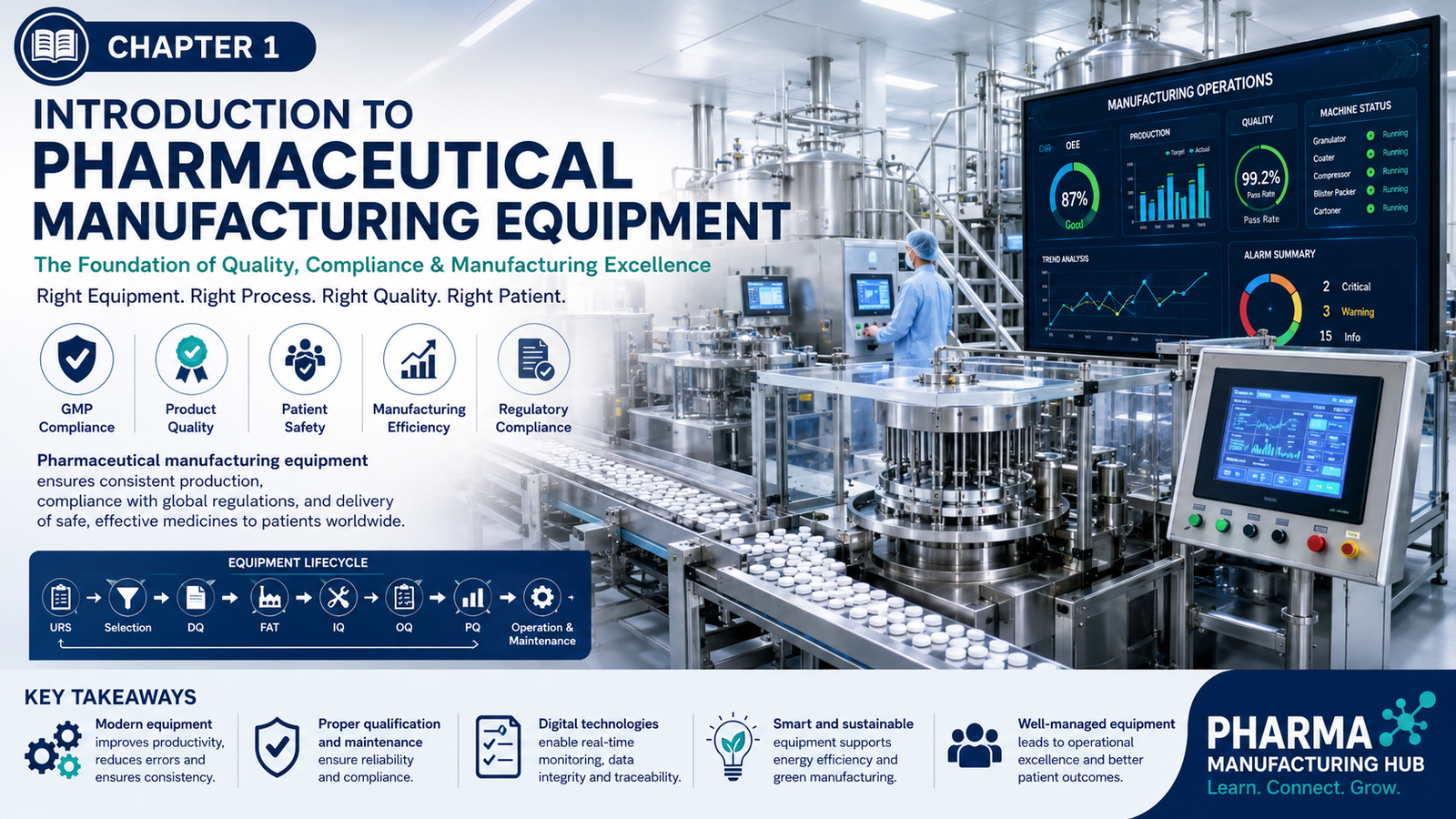
The Foundation of Pharmaceutical Manufacturing Equipment: The Backbone of Modern Medicine Production
Every tablet, capsule, injection, cream, or vaccine that reaches a patient begins its journey through a series of carefully designed pharmaceutical manufacturing equipment. From dispensing raw materials to packaging finished products, equipment plays a pivotal role in ensuring that medicines are produced consistently, safely, and in compliance with stringent global regulatory standards.
In today’s pharmaceutical industry, manufacturing equipment is far more than just machinery. It has evolved into an intelligent, data-driven, and highly automated ecosystem that integrates engineering, quality assurance, digital technologies, and regulatory compliance. Modern pharmaceutical facilities rely on advanced equipment to achieve high productivity, maintain product quality, reduce human intervention, and ensure patient safety.
As regulatory expectations become increasingly rigorous and pharmaceutical products grow more complex, selecting, qualifying, maintaining, and continuously improving manufacturing equipment has become a strategic business priority rather than merely an engineering function.
This article series explores pharmaceutical manufacturing equipment from its fundamental principles to emerging technologies such as Artificial Intelligence (AI), Digital Twins, Industry 4.0, and autonomous manufacturing systems.
Why Pharmaceutical Manufacturing Equipment Matters
Unlike many other manufacturing industries, pharmaceuticals directly impact human health. Any equipment malfunction, contamination, calibration drift, or process inconsistency can compromise product quality and potentially endanger patient safety.
Pharmaceutical manufacturing equipment serves several critical purposes:
- Ensures consistent product quality.
- Maintains process reproducibility.
- Prevents contamination and cross-contamination.
- Supports compliance with Good Manufacturing Practices (GMP).
- Enables efficient and cost-effective production.
- Facilitates validation and regulatory inspections.
- Generates reliable electronic records for traceability.
- Reduces operational risks and downtime.
- Supports continuous process improvement.
- Enhances manufacturing flexibility for new products.
Role of Pharmaceutical Equipment in Good Manufacturing Practices (GMP)
Good Manufacturing Practices (GMP) establish the minimum requirements for pharmaceutical manufacturing to ensure products are consistently produced and controlled according to quality standards. Equipment is one of the core pillars of GMP.
Properly designed, installed, qualified, operated, cleaned, and maintained equipment ensures that manufacturing processes remain under control throughout the product lifecycle.
Equipment Supports GMP by:
| GMP Requirement | Equipment Contribution |
|---|---|
| Product Quality | Consistent process performance |
| Patient Safety | Prevents contamination and mix-ups |
| Documentation | Generates electronic and manual records |
| Validation | Enables IQ, OQ, PQ activities |
| Traceability | Supports batch tracking and audit trails |
| Calibration | Ensures measurement accuracy |
| Cleaning | Prevents cross-contamination |
| Maintenance | Maintains operational reliability |
| Automation | Minimizes human errors |
| Compliance | Meets global regulatory expectations |
Equipment and Product Quality
Product quality is influenced by every stage of the manufacturing process, making equipment selection and performance critical.
Examples include:
- An improperly calibrated weighing balance can alter formulation accuracy.
- A poorly maintained tablet press may produce tablets with inconsistent weight or hardness.
- An inefficient fluid bed dryer can lead to excessive moisture, impacting product stability.
- An unqualified HVAC system can compromise cleanroom conditions and increase contamination risks.
Critical Quality Attributes (CQAs) Affected by Equipment
- Tablet Weight
- Hardness
- Friability
- Dissolution
- Moisture Content
- Blend Uniformity
- Particle Size Distribution
- Assay
- Content Uniformity
- Sterility (for sterile products)
Consistent equipment performance is therefore essential to maintaining these quality attributes within validated limits.
Equipment and Regulatory Compliance
Global regulatory agencies place significant emphasis on manufacturing equipment during inspections.
Inspectors routinely evaluate:
- Equipment qualification status.
- Preventive maintenance records.
- Calibration certificates.
- Cleaning validation.
- Equipment logbooks.
- Alarm management.
- Data integrity.
- Change control records.
- Electronic audit trails.
- User access controls.
Failure to demonstrate adequate equipment control can result in inspection observations, warning letters, product recalls, or regulatory actions.
Equipment and Patient Safety
The ultimate purpose of pharmaceutical manufacturing is to provide safe and effective medicines to patients.
Equipment contributes to patient safety by:
- Preventing contamination.
- Maintaining correct dosage strength.
- Ensuring product uniformity.
- Protecting product stability.
- Reducing foreign particle risks.
- Supporting sterile manufacturing where applicable.
- Enabling accurate labeling and packaging.
- Maintaining environmental controls.
A robust equipment lifecycle management program directly supports patient trust and public health.
Equipment and Manufacturing Efficiency
Modern pharmaceutical manufacturing demands high productivity without compromising quality.
Efficient equipment helps organizations:
- Increase production output.
- Reduce batch cycle time.
- Improve Overall Equipment Effectiveness (OEE).
- Minimize downtime.
- Lower operational costs.
- Reduce material wastage.
- Optimize energy consumption.
- Enhance workforce productivity.
- Improve schedule adherence.
- Accelerate product launches.
These improvements contribute to stronger business performance and competitiveness.
The Evolution of Pharmaceutical Equipment
The pharmaceutical industry has undergone a remarkable transformation over the past several decades.
Manual Equipment
        │
        ▼
Semi-Automatic Machines
        │
        ▼
Fully Automatic Systems
        │
        ▼
PLC-Controlled Equipment
        │
        ▼
SCADA Integration
        │
        ▼
MES Integration
        │
        ▼
Industry 4.0
        │
        ▼
Smart Manufacturing
        │
        ▼
AI-Driven Equipment
        │
        ▼
Digital Twins
        │
        ▼
Autonomous Manufacturing
Each stage has improved efficiency, process control, compliance, and data-driven decision-making.
Pharmaceutical Equipment Lifecycle
Effective lifecycle management ensures equipment remains reliable, compliant, and fit for its intended purpose.
User Requirement Specification (URS)
            │
            ▼
Equipment Selection
            │
            ▼
Design Qualification (DQ)
            │
            ▼
Factory Acceptance Test (FAT)
            │
            ▼
Installation Qualification (IQ)
            │
            ▼
Operational Qualification (OQ)
            │
            ▼
Performance Qualification (PQ)
            │
            ▼
Routine Operation
            │
            ▼
Calibration
            │
            ▼
Preventive Maintenance
            │
            ▼
Periodic Review
            │
            ▼
Requalification
            │
            ▼
Retirement / Replacement
Digital Transformation of Pharmaceutical Equipment
Modern equipment is increasingly integrated with digital technologies, enabling smarter and more efficient manufacturing.
Key digital trends include:
- Programmable Logic Controllers (PLCs)
- SCADA Systems
- Manufacturing Execution Systems (MES)
- Industrial Internet of Things (IIoT)
- Artificial Intelligence (AI)
- Machine Learning (ML)
- Digital Twins
- Predictive Maintenance
- Cloud Connectivity
- Electronic Batch Records
- Electronic Logbooks
- Advanced Process Control (APC)
- Vision Inspection Systems
- Real-Time Data Analytics
These technologies improve process visibility, reduce manual intervention, and support data-driven decision-making.
Challenges in Pharmaceutical Equipment Management
Despite technological advancements, manufacturers continue to face several challenges:
- High capital investment.
- Complex qualification and validation requirements.
- Frequent regulatory updates.
- Cybersecurity risks.
- Integration with legacy systems.
- Skilled workforce shortages.
- Spare parts availability.
- Equipment obsolescence.
- Increasing sustainability expectations.
- Data integrity and compliance.
Addressing these challenges requires a lifecycle approach involving engineering, quality, production, IT, and management.
Benefits of Investing in Advanced Pharmaceutical Equipment
| Area | Benefit |
|---|---|
| Product Quality | Improved consistency and reduced variability |
| Compliance | Enhanced regulatory readiness |
| Productivity | Increased throughput and efficiency |
| Cost | Reduced operational and maintenance costs |
| Sustainability | Lower energy and resource consumption |
| Digitalization | Better data collection and analytics |
| Maintenance | Predictive rather than reactive maintenance |
| Patient Safety | Reduced contamination and errors |
| Flexibility | Easier adaptation to new products |
| Business Growth | Faster time-to-market and improved competitiveness |
Case Study: Upgrading a Tablet Manufacturing Line
A mid-sized oral solid dosage (OSD) manufacturer replaced a legacy tablet compression line with a modern, PLC-controlled system integrated with SCADA and electronic batch records.
Results after 12 months:
| KPI | Before Upgrade | After Upgrade |
|---|---|---|
| OEE | 72% | 87% |
| Batch Rejections | 2.8% | 0.9% |
| Downtime | 14% | 6% |
| Batch Documentation Errors | 18 per month | 2 per month |
| Preventive Maintenance Compliance | 82% | 99% |
| Regulatory Observations | 5 | 0 |
This example illustrates how modern equipment can improve productivity, quality, compliance, and operational excellence simultaneously.
Key Takeaways
- Pharmaceutical manufacturing equipment is central to product quality, patient safety, and GMP compliance.
- Equipment must be designed, qualified, maintained, calibrated, and continuously monitored throughout its lifecycle.
- Digital technologies such as AI, IIoT, MES, SCADA, and Digital Twins are reshaping pharmaceutical manufacturing.
- Proper equipment management reduces risks, improves efficiency, and enhances regulatory readiness.
- Investment in modern equipment is a strategic enabler of operational excellence and long-term business success.
Conclusion
Pharmaceutical manufacturing equipment forms the foundation of every successful pharmaceutical operation. It is not merely a collection of machines but an integrated system that combines engineering excellence, quality assurance, regulatory compliance, and digital innovation. As the industry embraces automation, artificial intelligence, continuous manufacturing, and Industry 4.0, equipment will become increasingly intelligent, connected, and autonomous.
Understanding the principles of equipment selection, qualification, operation, and lifecycle management is essential for professionals across production, engineering, quality, validation, and regulatory functions. The subsequent chapters in this series will explore these topics in depth, beginning with the evolution of pharmaceutical manufacturing equipment and progressing through modern technologies, performance evaluation, regulatory expectations, and future trends. Quality, Compliance, and Manufacturing Excellence
Chapter 2: Evolution of Pharmaceutical Manufacturing Equipment
From Manual Operations to AI-Driven Smart Manufacturing
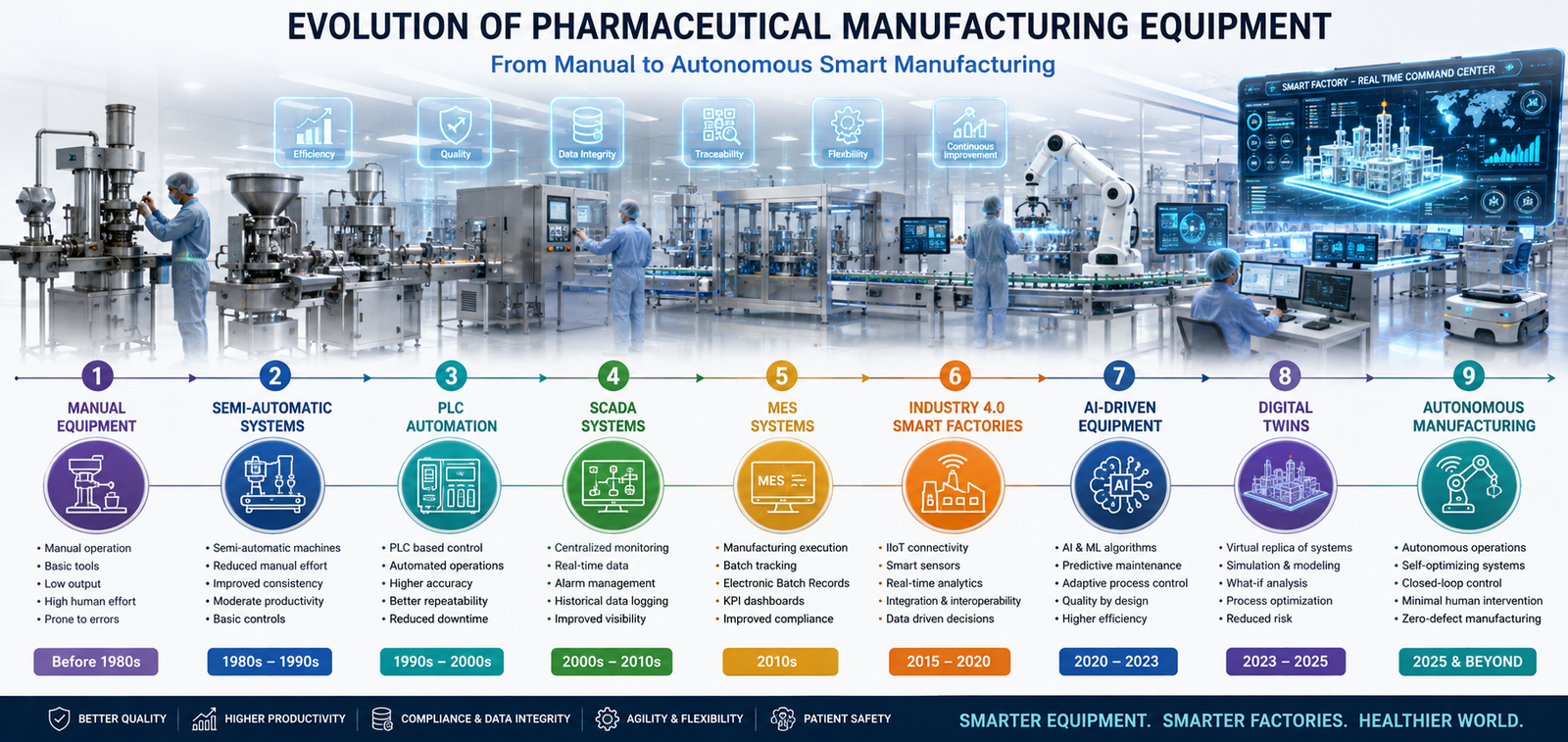
Introduction
The pharmaceutical industry has undergone one of the most remarkable technological transformations in manufacturing history. What began as small-scale manual production using basic equipment has evolved into highly automated, digitally connected, and intelligent manufacturing systems capable of producing millions of high-quality dosage units every day.
Pharmaceutical manufacturing equipment has continuously evolved to meet increasing demands for product quality, regulatory compliance, operational efficiency, sustainability, and patient safety. Today, modern pharmaceutical plants integrate automation, robotics, Artificial Intelligence (AI), Industrial Internet of Things (IIoT), Digital Twins, and predictive analytics to achieve unprecedented levels of precision and reliability.
This chapter explores the historical evolution of pharmaceutical manufacturing equipment, the driving forces behind technological advancements, and how these innovations are shaping the future of pharmaceutical manufacturing.
Why Equipment Evolution Was Necessary
Several factors have driven the continuous evolution of pharmaceutical manufacturing equipment:
- Increasing global demand for medicines.
- Stringent GMP regulations.
- Higher product quality expectations.
- Growing complexity of pharmaceutical formulations.
- Demand for greater production capacity.
- Reduction of human intervention and errors.
- Improved contamination control.
- Digital transformation initiatives.
- Sustainability and energy efficiency goals.
- Need for real-time monitoring and data-driven decision-making.
Timeline of Pharmaceutical Manufacturing Equipment Evolution
| Period | Major Development | Key Characteristics |
|---|---|---|
| Before 1950 | Manual Manufacturing | Hand-operated equipment, low productivity |
| 1950–1975 | Mechanical Equipment | Basic automation, improved consistency |
| 1975–1995 | PLC-Based Automation | Programmable controls, higher efficiency |
| 1995–2010 | SCADA & Computerization | Process monitoring, electronic records |
| 2010–2020 | Industry 4.0 | IoT, MES, data integration |
| 2020–2026 | AI & Smart Manufacturing | Predictive analytics, digital twins, robotics |
| 2030+ | Autonomous Manufacturing | Self-optimizing, AI-driven pharmaceutical plants |
Phase 1: Manual Pharmaceutical Manufacturing
In the early days of pharmaceutical production, nearly every manufacturing activity depended on manual labor.
Typical equipment included:
- Mortar and pestle
- Manual weighing balances
- Hand-operated tablet presses
- Manual capsule filling devices
- Stainless steel mixing vessels
- Drying trays
- Hand sieves
- Manual packaging tools
Characteristics
- Labor-intensive operations
- Limited batch sizes
- High operator dependency
- Minimal documentation
- Increased contamination risk
- Low production efficiency
- Inconsistent product quality
Advantages
- Low capital investment
- Simple operation
- Easy maintenance
- Suitable for small-scale production
Limitations
- High human error
- Poor repeatability
- Difficult GMP compliance
- Low throughput
- Limited traceability
Phase 2: Mechanical and Semi-Automatic Equipment
As pharmaceutical demand increased, manufacturers introduced mechanically driven equipment to improve productivity.
Examples included:
- Mechanical mixers
- Rotary tablet presses
- Semi-automatic capsule fillers
- Mechanical granulators
- Drum blenders
- Semi-automatic blister machines
Improvements
- Higher batch capacity
- Better mixing efficiency
- Reduced manual handling
- Improved consistency
- Increased production speed
However, operators still controlled many critical process parameters manually.
Phase 3: Fully Automatic Manufacturing Equipment
The next major milestone was the introduction of fully automated pharmaceutical machinery.
Automation enabled:
- Automatic material feeding
- Automatic compression
- Automatic weight adjustment
- Automatic rejection systems
- Automatic lubrication
- Automatic packaging
Examples include:
- High-speed tablet presses
- Automatic capsule fillers
- High Shear Granulators
- Fluid Bed Dryers with PLC controls
- Fully automatic blister packing machines
Benefits
- Reduced human intervention
- Higher productivity
- Improved product consistency
- Lower rejection rates
- Better GMP compliance
Phase 4: PLC-Based Equipment
The introduction of Programmable Logic Controllers (PLCs) revolutionized pharmaceutical manufacturing.
PLC-controlled equipment offered:
- Automated process sequences
- Recipe management
- Alarm handling
- Interlock systems
- Batch control
- Process repeatability
Typical PLC-controlled equipment includes:
- Tablet presses
- Coating machines
- Granulators
- FBDs
- Compression lines
- Packaging systems
Benefits
- Improved reliability
- Better process control
- Reduced operator errors
- Enhanced safety
- Faster troubleshooting
Phase 5: SCADA Integration
Supervisory Control and Data Acquisition (SCADA) systems enabled centralized monitoring and control of manufacturing equipment.
SCADA Functions
- Real-time equipment monitoring
- Alarm management
- Historical data storage
- Trend analysis
- Process visualization
- Remote operation
- Audit trails
Advantages
- Improved process visibility
- Faster decision-making
- Better compliance
- Reduced downtime
Phase 6: Manufacturing Execution Systems (MES)
MES bridges the gap between enterprise planning systems and shop-floor equipment.
Key Functions
- Electronic Batch Records (EBR)
- Work order management
- Material traceability
- Operator guidance
- Equipment utilization monitoring
- Production scheduling
- Performance dashboards
Benefits
- Paperless manufacturing
- Faster batch release
- Improved traceability
- Enhanced regulatory compliance
Phase 7: Industry 4.0 and Smart Manufacturing
Industry 4.0 introduced connected manufacturing where equipment communicates seamlessly across the production environment.
Core Technologies
- Industrial Internet of Things (IIoT)
- Smart Sensors
- Cloud Computing
- Edge Computing
- Big Data Analytics
- Machine Learning
- Artificial Intelligence
- Cyber-Physical Systems
Smart Equipment Features
- Self-diagnostics
- Predictive maintenance
- Real-time process optimization
- Remote monitoring
- Automated reporting
- Energy optimization
Phase 8: AI-Driven Pharmaceutical Equipment
Artificial Intelligence is transforming pharmaceutical equipment from automated machines into intelligent systems capable of learning and optimizing processes.
AI Applications
- Compression force optimization
- Predictive maintenance
- Vision-based inspection
- Defect detection
- Process optimization
- Root cause analysis
- Energy management
- Batch prediction
- Quality forecasting
Example
An AI-enabled tablet press can analyze historical production data, identify trends in tablet weight variation, and automatically adjust compression parameters to maintain product quality.
Phase 9: Digital Twin Technology
A Digital Twin is a virtual replica of a physical machine or process that continuously receives real-time operational data.
Benefits
- Virtual equipment simulation
- Predictive maintenance
- Process optimization
- Operator training
- Scenario testing
- Reduced downtime
Example
A digital twin of a fluid bed dryer can predict drying performance, identify potential failures, and recommend preventive maintenance before production is affected.
Phase 10: Autonomous Pharmaceutical Manufacturing
The future of pharmaceutical manufacturing lies in autonomous systems that require minimal human intervention.
Expected Features
- Self-learning equipment
- AI-driven decision-making
- Autonomous material movement
- Automatic cleaning validation
- Self-calibration
- Predictive quality assurance
- Lights-out manufacturing
- Real-time release testing
- Closed-loop process control
These technologies will enable pharmaceutical facilities to achieve higher efficiency, reduced variability, and enhanced compliance.
Comparison of Equipment Evolution
| Generation | Human Intervention | Automation | Data Availability | Compliance Support |
|---|---|---|---|---|
| Manual | Very High | None | Minimal | Low |
| Semi-Automatic | High | Partial | Limited | Moderate |
| Automatic | Moderate | High | Basic | Good |
| PLC-Controlled | Low | High | Moderate | Very Good |
| SCADA Integrated | Low | Advanced | Real-Time | Excellent |
| Industry 4.0 | Minimal | Intelligent | Connected | Excellent |
| AI-Driven | Very Minimal | Adaptive | Predictive | Outstanding |
| Autonomous | Near Zero | Self-Learning | Continuous | Future State |
Drivers of Modern Equipment Innovation
Key factors accelerating innovation include:
- Regulatory expectations for data integrity.
- Demand for continuous manufacturing.
- Cost reduction initiatives.
- Personalized medicine.
- Global supply chain resilience.
- Sustainability and carbon reduction goals.
- Advanced analytics and AI.
- Cybersecurity requirements.
- Faster product development.
- Enhanced patient safety.
Real-World Example: Modernizing an OSD Facility
A pharmaceutical company manufacturing oral solid dosage (OSD) products upgraded its production line from semi-automatic equipment to a fully integrated Industry 4.0 environment.
Project Highlights:
- PLC-controlled High Shear Granulator.
- Automated Fluid Bed Dryer.
- AI-enabled Tablet Compression Machine.
- Vision Inspection System.
- MES with Electronic Batch Records.
- SCADA-integrated utilities.
- Predictive maintenance platform.
Results after 18 months:
| KPI | Before Upgrade | After Upgrade |
|---|---|---|
| OEE | 74% | 91% |
| Batch Cycle Time | 18 hours | 13 hours |
| Product Rejections | 2.5% | 0.8% |
| Documentation Errors | 22/month | 3/month |
| Equipment Downtime | 12% | 4% |
| Energy Consumption | Baseline | 15% Reduction |
| Preventive Maintenance Compliance | 85% | 99% |
Future Outlook
The next decade will witness rapid adoption of:
- AI-powered manufacturing execution.
- Collaborative robots (Cobots).
- Digital Twin-based process optimization.
- Blockchain-enabled traceability.
- Real-Time Release Testing (RTRT).
- Self-healing manufacturing systems.
- Edge AI for equipment control.
- Autonomous quality management.
- Sustainable and energy-efficient equipment.
- Industry 5.0 with human-AI collaboration.
Manufacturers investing in these technologies will be better positioned to meet evolving regulatory requirements and remain competitive in the global pharmaceutical market.
Key Takeaways
- Pharmaceutical manufacturing equipment has evolved from manual tools to intelligent, AI-enabled systems.
- Automation, PLCs, SCADA, MES, and Industry 4.0 have significantly improved productivity, quality, and compliance.
- Digital Twins and predictive analytics are enabling proactive maintenance and process optimization.
- Autonomous manufacturing represents the next frontier, promising greater efficiency and reduced human intervention.
- Continuous investment in modern equipment is essential for operational excellence, regulatory readiness, and sustainable growth.
Conclusion
The evolution of pharmaceutical manufacturing equipment reflects the industry’s commitment to innovation, quality, and patient safety. Each technological advancement—from manual operations to AI-driven smart manufacturing—has addressed the growing demands of regulatory compliance, operational efficiency, and product consistency.
As pharmaceutical manufacturing continues to embrace digital transformation, future facilities will increasingly rely on interconnected, intelligent, and autonomous equipment. Understanding this evolution provides valuable context for selecting, operating, and optimizing modern pharmaceutical manufacturing systems.
Chapter 3: Classification of Pharmaceutical Manufacturing Equipment
A Comprehensive Guide to Equipment Categories in Modern Pharmaceutical Manufacturing
Introduction
Pharmaceutical manufacturing is a highly regulated and technology-driven industry where each piece of equipment has a specific role in ensuring product quality, operational efficiency, regulatory compliance, and patient safety. From receiving raw materials to packaging finished products, pharmaceutical manufacturing relies on a wide range of specialized equipment designed for different manufacturing operations.
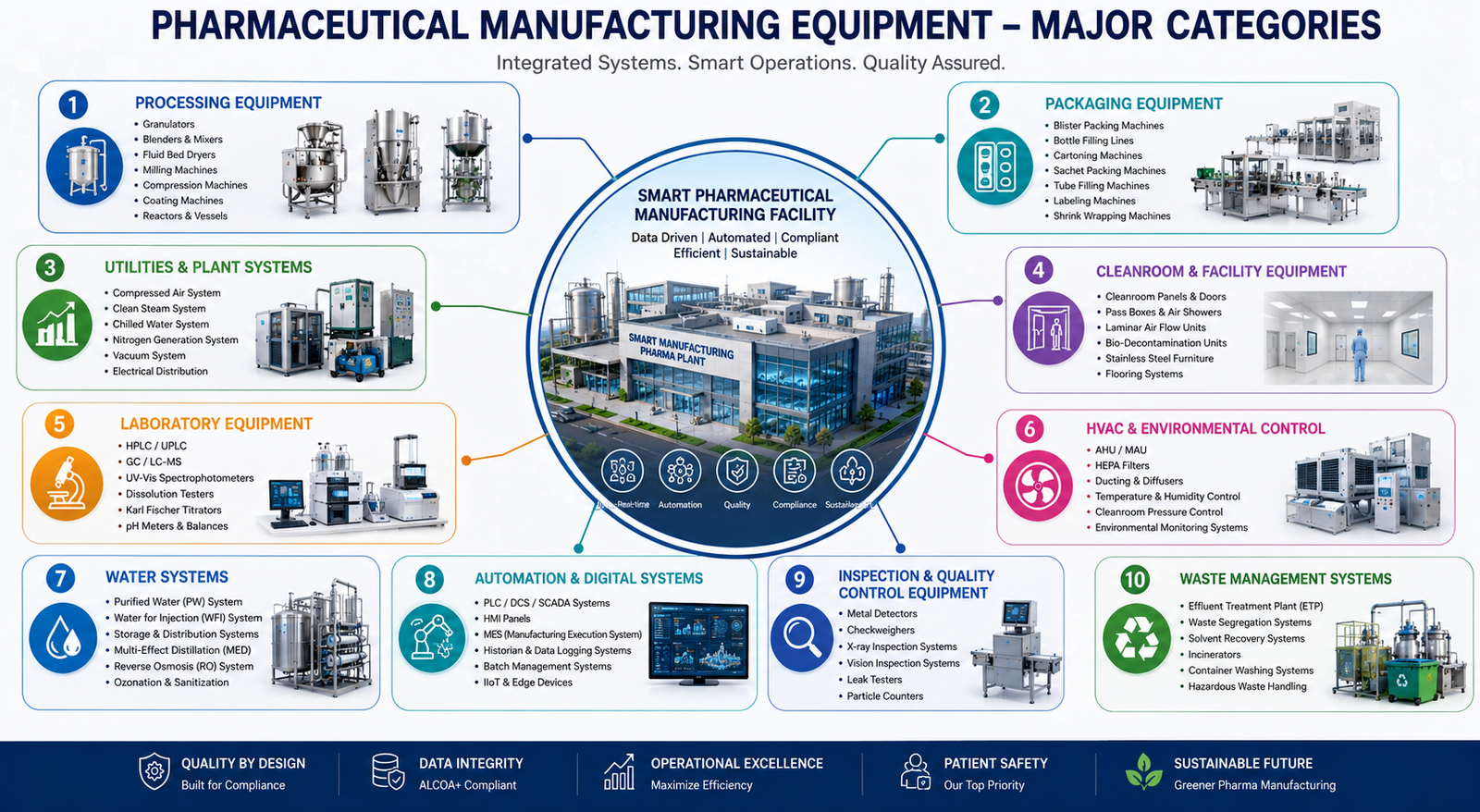
Modern pharmaceutical manufacturing equipment can be broadly classified based on its function, application, and role within the manufacturing process. Understanding these classifications is essential for production professionals, engineering teams, validation engineers, QA/QC personnel, project managers, and regulatory inspectors.
This chapter provides a detailed classification of pharmaceutical manufacturing equipment, including processing equipment, packaging systems, utilities, cleanroom equipment, laboratory instruments, material handling systems, automation technologies, and support systems.
Why Equipment Classification is Important
A systematic classification of pharmaceutical equipment helps organizations:
- Select appropriate equipment during facility design.
- Prepare User Requirement Specifications (URS).
- Facilitate qualification and validation activities.
- Optimize preventive maintenance programs.
- Improve spare parts management.
- Ensure GMP compliance.
- Simplify regulatory inspections.
- Enhance production planning.
- Improve training of operators and engineers.
- Support lifecycle management.
Overall Classification of Pharmaceutical Manufacturing Equipment
PHARMACEUTICAL MANUFACTURING EQUIPMENT
│
├── Processing Equipment
├── Packaging Equipment
├── Utility Equipment
├── Cleanroom Equipment
├── Laboratory Equipment
├── Material Handling Systems
├── Inspection Equipment
├── Automation & Digital Systems
├── HVAC Systems
├── Water Systems
├── Compressed Gas Systems
├── Clean Steam Systems
└── Waste Management Systems
1. Processing Equipment
Processing equipment is used to convert raw materials into finished pharmaceutical dosage forms while maintaining product quality and process consistency.
Major Processing Equipment
| Equipment | Primary Function |
|---|---|
| Dispensing Booth | Safe dispensing of raw materials |
| Vibro Sifter | Particle size separation |
| Multi Mill | Size reduction |
| Rapid Mixer Granulator (RMG) | Wet granulation |
| High Shear Granulator | Efficient granule formation |
| Fluid Bed Dryer (FBD) | Drying granules |
| Fluid Bed Processor | Drying, granulation, coating |
| Bin Blender | Uniform blending |
| Roll Compactor | Dry granulation |
| Tablet Compression Machine | Tablet formation |
| Capsule Filling Machine | Capsule filling |
| Coating Machine | Tablet coating |
| Metal Detector | Foreign particle detection |
| Tablet Deduster | Dust removal |
Key Objectives
- Product uniformity
- Batch consistency
- Process reproducibility
- Reduced contamination
- Improved productivity
2. Packaging Equipment
Packaging protects pharmaceutical products from environmental factors while ensuring traceability and regulatory compliance.
Primary Packaging Equipment
- Blister Packing Machine
- Strip Packing Machine
- Bottle Filling Machine
- Tube Filling Machine
- Ampoule Filling Machine
- Vial Filling Machine
- Sachet Packing Machine
Secondary Packaging Equipment
- Cartoning Machine
- Case Packer
- Shrink Wrapping Machine
- Labeling Machine
- Serialization System
- Palletizer
Functions
- Product protection
- Tamper evidence
- Product identification
- Regulatory labeling
- Track & Trace
- Shelf-life preservation
3. Utility Equipment
Utility systems provide essential services required for pharmaceutical manufacturing operations.
Major Utility Equipment
| Utility | Equipment |
|---|---|
| Purified Water | PW Generation System |
| Water for Injection | WFI System |
| Clean Steam | Clean Steam Generator |
| Compressed Air | Air Compressors & Dryers |
| Nitrogen | Nitrogen Generator |
| Vacuum | Vacuum Pumps |
| Chilled Water | Chillers |
| Steam | Steam Boilers |
| Electricity | DG Sets, UPS |
| HVAC | AHU, Ducting, Filters |
Utilities are often referred to as the “lifeline” of a pharmaceutical facility because production cannot proceed without them.
4. Cleanroom Equipment
Cleanroom equipment maintains the required environmental conditions for GMP-compliant manufacturing.
Typical Cleanroom Equipment
- Air Handling Units (AHUs)
- HEPA Filters
- Pass Boxes
- Dynamic Pass Boxes
- Air Showers
- Laminar Air Flow (LAF) Units
- Biosafety Cabinets
- Sampling Booths
- Dispensing Booths
- Airlocks
- Differential Pressure Monitoring Systems
- Particle Counters
Objectives
- Prevent contamination
- Maintain cleanliness classifications
- Control particulate levels
- Ensure microbial control
- Support sterile and non-sterile manufacturing
5. Laboratory Equipment
Laboratory equipment supports quality control, research and development, and stability testing.
Common QC Laboratory Equipment
- HPLC
- UPLC
- Gas Chromatography (GC)
- UV Spectrophotometer
- FTIR
- Dissolution Tester
- Disintegration Tester
- Hardness Tester
- Friability Tester
- Karl Fischer Moisture Analyzer
- pH Meter
- Analytical Balance
- Stability Chambers
Importance
- Product testing
- Raw material analysis
- Method validation
- Stability studies
- Regulatory compliance
6. Material Handling Systems
Material movement significantly affects manufacturing efficiency and contamination control.
Typical Systems
- Intermediate Bulk Containers (IBCs)
- Bin Lifters
- Vacuum Conveyors
- Pneumatic Conveyors
- Roller Conveyors
- Belt Conveyors
- Automatic Guided Vehicles (AGVs)
- Robotic Material Transfer Systems
- Drum Handling Equipment
- Pallet Trucks
Benefits
- Reduced manual handling
- Improved operator safety
- Lower contamination risk
- Enhanced productivity
- Better material traceability
7. Inspection Equipment
Inspection systems ensure that only products meeting quality standards are released.
Major Inspection Equipment
| Equipment | Purpose |
|---|---|
| Metal Detector | Detect metallic contaminants |
| Check Weigher | Verify product weight |
| Vision Inspection System | Detect visual defects |
| Leak Tester | Verify package integrity |
| X-ray Inspection | Detect foreign particles |
| Bottle Inspection Machine | Container inspection |
| Tablet Inspection Machine | Surface defect detection |
Modern inspection systems increasingly use Artificial Intelligence and machine vision to improve defect detection accuracy.
8. Automation and Digital Systems
Automation has transformed pharmaceutical manufacturing from operator-dependent processes to intelligent, connected production systems.
Major Automation Components
- PLC (Programmable Logic Controller)
- SCADA
- DCS (Distributed Control System)
- MES (Manufacturing Execution System)
- LIMS (Laboratory Information Management System)
- eQMS
- Electronic Batch Records (EBR)
- Historian Servers
- Industrial IoT Sensors
- Digital Twins
- AI Analytics Platforms
Benefits
- Real-time monitoring
- Data integrity
- Process optimization
- Reduced human error
- Improved compliance
- Enhanced decision-making
9. HVAC Systems
Heating, Ventilation, and Air Conditioning (HVAC) systems are critical for maintaining cleanroom conditions.
HVAC Components
- Air Handling Units (AHUs)
- HEPA Filters
- Pre-Filters
- Fine Filters
- Ducting
- Dampers
- Chillers
- Cooling Towers
- Humidifiers
- Dehumidifiers
- Temperature Sensors
- Pressure Sensors
Functions
- Temperature control
- Humidity control
- Pressure differentials
- Air cleanliness
- Air changes per hour (ACH)
- Cross-contamination prevention
10. Water Systems
Water is one of the most critical raw materials in pharmaceutical manufacturing.
Types of Pharmaceutical Water Systems
| System | Application |
|---|---|
| Potable Water | General utility |
| Purified Water (PW) | Manufacturing & cleaning |
| Water for Injection (WFI) | Sterile products |
| Pure Steam | Sterilization |
Major Equipment
- Multi-media Filters
- Activated Carbon Filters
- Softeners
- Reverse Osmosis (RO)
- Electro Deionization (EDI)
- UV Sterilizers
- Ozone Systems
- Storage Tanks
- Distribution Loops
11. Compressed Gas Systems
Compressed gases are widely used in pharmaceutical manufacturing.
Systems
- Compressed Air
- Nitrogen
- Oxygen
- Carbon Dioxide
- Instrument Air
Equipment
- Compressors
- Air Dryers
- Air Receivers
- Filtration Systems
- Nitrogen Generators
- Pressure Regulators
Applications include:
- Pneumatic operation
- Fluidization
- Blanketing
- Packaging
- Cleaning
- Process control
12. Clean Steam Systems
Clean steam is essential for sterilization and aseptic processing.
Major Components
- Clean Steam Generator
- Feed Water System
- Distribution Network
- Steam Traps
- Pressure Reducing Stations
- Condensate Recovery
Applications
- SIP (Steam-In-Place)
- Sterilization
- Humidification
- Equipment sanitization
13. Waste Management Systems
Waste management systems ensure environmental compliance and safe disposal of pharmaceutical waste.
Types
- Liquid Waste Treatment
- Solid Waste Collection
- Solvent Recovery
- Dust Collection Systems
- Effluent Treatment Plant (ETP)
- Sewage Treatment Plant (STP)
- Hazardous Waste Storage
- Biohazard Waste Systems
Benefits
- Environmental protection
- Regulatory compliance
- Worker safety
- Sustainable manufacturing
Emerging Equipment Categories
With Industry 4.0 and Pharma 4.0, new categories of equipment are gaining prominence:
- Collaborative Robots (Cobots)
- AI-Powered Vision Systems
- Autonomous Mobile Robots (AMRs)
- Digital Twin Platforms
- Predictive Maintenance Systems
- Smart Sensors
- Edge Computing Devices
- Augmented Reality (AR) Maintenance Tools
- Automated Cleaning Validation Systems
- Continuous Manufacturing Platforms
These technologies are reshaping pharmaceutical manufacturing by enabling real-time monitoring, adaptive control, and data-driven decision-making.
Equipment Classification Matrix
| Category | Examples | Primary Objective |
|---|---|---|
| Processing | RMG, FBD, Tablet Press | Product manufacture |
| Packaging | Blister Machine, Cartoner | Product protection |
| Utilities | PW, WFI, Steam | Process support |
| Cleanroom | AHU, LAF, Pass Box | Environmental control |
| Laboratory | HPLC, Dissolution Tester | Quality testing |
| Material Handling | IBC, AGV, Conveyor | Safe movement |
| Inspection | Metal Detector, Vision System | Quality assurance |
| Automation | PLC, SCADA, MES | Process control |
| HVAC | AHU, HEPA | Air quality |
| Water | RO, EDI, WFI | Pharmaceutical-grade water |
| Gas Systems | Compressor, Nitrogen Generator | Process utilities |
| Waste Management | ETP, Dust Collector | Environmental compliance |
Case Study: Integrated Equipment Classification in an OSD Facility
A modern oral solid dosage manufacturing facility categorized its equipment into functional groups to improve maintenance planning and regulatory compliance.
Implementation Outcomes:
| KPI | Before Classification | After Classification |
|---|---|---|
| Preventive Maintenance Compliance | 84% | 98% |
| Equipment Downtime | 10% | 5% |
| Spare Parts Availability | 78% | 96% |
| Qualification Documentation Accuracy | 88% | 100% |
| Audit Readiness | Moderate | Excellent |
The structured classification simplified equipment lifecycle management, reduced downtime, and enhanced GMP compliance.
Key Takeaways
- Pharmaceutical manufacturing equipment can be classified into functional categories such as processing, packaging, utilities, cleanroom, laboratory, material handling, inspection, automation, HVAC, water, gas, and waste management systems.
- Each equipment category has a distinct role in ensuring product quality, operational efficiency, and regulatory compliance.
- Integrated classification supports effective maintenance, qualification, calibration, and lifecycle management.
- Emerging technologies such as AI, robotics, Digital Twins, and smart sensors are creating new categories of intelligent pharmaceutical equipment.
- A well-organized equipment classification system strengthens GMP compliance, audit readiness, and overall manufacturing excellence.
Conclusion
The classification of pharmaceutical manufacturing equipment provides the foundation for understanding how different systems interact to produce safe, effective, and high-quality medicines. Each equipment category—from processing machinery and utility systems to digital automation platforms—contributes to the overall performance of a pharmaceutical manufacturing facility.
As the industry advances toward Pharma 4.0, equipment classifications are expanding to include intelligent, connected, and autonomous technologies. Organizations that adopt a structured approach to equipment selection, categorization, qualification, and lifecycle management will be better positioned to achieve operational excellence, regulatory compliance, and sustainable growth.
Chapter 4: Equipment Used in Oral Solid Dosage (OSD) Manufacturing
A Comprehensive Guide to Pharmaceutical Manufacturing Equipment for Tablet and Capsule Production
Introduction
Oral Solid Dosage (OSD) forms—including tablets, capsules, powders, granules, and sachets—account for nearly 70–80% of pharmaceutical products manufactured worldwide. Their popularity stems from patient convenience, dosage accuracy, stability, cost-effectiveness, and ease of transportation and storage.
The production of OSD products requires a series of specialized pharmaceutical manufacturing equipment designed to perform critical unit operations under stringent Good Manufacturing Practices (GMP). Each machine plays a distinct role in transforming raw materials into high-quality finished products while ensuring consistency, regulatory compliance, and patient safety.
This chapter provides a detailed overview of the major equipment used in OSD manufacturing, including their purpose, working principles, critical process parameters, advantages, limitations, common operational issues, maintenance requirements, and qualification considerations.
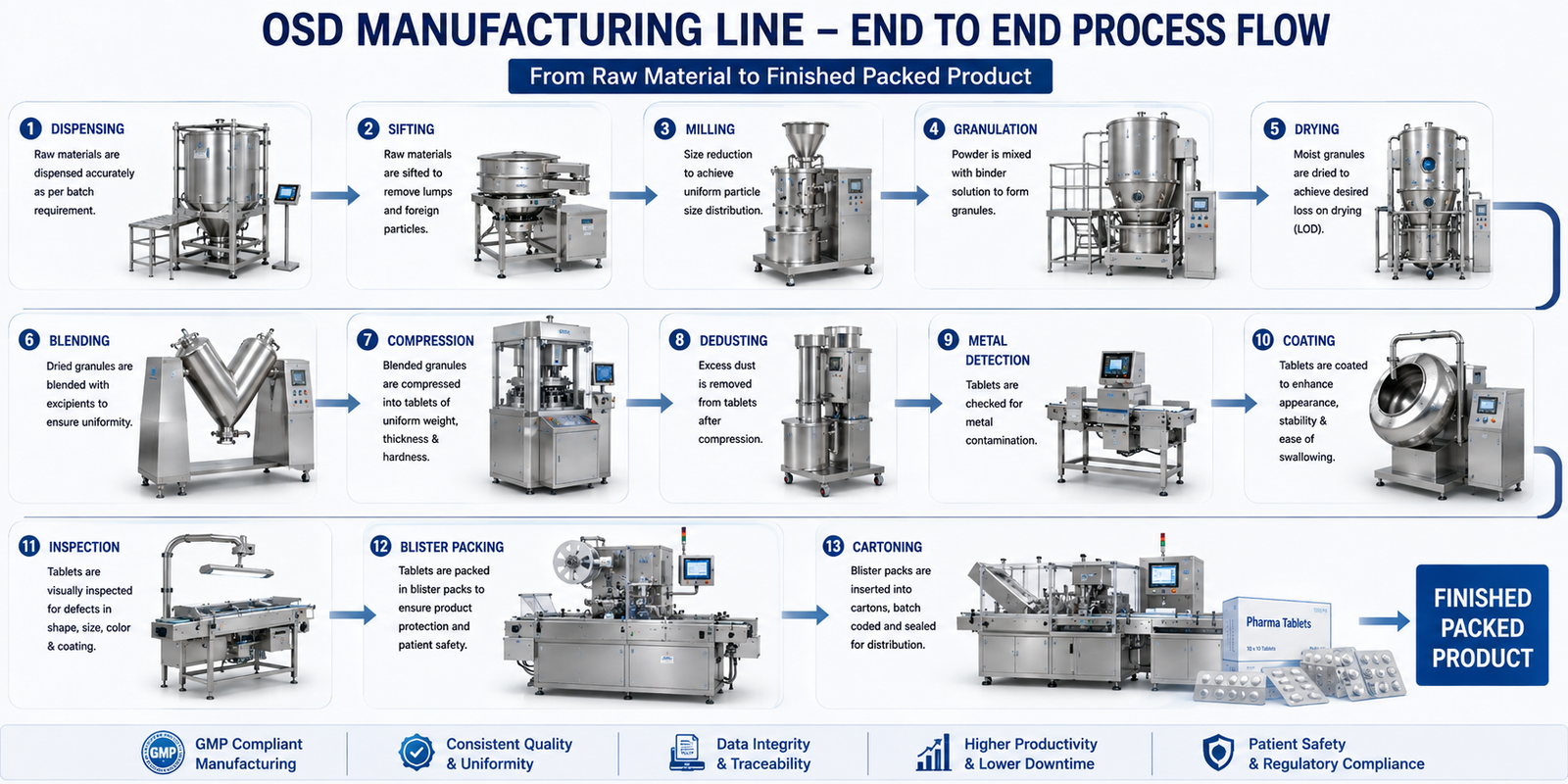
Typical OSD Manufacturing Process Flow
Raw Material Receipt
        │
        ▼
Sampling & Dispensing
        │
        ▼
Sifting
        │
        ▼
Milling
        │
        ▼
Granulation (Wet/Dry)
        │
        ▼
Drying
        │
        ▼
Sizing
        │
        ▼
Blending
        │
        ▼
Lubrication
        │
        ▼
Compression / Capsule Filling
        │
        ▼
Dedusting
        │
        ▼
Metal Detection
        │
        ▼
Coating (if applicable)
        │
        ▼
Inspection
        │
        ▼
Blister / Bottle Packing
        │
        ▼
Cartoning
        │
        ▼
Finished Goods
Equipment Overview
| Manufacturing Stage | Equipment |
|---|---|
| Dispensing | Dispensing Booth |
| Sifting | Vibro Sifter |
| Milling | Multi Mill |
| Wet Granulation | Rapid Mixer Granulator (RMG) / High Shear Granulator |
| Drying | Fluid Bed Dryer (FBD) |
| Dry Granulation | Roll Compactor |
| Blending | Bin Blender |
| Compression | Tablet Compression Machine |
| Encapsulation | Capsule Filling Machine |
| Dedusting | Tablet Deduster |
| Inspection | Metal Detector / IPC Equipment |
| Coating | Auto Coater |
| Packaging | Blister Packing Machine |
| Secondary Packaging | Cartoning Machine |
1. Dispensing Booth
Purpose
A dispensing booth provides a controlled environment for weighing and dispensing raw materials while minimizing dust generation and cross-contamination.
Working Principle
Air is drawn through HEPA filters to create negative pressure around the dispensing area, capturing airborne particles and protecting both the operator and the product.
Critical Parameters
- Air velocity
- Differential pressure
- HEPA filter integrity
- Illumination
- Airborne particle count
- Temperature
- Relative humidity
Advantages
- Protects operators from potent compounds.
- Reduces dust contamination.
- Maintains cleanroom conditions.
- Improves weighing accuracy.
Limitations
- Regular HEPA filter replacement required.
- Airflow disturbances can affect containment.
Common Problems
- Reduced airflow.
- Clogged pre-filters.
- Damaged HEPA filters.
- Pressure imbalance.
Maintenance
- Daily cleaning.
- Weekly airflow verification.
- Periodic smoke studies.
- HEPA integrity testing.
- Calibration of pressure gauges.
Qualification Requirements
- DQ
- IQ
- OQ
- PQ
- Airflow visualization
- HEPA filter integrity test
2. Vibro Sifter
Purpose
Separates oversized particles and foreign materials to achieve uniform particle size distribution.
Working Principle
A vibrating motor generates oscillatory motion, causing material to pass through a stainless-steel mesh while retaining oversized particles.
Critical Parameters
- Screen mesh size
- Vibration frequency
- Feed rate
- Material flow
- Product temperature
Advantages
- Uniform particle size.
- Improved blend homogeneity.
- Reduced foreign particle risk.
Limitations
- Screen wear.
- Mesh blockage.
- Product loss due to fine dust.
Common Problems
- Torn mesh.
- Excessive vibration.
- Material clogging.
Maintenance
- Inspect meshes before each batch.
- Lubricate motor bearings.
- Tighten clamps.
- Replace damaged screens.
Qualification
- IQ
- OQ
- PQ
- Mesh integrity verification
3. Multi Mill
Purpose
Reduces particle size of wet or dry granules before blending or compression.
Working Principle
A rotating impeller forces material through perforated screens to achieve the desired particle size.
Critical Parameters
- Rotor speed
- Screen size
- Feed rate
- Product temperature
Advantages
- Uniform granule size.
- High throughput.
- Versatile operation.
Limitations
- Heat generation.
- Screen wear.
- Dust formation.
Common Problems
- Rotor imbalance.
- Screen damage.
- Overheating.
Maintenance
- Blade inspection.
- Screen replacement.
- Bearing lubrication.
- Alignment checks.
Qualification
- IQ
- OQ
- PQ
4. Rapid Mixer Granulator (RMG)
Purpose
Performs wet granulation by mixing powders with a binder solution to form granules.
Working Principle
A high-speed impeller mixes the ingredients while a chopper breaks agglomerates, producing uniform granules.
Critical Parameters
- Impeller speed
- Chopper speed
- Binder addition rate
- Granulation time
- Product temperature
- Torque
Advantages
- Fast granulation.
- Uniform particle size.
- Improved compressibility.
Limitations
- High energy consumption.
- Over-granulation risk.
Common Problems
- Inconsistent binder distribution.
- Excessive granule growth.
Maintenance
- Seal inspection.
- Blade replacement.
- Motor servicing.
- Calibration of load cells.
Qualification
- DQ
- IQ
- OQ
- PQ
- Recipe verification
5. High Shear Granulator
High Shear Granulators operate on similar principles to RMGs but are optimized for rapid, high-energy mixing to produce dense, uniform granules. They are widely used for formulations requiring precise control over granule size and moisture distribution.
6. Fluid Bed Dryer (FBD)
Purpose
Dries wet granules efficiently using heated air.
Working Principle
Filtered hot air fluidizes the granules, allowing rapid and uniform moisture removal.
Critical Parameters
- Inlet air temperature
- Outlet air temperature
- Airflow
- Bed pressure
- Moisture content
- Drying time
Advantages
- Uniform drying.
- Short cycle time.
- High efficiency.
Limitations
- Static electricity.
- Filter blockage.
Common Problems
- Channeling.
- Uneven drying.
- Bag leakage.
Maintenance
- Filter bag inspection.
- Fan servicing.
- Temperature sensor calibration.
Qualification
- IQ
- OQ
- PQ
- Heat distribution study
7. Bin Blender
Purpose
Ensures homogeneous blending of granules with lubricants and glidants.
Working Principle
The bin rotates around its axis, gently tumbling the material for uniform mixing.
Critical Parameters
- Rotation speed
- Blending time
- Fill level
- Bin capacity
Advantages
- Excellent blend uniformity.
- Low segregation.
- Easy cleaning.
Limitations
- Over-blending risk.
- Lubricant overmixing.
Maintenance
- Gear inspection.
- Clamp verification.
- Bearing lubrication.
Qualification
- Blend uniformity study
- IQ
- OQ
- PQ
8. Roll Compactor
Purpose
Performs dry granulation for moisture- or heat-sensitive formulations.
Working Principle
Powder is compressed between counter-rotating rollers to form ribbons, which are milled into granules.
Critical Parameters
- Roller pressure
- Roller speed
- Gap width
- Feed screw speed
Advantages
- No drying step.
- Suitable for moisture-sensitive products.
- Lower processing time.
Limitations
- Ribbon density variation.
- Granule friability.
Qualification
- IQ
- OQ
- PQ
9. Tablet Compression Machine
Purpose
Compresses granules into tablets of uniform weight, hardness, and thickness.
Working Principle
Upper and lower punches compress granules within dies to form tablets.
Critical Parameters
- Compression force
- Tablet weight
- Hardness
- Thickness
- Turret speed
- Fill depth
Advantages
- High production capacity.
- Excellent consistency.
- Automated controls.
Limitations
- Punch wear.
- Tooling costs.
Common Problems
- Capping.
- Lamination.
- Sticking.
- Picking.
- Weight variation.
Maintenance
- Punch and die inspection.
- Lubrication.
- Force sensor calibration.
- Turret alignment.
Qualification
- IQ
- OQ
- PQ
- Compression force verification
- Weight accuracy study
10. Capsule Filling Machine
Purpose
Fills hard gelatin or HPMC capsules with powders, pellets, or granules.
Working Principle
Capsules are separated, filled using dosing mechanisms, and automatically closed.
Critical Parameters
- Fill weight
- Capsule orientation
- Machine speed
- Vacuum pressure
Common Problems
- Capsule rejection.
- Weight variation.
- Improper locking.
Qualification
- IQ
- OQ
- PQ
11. Metal Detector
Purpose
Detects metallic contamination before packaging.
Detectable Metals
- Ferrous
- Non-ferrous
- Stainless steel
Qualification
- Challenge tests
- Sensitivity verification
- OQ
- PQ
12. Tablet Deduster
Purpose
Removes excess powder adhering to compressed tablets before inspection and packaging.
Benefits
- Improved appearance.
- Better metal detector performance.
- Reduced dust contamination.
13. Coating Machine
Purpose
Applies functional or aesthetic coatings to tablets.
Types of Coating
- Film coating
- Sugar coating
- Enteric coating
- Modified-release coating
Critical Parameters
- Inlet temperature
- Spray rate
- Atomization pressure
- Pan speed
- Exhaust temperature
Common Problems
- Orange peel.
- Picking.
- Color variation.
- Twinning.
14. In-Process Control (IPC) Equipment
Common Instruments
- Tablet hardness tester
- Friability tester
- Disintegration tester
- Thickness gauge
- Weight balance
- Moisture analyzer
Purpose
- Monitor critical quality attributes during production.
- Ensure the process remains within validated limits.
15. Blister Packing Machine
Purpose
Packages tablets or capsules into blister packs, protecting them from moisture, oxygen, and contamination.
Main Functions
- Pocket forming
- Product feeding
- Sealing
- Printing
- Cutting
Critical Parameters
- Sealing temperature
- Forming pressure
- Machine speed
- Registration accuracy
16. Cartoning Machine
Purpose
Packages blister strips or bottles into cartons with patient information leaflets.
Features
- Automatic leaflet insertion
- Barcode verification
- Serialization integration
- Tamper-evident sealing
Equipment Qualification Matrix
| Equipment | DQ | IQ | OQ | PQ |
|---|---|---|---|---|
| Dispensing Booth | ✓ | ✓ | ✓ | ✓ |
| Vibro Sifter | ✓ | ✓ | ✓ | ✓ |
| Multi Mill | ✓ | ✓ | ✓ | ✓ |
| RMG / High Shear Granulator | ✓ | ✓ | ✓ | ✓ |
| Fluid Bed Dryer | ✓ | ✓ | ✓ | ✓ |
| Bin Blender | ✓ | ✓ | ✓ | ✓ |
| Roll Compactor | ✓ | ✓ | ✓ | ✓ |
| Tablet Compression Machine | ✓ | ✓ | ✓ | ✓ |
| Capsule Filling Machine | ✓ | ✓ | ✓ | ✓ |
| Metal Detector | ✓ | ✓ | ✓ | ✓ |
| Coating Machine | ✓ | ✓ | ✓ | ✓ |
| Blister Packing Machine | ✓ | ✓ | ✓ | ✓ |
| Cartoning Machine | ✓ | ✓ | ✓ | ✓ |
OSD Equipment Selection Checklist
Before purchasing or qualifying any OSD manufacturing equipment, verify:
- GMP-compliant design (easy-to-clean, hygienic construction)
- Stainless steel 316L product-contact surfaces
- Compliance with URS and process requirements
- Adequate production capacity
- Automation and PLC/HMI functionality
- Compatibility with SCADA/MES integration
- Availability of spare parts and local service support
- Vendor qualification and regulatory track record
- Ease of cleaning and maintenance
- Qualification documentation (DQ/IQ/OQ/PQ support)
- Data integrity and 21 CFR Part 11 readiness (where applicable)
- Energy efficiency and sustainability features
Case Study: Modernizing an OSD Manufacturing Line
A pharmaceutical manufacturer upgraded its legacy OSD production line by installing a PLC-controlled Rapid Mixer Granulator, Fluid Bed Dryer, Tablet Compression Machine with automatic weight control, Vision Inspection System, and MES-integrated Blister Packaging Line.
Results After 12 Months
| KPI | Before Upgrade | After Upgrade |
|---|---|---|
| Overall Equipment Effectiveness (OEE) | 76% | 91% |
| Batch Rejections | 2.4% | 0.7% |
| Compression Speed | 180,000 tablets/hour | 320,000 tablets/hour |
| Equipment Downtime | 11% | 4% |
| Documentation Errors | 16/month | 2/month |
| Preventive Maintenance Compliance | 86% | 99% |
| Energy Consumption | Baseline | 14% Reduction |
Key Takeaways
- OSD manufacturing relies on a sequence of specialized equipment, each performing a critical unit operation from dispensing to final packaging.
- Proper equipment selection, operation, maintenance, and qualification are essential for achieving consistent product quality and GMP compliance.
- Critical process parameters must be continuously monitored to ensure validated manufacturing performance.
- Modern OSD equipment increasingly incorporates PLCs, SCADA, MES, vision systems, and AI-driven analytics to improve productivity and regulatory readiness.
- A lifecycle approach—including qualification, preventive maintenance, calibration, and periodic review—maximizes equipment reliability and operational excellence.
Conclusion
Oral Solid Dosage manufacturing equipment forms the backbone of pharmaceutical production, enabling the efficient, consistent, and compliant manufacture of tablets and capsules. Each machine contributes to the overall process by performing a specific function while maintaining critical quality attributes and meeting stringent regulatory expectations.
As pharmaceutical manufacturing embraces Pharma 4.0, OSD equipment is becoming smarter, more connected, and increasingly autonomous. Integrating automation, digital monitoring, predictive maintenance, and data analytics will continue to enhance productivity, quality assurance, and patient safety.
Chapter 5: Equipment Evaluation Before Purchase
A Strategic Guide to Selecting Pharmaceutical Manufacturing Equipment
Introduction
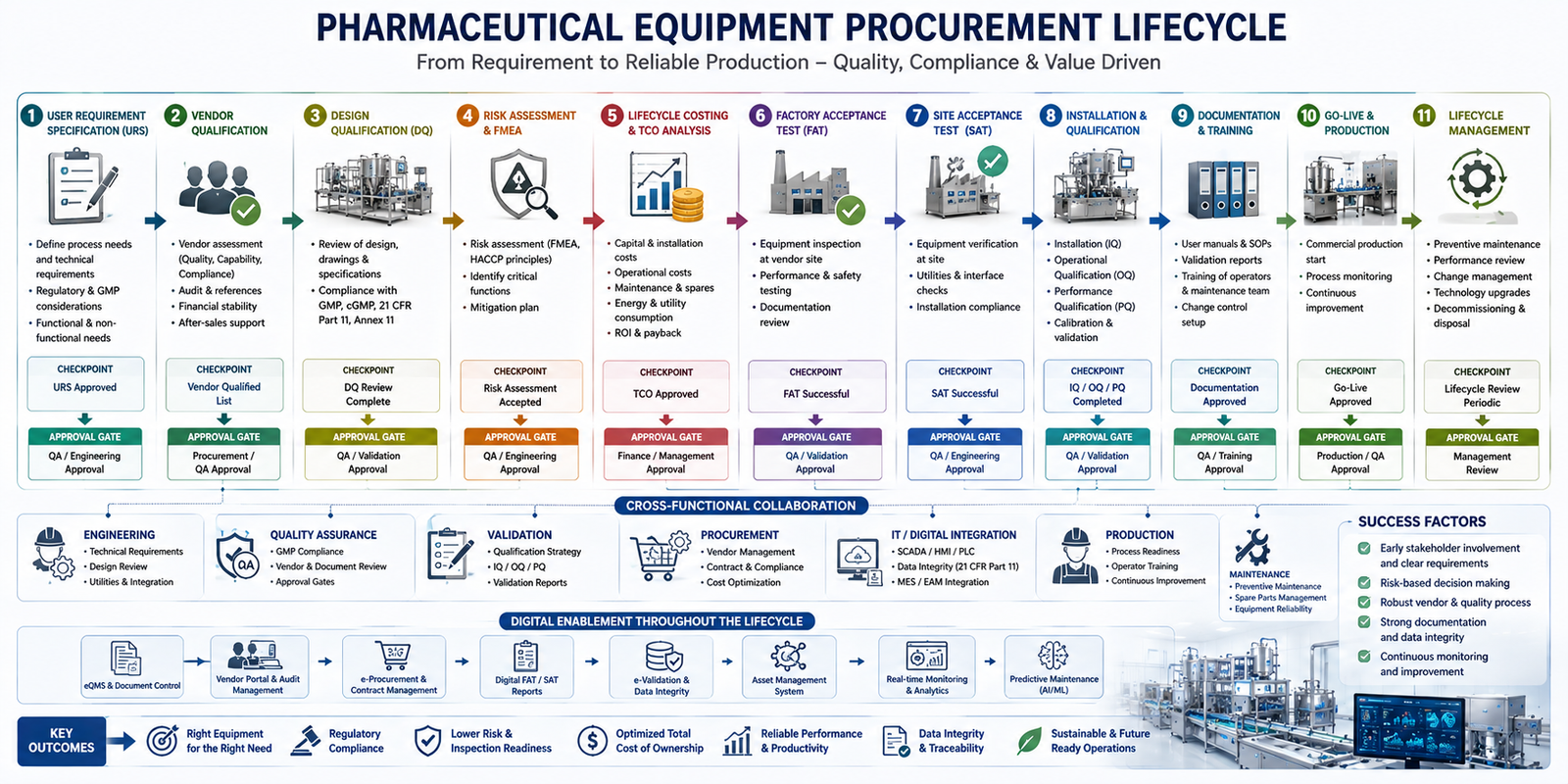
Selecting pharmaceutical manufacturing equipment is one of the most critical investment decisions for any pharmaceutical organization. Unlike conventional industrial machinery, pharmaceutical equipment must not only deliver the required production capacity but also comply with stringent Good Manufacturing Practices (GMP), global regulatory expectations, validation requirements, and long-term operational needs.
A poor equipment selection can result in production inefficiencies, validation failures, increased maintenance costs, regulatory observations, frequent downtime, and even product recalls. Conversely, a well-planned evaluation process ensures that the equipment aligns with process requirements, quality objectives, and future business growth.
Equipment evaluation is therefore a cross-functional process involving Production, Engineering, Quality Assurance (QA), Quality Control (QC), Validation, Regulatory Affairs, Information Technology (IT), Procurement, Environment Health & Safety (EHS), and Finance.
This chapter provides a structured approach to evaluating pharmaceutical manufacturing equipment before purchase, from defining the User Requirement Specification (URS) to vendor qualification, risk assessment, lifecycle costing, digital integration, and final selection.
Why Equipment Evaluation Is Critical
Proper evaluation helps organizations:
- Select equipment that meets process and product requirements.
- Ensure compliance with GMP and global regulatory expectations.
- Reduce lifecycle costs.
- Improve Overall Equipment Effectiveness (OEE).
- Simplify qualification and validation.
- Reduce downtime and maintenance.
- Enhance operator safety.
- Support future automation and digitalization.
- Minimize project risks.
- Maximize return on investment (ROI).
Equipment Procurement Lifecycle
Business Need
      │
      ▼
User Requirement Specification (URS)
      │
      ▼
Budget Approval
      │
      ▼
Vendor Identification
      │
      ▼
Technical Evaluation
      │
      ▼
Vendor Qualification
      │
      ▼
Risk Assessment
      │
      ▼
Design Qualification (DQ)
      │
      ▼
Commercial Evaluation
      │
      ▼
Purchase Order
      │
      ▼
Factory Acceptance Test (FAT)
      │
      ▼
Delivery & Installation
      │
      ▼
Site Acceptance Test (SAT)
      │
      ▼
IQ / OQ / PQ
      │
      ▼
Routine Production
Step 1: Define the User Requirement Specification (URS)
The User Requirement Specification (URS) is the foundation of equipment evaluation. It describes what the equipment must achieve, without prescribing how the manufacturer should design it.
Typical URS Contents
- Equipment name and intended use
- Product type(s)
- Batch size
- Production capacity
- Material of construction (e.g., SS 316L product-contact parts)
- GMP design requirements
- Utility requirements
- Automation level (PLC/HMI/SCADA/MES)
- Data integrity and 21 CFR Part 11 compliance
- Cleaning requirements
- Safety features
- Environmental conditions
- Qualification documentation requirements
- Spare parts
- Documentation package
- Training requirements
- Warranty and after-sales support
Best Practice: Develop the URS through a multidisciplinary team to ensure all user needs are captured.
Step 2: Process and Capacity Evaluation
The selected equipment should match both current and future manufacturing needs.
Key Evaluation Questions
- What dosage forms will be manufactured?
- What are the target batch sizes?
- What is the expected annual production volume?
- Can the equipment handle multiple products?
- Is scale-up possible?
- Does it support continuous manufacturing if required?
Capacity Evaluation Example
| Parameter | Requirement |
|---|---|
| Batch Size | 300 kg |
| Tablets per Hour | 300,000 |
| Product Changeover | <2 hours |
| OEE Target | >85% |
| Availability | >95% |
Step 3: GMP Design Evaluation
Equipment must be designed for cleanability, maintainability, and contamination control.
GMP Design Checklist
- Product-contact parts made from SS 316L.
- Smooth, crevice-free surfaces.
- Hygienic welds.
- Easy access for cleaning.
- CIP/SIP capability where applicable.
- Dust-tight design.
- No dead legs in product paths.
- Appropriate surface finish (Ra value).
- Proper labeling and identification.
Step 4: Vendor Qualification
Choosing the right supplier is as important as selecting the equipment itself.
Vendor Evaluation Criteria
| Criteria | Evaluation |
|---|---|
| GMP Experience | Excellent / Good / Poor |
| Pharmaceutical References | Yes / No |
| Regulatory Inspection History | Acceptable |
| Technical Expertise | High |
| Financial Stability | Verified |
| Global Service Network | Available |
| Spare Parts Availability | Confirmed |
| Validation Support | Included |
| Documentation Quality | Satisfactory |
| Training Capability | Available |
Vendor Audit Areas
- Manufacturing capability
- Quality management system
- Calibration practices
- Welding procedures
- Material traceability
- Documentation control
- Factory testing facilities
Step 5: Technical Evaluation
Assess the equipment against the URS and intended process.
Technical Considerations
- Throughput
- Accuracy
- Repeatability
- Flexibility
- Automation level
- Ease of operation
- Changeover time
- Cleaning accessibility
- Safety systems
- Noise and vibration
- Footprint
- Utility consumption
Step 6: Risk Assessment
Risk assessment should be conducted before finalizing the purchase to identify potential impacts on product quality, patient safety, and regulatory compliance.
Common Risk Assessment Tools
- Failure Mode and Effects Analysis (FMEA)
- Hazard Analysis
- HACCP
- Risk Ranking
- Risk Matrix
Example Risk Matrix
| Risk | Impact | Probability | Mitigation |
|---|---|---|---|
| Equipment undersized | High | Medium | Capacity study |
| Spare parts unavailable | High | Low | Long-term agreement |
| Software incompatibility | Medium | Medium | FAT testing |
| Cleaning challenges | High | Low | DQ review |
Step 7: Design Qualification (DQ)
Design Qualification verifies that the proposed equipment design meets the URS and GMP requirements before fabrication.
DQ Review Includes
- URS compliance
- Process suitability
- Material of construction
- Instrumentation
- Utilities
- Automation architecture
- Safety features
- Maintenance access
- Cleaning concept
Step 8: Factory Acceptance Test (FAT)
The FAT is performed at the vendor’s site before shipment to confirm that the equipment performs according to specifications.
FAT Activities
- Mechanical inspection
- Functional testing
- Instrument calibration verification
- PLC/HMI testing
- Alarm testing
- Interlock verification
- Recipe verification
- Documentation review
- Safety checks
FAT Deliverables
- FAT protocol
- Test records
- Deviation report
- Calibration certificates
- Software backup
- Final FAT report
Step 9: Site Acceptance Test (SAT)
After installation, the SAT confirms that the equipment has been installed correctly and functions properly within the manufacturing facility.
SAT Checklist
- Utilities connected
- Mechanical integrity
- Instrument verification
- Alarm functionality
- Safety devices
- Communication with SCADA/MES
- Operator interfaces
- Documentation completeness
Step 10: Lifecycle Cost Evaluation
The purchase price represents only part of the total investment.
Lifecycle Cost Components
| Cost Element | Typical Considerations |
|---|---|
| Capital Cost | Purchase and installation |
| Qualification | DQ, IQ, OQ, PQ |
| Maintenance | Preventive and corrective |
| Spare Parts | Annual consumption |
| Utilities | Power, air, steam, water |
| Calibration | Routine services |
| Training | Operators and maintenance staff |
| Software Upgrades | Licenses and support |
| Decommissioning | End-of-life disposal |
Step 11: Energy Efficiency and Sustainability
Modern pharmaceutical facilities prioritize sustainable equipment.
Evaluation Parameters
- Power consumption
- Water usage
- Compressed air demand
- Heat recovery
- Variable Frequency Drives (VFDs)
- Waste generation
- Carbon footprint
- Noise levels
Selecting energy-efficient equipment can significantly reduce operating costs and support environmental goals.
Step 12: Digital Integration Capability
Future-ready equipment should integrate seamlessly with digital manufacturing systems.
Integration Checklist
- PLC compatibility
- SCADA connectivity
- MES integration
- OPC UA communication
- IIoT readiness
- Electronic Batch Records (EBR)
- Historian connectivity
- API support
- Remote diagnostics
- Cloud compatibility
Step 13: Cybersecurity Evaluation
As equipment becomes more connected, cybersecurity becomes essential.
Key Requirements
- Role-based access control
- Secure authentication
- Audit trails
- Encrypted communications
- Backup and disaster recovery
- Patch management
- Compliance with 21 CFR Part 11 and Annex 11
- Vendor cybersecurity support
Step 14: Scalability and Future Expansion
Evaluate whether the equipment can accommodate future business needs.
Considerations
- Capacity upgrades
- Additional modules
- Software expansion
- New product introduction
- Automation enhancements
- Integration with future systems
Vendor Comparison Matrix
| Evaluation Criteria | Vendor A | Vendor B | Vendor C |
|---|---|---|---|
| URS Compliance | 95% | 88% | 91% |
| GMP Design | Excellent | Good | Excellent |
| Automation | Advanced | Standard | Advanced |
| Digital Integration | Excellent | Moderate | Excellent |
| FAT Support | Excellent | Good | Excellent |
| Qualification Documents | Complete | Partial | Complete |
| After-Sales Service | 24/7 | Business Hours | 24/7 |
| Spare Parts Availability | High | Medium | High |
| Total Lifecycle Cost | Medium | Low | Medium |
| Overall Score | 93/100 | 81/100 | 90/100 |
Equipment Evaluation Checklist
Before approving equipment purchase, confirm:
- Approved URS available
- Cross-functional review completed
- Vendor qualified
- DQ completed
- Risk assessment approved
- FAT planned
- SAT included
- Qualification documents included
- Spare parts list available
- Recommended maintenance plan provided
- Calibration requirements identified
- Training package included
- Cybersecurity assessment completed
- Digital integration verified
- Lifecycle cost acceptable
Case Study: Selecting a New Tablet Compression Machine
A pharmaceutical company planned to replace an aging tablet press with a high-speed automated system.
Evaluation Process:
- Developed a comprehensive URS.
- Shortlisted three qualified vendors.
- Conducted vendor audits.
- Performed FMEA-based risk assessment.
- Witnessed FAT at the supplier’s facility.
- Compared lifecycle costs rather than purchase price alone.
Results:
| KPI | Previous Machine | New Machine |
|---|---|---|
| Output Capacity | 180,000 tablets/hour | 320,000 tablets/hour |
| OEE | 78% | 92% |
| Product Changeover | 3.5 hours | 1.5 hours |
| Batch Rejections | 2.2% | 0.6% |
| Energy Consumption | Baseline | 12% Reduction |
| Preventive Maintenance Compliance | 84% | 99% |
The project demonstrated that a structured evaluation process can improve productivity, reduce operational costs, and enhance regulatory compliance.
Best Practices for Equipment Evaluation
- Involve all stakeholders early in the project.
- Base decisions on lifecycle value rather than purchase price alone.
- Use a detailed and approved URS.
- Conduct formal risk assessments.
- Perform vendor audits for critical equipment.
- Witness FAT and document observations.
- Ensure comprehensive qualification support.
- Verify digital integration and cybersecurity readiness.
- Consider sustainability and future scalability.
- Maintain complete documentation for regulatory inspections.
Key Takeaways
- Equipment evaluation is a strategic process that directly influences product quality, compliance, operational efficiency, and business performance.
- A well-defined URS is the cornerstone of successful equipment selection.
- Vendor qualification, risk assessment, DQ, FAT, and SAT are essential steps before purchase.
- Lifecycle cost, energy efficiency, digital integration, and cybersecurity are increasingly important evaluation criteria.
- A structured, multidisciplinary evaluation approach reduces risks and ensures long-term value.
Conclusion
Selecting pharmaceutical manufacturing equipment extends far beyond comparing technical specifications or purchase prices. It requires a comprehensive assessment of process suitability, GMP compliance, vendor capability, validation requirements, digital readiness, lifecycle costs, and future scalability.
Organizations that implement a robust equipment evaluation process are better equipped to achieve regulatory compliance, operational excellence, and sustainable growth. As pharmaceutical manufacturing continues to embrace automation, AI, and Industry 4.0, investment decisions made today will shape manufacturing performance for years to come.
Chapter 6: Qualification and Validation of Pharmaceutical Manufacturing Equipment
A Comprehensive Guide to Equipment Qualification, Lifecycle Validation, and GMP Compliance
Introduction
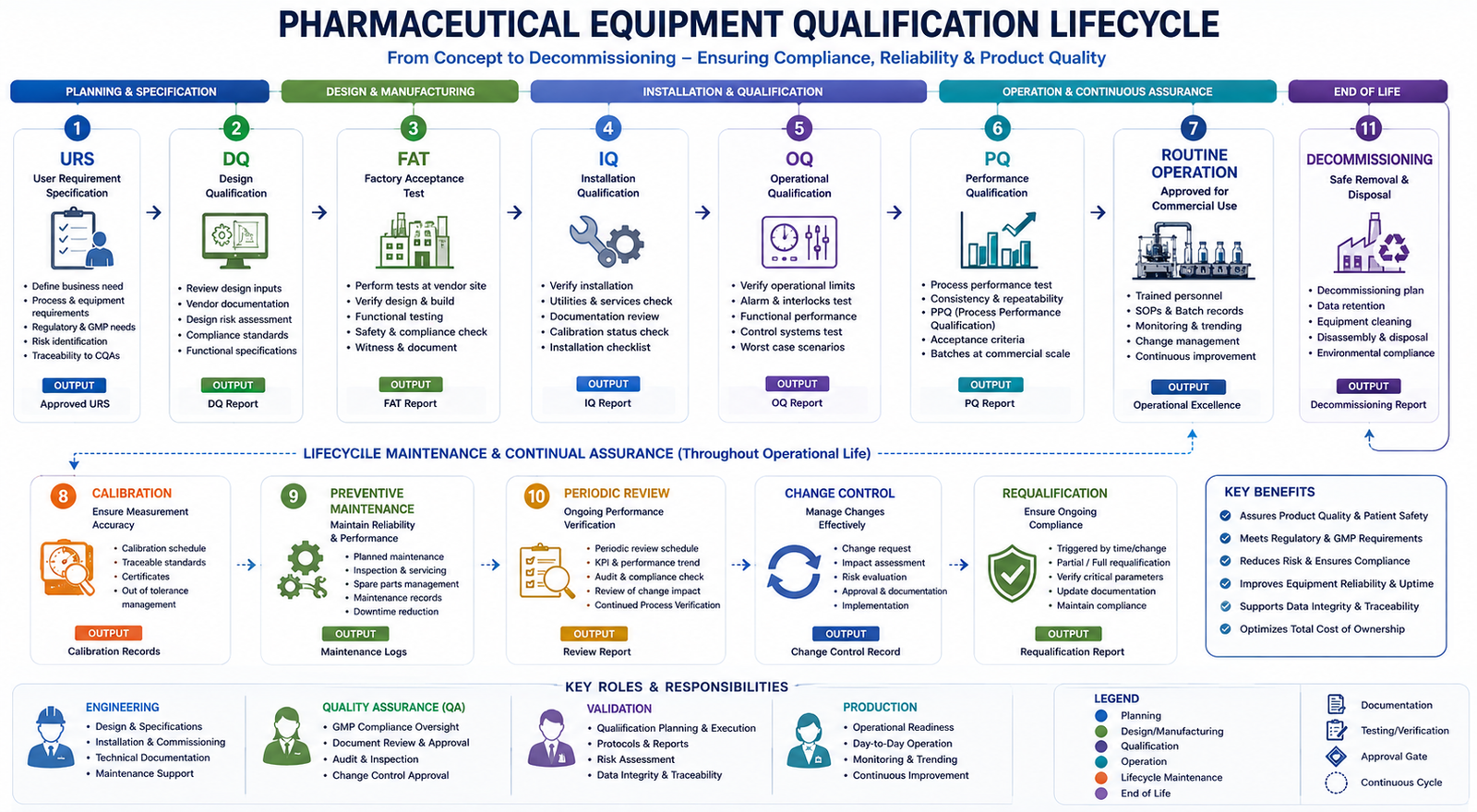
In pharmaceutical manufacturing, purchasing state-of-the-art equipment is only the beginning. Before equipment can be used for commercial production, it must be qualified and validated to demonstrate that it is suitable for its intended purpose and capable of consistently producing products that meet predefined quality attributes.
Regulatory authorities such as the US FDA, EMA, MHRA, WHO, PIC/S, and ICH expect pharmaceutical manufacturers to establish documented evidence that manufacturing equipment is properly designed, installed, operated, and performs consistently under routine production conditions.
Equipment qualification is not a one-time activity but a lifecycle approach that begins with defining user requirements and continues through installation, operation, maintenance, calibration, periodic review, change control, requalification, and eventual decommissioning.
This chapter explains the principles, stages, documentation, and best practices for equipment qualification and validation in pharmaceutical manufacturing.
What Is Equipment Qualification?
Equipment Qualification is the documented process of demonstrating that equipment is:
- Properly designed.
- Correctly installed.
- Operates according to predefined specifications.
- Performs consistently under actual manufacturing conditions.
- Suitable for its intended pharmaceutical application.
The objective is to ensure that equipment consistently supports product quality, process reliability, and regulatory compliance.
Qualification vs Validation
Although often used interchangeably, qualification and validation have distinct meanings.
| Qualification | Validation |
|---|---|
| Focuses on equipment, utilities, and facilities | Focuses on manufacturing processes |
| Demonstrates equipment fitness for intended use | Demonstrates consistent product quality |
| Includes DQ, IQ, OQ, PQ | Includes Process Validation, Cleaning Validation, CSV |
| Engineering-led with QA oversight | Cross-functional, quality-driven |
Relationship: Qualified equipment provides the foundation for validated manufacturing processes.
Regulatory Expectations
Global regulatory agencies require documented evidence that equipment is qualified throughout its lifecycle.
Key references include:
- US FDA 21 CFR Parts 210 & 211
- EU GMP Volume 4
- WHO GMP Guidelines
- PIC/S GMP Guide
- ICH Q8, Q9, Q10
- ISPE Baseline Guides
- GAMP 5 (Second Edition)
- EU GMP Annex 11 (Computerized Systems)
- 21 CFR Part 11 (Electronic Records and Electronic Signatures)
Equipment Qualification Lifecycle
User Requirement Specification (URS)
          │
          ▼
Design Qualification (DQ)
          │
          ▼
Factory Acceptance Test (FAT)
          │
          ▼
Installation Qualification (IQ)
          │
          ▼
Operational Qualification (OQ)
          │
          ▼
Performance Qualification (PQ)
          │
          ▼
Routine Manufacturing
          │
          ▼
Calibration
          │
          ▼
Preventive Maintenance
          │
          ▼
Periodic Review
          │
          ▼
Change Control
          │
          ▼
Requalification
          │
          ▼
Retirement / Decommissioning
User Requirement Specification (URS)
The URS is the foundation of qualification. It defines what the equipment must achieve from the user’s perspective.
Typical URS Content
- Intended use
- Product type
- Batch size
- Capacity
- Utilities
- Material of construction
- Automation requirements
- GMP requirements
- Cleaning requirements
- Safety requirements
- Documentation
- Qualification requirements
- Spare parts
- Regulatory expectations
A well-prepared URS simplifies downstream qualification activities.
Design Qualification (DQ)
Objective
Design Qualification verifies that the proposed equipment design satisfies the URS and applicable GMP requirements before fabrication or procurement.
DQ Activities
- Review URS compliance.
- Assess equipment design.
- Verify material of construction.
- Review P&IDs and layouts.
- Assess cleanability.
- Review automation architecture.
- Verify instrumentation.
- Confirm safety features.
- Evaluate maintenance accessibility.
- Conduct design risk assessment.
Deliverables
- Approved DQ protocol
- Design review report
- Risk assessment
- DQ summary report
Factory Acceptance Test (FAT)
The FAT is performed at the supplier’s facility before shipment.
Objectives
- Verify mechanical integrity.
- Confirm functionality.
- Test PLC/HMI software.
- Verify alarms and interlocks.
- Check instrumentation.
- Review documentation.
- Identify defects before delivery.
FAT Checklist
- Equipment dimensions
- Mechanical operation
- Utilities
- Instrument calibration
- Recipe functionality
- Alarm testing
- Safety devices
- Data logging
- Software backup
Installation Qualification (IQ)
Objective
Installation Qualification verifies that the equipment has been installed according to approved engineering drawings, manufacturer recommendations, and GMP requirements.
IQ Verification
Equipment Identification
- Equipment ID
- Model number
- Serial number
- Manufacturer
Installation Verification
- Foundation
- Alignment
- Leveling
- Utilities
- Piping
- Electrical wiring
- Earthing
- Safety guards
Documentation Review
- Equipment manuals
- Drawings
- Spare parts list
- Calibration certificates
- Material certificates
- Welding records
Instrument Verification
- Pressure gauges
- Temperature sensors
- Flow meters
- Load cells
- PLC hardware
Operational Qualification (OQ)
Objective
Operational Qualification demonstrates that the equipment operates according to predetermined specifications throughout its operating range.
OQ Activities
- Start-up verification
- Shutdown verification
- Alarm testing
- Interlock verification
- Recipe testing
- Speed verification
- Temperature verification
- Pressure verification
- PLC functionality
- Emergency stop verification
- User access verification
- Audit trail verification
Typical OQ Tests
| Test | Purpose |
|---|---|
| Motor rotation | Correct direction |
| Alarm verification | Operator notification |
| Interlock testing | Equipment protection |
| Instrument calibration | Accuracy |
| Speed verification | Process control |
| HMI functionality | User interface |
Performance Qualification (PQ)
Objective
Performance Qualification demonstrates that the equipment consistently performs under actual production conditions using approved procedures and trained personnel.
PQ Includes
- Commercial batches
- Routine operating conditions
- Approved raw materials
- Qualified operators
- Standard operating procedures
- In-process testing
- Finished product testing
Typically, three consecutive successful commercial-scale batches are used to demonstrate consistent performance, although the exact approach should be justified based on risk and regulatory expectations.
Computer System Validation (CSV)
Modern pharmaceutical equipment increasingly includes computerized systems.
CSV ensures that software and electronic systems consistently perform as intended.
CSV Activities
- Software risk assessment
- Functional specification
- Configuration verification
- User access testing
- Audit trail testing
- Backup verification
- Disaster recovery testing
- Electronic signature verification
- Part 11 compliance testing
Calibration
Calibration ensures that measuring instruments remain accurate and traceable.
Instruments Requiring Calibration
- Pressure gauges
- Temperature transmitters
- Flow meters
- Weighing balances
- Load cells
- Differential pressure sensors
- Humidity sensors
- Tachometers
Calibration Frequency
Depends on:
- Manufacturer recommendations
- Regulatory requirements
- Equipment criticality
- Historical performance
- Risk assessment
Preventive Maintenance
Preventive maintenance reduces equipment failures and extends service life.
Typical Activities
- Lubrication
- Belt replacement
- Seal inspection
- Bearing replacement
- Alignment
- Cleaning
- Filter replacement
- Sensor inspection
- Motor servicing
Maintenance activities should be documented and linked to equipment history.
Periodic Review
Equipment performance should be reviewed regularly to confirm continued suitability.
Review Includes
- Calibration status
- Maintenance history
- Breakdown analysis
- Qualification deviations
- Product quality impact
- Change controls
- OEE trends
- Regulatory observations
Change Control
Any modification affecting qualified equipment must undergo formal change control.
Examples
- Software upgrades
- Component replacement
- New product introduction
- Utility modifications
- Sensor replacement
- Capacity upgrades
Each change should be assessed for its impact on qualification status and product quality.
Requalification
Requalification confirms that equipment remains fit for its intended use after significant changes or at predefined intervals.
Triggers
- Major maintenance
- Relocation
- Software updates
- Product change
- Utility changes
- Extended shutdown
- Regulatory requirements
Qualification Documentation
A complete qualification package typically includes:
- URS
- Risk Assessment
- DQ Protocol & Report
- FAT Protocol & Report
- SAT Report
- IQ Protocol & Report
- OQ Protocol & Report
- PQ Protocol & Report
- Calibration Certificates
- Maintenance Plan
- SOPs
- Training Records
- Deviations
- CAPAs
- Traceability Matrix
- Final Qualification Summary Report
Roles and Responsibilities
| Department | Responsibilities |
|---|---|
| Engineering | Installation, maintenance, IQ support |
| Validation | Qualification protocols and reports |
| QA | Review and approval |
| Production | Operational support, PQ execution |
| QC | Sampling and testing |
| IT | CSV and network integration |
| EHS | Safety assessment |
| Vendor | FAT support, documentation, training |
Equipment Qualification Checklist
Before equipment release, verify:
- Approved URS
- DQ completed
- FAT successfully executed
- SAT completed
- IQ approved
- OQ approved
- PQ successfully completed
- Calibration current
- Preventive maintenance established
- SOPs approved
- Operators trained
- Change controls closed
- QA approval obtained
Case Study: Qualification of a Fluid Bed Dryer
A pharmaceutical company installed a new Fluid Bed Dryer (FBD) for tablet granule drying.
Qualification Activities
- URS prepared and approved.
- DQ confirmed GMP-compliant design.
- FAT performed at the vendor’s facility.
- IQ verified utilities, installation, and documentation.
- OQ tested airflow, temperature control, alarms, and interlocks.
- PQ completed using three commercial-scale batches.
Results
| KPI | Outcome |
|---|---|
| Drying Uniformity | Passed |
| Moisture Content | Within Specification |
| Alarm Functionality | Passed |
| Temperature Distribution | Uniform |
| Calibration Compliance | 100% |
| Qualification Status | Approved |
The equipment was released for routine commercial production with no major deviations.
Best Practices
- Develop a detailed URS before procurement.
- Apply a risk-based qualification approach.
- Involve QA, Engineering, Production, and Validation from project initiation.
- Maintain complete and traceable documentation.
- Integrate qualification with lifecycle maintenance and calibration.
- Validate computerized systems alongside equipment.
- Use change control to protect the qualified state.
- Perform periodic reviews to ensure continued compliance.
- Train operators before equipment release.
- Retain qualification records for regulatory inspections.
Key Takeaways
- Equipment qualification provides documented evidence that equipment is fit for its intended pharmaceutical use.
- The qualification lifecycle includes URS, DQ, FAT, IQ, OQ, PQ, calibration, maintenance, periodic review, change control, and requalification.
- Qualification supports GMP compliance, process reliability, and product quality.
- Computerized systems require additional validation to meet data integrity and regulatory expectations.
- Lifecycle management is essential to maintaining equipment in a qualified state throughout its operational life.
Conclusion
Equipment qualification and validation are fundamental to pharmaceutical manufacturing excellence. They ensure that equipment not only meets technical specifications but also consistently delivers reliable performance under routine production conditions. A structured, lifecycle-based qualification program minimizes risks, supports regulatory compliance, and safeguards product quality and patient safety.
As pharmaceutical manufacturing continues to evolve with automation, digitalization, and AI-enabled systems, qualification strategies must also advance to encompass software validation, cybersecurity, and intelligent equipment management. Organizations that embed qualification into every stage of the equipment lifecycle will be well positioned to meet future regulatory expectations and achieve sustainable operational excellence.
Chapter 7: Current Scenario of Pharmaceutical Manufacturing Equipment (2026)
How Smart Technologies, Automation, and Digital Transformation Are Reshaping Pharmaceutical Manufacturing
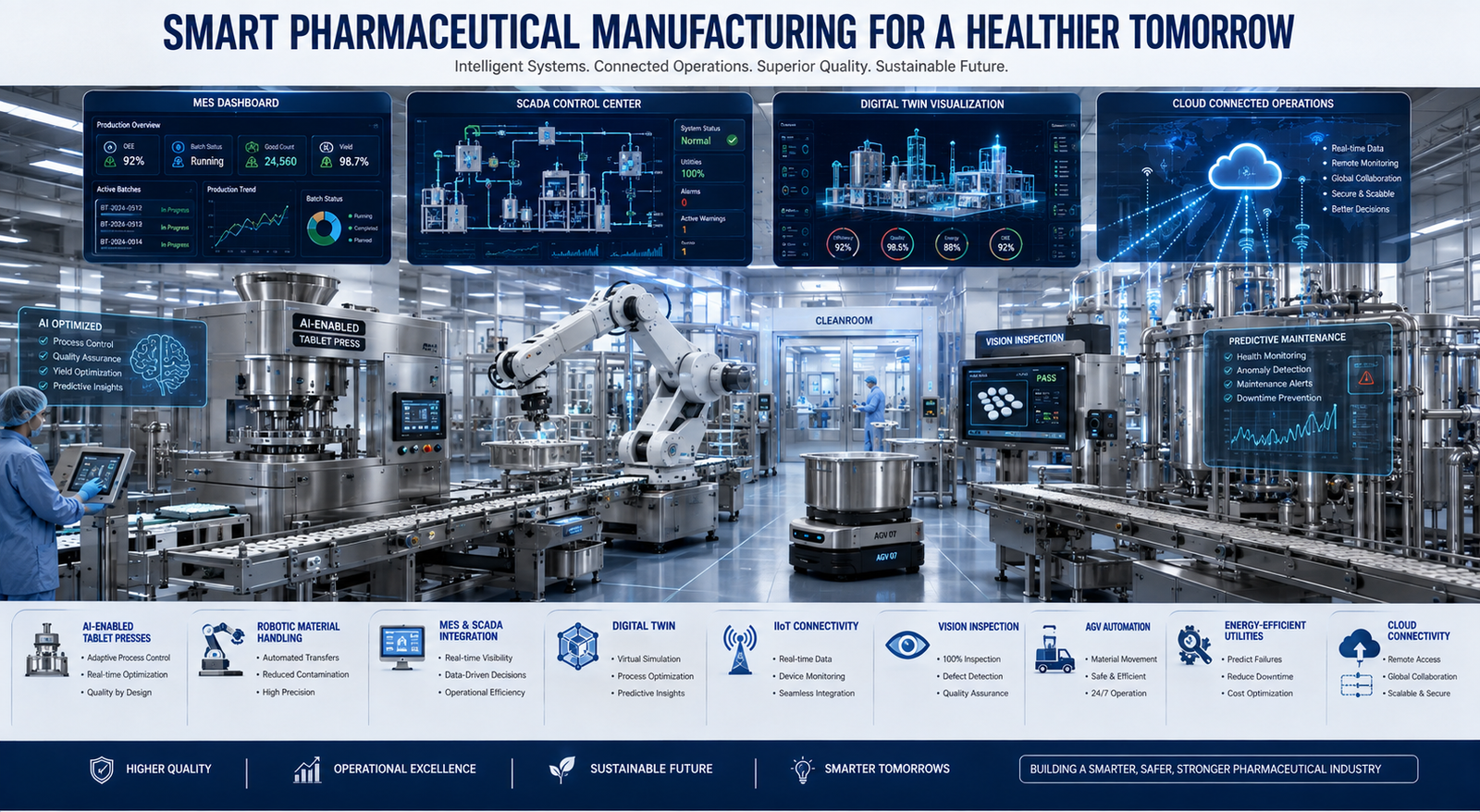
Introduction
The pharmaceutical manufacturing industry in 2026 is experiencing one of the most significant technological transformations in its history. Increasing regulatory expectations, growing demand for high-quality medicines, supply chain resilience initiatives, and rapid advances in digital technologies are driving organizations to modernize their manufacturing facilities.
Today’s pharmaceutical manufacturing equipment is no longer limited to mechanical operations. Modern production systems are intelligent, connected, automated, and data-driven, integrating Artificial Intelligence (AI), Machine Learning (ML), Industrial Internet of Things (IIoT), Robotics, Manufacturing Execution Systems (MES), Digital Twins, Advanced Process Control (APC), and cloud-based analytics.
These technologies are enabling pharmaceutical manufacturers to improve Overall Equipment Effectiveness (OEE), product quality, data integrity, predictive maintenance, sustainability, and regulatory compliance, while reducing operational costs and accelerating time to market.
This chapter examines the current state of pharmaceutical manufacturing equipment in 2026, highlighting the latest technologies, industry trends, challenges, and opportunities shaping the future of pharmaceutical manufacturing.
Global Pharmaceutical Manufacturing Landscape (2026)
The pharmaceutical sector continues to evolve in response to technological innovation, regulatory requirements, and market demand.
Key Drivers
- Increased global demand for medicines
- Expansion of biologics and personalized therapies
- Growth in contract manufacturing (CDMOs)
- Digital transformation initiatives
- Regulatory emphasis on data integrity
- Sustainability and ESG commitments
- Workforce shortages driving automation
- Supply chain diversification and resilience
Modern manufacturing facilities are increasingly designed as smart factories, where equipment, utilities, and enterprise systems communicate seamlessly in real time.
Major Trends in Pharmaceutical Manufacturing Equipment (2026)
| Trend | Industry Impact |
|---|---|
| Smart Manufacturing | Higher productivity and process visibility |
| AI & Machine Learning | Predictive quality and maintenance |
| Robotics | Reduced manual intervention |
| Digital Twins | Virtual simulation and optimization |
| Continuous Manufacturing | Faster production and lower waste |
| Advanced Process Control | Improved process consistency |
| Vision Inspection | Enhanced product quality |
| Cloud Analytics | Centralized performance monitoring |
| Sustainability | Lower energy and resource consumption |
| Modular Manufacturing | Faster facility deployment |
1. Automation
Automation remains one of the strongest drivers of pharmaceutical manufacturing modernization.
Current Applications
- Automated dispensing systems
- Robotic granulation loading
- Automated tablet compression
- Automated capsule filling
- Robotic packaging
- Automatic palletizing
- Automated sampling
- Electronic batch recording
Benefits
- Reduced human error
- Increased productivity
- Better repeatability
- Improved GMP compliance
- Reduced contamination risk
2. Robotics
Industrial robots have become commonplace in pharmaceutical facilities, particularly in repetitive and high-precision tasks.
Typical Applications
- Material transfer
- Packaging
- Palletizing
- Visual inspection
- Sampling
- Laboratory automation
- Sterile manufacturing
- Warehouse automation
Collaborative Robots (Cobots)
Cobots work safely alongside operators without extensive safety barriers.
Typical tasks include:
- Product loading
- Carton handling
- Label application
- Small component assembly
- IPC sample transport
3. Isolators and Restricted Access Barrier Systems (RABS)
Contamination control remains a major focus in pharmaceutical manufacturing.
Isolators
Provide a sealed environment for aseptic processing, minimizing operator intervention.
Advantages
- Superior contamination control
- Reduced cleanroom classification requirements
- Lower microbial risk
- Enhanced operator protection
RABS
Restricted Access Barrier Systems provide physical separation between operators and critical manufacturing areas.
Widely used in:
- Sterile filling
- Aseptic processing
- Vaccine manufacturing
4. Continuous Manufacturing
Traditional batch manufacturing is gradually being complemented by continuous manufacturing technologies.
Benefits
- Reduced manufacturing time
- Lower inventory
- Improved process control
- Smaller equipment footprint
- Real-Time Release Testing (RTRT)
- Reduced waste
Equipment Involved
- Continuous feeders
- Continuous granulators
- Twin-screw extruders
- Continuous dryers
- Continuous tablet presses
5. Process Analytical Technology (PAT)
PAT enables real-time monitoring and control of manufacturing processes.
Common PAT Tools
- Near Infrared (NIR) Spectroscopy
- Raman Spectroscopy
- Particle Size Analyzers
- Moisture Sensors
- Blend Uniformity Monitoring
- In-line Weight Monitoring
Advantages
- Real-time quality assurance
- Reduced sampling
- Faster batch release
- Improved process understanding
6. Quality by Design (QbD)
Modern equipment increasingly supports QbD principles by enabling robust process control.
Equipment Features
- Recipe management
- Automatic parameter control
- Data trending
- Process capability analysis
- Statistical Process Control (SPC)
7. Digital Batch Records (DBR)
Paper-based batch documentation is rapidly being replaced by electronic systems.
Advantages
- Reduced documentation errors
- Faster review
- Improved traceability
- Electronic signatures
- Audit trail functionality
- Enhanced compliance with 21 CFR Part 11
8. Electronic Logbooks
Electronic logbooks replace manual equipment logbooks.
Features
- Equipment usage history
- Cleaning records
- Calibration status
- Maintenance records
- Electronic approvals
- Automatic reminders
9. Artificial Intelligence (AI)
AI has become a transformative technology across pharmaceutical manufacturing.
Current Applications
- Predictive maintenance
- Equipment health monitoring
- Vision inspection
- Process optimization
- Root cause analysis
- Energy optimization
- Production scheduling
- Quality prediction
Example
AI algorithms analyze historical compression data to optimize tablet weight and hardness while minimizing rejects.
10. Machine Learning (ML)
ML algorithms continuously improve process performance by learning from historical manufacturing data.
Applications
- Failure prediction
- Process optimization
- Yield prediction
- Anomaly detection
- Energy management
11. Industrial Internet of Things (IIoT)
IIoT connects equipment, sensors, and enterprise systems for real-time data exchange.
Connected Equipment
- Tablet presses
- Granulators
- FBDs
- HVAC systems
- Water systems
- Compressors
- Packaging lines
Benefits
- Remote monitoring
- Predictive maintenance
- Asset tracking
- Real-time dashboards
- Improved OEE
12. Digital Twins
A Digital Twin is a dynamic virtual model of physical equipment or an entire manufacturing process.
Applications
- Virtual commissioning
- Process simulation
- Maintenance planning
- Operator training
- Failure prediction
Benefits
- Reduced downtime
- Faster optimization
- Lower validation risk
13. Smart Sensors
Modern pharmaceutical equipment incorporates intelligent sensors for continuous monitoring.
Sensor Types
- Temperature
- Pressure
- Flow
- Vibration
- Torque
- Humidity
- Particle count
- Energy consumption
14. Vision Inspection Systems
AI-enabled vision systems perform high-speed product inspection.
Detectable Defects
- Tablet chips
- Cracks
- Color variation
- Missing tablets
- Packaging defects
- Labeling errors
- Barcode verification
15. Predictive Maintenance
Rather than waiting for failures, predictive maintenance uses sensor data and AI to identify potential issues before breakdowns occur.
Monitored Parameters
- Vibration
- Bearing temperature
- Motor current
- Lubrication condition
- Noise
- Cycle counts
Benefits
- Reduced downtime
- Lower maintenance costs
- Increased equipment availability
16. Cloud Manufacturing
Cloud-based platforms enable centralized monitoring across multiple manufacturing sites.
Benefits
- Global production visibility
- Centralized reporting
- Remote diagnostics
- Faster decision-making
- Standardized KPIs
17. Manufacturing Execution System (MES)
MES has become the operational backbone of modern pharmaceutical manufacturing.
Functions
- Production scheduling
- Electronic Batch Records
- Recipe management
- Material traceability
- Equipment utilization
- OEE monitoring
- Performance dashboards
18. Laboratory Information Management System (LIMS)
LIMS integrates laboratory testing with manufacturing operations.
Advantages
- Sample tracking
- Electronic results
- Instrument integration
- Regulatory compliance
- Data integrity
19. Electronic Quality Management System (eQMS)
Modern eQMS platforms integrate quality processes across the enterprise.
Modules
- Deviations
- CAPA
- Change Control
- Training
- Complaints
- Audit Management
- Document Control
20. Serialization and Track & Trace
Serialization is now a standard requirement in many markets.
Equipment Includes
- Vision systems
- Barcode printers
- Label inspection cameras
- Aggregation systems
Benefits
- Counterfeit prevention
- Supply chain transparency
- Regulatory compliance
- Product recall management
21. Sustainability and Green Manufacturing
Environmental sustainability is a strategic priority in 2026.
Equipment Innovations
- Variable Frequency Drives (VFDs)
- Heat recovery systems
- Energy-efficient motors
- Water recycling systems
- Smart HVAC controls
- Low-emission boilers
Benefits
- Reduced carbon footprint
- Lower operating costs
- Improved ESG performance
22. Single-Use Technologies
Single-use equipment is increasingly adopted for biologics and specialized manufacturing.
Advantages
- Reduced cleaning validation
- Faster product changeover
- Lower contamination risk
- Flexible manufacturing
23. Modular Manufacturing
Modular equipment enables faster facility construction and expansion.
Features
- Prefabricated modules
- Standardized interfaces
- Faster qualification
- Scalability
- Reduced project timelines
Current Challenges
Despite technological progress, manufacturers continue to face:
- High capital investment.
- Cybersecurity threats.
- Data integrity expectations.
- Legacy equipment integration.
- Skilled workforce shortages.
- Validation complexity.
- Spare parts availability.
- Regulatory changes.
- Rising energy costs.
- Supply chain disruptions.
Current Scenario in India
India remains one of the world’s leading pharmaceutical manufacturing hubs, supported by a strong base of generic drug manufacturers, contract development and manufacturing organizations (CDMOs), and pharmaceutical machinery suppliers.
Key Trends
- Increased adoption of automated OSD manufacturing lines
- Expansion of continuous manufacturing pilots
- Greater use of MES, SCADA, and Electronic Batch Records
- Growth in AI-enabled vision inspection and predictive maintenance
- Investment in energy-efficient HVAC, water systems, and utilities
- Rising demand for equipment compliant with US FDA, EU GMP, WHO GMP, and PIC/S expectations
- Increased focus on serialization, data integrity, and cybersecurity
Case Study: Digital Transformation of an OSD Facility
A large oral solid dosage manufacturing site upgraded its production operations using:
- MES
- SCADA
- AI-enabled tablet compression
- Digital Batch Records
- Predictive maintenance platform
- Vision inspection
- Smart sensors
- Energy monitoring
Results
| KPI | Before | After |
|---|---|---|
| OEE | 79% | 92% |
| Equipment Downtime | 10% | 4% |
| Batch Documentation Errors | 20/month | 2/month |
| Product Rejections | 2.5% | 0.7% |
| Energy Consumption | Baseline | 16% Reduction |
| Maintenance Cost | Baseline | 18% Reduction |
| Batch Release Time | 5 days | 2 days |
Best Practices
- Invest in digital-ready equipment.
- Integrate PLC, SCADA, and MES from project inception.
- Adopt predictive maintenance programs.
- Use PAT for real-time process monitoring.
- Strengthen cybersecurity for connected equipment.
- Train personnel in AI, automation, and digital systems.
- Incorporate sustainability metrics into equipment selection.
- Implement lifecycle management for all critical assets.
- Review equipment performance using OEE and other KPIs.
- Continuously assess emerging technologies for future upgrades.
Key Takeaways
- Pharmaceutical manufacturing equipment in 2026 is increasingly intelligent, connected, and automated.
- AI, robotics, IIoT, Digital Twins, and predictive maintenance are transforming production efficiency and quality.
- MES, LIMS, eQMS, and Electronic Batch Records improve traceability, compliance, and data integrity.
- Sustainability, serialization, and cybersecurity are now integral considerations in equipment strategy.
- Manufacturers that embrace digital transformation are better positioned to meet regulatory expectations, improve operational performance, and remain competitive.
Conclusion
The pharmaceutical manufacturing landscape in 2026 reflects a decisive shift from traditional automation toward smart, data-driven manufacturing ecosystems. Equipment is no longer viewed simply as machinery but as a connected source of operational intelligence that supports quality, compliance, and continuous improvement.
Organizations investing in AI-enabled equipment, digital integration, predictive maintenance, and sustainable technologies are achieving measurable gains in productivity, regulatory readiness, and business resilience. As the industry moves toward autonomous manufacturing and Industry 5.0, today’s investments in modern equipment and digital infrastructure will form the foundation for the pharmaceutical factories of the future.
Chapter 8: Latest Developments in Pharmaceutical Manufacturing Equipment
Emerging Technologies Transforming Pharmaceutical Manufacturing in 2026 and Beyond
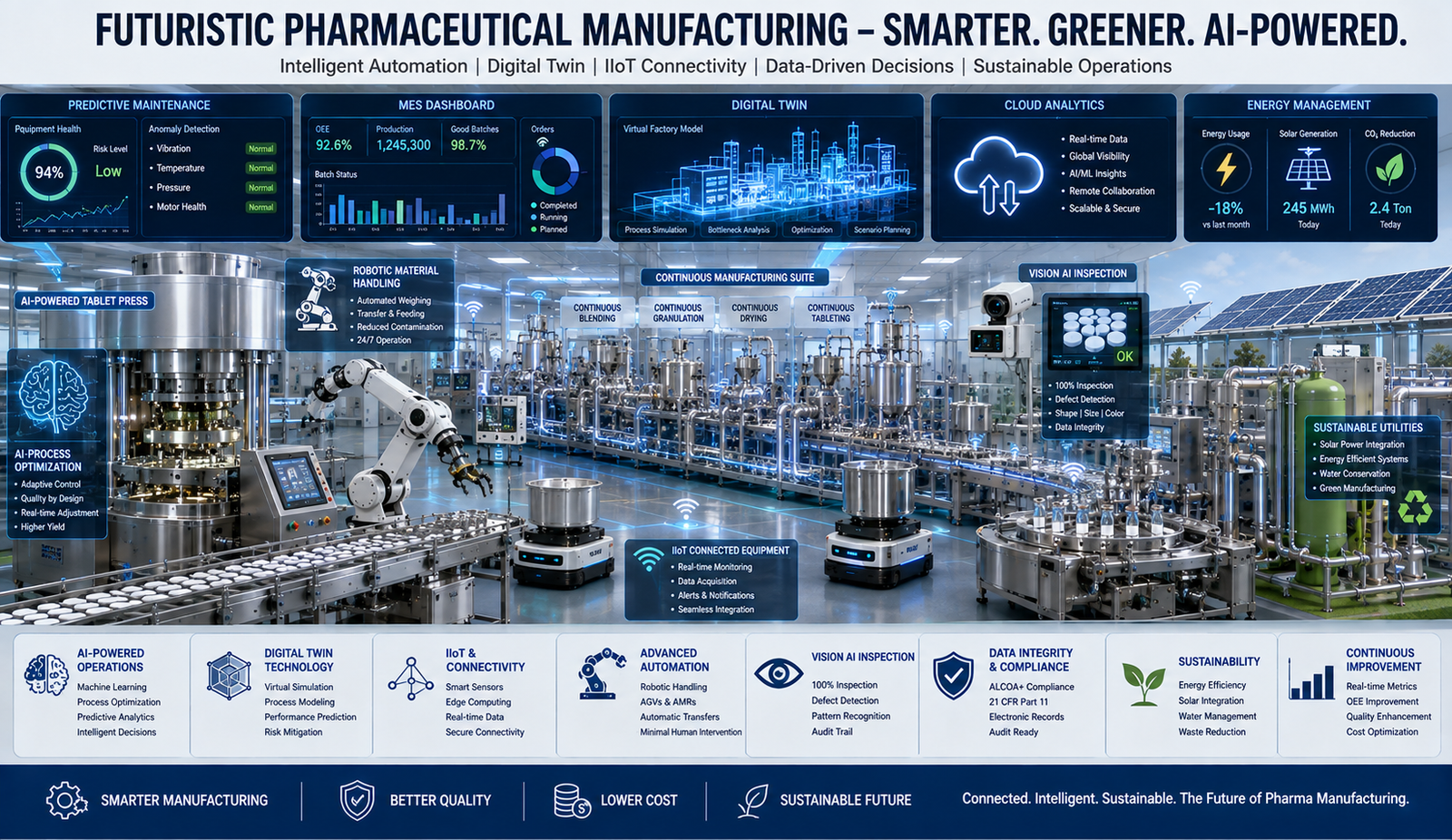
Introduction
The pharmaceutical manufacturing industry is undergoing a technological revolution unlike any seen before. Traditional manufacturing equipment, once focused primarily on mechanical performance and automation, is now evolving into intelligent, connected, autonomous, and self-optimizing systems.
The convergence of Artificial Intelligence (AI), Machine Learning (ML), Industrial Internet of Things (IIoT), robotics, cloud computing, edge computing, digital twins, advanced analytics, and continuous manufacturing is redefining how pharmaceutical products are manufactured, monitored, and released.
These technological developments are enabling manufacturers to improve:
- Product Quality
- Patient Safety
- Process Reliability
- Operational Efficiency
- Regulatory Compliance
- Sustainability
- Manufacturing Flexibility
- Predictive Maintenance
- Data Integrity
- Supply Chain Visibility
This chapter explores the latest innovations in pharmaceutical manufacturing equipment and how they are shaping the future of the pharmaceutical industry.
Technology Evolution
Traditional Equipment
        │
        ▼
PLC Automation
        │
        ▼
SCADA Integration
        │
        ▼
MES Connectivity
        │
        ▼
Industrial IoT
        │
        ▼
Artificial Intelligence
        │
        ▼
Digital Twins
        │
        ▼
Autonomous Manufacturing
1. AI-Driven Tablet Compression Machines
Modern tablet presses are no longer limited to maintaining compression force and turret speed. They are increasingly equipped with AI algorithms that monitor and optimize production in real time.
Features
- Automatic weight correction
- AI-based compression optimization
- Punch wear prediction
- Automatic rejection analysis
- Real-time trend monitoring
- Predictive maintenance alerts
Benefits
- Reduced tablet rejection
- Higher OEE
- Improved content uniformity
- Reduced operator intervention
- Consistent tablet hardness
Practical Example
An AI-enabled tablet press can detect a gradual increase in tablet weight variation caused by punch wear and recommend maintenance before the product falls outside specification.
2. Smart Tablet Coating Systems
Traditional coating relied heavily on operator experience. Today’s coating systems incorporate intelligent automation.
Smart Features
- Automatic spray rate adjustment
- Exhaust air optimization
- Inlet temperature control
- Moisture monitoring
- AI-based coating endpoint prediction
- Uniform film thickness analysis
Benefits
- Shorter coating cycles
- Lower coating defects
- Better color consistency
- Reduced solvent consumption
3. Autonomous Vision Inspection Systems
Vision inspection has evolved from simple image recognition to AI-powered defect analysis.
Detectable Defects
- Chips
- Cracks
- Broken tablets
- Color variations
- Surface contamination
- Foreign particles
- Printing defects
- Packaging damage
AI Advantages
Unlike conventional systems, AI continuously learns from historical inspection data, improving its ability to distinguish true defects from acceptable product variations.
4. Digital Twin Technology
A Digital Twin is a dynamic virtual model of physical equipment that continuously receives operational data from sensors.
Applications
- Equipment simulation
- Process optimization
- Predictive maintenance
- Virtual commissioning
- Operator training
- Failure analysis
Example
A digital twin of a Fluid Bed Dryer can simulate drying performance under different operating conditions and predict the impact of airflow or temperature changes before implementing them on the production line.
5. Pharmaceutical 3D Printing
Additive manufacturing is emerging as a valuable technology in pharmaceutical manufacturing.
Current Applications
- Personalized medicines
- Rapid prototyping
- Tooling components
- Customized dosing
- Clinical trial materials
Advantages
- Individualized therapy
- Reduced waste
- Faster product development
- Flexible manufacturing
6. Remote Equipment Monitoring
Manufacturers increasingly monitor production equipment remotely through secure cloud-based platforms.
Monitored Parameters
- Equipment status
- Alarm history
- Energy consumption
- Production output
- Downtime
- OEE
- Maintenance alerts
Benefits
- Faster troubleshooting
- Centralized oversight
- Reduced travel
- Improved response times
7. Edge Computing
Rather than sending all production data to centralized servers, edge computing processes information directly at the equipment level.
Benefits
- Faster decision-making
- Lower network traffic
- Reduced latency
- Improved cybersecurity
- Higher system reliability
Applications
- Real-time alarm processing
- Vision inspection
- AI inference at the machine level
- Equipment health monitoring
8. Industrial Internet of Things (IIoT)
IIoT has transformed isolated machines into interconnected manufacturing assets.
Connected Equipment
- Tablet presses
- Granulators
- Fluid Bed Dryers
- HVAC systems
- Water systems
- Packaging lines
- Utilities
Advantages
- Real-time data collection
- Predictive analytics
- Asset tracking
- Remote diagnostics
- Energy optimization
9. Wireless Smart Sensors
Modern pharmaceutical equipment now incorporates intelligent wireless sensors.
Common Sensors
- Temperature
- Pressure
- Vibration
- Humidity
- Torque
- Flow
- Energy
- Differential pressure
Benefits
- Reduced wiring
- Easier installation
- Improved monitoring
- Lower maintenance costs
10. Self-Calibrating Equipment
Emerging technologies are enabling instruments to automatically verify or assist calibration through built-in diagnostics and reference standards, reducing manual intervention where appropriate.
Advantages
- Reduced calibration downtime
- Higher measurement reliability
- Improved traceability
- Lower maintenance effort
Note: Even with advanced features, calibration strategies must remain aligned with GMP procedures and regulatory expectations.
11. Robotic Material Transfer
Automated Guided Vehicles (AGVs) and Autonomous Mobile Robots (AMRs) are replacing manual material movement.
Applications
- Raw material transfer
- Bin movement
- Pallet transport
- Warehouse automation
- Finished goods movement
Benefits
- Reduced contamination
- Improved safety
- Lower labor costs
- Increased efficiency
12. Automated Cleaning Validation
Cleaning validation has become increasingly digital.
Modern Features
- Online TOC monitoring
- Conductivity measurement
- Automated rinse sampling
- Electronic documentation
- AI trend analysis
Benefits
- Faster cleaning verification
- Improved compliance
- Reduced documentation effort
13. Real-Time Release Testing (RTRT)
RTRT allows products to be released based on continuous process monitoring rather than relying solely on end-product testing.
Enabled By
- PAT
- AI
- Advanced sensors
- Process modeling
- Statistical analysis
Benefits
- Faster batch release
- Reduced laboratory testing
- Lower inventory
- Better process understanding
14. PAT Integration
Modern manufacturing equipment increasingly integrates Process Analytical Technology (PAT).
Common PAT Tools
- Near Infrared (NIR)
- Raman Spectroscopy
- Moisture sensors
- Particle size analyzers
- Blend uniformity monitoring
Advantages
- Continuous quality assurance
- Reduced sampling
- Better process control
- Increased manufacturing efficiency
15. Vision AI
Artificial Intelligence has significantly improved pharmaceutical vision inspection.
Capabilities
- Deep learning defect detection
- OCR verification
- Barcode validation
- Label inspection
- Foreign particle detection
- Packaging verification
16. Collaborative Robots (Cobots)
Cobots are designed to safely work alongside human operators.
Common Tasks
- Sample collection
- Packaging
- Material loading
- Label placement
- Component assembly
Benefits
- Flexible automation
- Improved ergonomics
- Reduced repetitive work
- Enhanced productivity
17. Advanced Process Control (APC)
APC continuously adjusts manufacturing parameters to maintain optimal process conditions.
Controlled Parameters
- Compression force
- Blend uniformity
- Drying temperature
- Spray rate
- Airflow
- Feed rate
Benefits
- Reduced variability
- Higher yield
- Improved consistency
- Lower reject rates
18. Continuous Manufacturing Platforms
Continuous manufacturing systems integrate multiple unit operations into one uninterrupted process.
Equipment Includes
- Continuous feeders
- Twin-screw granulators
- Continuous dryers
- Continuous blenders
- Continuous tablet presses
- Continuous coaters
Benefits
- Smaller footprint
- Lower inventory
- Reduced waste
- Higher productivity
- Faster product release
19. Digital Maintenance Platforms
Modern maintenance has become predictive rather than reactive.
Features
- Equipment health dashboards
- AI failure prediction
- Spare parts optimization
- Mobile maintenance applications
- Digital work orders
Benefits
- Reduced downtime
- Higher equipment availability
- Better maintenance planning
20. Sustainable Equipment Design
Equipment manufacturers are focusing on environmentally responsible technologies.
Innovations
- High-efficiency motors
- Variable Frequency Drives (VFDs)
- Heat recovery systems
- Water recycling
- Low-emission systems
- Eco-friendly refrigerants
- Energy monitoring dashboards
Business Benefits
- Lower operating costs
- Reduced carbon emissions
- Improved ESG performance
- Regulatory alignment
Emerging Technologies Expected by 2030
The next generation of pharmaceutical manufacturing equipment is expected to include:
- AI-assisted autonomous process control
- Humanoid maintenance assistants
- Self-optimizing production lines
- Blockchain-enabled equipment records
- Quantum-enhanced optimization (early-stage research)
- AI-generated maintenance procedures
- Fully digital validation documentation
- Autonomous quality decision support
- Industry 5.0 collaborative manufacturing
- Carbon-neutral manufacturing equipment
Technology Comparison
| Technology | Primary Benefit | GMP Impact |
|---|---|---|
| AI | Process optimization | High |
| Digital Twin | Simulation | High |
| IIoT | Connectivity | High |
| Edge Computing | Fast analytics | Medium |
| Vision AI | Inspection | High |
| Cobots | Flexible automation | Medium |
| RTRT | Faster release | High |
| APC | Process consistency | High |
| AGVs/AMRs | Material handling | Medium |
| Smart Sensors | Continuous monitoring | High |
Case Study: AI-Enabled OSD Manufacturing Line
A pharmaceutical manufacturer modernized its Oral Solid Dosage (OSD) production line by implementing:
- AI-enabled tablet press
- Digital Twin of the granulation process
- IIoT-connected utilities
- Vision AI inspection
- AGV-based material handling
- Predictive maintenance software
- MES integration
Results After 18 Months
| KPI | Before | After |
|---|---|---|
| OEE | 80% | 94% |
| Equipment Downtime | 9% | 3% |
| Batch Rejections | 2.3% | 0.5% |
| Energy Consumption | Baseline | 17% Reduction |
| Product Changeover | 2.8 hrs | 1.4 hrs |
| Maintenance Cost | Baseline | 20% Reduction |
| Batch Release Time | 4 Days | 1.5 Days |
Best Practices for Adopting New Equipment Technologies
- Align technology investments with business and regulatory objectives.
- Perform risk assessments before implementation.
- Validate AI-enabled and computerized systems appropriately.
- Ensure cybersecurity measures are incorporated into connected equipment.
- Train operators, engineers, and maintenance teams on new technologies.
- Integrate equipment with MES, SCADA, and eQMS where practical.
- Monitor performance using KPIs such as OEE, MTBF, and MTTR.
- Adopt a phased implementation strategy for complex technologies.
- Continuously review emerging innovations for future competitiveness.
- Maintain complete documentation to support inspections and audits.
Key Takeaways
- Pharmaceutical manufacturing equipment is evolving from automated machines to intelligent, connected, and adaptive systems.
- AI, Digital Twins, IIoT, Vision AI, APC, and continuous manufacturing are among the most influential innovations in 2026.
- Predictive maintenance, remote monitoring, and digital validation are improving equipment reliability and regulatory readiness.
- Sustainability, energy efficiency, and modular design are becoming key purchasing considerations.
- Organizations that embrace these technologies can enhance product quality, operational excellence, and long-term competitiveness.
Conclusion
The latest developments in pharmaceutical manufacturing equipment are redefining the industry’s approach to quality, efficiency, and compliance. Advances in AI, robotics, digital connectivity, and advanced process control are enabling smarter manufacturing systems that are more responsive, data-driven, and resilient than ever before.
While successful adoption requires careful planning, qualification, cybersecurity, and workforce development, these technologies offer significant opportunities to reduce variability, improve patient safety, and accelerate innovation. As the industry progresses toward Pharma 4.0 and Industry 5.0, modern equipment will increasingly function as intelligent partners in pharmaceutical manufacturing rather than simply automated machines.
Chapter 9: Future Expectations of Pharmaceutical Manufacturing Equipment (2030–2040)
The Future of Intelligent, Autonomous, and Sustainable Pharmaceutical Manufacturing
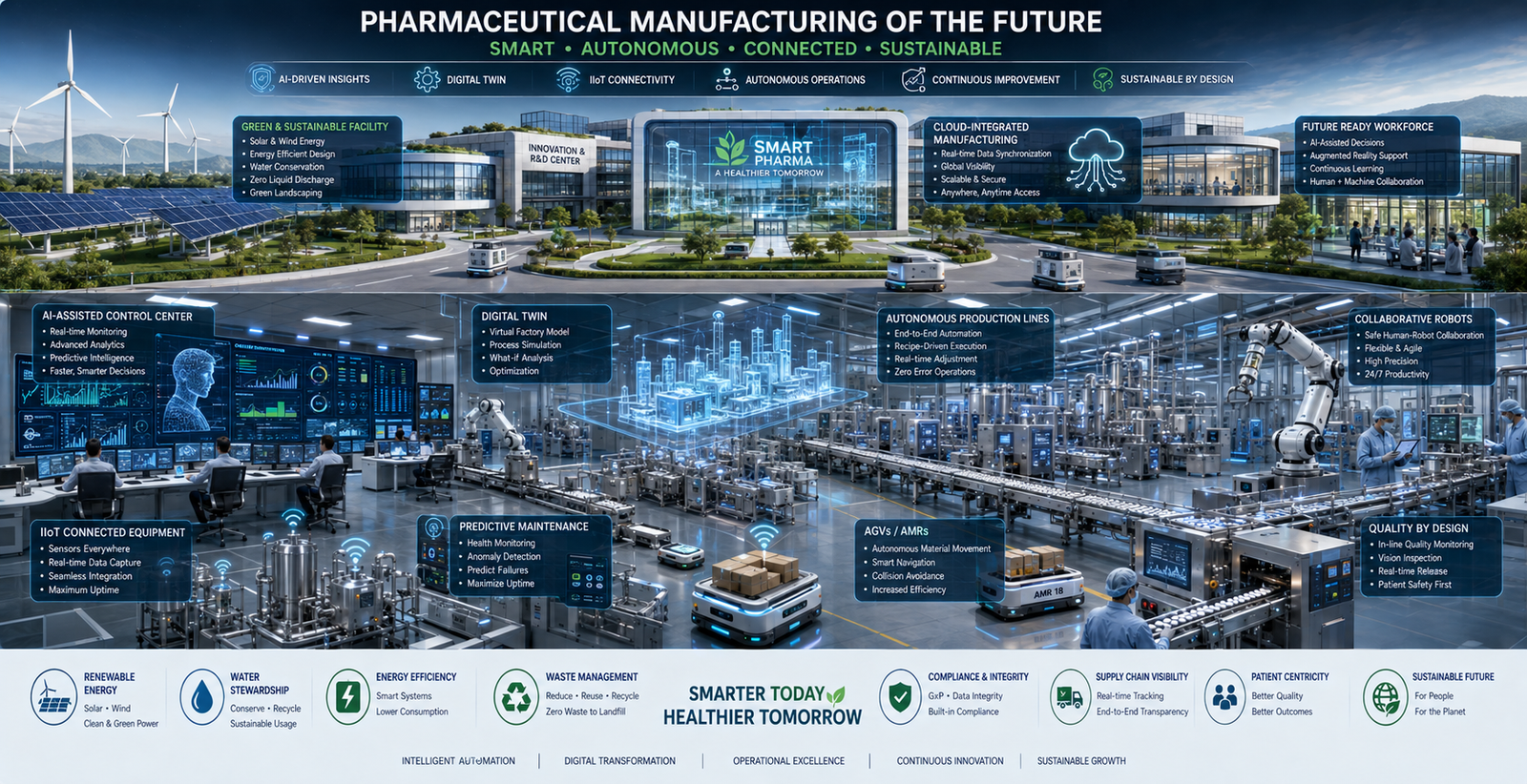
Introduction
The pharmaceutical industry is entering a transformative era where manufacturing equipment will evolve far beyond automation. Between 2030 and 2040, pharmaceutical facilities are expected to become highly intelligent, autonomous, interconnected, and sustainable, driven by advancements in Artificial Intelligence (AI), Industry 5.0, robotics, digital twins, advanced analytics, cloud computing, quantum technologies, and next-generation process control.
Future pharmaceutical manufacturing equipment will not only perform production tasks but also analyze data, predict failures, optimize processes, make operational recommendations, and increasingly execute routine decisions within validated boundaries. Human roles will shift from direct machine operation toward supervision, exception management, strategic planning, and continuous improvement.
This chapter explores the future expectations for pharmaceutical manufacturing equipment, emerging technologies, and the opportunities and challenges that organizations should prepare for over the next decade.
Future Evolution of Pharmaceutical Manufacturing
Traditional Manufacturing
          │
          ▼
Automation
          │
          ▼
Digital Manufacturing
          │
          ▼
Smart Manufacturing
          │
          ▼
AI-Assisted Manufacturing
          │
          ▼
Autonomous Manufacturing
          │
          ▼
Industry 5.0
          │
          ▼
Self-Optimizing Pharmaceutical Plants
Key Drivers of Future Transformation
Several factors will continue to accelerate innovation in pharmaceutical manufacturing equipment.
Primary Drivers
- Increasing regulatory expectations
- Growing demand for personalized medicines
- Expansion of biologics and advanced therapies
- Labor shortages and aging workforce
- Artificial Intelligence maturity
- Sustainable manufacturing goals
- Carbon neutrality commitments
- Supply chain resilience
- Digital transformation initiatives
- Faster product development cycles
1. Autonomous Pharmaceutical Manufacturing Plants
Future pharmaceutical plants are expected to operate with significantly higher levels of autonomy, where integrated equipment continuously communicates and coordinates production activities.
Expected Characteristics
- Minimal manual intervention
- Automatic process optimization
- Intelligent scheduling
- Autonomous material movement
- Continuous quality monitoring
- Self-diagnosing equipment
- Predictive maintenance
- Automated documentation
Benefits
- Higher productivity
- Improved product consistency
- Reduced operational costs
- Enhanced regulatory compliance
- Faster production cycles
2. AI Operators
Artificial Intelligence will increasingly function as a digital operational assistant, supporting human teams by analyzing large volumes of manufacturing data.
Potential Capabilities
- Recommend process adjustments
- Detect abnormal equipment behavior
- Support deviation investigations
- Prioritize maintenance activities
- Analyze production trends
- Forecast equipment failures
- Optimize production schedules
Important: Decisions affecting product quality or patient safety are expected to remain under appropriate human oversight unless future regulatory frameworks explicitly permit greater autonomy.
3. Lights-Out Manufacturing
Lights-out manufacturing refers to highly automated facilities capable of operating for extended periods with minimal on-site human intervention.
Suitable Operations
- Tablet compression
- Packaging
- Material transport
- Warehouse management
- Environmental monitoring
Advantages
- Continuous production
- Reduced labor dependency
- Lower operating costs
- Improved equipment utilization
Challenges
- Advanced cybersecurity
- Robust redundancy systems
- Reliable remote monitoring
- Regulatory acceptance
4. Digital Twin Plants
Future manufacturing facilities are expected to create digital twins not only for individual equipment but also for complete production lines and entire plants.
Applications
- Virtual process optimization
- Capacity planning
- Utility optimization
- Maintenance simulation
- Regulatory change impact analysis
- Operator training
Benefits
- Faster technology transfer
- Reduced validation effort
- Better production planning
- Improved operational visibility
5. Self-Optimizing Equipment
Next-generation equipment is expected to continuously analyze operational performance and recommend or automatically implement approved optimization strategies.
Examples
- Tablet presses adjusting compression profiles within validated limits
- Coating systems optimizing spray parameters
- Dryers adapting airflow based on moisture trends
- Packaging lines balancing throughput to reduce bottlenecks
These optimizations must remain within validated operating ranges and change-control requirements.
6. Self-Learning Manufacturing Systems
Machine learning models will continue to improve process understanding by learning from historical production data.
Potential Applications
- Predictive yield improvement
- Energy optimization
- Equipment health prediction
- Process capability analysis
- Root cause identification
7. Blockchain Integration
Blockchain technology may support secure and immutable records across manufacturing and supply chains.
Possible Applications
- Equipment maintenance records
- Calibration history
- Qualification documentation
- Supply chain traceability
- Serialization data
- Audit trail protection
Potential Benefits
- Improved transparency
- Enhanced traceability
- Stronger data integrity
- Simplified audits
8. Real-Time Release Testing (RTRT)
RTRT adoption is expected to expand as Process Analytical Technology (PAT), AI, and advanced process models mature.
Future Benefits
- Reduced laboratory testing
- Faster product release
- Improved process understanding
- Lower inventory costs
9. Zero Human Intervention (Vision)
Some highly repetitive manufacturing operations may approach near-autonomous execution.
Possible Areas
- Material transfer
- Packaging
- Warehousing
- Environmental monitoring
- Utility operation
However, complete elimination of human involvement across pharmaceutical manufacturing is unlikely in the foreseeable future due to regulatory oversight, scientific judgment, quality review, and continuous improvement responsibilities.
10. Smart Quality Systems
Future quality management systems will become increasingly integrated and predictive.
Expected Features
- AI-assisted deviation management
- Intelligent CAPA recommendations
- Automated trend analysis
- Digital audits
- Predictive risk assessments
- Dynamic quality dashboards
11. Generative AI in Pharmaceutical Manufacturing
Generative AI has the potential to enhance documentation, knowledge management, and decision support.
Potential Applications
- SOP drafting
- Qualification protocol preparation
- Risk assessment support
- Technical report generation
- Training material creation
- Equipment troubleshooting assistance
All AI-generated outputs should be reviewed and approved by qualified personnel before use in regulated activities.
12. Agentic AI
Agentic AI systems are designed to execute predefined workflows with limited human intervention while operating within established governance and validation controls.
Possible Applications
- Maintenance scheduling
- Spare parts ordering
- Utility optimization
- Alarm prioritization
- Batch documentation workflows
Organizations should implement appropriate governance, validation, and oversight before deploying such systems in GMP environments.
13. Industry 5.0
Industry 5.0 emphasizes collaboration between people and intelligent technologies rather than replacing human expertise.
Core Principles
- Human-centric manufacturing
- Sustainability
- Resilience
- AI-assisted decision-making
- Collaborative robotics
- Flexible production
Impact on Pharmaceutical Equipment
- Enhanced operator interfaces
- Personalized maintenance guidance
- Adaptive manufacturing workflows
- Increased flexibility for small-batch production
14. Sustainable Manufacturing
Environmental sustainability will continue to influence equipment design.
Future Innovations
- Net-zero energy equipment
- Water recycling systems
- Heat recovery technologies
- Low-emission utilities
- Green refrigerants
- High-efficiency motors
- Renewable energy integration
Expected Outcomes
- Lower carbon emissions
- Reduced operating costs
- Improved ESG performance
15. Carbon-Neutral Pharmaceutical Plants
Many organizations have announced long-term carbon reduction goals.
Future facilities may include:
- Solar energy systems
- Hydrogen-ready utilities
- Battery energy storage
- Smart energy management
- Carbon monitoring dashboards
- Low-carbon construction materials
16. Advanced Robotics
Future robotic systems are expected to become more adaptive and collaborative.
Future Applications
- Material handling
- Sampling
- Packaging
- Inspection
- Laboratory automation
- Warehouse logistics
Robots will increasingly integrate with AI-based scheduling and equipment management systems.
17. Intelligent Predictive Maintenance
Maintenance strategies will continue shifting from time-based schedules toward condition-based and predictive approaches.
Future Technologies
- AI analytics
- Vibration monitoring
- Thermal imaging
- Acoustic analysis
- Digital twins
- Equipment health scoring
18. Hyper-Connected Manufacturing
Equipment across manufacturing, laboratories, warehouses, and utilities will become increasingly interconnected.
Integrated Systems
- MES
- SCADA
- ERP
- LIMS
- eQMS
- Warehouse Management Systems (WMS)
- Supplier platforms
This integration will improve end-to-end visibility and decision-making.
19. Flexible and Modular Manufacturing
Future facilities will require greater agility.
Equipment Characteristics
- Modular skids
- Plug-and-play automation
- Rapid qualification approaches
- Flexible product changeovers
- Multi-product capability
Future Skills for Pharmaceutical Professionals
As manufacturing evolves, workforce competencies will also change.
Key Skills
- AI literacy
- Data analytics
- Digital validation
- Cybersecurity awareness
- Automation engineering
- Robotics maintenance
- PAT and process analytics
- Digital Twin interpretation
- Risk management
- Cross-functional collaboration
Future Challenges
Despite technological progress, several challenges remain.
Key Challenges
- High capital investment
- Cybersecurity threats
- Validation of AI-enabled systems
- Regulatory harmonization
- Data governance
- Workforce upskilling
- Ethical use of AI
- Legacy equipment integration
- Vendor dependency
- Change management
Case Study: Vision of a 2035 Smart OSD Manufacturing Facility
A pharmaceutical company designs a next-generation Oral Solid Dosage (OSD) facility with the following capabilities:
- AI-assisted tablet compression
- Continuous manufacturing modules
- Digital Twin of the production line
- Autonomous Mobile Robots (AMRs) for material transfer
- Predictive maintenance platform
- Integrated MES, SCADA, LIMS, and eQMS
- Energy optimization dashboard
- Real-Time Release Testing (RTRT)
Projected Operational Improvements
| KPI | Conventional Plant | Smart Plant (Projected) |
|---|---|---|
| OEE | 85% | 95% |
| Equipment Downtime | 7% | 2% |
| Product Rejections | 1.5% | 0.4% |
| Batch Release Time | 3 Days | Same Day |
| Energy Consumption | Baseline | 25% Lower |
| Maintenance Cost | Baseline | 30% Lower |
| Paper Documentation | Extensive | Minimal |
These values are illustrative projections and will vary depending on technology maturity, regulatory acceptance, and implementation quality.
Strategic Roadmap for Manufacturers
2026–2030
- Expand automation
- Deploy predictive maintenance
- Implement AI-assisted analytics
- Strengthen cybersecurity
- Improve data integrity
2030–2035
- Scale Digital Twins
- Adopt advanced robotics
- Expand continuous manufacturing
- Integrate enterprise-wide digital platforms
2035–2040
- Increase autonomous operations where appropriate
- Broaden AI-supported quality management
- Advance sustainable manufacturing
- Mature human-AI collaboration under Industry 5.0
Best Practices for Preparing Today
- Invest in digital-ready equipment.
- Standardize data collection and governance.
- Build multidisciplinary teams with engineering, IT, QA, and data science expertise.
- Validate computerized and AI-enabled systems using risk-based approaches.
- Develop comprehensive cybersecurity programs.
- Prioritize scalable, modular equipment.
- Continuously train employees on emerging technologies.
- Monitor evolving regulatory guidance on AI and digital manufacturing.
- Integrate sustainability into capital investment decisions.
- Maintain a lifecycle approach to equipment qualification and performance monitoring.
Key Takeaways
- Pharmaceutical manufacturing equipment is expected to become increasingly intelligent, connected, and autonomous over the next decade.
- AI, Digital Twins, robotics, Industry 5.0, and predictive analytics will significantly influence future equipment capabilities.
- Human expertise will remain essential for scientific judgment, governance, quality oversight, and regulatory compliance.
- Sustainability, flexibility, and cybersecurity will become central design considerations.
- Organizations that invest strategically in digital transformation and workforce development will be better positioned for long-term competitiveness.
Conclusion
The future of pharmaceutical manufacturing equipment lies in the convergence of intelligent automation, digital connectivity, sustainable engineering, and human expertise. Rather than replacing professionals, emerging technologies are expected to enhance their ability to make informed decisions, improve operational efficiency, and maintain the highest standards of product quality and patient safety.
Between 2030 and 2040, manufacturers that adopt a structured, risk-based approach to innovation—supported by strong validation, cybersecurity, and regulatory compliance—will be well positioned to lead the next generation of pharmaceutical manufacturing.
Chapter 10: Frequently Asked Questions (FAQs) About Pharmaceutical Manufacturing Equipment
The Complete FAQ Guide for GMP, Qualification, Validation, Automation, AI, and Modern Pharmaceutical Manufacturing
Introduction
Pharmaceutical manufacturing equipment is the foundation of modern medicine production. Whether you are a production engineer, validation specialist, quality assurance professional, maintenance engineer, regulatory auditor, or pharmaceutical student, understanding equipment selection, qualification, operation, maintenance, and emerging technologies is essential for achieving Good Manufacturing Practices (GMP) and ensuring patient safety.
This chapter answers the most commonly asked questions about pharmaceutical manufacturing equipment, covering equipment qualification, validation, automation, Artificial Intelligence (AI), Industry 4.0, Process Analytical Technology (PAT), Digital Twins, Overall Equipment Effectiveness (OEE), calibration, maintenance, and regulatory compliance.
Frequently Asked Questions
1. What is pharmaceutical manufacturing equipment?
Pharmaceutical manufacturing equipment consists of machines, utilities, and supporting systems used to manufacture, inspect, package, and store pharmaceutical products while ensuring product quality, patient safety, and compliance with regulatory requirements.
Examples include:
- Rapid Mixer Granulators (RMG)
- Fluid Bed Dryers (FBD)
- Tablet Compression Machines
- Capsule Filling Machines
- Coating Machines
- Blister Packing Machines
- HVAC Systems
- Purified Water (PW) Systems
- Water for Injection (WFI) Systems
2. Why is pharmaceutical manufacturing equipment important?
It ensures:
- Consistent product quality
- Accurate dosage
- GMP compliance
- Patient safety
- Efficient production
- Reduced contamination
- Product traceability
- Regulatory readiness
3. What are the major categories of pharmaceutical manufacturing equipment?
The main categories include:
- Processing Equipment
- Packaging Equipment
- Utility Systems
- Cleanroom Equipment
- Laboratory Equipment
- Inspection Systems
- Material Handling Equipment
- Automation Systems
- HVAC Systems
- Water Systems
- Clean Steam Systems
- Waste Management Systems
4. What is Equipment Qualification?
Equipment Qualification is the documented process that demonstrates equipment is properly designed, installed, operated, and performs consistently for its intended pharmaceutical use.
It includes:
- Design Qualification (DQ)
- Installation Qualification (IQ)
- Operational Qualification (OQ)
- Performance Qualification (PQ)
5. What is the difference between qualification and validation?
| Qualification | Validation |
|---|---|
| Applies to equipment, utilities, and facilities | Applies to manufacturing processes and supporting systems |
| Confirms equipment fitness for intended use | Confirms consistent production of quality products |
| Includes DQ, IQ, OQ, PQ | Includes Process Validation, Cleaning Validation, CSV |
6. What is Design Qualification (DQ)?
DQ verifies that the proposed equipment design satisfies the User Requirement Specification (URS), GMP principles, and applicable regulatory expectations before fabrication or purchase.
7. What is Installation Qualification (IQ)?
IQ verifies that equipment has been installed correctly according to approved engineering drawings, manufacturer recommendations, and qualification protocols.
8. What is Operational Qualification (OQ)?
OQ confirms that equipment operates correctly throughout its defined operating ranges, including alarms, interlocks, control systems, and instrumentation.
9. What is Performance Qualification (PQ)?
PQ demonstrates that qualified equipment consistently performs under routine manufacturing conditions using approved procedures, trained personnel, and representative production batches.
10. What is a User Requirement Specification (URS)?
The URS is a document that defines the operational, technical, quality, safety, automation, and regulatory requirements that equipment must satisfy.
11. What is Factory Acceptance Testing (FAT)?
FAT is conducted at the equipment manufacturer’s site before shipment to verify functionality, mechanical integrity, software operation, alarms, interlocks, and documentation.
12. What is Site Acceptance Testing (SAT)?
SAT is performed after installation to verify that the equipment functions correctly within the actual manufacturing facility and interfaces properly with site utilities and systems.
13. Why is preventive maintenance important?
Preventive maintenance:
- Reduces equipment failures
- Improves OEE
- Extends equipment life
- Reduces downtime
- Improves GMP compliance
- Lowers maintenance costs
14. What is calibration?
Calibration compares an instrument’s measurements against a traceable reference standard to confirm its accuracy and ensure reliable process control.
15. Which instruments require calibration?
Typical instruments include:
- Pressure gauges
- Temperature sensors
- Flow meters
- Load cells
- Weighing balances
- Humidity sensors
- Differential pressure transmitters
- Tachometers
16. What is Computer System Validation (CSV)?
CSV provides documented evidence that computerized systems consistently perform as intended and comply with applicable data integrity and electronic record requirements.
17. What is Overall Equipment Effectiveness (OEE)?
OEE is a key performance indicator used to measure manufacturing efficiency.
It is based on three components:
- Availability
- Performance
- Quality
A higher OEE generally indicates more effective utilization of manufacturing equipment.
18. What is Process Analytical Technology (PAT)?
PAT is a framework for designing, analyzing, and controlling manufacturing processes through timely measurements of critical quality and performance attributes.
Common PAT tools include:
- Near Infrared (NIR)
- Raman Spectroscopy
- Moisture analyzers
- Particle size analyzers
19. What is Continuous Manufacturing?
Continuous Manufacturing integrates multiple processing steps into a continuous production flow rather than relying solely on discrete batch operations.
Benefits include:
- Faster production
- Reduced waste
- Better process control
- Lower inventory
- Potential for Real-Time Release Testing (RTRT)
20. What is a Digital Twin?
A Digital Twin is a virtual representation of physical equipment or processes that uses operational data to support simulation, monitoring, optimization, and predictive maintenance.
21. How is Artificial Intelligence used in pharmaceutical manufacturing equipment?
AI supports:
- Predictive maintenance
- Process optimization
- Vision inspection
- Production scheduling
- Equipment health monitoring
- Trend analysis
- Root cause investigation
- Quality prediction
AI implementations should be governed by appropriate validation and quality oversight in regulated environments.
22. What are Collaborative Robots (Cobots)?
Cobots are robots designed to work safely alongside human operators.
Typical applications include:
- Material transfer
- Packaging
- Sampling
- Inspection
- Laboratory automation
23. What is predictive maintenance?
Predictive maintenance uses equipment condition data—such as vibration, temperature, and motor current—to estimate when maintenance should be performed before failures occur.
24. What is Pharma 4.0?
Pharma 4.0 is the pharmaceutical industry’s application of Industry 4.0 principles, integrating digital technologies, automation, connectivity, and intelligent analytics to improve manufacturing performance and quality.
25. What is Industry 5.0?
Industry 5.0 emphasizes collaboration between people and intelligent technologies while focusing on sustainability, resilience, and human-centric manufacturing.
26. What regulatory guidelines apply to pharmaceutical manufacturing equipment?
Key regulatory references include:
- US FDA 21 CFR Parts 210 & 211
- 21 CFR Part 11
- EU GMP
- WHO GMP
- PIC/S GMP Guide
- ICH Q8
- ICH Q9
- ICH Q10
- EU GMP Annex 11
- ISPE Baseline Guides
- GAMP 5
27. What should be considered before purchasing pharmaceutical manufacturing equipment?
Important considerations include:
- User Requirement Specification (URS)
- Production capacity
- GMP design
- Vendor qualification
- Qualification support
- Lifecycle cost
- Automation capability
- Digital integration
- Spare parts availability
- Energy efficiency
- Cybersecurity
- Regulatory compliance
28. How often should pharmaceutical equipment be requalified?
Requalification frequency depends on:
- Equipment criticality
- Regulatory expectations
- Risk assessment
- Major modifications
- Product changes
- Extended shutdowns
- Historical performance
Organizations should define requalification intervals through a documented, risk-based approach.
29. What are the biggest challenges in pharmaceutical manufacturing equipment management?
Common challenges include:
- High capital investment
- Aging equipment
- Validation complexity
- Cybersecurity
- Data integrity
- Skilled workforce shortages
- Spare parts availability
- Energy efficiency
- Sustainability goals
- Integration with legacy systems
30. What is the future of pharmaceutical manufacturing equipment?
The future is expected to include:
- AI-assisted manufacturing
- Advanced robotics
- Digital Twin technology
- Predictive maintenance
- Continuous manufacturing
- Smart quality systems
- Sustainable equipment
- Modular manufacturing
- Real-Time Release Testing (RTRT)
- Greater human-AI collaboration under Industry 5.0
Future adoption will depend on technological maturity, regulatory acceptance, and successful implementation.
Quick Reference Table
| Topic | Key Takeaway |
|---|---|
| Equipment Qualification | Demonstrates equipment fitness for intended use |
| Validation | Confirms process consistency |
| URS | Defines user requirements |
| DQ | Verifies design meets URS |
| IQ | Confirms correct installation |
| OQ | Confirms correct operation |
| PQ | Confirms consistent performance |
| PAT | Enables real-time process monitoring |
| AI | Supports optimization and predictive analytics |
| Digital Twin | Virtual equipment model for simulation and monitoring |
| OEE | Measures manufacturing efficiency |
| Preventive Maintenance | Reduces failures and downtime |
| Calibration | Ensures measurement accuracy |
| CSV | Validates computerized systems |
| Industry 5.0 | Human-centric intelligent manufacturing |
Best Practices
- Develop detailed User Requirement Specifications (URS) before procurement.
- Apply risk-based qualification and validation throughout the equipment lifecycle.
- Maintain robust preventive maintenance and calibration programs.
- Integrate automation and digital technologies where they provide measurable value.
- Ensure computerized systems comply with applicable data integrity requirements.
- Train personnel regularly on equipment operation, GMP, and emerging technologies.
- Monitor KPIs such as OEE, MTBF, MTTR, downtime, and energy consumption.
- Maintain complete documentation to support inspections and audits.
- Strengthen cybersecurity for connected manufacturing equipment.
- Continuously review new technologies and regulatory developments.
Key Takeaways
- Pharmaceutical manufacturing equipment is central to product quality, GMP compliance, and patient safety.
- Qualification, validation, maintenance, and calibration are essential for maintaining equipment in a compliant state.
- AI, Digital Twins, PAT, robotics, and Industry 4.0 technologies are transforming equipment capabilities.
- Lifecycle management and continuous improvement remain fundamental to sustainable manufacturing excellence.
- Keeping pace with evolving technologies and regulations helps organizations remain competitive and inspection-ready.
Conclusion
Pharmaceutical manufacturing equipment continues to evolve in response to scientific innovation, regulatory expectations, and market demands. While technology is advancing rapidly, the fundamental objectives remain unchanged: producing safe, effective, and high-quality medicines while protecting patients and maintaining regulatory compliance.
By understanding the concepts covered in these FAQs—from qualification and validation to AI, predictive maintenance, and future manufacturing trends—pharmaceutical professionals can make better decisions, improve operational performance, and support long-term manufacturing excellence.
Final Thoughts
Pharmaceutical manufacturing equipment will continue to evolve, but the industry’s core mission will remain unchanged:
To manufacture safe, effective, and high-quality medicines for patients around the world.
Emerging technologies such as Artificial Intelligence, Digital Twins, Industry 5.0, predictive analytics, and advanced robotics will undoubtedly redefine manufacturing processes. However, technology alone cannot guarantee success.
The true competitive advantage will come from organizations that combine:
- Modern equipment
- Strong engineering practices
- Effective qualification
- Robust quality systems
- Skilled professionals
- Regulatory excellence
- Continuous innovation
- A culture of continuous improvement
These elements together create resilient pharmaceutical manufacturing operations capable of meeting future challenges while maintaining the highest standards of quality and compliance.
Final Key Takeaways
✔ Pharmaceutical manufacturing equipment is the foundation of GMP compliance and product quality.
✔ Equipment lifecycle management—from URS to retirement—is essential for long-term reliability.
✔ Qualification, validation, calibration, and maintenance ensure consistent manufacturing performance.
✔ Digital transformation is reshaping pharmaceutical manufacturing through AI, Digital Twins, IIoT, and smart automation.
✔ Sustainability, cybersecurity, and data integrity are now strategic priorities in equipment management.
✔ Human expertise remains central to quality oversight, scientific decision-making, and regulatory compliance.
✔ Continuous improvement and innovation are critical for maintaining competitiveness in the evolving pharmaceutical industry.
About the Author
Ramesh Palav is a pharmaceutical manufacturing professional with 21+ years of experience in Oral Solid Dosage manufacturing, production operations, GMP compliance, qualification, validation, QMS and operational excellence. Through Pharma Manufacturing Hub, he shares practical industry knowledge with pharmaceutical professionals, students and manufacturing leaders.