
Chapter 27-Frequently Asked Questions (FAQs) and Conclusion
27.1 Introduction
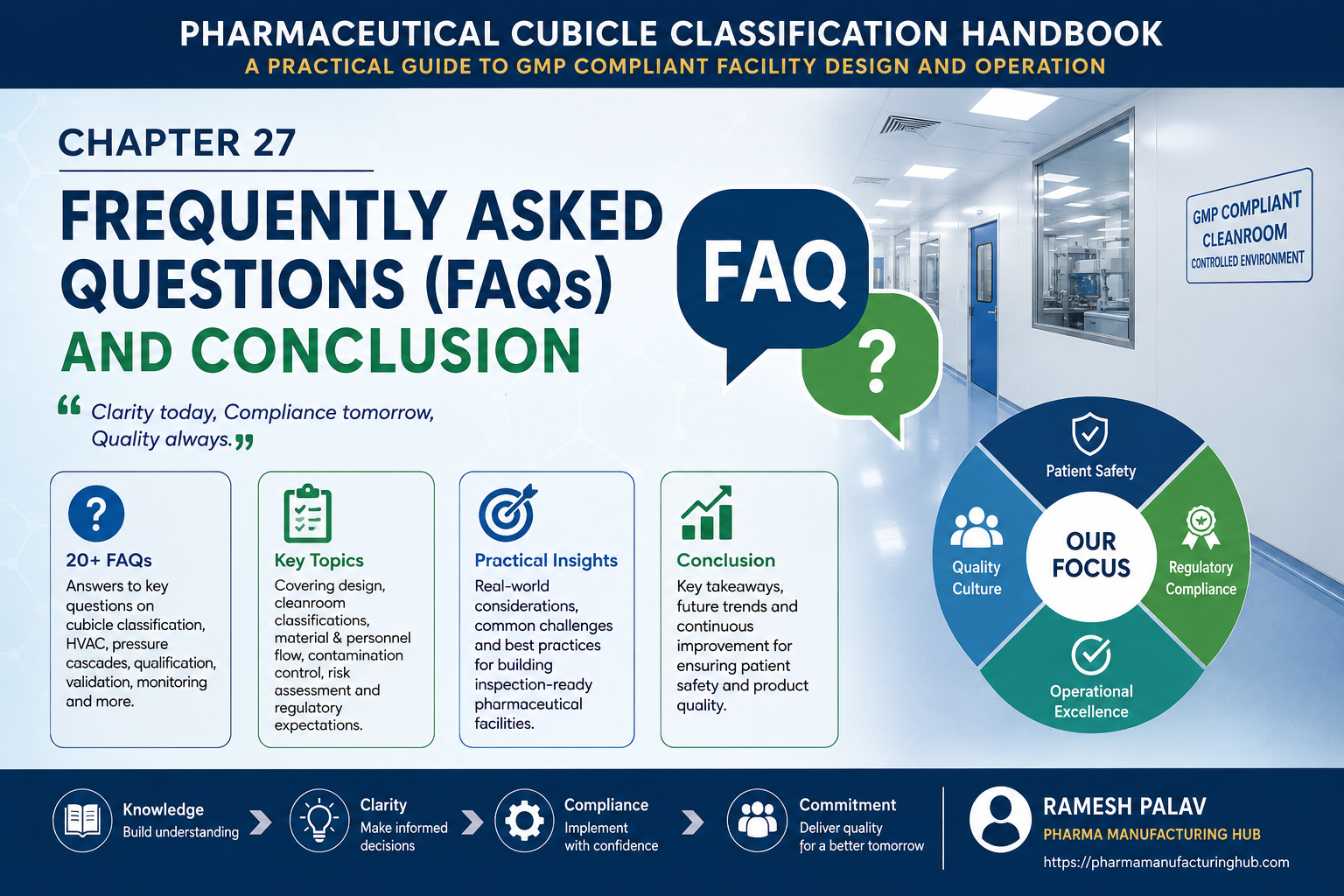
Throughout this handbook, we have explored every major aspect of Pharmaceutical Cubicle Classification, including facility design, cleanroom classifications, HVAC systems, pressure cascades, material and personnel flow, qualification, validation, environmental monitoring, risk assessment, regulatory expectations, inspection readiness, and engineering best practices.
This final chapter addresses some of the most frequently asked questions raised by pharmaceutical professionals, followed by a summary of the key principles that should guide the design and operation of GMP-compliant pharmaceutical facilities.
Frequently Asked Questions (FAQs)
FAQ 1: What is a pharmaceutical cubicle?
A pharmaceutical cubicle is a designated manufacturing or support room within a pharmaceutical facility that is designed and controlled to perform a specific operation while maintaining defined environmental conditions such as cleanliness, temperature, humidity, airflow, and pressure. Proper cubicle classification helps minimize contamination and supports GMP compliance.
FAQ 2: Why is cubicle classification important?
Cubicle classification helps to:
- Prevent contamination and cross-contamination.
- Protect product quality and patient safety.
- Maintain appropriate environmental conditions.
- Support efficient manufacturing operations.
- Demonstrate compliance with GMP requirements.
FAQ 3: What factors determine cubicle classification?
Typical factors include:
- Product type
- Potency
- Toxicity
- Sterility requirements
- Manufacturing process
- Dust generation
- Cross-contamination risk
- Operator exposure
- Regulatory requirements
- Quality Risk Management (QRM)
FAQ 4: Which regulations govern cubicle classification?
Cubicle classification should align with applicable guidance and regulations, including:
- WHO GMP
- US FDA Current Good Manufacturing Practice (CGMP)
- EU GMP Volume 4
- EU GMP Annex 1
- PIC/S GMP Guide
- ISPE Baseline Guides
- ISO 14644
- ICH Q9
- ICH Q10
FAQ 5: What is the difference between ISO Class and EU GMP Grades?
- ISO 14644 classifies cleanrooms based on airborne particle concentrations.
- EU GMP Annex 1 assigns Grades A–D based on the intended use of the cleanroom in sterile manufacturing, incorporating both cleanliness and operational context.
The two systems are related but are not interchangeable.
FAQ 6: What is a pressure cascade?
A pressure cascade is a controlled pressure relationship between adjacent rooms that directs airflow from one area to another to reduce the risk of contamination or cross-contamination.
FAQ 7: When should positive pressure be used?
Positive pressure is commonly used to:
- Protect products from external contamination.
- Maintain cleaner areas relative to surrounding spaces.
- Support conventional OSD manufacturing and many aseptic support areas.
The appropriate pressure strategy should always be based on risk assessment.
FAQ 8: When should negative pressure be used?
Negative pressure is generally applied where containment of hazardous materials is required, such as:
- Highly potent APIs (HPAPIs)
- Cytotoxic products
- Certain hormone manufacturing processes
- Hazardous chemical handling
The objective is to protect personnel and adjacent areas from hazardous exposure.
FAQ 9: What is HVAC zoning?
HVAC zoning is the division of a pharmaceutical facility into separate environmental control zones served by one or more Air Handling Units (AHUs) to maintain the required temperature, humidity, pressure, and air cleanliness for each area.
FAQ 10: Why are airlocks necessary?
Airlocks help maintain pressure differentials and reduce contamination during the movement of personnel and materials between areas of different environmental classifications.
FAQ 11: What is the difference between a Personnel Airlock (PAL) and a Material Airlock (MAL)?
| Personnel Airlock (PAL) | Material Airlock (MAL) |
|---|---|
| Used for personnel entry and exit | Used for material transfer |
| Supports gowning and de-gowning | Supports controlled movement of materials |
| Helps maintain personnel hygiene | Helps prevent contamination during material transfer |
FAQ 12: What is the purpose of a pass box?
A pass box allows materials to move between controlled areas while minimizing direct personnel movement and reducing the risk of contamination.
FAQ 13: Why is environmental monitoring important?
Environmental monitoring confirms that manufacturing environments remain in a controlled state by monitoring:
- Airborne particles
- Microorganisms
- Surfaces
- Personnel
- Temperature
- Relative humidity
- Differential pressure
FAQ 14: How often should pharmaceutical facilities be requalified?
The frequency should be established through Quality Risk Management, regulatory requirements, and historical performance. Requalification should also be considered after significant facility, equipment, or process changes.
FAQ 15: What is the role of HEPA filters?
HEPA filters remove airborne particulate matter from supply air and are critical for maintaining the cleanliness of many controlled pharmaceutical environments. Their application depends on the cleanroom classification and process risk.
FAQ 16: What is a Contamination Control Strategy (CCS)?
A CCS is a comprehensive, risk-based approach that integrates facility design, HVAC systems, environmental monitoring, qualification, cleaning, personnel practices, and quality systems to minimize contamination risks throughout the product lifecycle.
FAQ 17: What is the difference between qualification and validation?
| Qualification | Validation |
|---|---|
| Confirms that facilities, utilities, equipment, and systems are fit for their intended use | Confirms that processes consistently produce results meeting predetermined specifications |
| Engineering-focused | Process-focused |
Both are essential components of a Pharmaceutical Quality System.
FAQ 18: Which risk assessment tools are commonly used?
Common tools include:
- Failure Mode and Effects Analysis (FMEA)
- Hazard Analysis and Critical Control Points (HACCP)
- Hazard and Operability Study (HAZOP)
- Fault Tree Analysis (FTA)
- Preliminary Hazard Analysis (PHA)
The choice of tool should be appropriate for the complexity and risk of the activity.
FAQ 19: What are the most common inspection observations?
Common observations include:
- Pressure cascade failures.
- Poor HVAC performance.
- Incomplete qualification.
- Inadequate environmental monitoring.
- Weak change control.
- Poor documentation.
- Incomplete Contamination Control Strategy.
- Inadequate personnel practices.
FAQ 20: How can facilities remain inspection-ready?
Best practices include:
- Routine internal audits.
- Current qualification and validation records.
- Preventive maintenance.
- Trending environmental data.
- Effective CAPA.
- Ongoing personnel training.
- Periodic review of risk assessments and CCS.
- Strong documentation practices.
FAQ 21: What are the biggest mistakes in cubicle classification?
Common mistakes include:
- Copying designs from other facilities without risk assessment.
- Using shared HVAC systems without scientific justification.
- Poor segregation of personnel and material flow.
- Ignoring future expansion requirements.
- Weak pressure monitoring.
- Insufficient documentation.
FAQ 22: What is the future of pharmaceutical facility design?
Emerging trends include:
- Artificial Intelligence (AI) for predictive environmental monitoring.
- Internet of Things (IoT)-enabled sensors.
- Digital twins for facility simulation.
- Predictive maintenance.
- Smart Building Management Systems.
- Advanced robotics in aseptic processing.
- Data-driven contamination control strategies.
These technologies should be implemented within validated and data integrity-compliant frameworks.
27.2 Final Key Principles
Successful pharmaceutical cubicle classification should always be based on:
✔ Scientific engineering principles
✔ Quality Risk Management (ICH Q9)
✔ Contamination Control Strategy (CCS)
✔ Lifecycle qualification and validation
✔ GMP-compliant facility design
✔ Robust HVAC systems
✔ Effective pressure cascades
✔ Controlled material and personnel flow
✔ Continuous environmental monitoring
✔ Comprehensive documentation
✔ Preventive maintenance
✔ Continuous improvement
27.3 Integrated Cubicle Classification Framework
Product & Process Knowledge
            │
            ▼
Quality Risk Management
            │
            ▼
Facility Layout & Zoning
            │
            ▼
Cubicle Classification
            │
            ▼
HVAC Design
            │
            ▼
Pressure Cascade
            │
            ▼
Material & Personnel Flow
            │
            ▼
Environmental Monitoring
            │
            ▼
Qualification & Validation
            │
            ▼
Contamination Control Strategy
            │
            ▼
Continuous Improvement
            │
            ▼
Regulatory Compliance & Patient Safety
27.4 Overall Summary
This handbook has provided a structured, engineering-based approach to pharmaceutical cubicle classification, covering:
- Fundamentals of cubicle classification
- Product risk assessment
- Cleanroom classifications
- HVAC design and zoning
- Pressure cascade principles
- Material and personnel flow
- Airlocks and pass boxes
- OSD, Sterile, and API facility classification
- Environmental monitoring
- Qualification and validation
- Quality Risk Management
- Contamination Control Strategy
- Regulatory expectations
- Inspection readiness
- Practical case studies
- GMP checklists
- Industry FAQs
Together, these topics provide a practical framework for designing, operating, and maintaining pharmaceutical manufacturing facilities that meet international GMP expectations.
27.5 Final Recommendations
To achieve long-term compliance and operational excellence:
- Base every facility design decision on documented Quality Risk Management.
- Integrate engineering, Quality Assurance, Production, Validation, Maintenance, and EHS teams throughout the facility lifecycle.
- Maintain a living Contamination Control Strategy and review it periodically.
- Invest in training, qualification, preventive maintenance, and environmental monitoring.
- Use digital technologies responsibly to enhance monitoring, trending, and decision-making.
- Regularly review regulatory updates and adapt facility controls as expectations evolve.
- Foster a culture of quality, continuous improvement, and patient-focused decision-making.
Closing Message
Pharmaceutical manufacturing is built on the trust that every medicine reaching a patient is safe, effective, and of consistently high quality. Achieving that trust begins with well-designed facilities, scientifically justified cubicle classifications, robust contamination control, and a strong quality culture.
Engineering excellence, regulatory compliance, and operational discipline are not independent objectives—they work together to protect patients and sustain pharmaceutical manufacturing performance.
About the Author
Ramesh Palav is a pharmaceutical manufacturing professional with 21+ years of experience in Oral Solid Dosage manufacturing, production operations, GMP compliance, qualification, validation, QMS and operational excellence. Through Pharma Manufacturing Hub, he shares practical industry knowledge with pharmaceutical professionals, students and manufacturing leaders.