
Chapter 25
25.1 Introduction
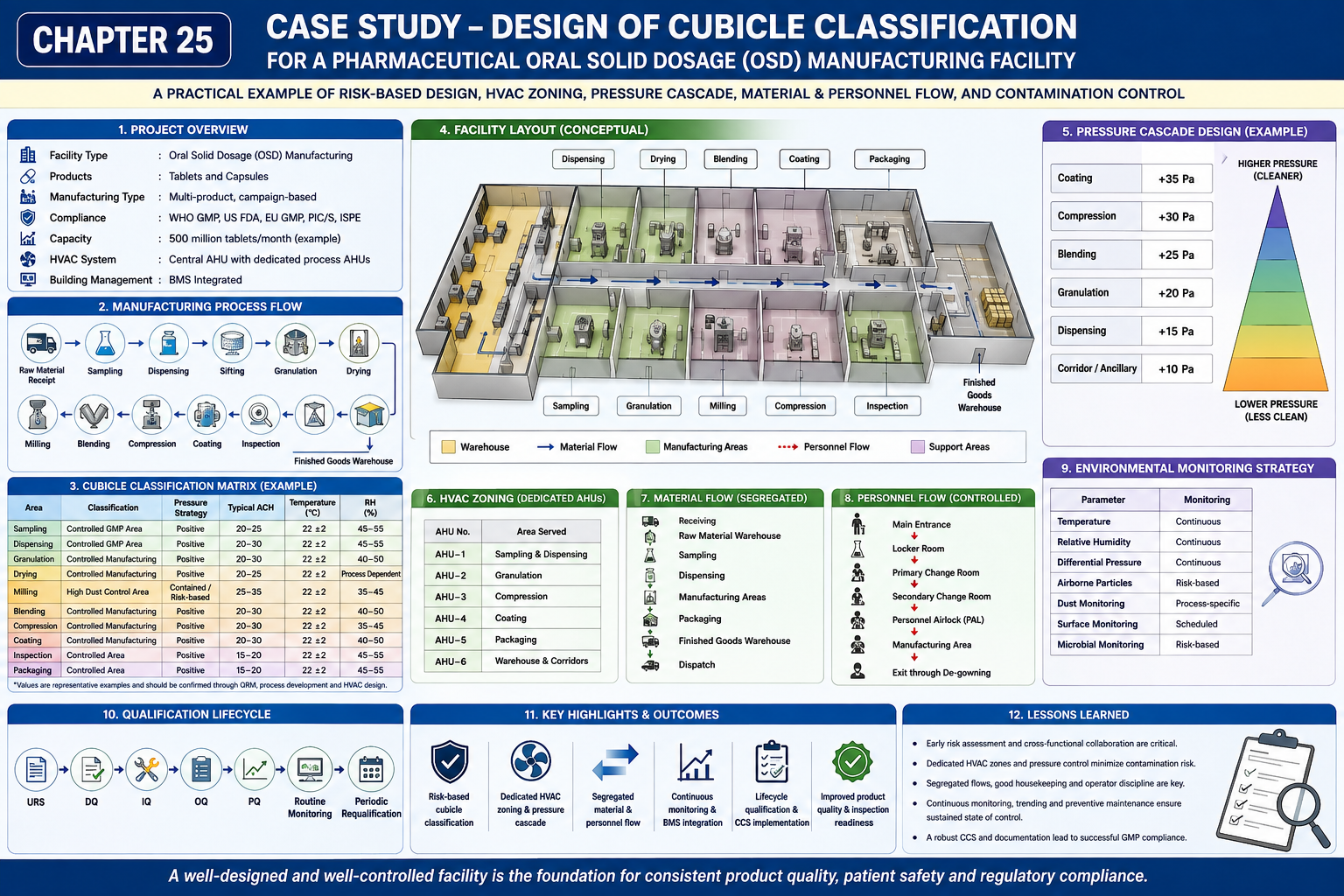
The concepts discussed in the previous chapters become most valuable when applied to a practical facility design. This chapter presents a comprehensive case study of a multi-product Oral Solid Dosage (OSD) pharmaceutical manufacturing facility, demonstrating how cubicle classification, HVAC zoning, pressure cascades, material flow, personnel flow, and contamination control are integrated into a GMP-compliant facility.
The objective is to illustrate how engineering principles, Quality Risk Management (ICH Q9), and global GMP requirements can be combined to create a robust pharmaceutical manufacturing environment.
This case study is intended as a training reference for:
- Pharmaceutical Engineers
- Production Managers
- Validation Engineers
- HVAC Engineers
- QA Professionals
- Consultants
- Regulatory Auditors
- Pharmaceutical Students
25.2 Project Overview
Facility Description
| Parameter | Description |
|---|---|
| Facility Type | Oral Solid Dosage (OSD) Manufacturing |
| Products | Tablets and Capsules |
| Manufacturing Type | Multi-product, campaign-based |
| Compliance Standards | WHO GMP, US FDA, EU GMP, PIC/S, ISPE |
| Manufacturing Capacity | 500 million tablets/month (example) |
| HVAC System | Central AHU with dedicated process AHUs |
| Building Management | BMS integrated |
25.3 Design Objectives
The facility was designed to:
- Prevent cross-contamination.
- Maintain product quality.
- Support efficient production.
- Provide logical material and personnel flow.
- Ensure regulatory compliance.
- Facilitate qualification and maintenance.
- Allow future expansion.
25.4 Manufacturing Process Flow
Raw Material Receipt
          │
          ▼
Raw Material Warehouse
          │
          ▼
Sampling
          │
          ▼
Dispensing
          │
          ▼
Sifting
          │
          ▼
Granulation
          │
          ▼
Drying
          │
          ▼
Milling
          │
          ▼
Blending
          │
          ▼
Compression
          │
          ▼
Coating
          │
          ▼
Inspection
          │
          ▼
Packaging
          │
          ▼
Finished Goods Warehouse
The process follows a unidirectional flow, eliminating backtracking and reducing contamination risks.
25.5 Facility Layout Concept
Warehouse
     │
Sampling
     │
Dispensing
     │
Granulation
     │
Drying
     │
Milling
     │
Blending
     │
Compression
     │
Coating
     │
Inspection
     │
Packaging
     │
Finished Goods
The layout minimizes product movement and simplifies material logistics.
25.6 Cubicle Classification Matrix
| Manufacturing Area | Classification | Pressure Strategy | Typical ACH | Temperature | RH |
|---|---|---|---|---|---|
| Sampling | Controlled GMP Area | Positive | 20–25 | 22°C | 45–55% |
| Dispensing | Controlled GMP Area | Positive | 20–30 | 22°C | 45–55% |
| Granulation | Controlled Manufacturing | Positive | 20–30 | 22°C | 40–50% |
| Drying | Controlled Manufacturing | Positive | 20–25 | 22°C | Process dependent |
| Milling | High Dust Control Area | Contained / risk-based | 25–35 | 22°C | 35–45% |
| Blending | Controlled Manufacturing | Positive | 20–30 | 22°C | 40–50% |
| Compression | Controlled Manufacturing | Positive | 20–30 | 22°C | 35–45% |
| Coating | Controlled Manufacturing | Positive | 20–30 | 22°C | 40–50% |
| Inspection | Controlled Area | Positive | 15–20 | 22°C | 45–55% |
| Packaging | Controlled Area | Positive | 15–20 | 22°C | 45–55% |
Values shown are representative examples and should be confirmed through process development, HVAC design, and Quality Risk Management.
25.7 HVAC Zoning
Dedicated HVAC zoning was selected to improve contamination control.
| AHU | Area Served |
|---|---|
| AHU-1 | Sampling & Dispensing |
| AHU-2 | Granulation |
| AHU-3 | Compression |
| AHU-4 | Coating |
| AHU-5 | Packaging |
| AHU-6 | Warehouse & Corridors |
Design Benefits
- Reduced cross-contamination.
- Easier maintenance.
- Improved balancing.
- Simplified qualification.
- Greater operational flexibility.
25.8 Pressure Cascade Design
Coating
 +35 Pa
     │
Compression
 +30 Pa
     │
Blending
 +25 Pa
     │
Granulation
 +20 Pa
     │
Dispensing
 +15 Pa
     │
Corridor
 +10 Pa
The pressure cascade maintains airflow from cleaner to less clean areas, reducing dust migration.
25.9 Material Flow
Receiving
     │
Warehouse
     │
Sampling
     │
Dispensing
     │
Manufacturing
     │
Packaging
     │
Finished Goods
     │
Dispatch
Best Practices
- Dedicated material corridors.
- Material Airlocks (MALs).
- Barcode-based identification.
- Quarantine and released material segregation.
25.10 Personnel Flow
Main Entrance
      │
Locker Room
      │
Primary Change Room
      │
Secondary Change Room
      │
Personnel Airlock (PAL)
      │
Manufacturing Area
      │
Exit through De-gowning
Personnel movement is separated from material flow to minimize contamination.
25.11 Airlocks and Pass Boxes
Personnel Airlocks (PAL)
- Controlled entry.
- Door interlocking.
- Pressure monitoring.
- Gowning area.
Material Airlocks (MAL)
- Raw material transfer.
- Intermediate transfer.
- Packaging component transfer.
Pass Boxes
- Static pass boxes for documents and low-risk materials.
- Dynamic pass boxes for higher-risk transfers where justified.
25.12 Environmental Monitoring Strategy
| Parameter | Monitoring |
|---|---|
| Temperature | Continuous |
| Relative Humidity | Continuous |
| Differential Pressure | Continuous |
| Airborne Particles | Risk-based |
| Dust | Process-specific |
| Surface Monitoring | Scheduled |
| Air Sampling | Risk-based |
Monitoring results are reviewed monthly for trends.
25.13 Qualification Strategy
Lifecycle Qualification
URS
 │
 ▼
DQ
 │
 ▼
IQ
 │
 ▼
OQ
 │
 ▼
PQ
 │
 ▼
Routine Monitoring
 │
 ▼
Periodic Requalification
Qualification Activities
- HVAC qualification.
- Pressure mapping.
- Temperature mapping.
- RH mapping.
- HEPA integrity testing (where applicable).
- Airflow visualization.
- Environmental monitoring verification.
25.14 Risk Assessment Summary
| Risk | Likelihood | Impact | Control Measure |
|---|---|---|---|
| Cross-contamination | Medium | High | Dedicated HVAC zones and pressure cascade |
| Dust migration | High | High | Local exhaust and containment |
| Material mix-up | Medium | High | Barcode system and line clearance |
| Pressure failure | Low | High | Continuous monitoring and alarms |
| Environmental excursion | Medium | Medium | Trend analysis and CAPA |
25.15 Contamination Control Strategy (CCS)
The CCS included:
- Scientific cubicle classification.
- Risk-based HVAC zoning.
- Pressure cascade verification.
- Controlled material and personnel flow.
- Environmental monitoring.
- Cleaning and disinfection program.
- Qualification and validation.
- Preventive maintenance.
- Change control.
- CAPA integration.
25.16 Building Management System (BMS)
The facility implemented a BMS to continuously monitor:
- Temperature
- Relative Humidity
- Differential Pressure
- AHU Status
- Filter Alarms
- Fan Status
- Trend Reports
Critical alarms were routed to Engineering and QA for prompt response.
25.17 Inspection Readiness
The facility maintained inspection readiness through:
- Annual internal GMP audits.
- Quarterly HVAC reviews.
- Periodic smoke studies.
- Routine environmental monitoring review.
- Annual requalification.
- Mock regulatory inspections.
- CAPA effectiveness checks.
25.18 Challenges Encountered
| Challenge | Resolution |
|---|---|
| Pressure fluctuation in compression room | HVAC balancing and recalibration |
| High dust during milling | Upgraded dust extraction and containment |
| Frequent door opening | Access control and operator training |
| RH variation in coating room | Improved humidity control strategy |
| Material congestion | Redesigned staging areas and material flow |
25.19 Lessons Learned
- Risk-based design minimizes costly modifications later.
- Dedicated HVAC zoning improves operational stability.
- Pressure cascades require continuous monitoring.
- Material and personnel segregation significantly reduces contamination risk.
- Early involvement of QA, Engineering, Production, Validation, and Maintenance improves facility performance.
- Preventive maintenance and trending reduce unexpected failures.
25.20 Performance Outcomes
| Performance Indicator | Result |
|---|---|
| Pressure Cascade Compliance | >99% within limits (example) |
| Environmental Monitoring Excursions | Reduced after optimization |
| Internal Audit Observations | Significantly reduced |
| Regulatory Inspection Outcome | Successful GMP inspection |
| HVAC Downtime | Reduced through preventive maintenance |
| Product Rejection Due to Environmental Issues | No significant trend observed |
Illustrative results shown for training purposes; actual performance will vary by facility.
25.21 Best Practices Demonstrated
✔ Risk-based cubicle classification
✔ Dedicated HVAC zoning
✔ Scientific pressure cascade
✔ Segregated material and personnel flow
✔ Continuous environmental monitoring
✔ Integrated Building Management System
✔ Lifecycle qualification
✔ Preventive maintenance
✔ Comprehensive Contamination Control Strategy
✔ Strong Quality Risk Management
25.22 Case Study Checklist
| Checkpoint | Status |
|---|---|
| Facility layout optimized | ☐ |
| Cubicle classification justified | ☐ |
| HVAC zoning documented | ☐ |
| Pressure cascade verified | ☐ |
| Material flow segregated | ☐ |
| Personnel flow controlled | ☐ |
| CCS implemented | ☐ |
| Qualification complete | ☐ |
| Environmental monitoring active | ☐ |
| Inspection readiness maintained | ☐ |
25.23 Integrated Facility Design Model
Quality Risk Management
         │
Facility Layout
         │
Cubicle Classification
         │
HVAC Design
         │
Pressure Cascade
         │
Material Flow
         │
Personnel Flow
         │
Environmental Monitoring
         │
Qualification & Validation
         │
Contamination Control Strategy
         │
Continuous Improvement
Chapter Summary
This case study demonstrates how pharmaceutical cubicle classification is successfully implemented in a multi-product OSD manufacturing facility by integrating engineering design, Quality Risk Management, HVAC zoning, pressure cascades, material and personnel flow, qualification, environmental monitoring, and contamination control into a unified facility strategy. A lifecycle approach supported by continuous monitoring, preventive maintenance, and inspection readiness helps ensure consistent product quality, operational efficiency, and sustained GMP compliance.
Key Takeaways
- A successful OSD facility begins with a risk-based design supported by documented engineering decisions.
- Cubicle classification, HVAC zoning, and pressure cascades must function together to control contamination.
- Segregated material and personnel flows reduce the risk of mix-ups and cross-contamination.
- Continuous environmental monitoring, qualification, and preventive maintenance help maintain the facility in a validated state.
- Collaboration between Engineering, QA, Production, Validation, Maintenance, and EHS is essential for long-term operational excellence.
Next Chapter
Chapter 26 – Practical GMP Checklists for Pharmaceutical Cubicle Classification, including comprehensive audit checklists for cubicle design review, HVAC systems, pressure cascade verification, environmental monitoring, qualification readiness, validation readiness, inspection readiness, and GMP compliance, providing practical tools for engineers, QA teams, auditors, and pharmaceutical manufacturing professionals.
About the Author
Ramesh Palav is a pharmaceutical manufacturing professional with 21+ years of experience in Oral Solid Dosage manufacturing, production operations, GMP compliance, qualification, validation, QMS and operational excellence. Through Pharma Manufacturing Hub, he shares practical industry knowledge with pharmaceutical professionals, students and manufacturing leaders.