
24.1 Introduction
Pharmaceutical cubicle classification is a critical engineering and quality function that directly influences product quality, patient safety, contamination control, operational efficiency, and regulatory compliance. While regulatory guidelines define the minimum expectations, leading pharmaceutical organizations adopt best practices that exceed basic compliance by integrating risk management, advanced engineering, digital technologies, and continuous improvement into facility design and operation.
World-class pharmaceutical facilities treat cubicle classification as a dynamic lifecycle process rather than a one-time engineering activity. From conceptual design through routine operation, maintenance, qualification, and facility modernization, every decision should be supported by scientific evidence, Quality Risk Management (QRM), and operational data.
This chapter presents internationally recognized best practices derived from guidance published by WHO GMP, US FDA, EU GMP, PIC/S, ISPE, ISO 14644, ICH Q9, and ICH Q10, together with practical engineering and operational experience.
24.2 Objectives of Best Practices
The objectives are to:
- Enhance product quality.
- Strengthen contamination control.
- Improve operator safety.
- Reduce cross-contamination.
- Optimize HVAC performance.
- Improve inspection readiness.
- Support lifecycle compliance.
- Promote operational excellence.
- Reduce operational costs without compromising GMP.
24.3 Design Cubicles Based on Risk
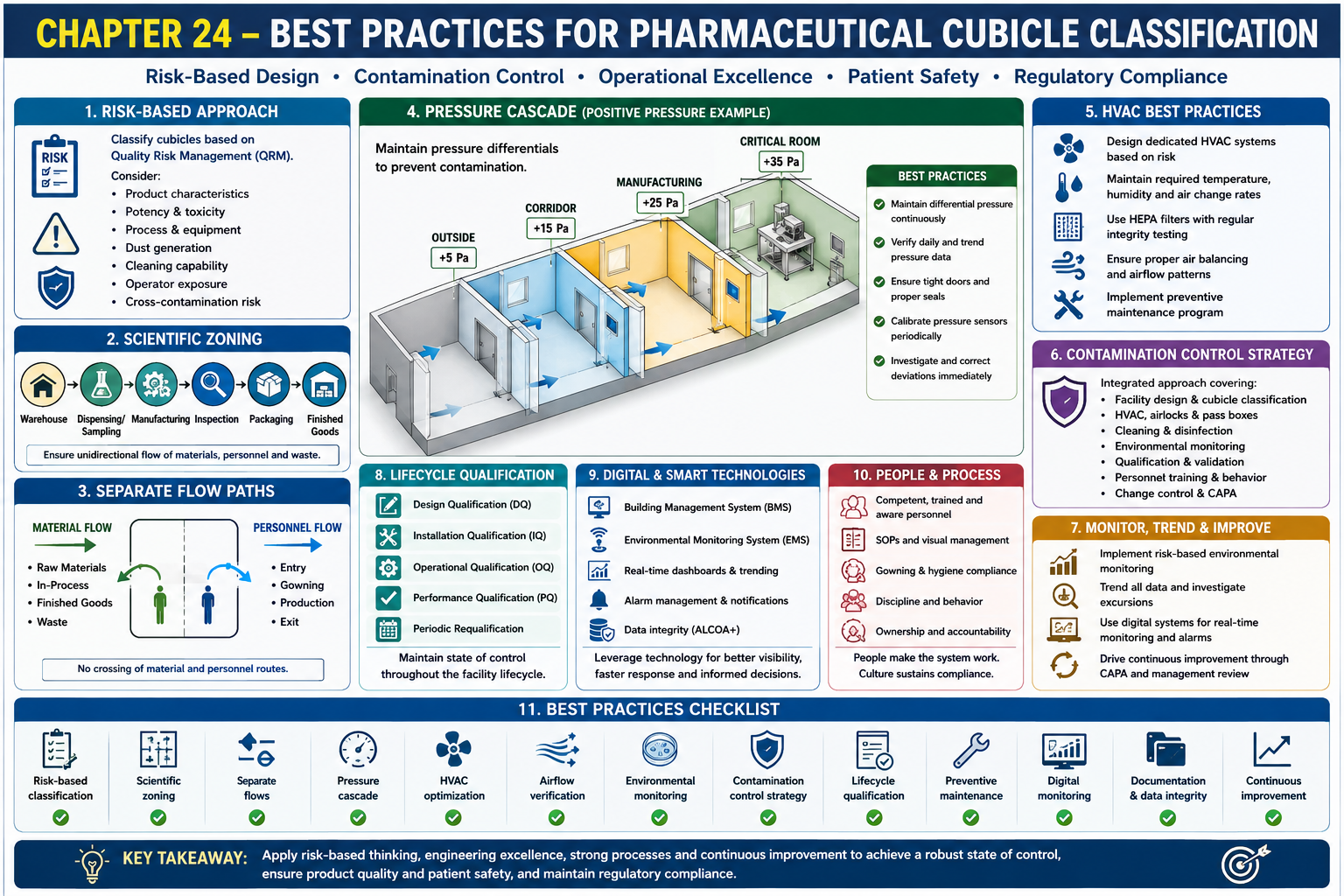
The first principle of world-class facility design is that cubicle classification should always be based on documented Quality Risk Management (QRM).
Consider:
- Product characteristics
- Potency
- Toxicity
- Dust generation
- Sterility requirements
- Manufacturing process
- Cleaning capability
- Operator exposure
- Environmental impact
Every classification decision should have documented scientific justification.
24.4 Develop a Scientific Zoning Strategy
Facility zoning should reflect contamination risks rather than convenience.
Typical Zoning
Warehouse
      │
Sampling
      │
Dispensing
      │
Manufacturing
      │
Inspection
      │
Packaging
      │
Finished Goods
Each zone should support unidirectional movement of materials, personnel, and waste.
24.5 Separate Material and Personnel Flow
Crossing routes are a common cause of contamination and regulatory observations.
Best Practices
✔ Dedicated personnel corridors
✔ Dedicated material corridors
✔ Separate waste routes
✔ Material Airlocks (MAL)
✔ Personnel Airlocks (PAL)
✔ Clearly defined traffic flow
24.6 Design an Effective Pressure Cascade
Pressure differentials should be based on product risk and contamination control needs.
Typical Positive Pressure Strategy
Critical Room
     +35 Pa
        │
Manufacturing
     +25 Pa
        │
Corridor
     +15 Pa
        │
Outside
      +5 Pa
For containment facilities, the pressure hierarchy may be intentionally reversed to protect personnel and the surrounding environment.
Pressure values should be established during HVAC design and confirmed during qualification.
24.7 Use Dedicated Cubicles for High-Risk Products
Dedicated facilities or cubicles should be considered for:
- Highly Potent APIs (HPAPIs)
- Cytotoxic products
- Hormones
- Sensitizing compounds
- Penicillins
- Certain cephalosporins (based on risk assessment)
- Live biological materials (where applicable)
This minimizes cross-contamination risks and simplifies facility management.
24.8 Optimize HVAC Zoning
HVAC zoning should support:
- Product segregation.
- Pressure cascade.
- Environmental consistency.
- Energy efficiency.
- Ease of maintenance.
Example
| AHU | Area |
|---|---|
| AHU-1 | Dispensing |
| AHU-2 | Granulation |
| AHU-3 | Compression |
| AHU-4 | Coating |
| AHU-5 | Packaging |
Dedicated systems should be considered where justified by product or process risk.
24.9 Maintain Environmental Conditions
Maintain qualified environmental conditions throughout production.
Typical monitored parameters:
| Parameter | Monitoring Strategy |
|---|---|
| Temperature | Continuous or scheduled |
| Relative Humidity | Continuous or scheduled |
| Differential Pressure | Continuous in critical areas |
| Airborne Particles | Risk-based |
| Microbial Monitoring | Risk-based |
| Airflow | Periodic verification |
Monitoring strategies should be reviewed based on product and process risk.
24.10 Implement a Robust Contamination Control Strategy (CCS)
A comprehensive CCS should integrate:
- Facility design
- Cubicle classification
- HVAC systems
- Airlocks
- Pass boxes
- Cleaning and disinfection
- Environmental monitoring
- Qualification and validation
- Preventive maintenance
- Personnel training
- Change control
The CCS should be a living document that evolves with facility and process changes.
24.11 Perform Lifecycle Qualification
Qualification should continue throughout the life of the facility.
Design Qualification
        │
Installation Qualification
        │
Operational Qualification
        │
Performance Qualification
        │
Routine Monitoring
        │
Periodic Requalification
Qualification should be linked to preventive maintenance and change control.
24.12 Conduct Regular Airflow Visualization
Smoke studies should be performed:
- During qualification.
- After HVAC modifications.
- Following major layout changes.
- During periodic requalification.
- When airflow concerns arise.
These studies confirm airflow patterns and identify potential turbulence.
24.13 Strengthen Environmental Monitoring
Best practices include:
- Risk-based sampling locations.
- Trending of all environmental data.
- Continuous monitoring where appropriate.
- Timely investigation of excursions.
- Integration with CAPA.
- Periodic review of monitoring plans.
24.14 Apply Digital Monitoring Technologies
Modern pharmaceutical facilities increasingly use digital systems for environmental oversight.
Examples include:
- Building Management System (BMS)
- Environmental Monitoring System (EMS)
- Supervisory Control and Data Acquisition (SCADA)
- Manufacturing Execution System (MES)
- Digital dashboards
- Automated alarm management
These technologies support data integrity, faster response to deviations, and informed decision-making.
24.15 Strengthen Preventive Maintenance
Preventive maintenance should include:
- AHU inspection
- HEPA filter inspection
- Fan maintenance
- Damper adjustment
- Sensor calibration
- Door interlock verification
- Pressure transmitter verification
- BMS health checks
Maintenance should be scheduled, documented, and reviewed for potential qualification impact.
24.16 Improve Documentation
Maintain complete documentation for:
- Qualification
- Validation
- Environmental Monitoring
- HVAC balancing
- Calibration
- Preventive Maintenance
- SOPs
- Risk Assessments
- Change Control
- CAPA
All records should comply with ALCOA+ principles.
24.17 Strengthen Personnel Competency
Training should include:
- GMP
- Cubicle classification principles
- HVAC awareness
- Pressure cascade
- Gowning
- Contamination control
- Environmental monitoring
- Data integrity
- Change control
Competency should be periodically assessed and documented.
24.18 Integrate Sustainability
Environmental control and sustainability can coexist when properly engineered.
Examples include:
- Variable frequency drives (VFDs) on HVAC fans
- High-efficiency motors
- Energy-efficient HEPA filter selection
- Heat recovery systems (where appropriate)
- LED lighting
- Smart HVAC control algorithms
- Optimized air change rates based on validated risk assessments
Energy-saving measures should never compromise GMP requirements.
24.19 Apply Continuous Improvement
Continuous improvement should be driven by:
- Internal audits
- Environmental trends
- CAPA effectiveness
- Management reviews
- Regulatory updates
- Technology improvements
- Benchmarking
- Customer feedback
24.20 Best Practices for Different Facility Types
| Facility | Best Practice |
|---|---|
| OSD | Dust control and pressure cascade |
| Sterile | Robust CCS, unidirectional airflow, continuous monitoring |
| API | Containment and solvent management |
| HPAPI | Dedicated HVAC and containment systems |
| Biotechnology | Closed processing and contamination control |
| Packaging | Effective line clearance and product segregation |
24.21 Future Trends
Emerging technologies influencing cubicle classification include:
- Artificial Intelligence (AI) for predictive environmental monitoring
- Digital twins for facility performance simulation
- IoT-enabled environmental sensors
- Predictive maintenance
- Automated contamination risk analytics
- Cloud-based environmental dashboards
- Advanced robotics in aseptic manufacturing
- Machine learning for trend analysis
Adoption should follow validation, cybersecurity, and data integrity requirements.
24.22 Common Pitfalls to Avoid
Avoid:
- Copying classifications from other facilities without justification.
- Shared HVAC systems without documented risk assessment.
- Poor pressure cascade maintenance.
- Inadequate airflow studies.
- Weak change control.
- Incomplete qualification.
- Poor documentation.
- Ignoring environmental trends.
- Delaying CAPA implementation.
24.23 Best Practice Case Study
Facility
Multi-product OSD Manufacturing Plant
Improvement Initiative
The facility implemented:
- Dedicated AHUs for dust-generating operations.
- Redesigned personnel and material flow.
- Continuous differential pressure monitoring.
- Digital environmental dashboards.
- Quarterly airflow visualization studies.
- Risk-based Environmental Monitoring Program.
- Comprehensive Contamination Control Strategy.
Results
| Parameter | Before | After |
|---|---|---|
| Pressure excursions | Frequent | Rare |
| Environmental monitoring deviations | Higher | Reduced |
| Internal audit observations | Multiple | Significantly reduced |
| HVAC downtime | Higher | Reduced through preventive maintenance |
| Inspection readiness | Reactive | Proactive |
24.24 Best Practice Checklist
| Checkpoint | Status |
|---|---|
| Risk-based cubicle classification documented | ☐ |
| Scientific HVAC zoning implemented | ☐ |
| Pressure cascade verified | ☐ |
| Material and personnel flow separated | ☐ |
| Contamination Control Strategy current | ☐ |
| Environmental Monitoring Program optimized | ☐ |
| Qualification lifecycle maintained | ☐ |
| Preventive maintenance current | ☐ |
| Digital monitoring systems operational | ☐ |
| Personnel training completed | ☐ |
| Continuous improvement program active | ☐ |
24.25 Operational Excellence Framework
Quality Risk Management
          │
Facility Design
          │
Cubicle Classification
          │
HVAC & Pressure Control
          │
Environmental Monitoring
          │
Qualification & Validation
          │
Digital Monitoring
          │
CAPA & Change Control
          │
Continuous Improvement
          │
Operational Excellence
Chapter Summary
Achieving excellence in pharmaceutical cubicle classification requires more than compliance with regulatory requirements. It demands a proactive, science-based approach that integrates Quality Risk Management, robust engineering design, contamination control, lifecycle qualification, digital monitoring, and continuous improvement. Organizations that implement these best practices create facilities that are safer, more efficient, easier to maintain, and consistently capable of meeting evolving global regulatory expectations while protecting product quality and patient safety.
Key Takeaways
- Best practices go beyond regulatory compliance and focus on building a sustainable state of control.
- Risk-based facility design, scientific zoning, optimized HVAC systems, and effective contamination control are the foundation of robust cubicle classification.
- Lifecycle qualification, preventive maintenance, digital monitoring, and strong documentation ensure long-term GMP compliance.
- Continuous improvement, supported by environmental trends, internal audits, and CAPA, enhances operational reliability.
- Future-ready pharmaceutical facilities will increasingly leverage AI, IoT, predictive analytics, and digital technologies while maintaining validation and data integrity.
Next Chapter
Chapter 25 – Case Study: Design of Cubicle Classification for a Pharmaceutical Oral Solid Dosage (OSD) Manufacturing Facility, providing a complete real-world engineering example including facility layout, room classifications, HVAC zoning, pressure cascade, material and personnel flow, qualification strategy, contamination control rationale, and GMP compliance considerations from concept through commercial operation.
About the Author
Ramesh Palav is a pharmaceutical manufacturing professional with 21+ years of experience in Oral Solid Dosage manufacturing, production operations, GMP compliance, qualification, validation, QMS and operational excellence. Through Pharma Manufacturing Hub, he shares practical industry knowledge with pharmaceutical professionals, students and manufacturing leaders.