
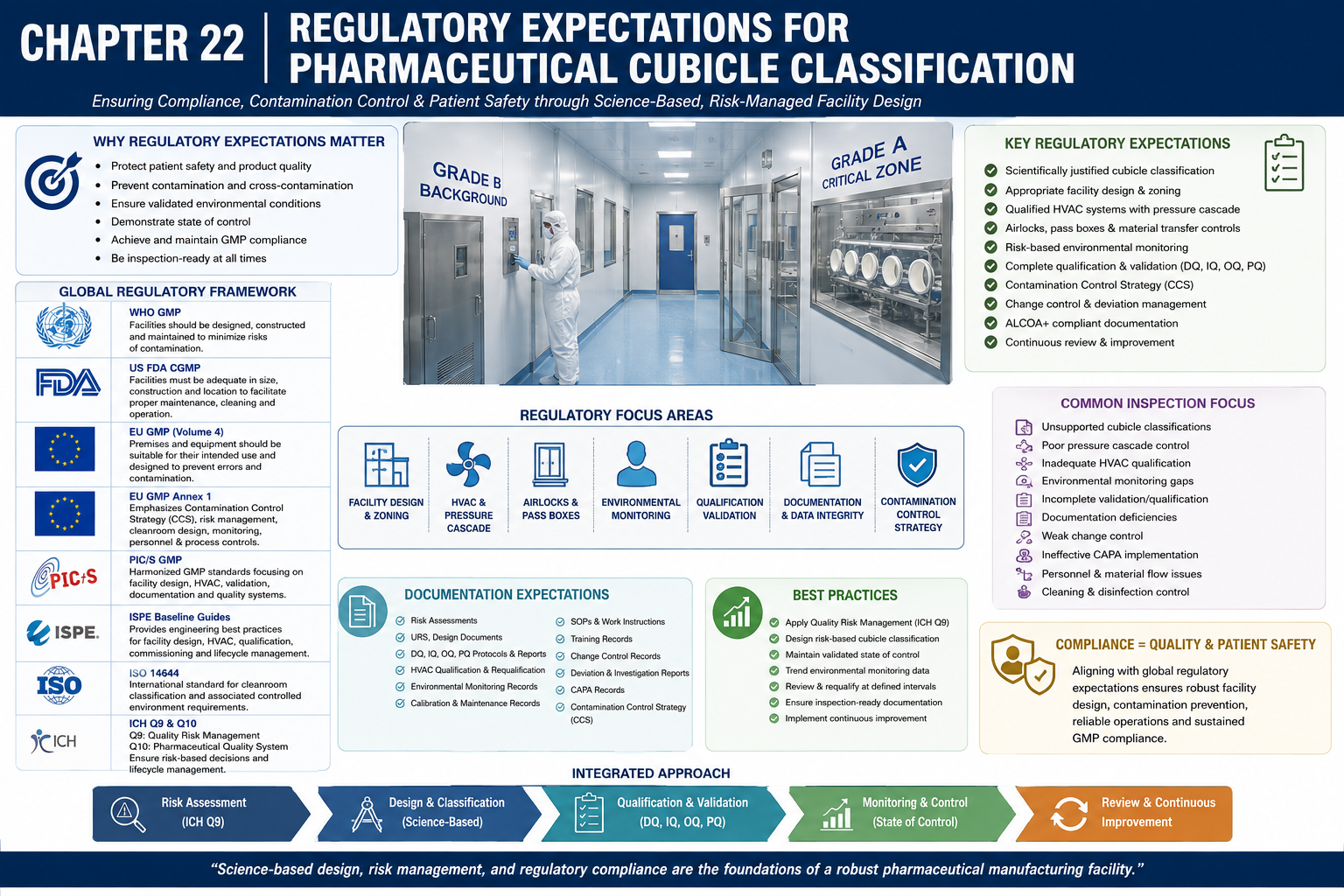
22.1 Introduction
Pharmaceutical cubicle classification is not merely an engineering exercise—it is a regulatory expectation that directly impacts product quality, patient safety, contamination control, and Good Manufacturing Practice (GMP) compliance. Global regulatory authorities expect pharmaceutical manufacturers to design, qualify, operate, and maintain manufacturing cubicles using a science-based, risk-managed approach supported by documented evidence.
Regulators no longer focus only on compliance with specifications; they assess whether facility design, environmental controls, and contamination control strategies are scientifically justified and capable of consistently protecting product quality throughout the product lifecycle.
The classification of pharmaceutical cubicles should therefore be aligned with internationally recognized standards and guidance, including:
- WHO GMP
- US FDA Current Good Manufacturing Practice (CGMP)
- EU GMP Volume 4
- EU GMP Annex 1
- PIC/S GMP Guide
- ISPE Baseline Guides
- ISO 14644 Series
- ICH Q9 (Quality Risk Management)
- ICH Q10 (Pharmaceutical Quality System)
22.2 Objectives of Regulatory Compliance
The primary objectives are to:
- Protect patient safety.
- Ensure product quality.
- Prevent contamination and cross-contamination.
- Maintain validated environmental conditions.
- Demonstrate state of control.
- Ensure data integrity.
- Facilitate successful regulatory inspections.
- Promote continuous improvement.
22.3 Global Regulatory Framework
| Organization | Primary Focus |
|---|---|
| WHO | International GMP guidance |
| US FDA | Current Good Manufacturing Practice (CGMP) |
| European Commission | EU GMP Volume 4 |
| PIC/S | Harmonized GMP guidance |
| ISPE | Engineering best practices |
| ISO | International cleanroom standards |
| ICH | Harmonized quality management principles |
22.4 WHO GMP Expectations
WHO GMP requires pharmaceutical manufacturers to ensure that facilities are designed and maintained to minimize contamination risks.
Key Expectations
- Scientific facility design
- Appropriate room classification
- Logical material and personnel flow
- Suitable HVAC systems
- Environmental monitoring
- Qualification and validation
- Preventive maintenance
- Effective documentation
Inspectors typically evaluate whether facility design supports consistent manufacturing and contamination prevention.
22.5 US FDA Expectations
The US FDA expects facilities to be designed and operated to prevent contamination and ensure product quality.
Typical inspection focus includes:
- Facility design
- Environmental controls
- HVAC performance
- Pressure differentials
- Equipment qualification
- Cleaning validation
- Change control
- Data integrity
- Investigation of deviations
Facilities should demonstrate that engineering controls remain effective throughout routine manufacturing.
22.6 EU GMP Expectations
EU GMP Volume 4 emphasizes:
- Appropriate premises
- Suitable equipment
- Scientific contamination control
- Facility qualification
- Lifecycle validation
- Documentation
- Risk management
Facility layouts should support efficient manufacturing while preventing mix-ups and contamination.
22.7 EU GMP Annex 1 Expectations
EU GMP Annex 1 places strong emphasis on contamination control in sterile manufacturing.
Key Requirements
- Contamination Control Strategy (CCS)
- Risk-based facility design
- Cleanroom classification
- Airflow visualization
- Environmental monitoring
- Personnel qualification
- Media fills
- Lifecycle qualification
- Continuous improvement
Although Annex 1 primarily applies to sterile products, many of its risk management principles are valuable for other pharmaceutical operations.
22.8 PIC/S Expectations
PIC/S promotes harmonized GMP implementation across participating regulatory authorities.
Inspectors typically review:
- Facility zoning
- HVAC systems
- Pressure cascades
- Airlocks
- Pass boxes
- Cleaning programs
- Qualification records
- Environmental monitoring
- CAPA effectiveness
22.9 ISPE Expectations
ISPE Baseline Guides provide engineering best practices for pharmaceutical facility design.
Typical recommendations include:
- Risk-based HVAC design
- Lifecycle approach
- Commissioning and qualification
- Facility zoning
- Clean utility design
- Contamination control
- Maintainability
- Energy optimization without compromising GMP
22.10 ISO 14644 Expectations
ISO 14644 provides internationally recognized requirements for cleanrooms.
The standard covers:
- Cleanroom classification
- Airborne particle testing
- Cleanroom performance testing
- Airflow testing
- Pressure verification
- Recovery testing
- Monitoring programs
Cleanroom qualification should follow applicable ISO testing methodologies where relevant.
22.11 ICH Q9 – Quality Risk Management
Regulators expect manufacturers to apply Quality Risk Management throughout the facility lifecycle.
Typical applications include:
- Cubicle classification
- HVAC zoning
- Pressure cascade design
- Material flow
- Personnel flow
- Environmental monitoring
- Change control
- Qualification planning
Engineering decisions should be supported by documented risk assessments.
22.12 ICH Q10 – Pharmaceutical Quality System
ICH Q10 integrates engineering controls into the overall Pharmaceutical Quality System.
Typical elements include:
- Management responsibility
- Continuous improvement
- CAPA
- Change management
- Knowledge management
- Lifecycle management
- Performance monitoring
Facility controls should be managed within the site’s quality system.
22.13 Regulatory Expectations for Cubicle Classification
Every pharmaceutical cubicle should have documented justification covering:
| Requirement | Regulatory Expectation |
|---|---|
| Room Classification | Scientifically justified |
| HVAC Design | Qualified and documented |
| Pressure Cascade | Verified and monitored |
| Material Flow | Controlled and documented |
| Personnel Flow | Segregated where appropriate |
| Environmental Monitoring | Risk-based |
| Cleaning Program | Validated or verified as applicable |
| Qualification | Complete lifecycle documentation |
22.14 Regulatory Expectations for HVAC
Regulators typically verify:
- HVAC qualification
- Air balancing
- HEPA filter integrity
- Air change rates
- Pressure monitoring
- Alarm functionality
- Preventive maintenance
- Calibration
- Requalification records
HVAC systems should consistently maintain qualified environmental conditions.
22.15 Regulatory Expectations for Airlocks
Inspectors evaluate:
- Door interlocking
- Pressure differentials
- Cleaning status
- Personnel behavior
- Material transfer procedures
- Alarm functionality
- Qualification records
Airlocks should function as effective contamination control barriers.
22.16 Regulatory Expectations for Pass Boxes
Typical inspection points include:
- Door interlocks
- Cleaning records
- HEPA qualification (dynamic pass boxes)
- Pressure control
- SOP availability
- Operator training
- Preventive maintenance
Pass boxes should facilitate material transfer without compromising environmental control.
22.17 Regulatory Expectations for Environmental Monitoring
Inspectors generally review:
- Monitoring locations
- Monitoring frequency
- Trend analysis
- Alert and action levels
- Investigation reports
- CAPA implementation
- Personnel monitoring
- Instrument calibration
Programs should be risk-based and supported by scientific rationale.
22.18 Regulatory Expectations for Qualification
Qualification documentation should demonstrate:
- Design Qualification (DQ)
- Installation Qualification (IQ)
- Operational Qualification (OQ)
- Performance Qualification (PQ)
- Periodic requalification
- Change control
- Deviations and CAPA
- Final approval
Qualification should provide evidence that facilities consistently perform as intended.
22.19 Regulatory Expectations for Documentation
Inspectors expect documentation that is:
- Complete
- Accurate
- Legible
- Traceable
- Controlled
- Current
- Approved
- Readily available
Typical documents include:
- URS
- Risk Assessments
- Validation Master Plan (VMP)
- Qualification Protocols
- Environmental Monitoring Records
- Calibration Certificates
- Maintenance Logs
- SOPs
- Change Controls
- CAPA Records
Documentation should follow ALCOA+ data integrity principles.
22.20 Inspection Focus Areas
During GMP inspections, regulators commonly assess:
Facility Design
      │
HVAC Systems
      │
Cubicle Classification
      │
Pressure Cascade
      │
Environmental Monitoring
      │
Qualification
      │
Validation
      │
Documentation
      │
Personnel Practices
      │
Contamination Control Strategy
22.21 Common Regulatory Deficiencies
Inspectors frequently identify:
- Unsupported cubicle classifications.
- Poor pressure cascade control.
- Shared HVAC systems without documented risk assessment.
- Incomplete qualification records.
- Missing smoke studies.
- Environmental monitoring gaps.
- Weak Contamination Control Strategy.
- Inadequate change control.
- Poor cleaning documentation.
- Incomplete investigation of environmental excursions.
22.22 Best Practices for Inspection Readiness
- Maintain inspection-ready documentation at all times.
- Perform periodic internal GMP audits.
- Review cubicle classifications after significant changes.
- Trend environmental monitoring data.
- Requalify facilities at defined intervals.
- Ensure calibration and preventive maintenance remain current.
- Conduct periodic training on GMP and contamination control.
- Integrate Quality Risk Management into routine operations.
- Maintain an up-to-date Contamination Control Strategy.
22.23 Case Study – Regulatory Inspection of an OSD Facility
Facility
Multi-product Oral Solid Dosage Manufacturing Plant
Inspection Scope
- Facility design
- HVAC systems
- Cubicle classification
- Material flow
- Personnel flow
- Environmental monitoring
- Qualification documentation
Observations
| Observation | Action Taken |
|---|---|
| Pressure differential trend identified | HVAC balancing completed and monitoring enhanced |
| Environmental monitoring trend reviewed | Sampling locations optimized through risk assessment |
| Qualification documentation updated | Requalification completed and documentation revised |
Outcome
- Improved facility control.
- Enhanced GMP compliance.
- Better inspection preparedness.
- Strengthened contamination control.
22.24 Regulatory Compliance Checklist
| Checkpoint | Status |
|---|---|
| Cubicle classification justified | ☐ |
| Risk assessments approved | ☐ |
| HVAC qualified | ☐ |
| Pressure cascade verified | ☐ |
| Environmental Monitoring Program implemented | ☐ |
| Airlocks and Pass Boxes qualified | ☐ |
| DQ, IQ, OQ, PQ completed | ☐ |
| Calibration current | ☐ |
| Preventive maintenance completed | ☐ |
| Contamination Control Strategy documented | ☐ |
| Change control implemented | ☐ |
| Documentation inspection-ready | ☐ |
22.25 Global Regulatory Compliance Framework
WHO GMP
     │
US FDA CGMP
     │
EU GMP Volume 4
     │
EU GMP Annex 1
     │
PIC/S GMP
     │
ISO 14644
     │
ICH Q9
     │
ICH Q10
     │
ISPE Baseline Guides
     │
Risk-Based Pharmaceutical Facility Design
Chapter Summary
Global regulatory authorities expect pharmaceutical manufacturers to adopt a science-based, risk-managed approach to cubicle classification, facility design, and contamination control. Compliance extends beyond meeting individual requirements; it requires demonstrating a sustained state of control through effective facility design, qualified HVAC systems, validated environmental conditions, robust documentation, Quality Risk Management, and a comprehensive Contamination Control Strategy. Organizations that integrate these expectations into their Pharmaceutical Quality System are better positioned to ensure product quality, patient safety, and long-term regulatory compliance.
Key Takeaways
- Regulatory expectations for cubicle classification are based on scientific justification, documented risk assessments, and lifecycle management.
- WHO GMP, US FDA, EU GMP, PIC/S, ISO 14644, ICH Q9, ICH Q10, and ISPE guidance collectively provide the framework for compliant pharmaceutical facility design.
- Inspectors focus on contamination control, HVAC performance, pressure cascades, qualification, environmental monitoring, documentation, and personnel practices.
- A comprehensive Contamination Control Strategy (CCS), supported by robust Quality Risk Management, is central to demonstrating GMP compliance.
- Maintaining inspection readiness requires continuous monitoring, periodic review, effective change control, and a strong quality culture.
Next Chapter
Chapter 23 – Common Inspection Observations in Pharmaceutical Cubicle Classification, covering US FDA, WHO, MHRA, EU GMP, and PIC/S inspection findings, recurring GMP deficiencies, root cause analysis, CAPA strategies, preventive measures, audit readiness, and industry best practices for pharmaceutical manufacturing facilities.
About the Author
Ramesh Palav is a pharmaceutical manufacturing professional with 21+ years of experience in Oral Solid Dosage manufacturing, production operations, GMP compliance, qualification, validation, QMS and operational excellence. Through Pharma Manufacturing Hub, he shares practical industry knowledge with pharmaceutical professionals, students and manufacturing leaders.