
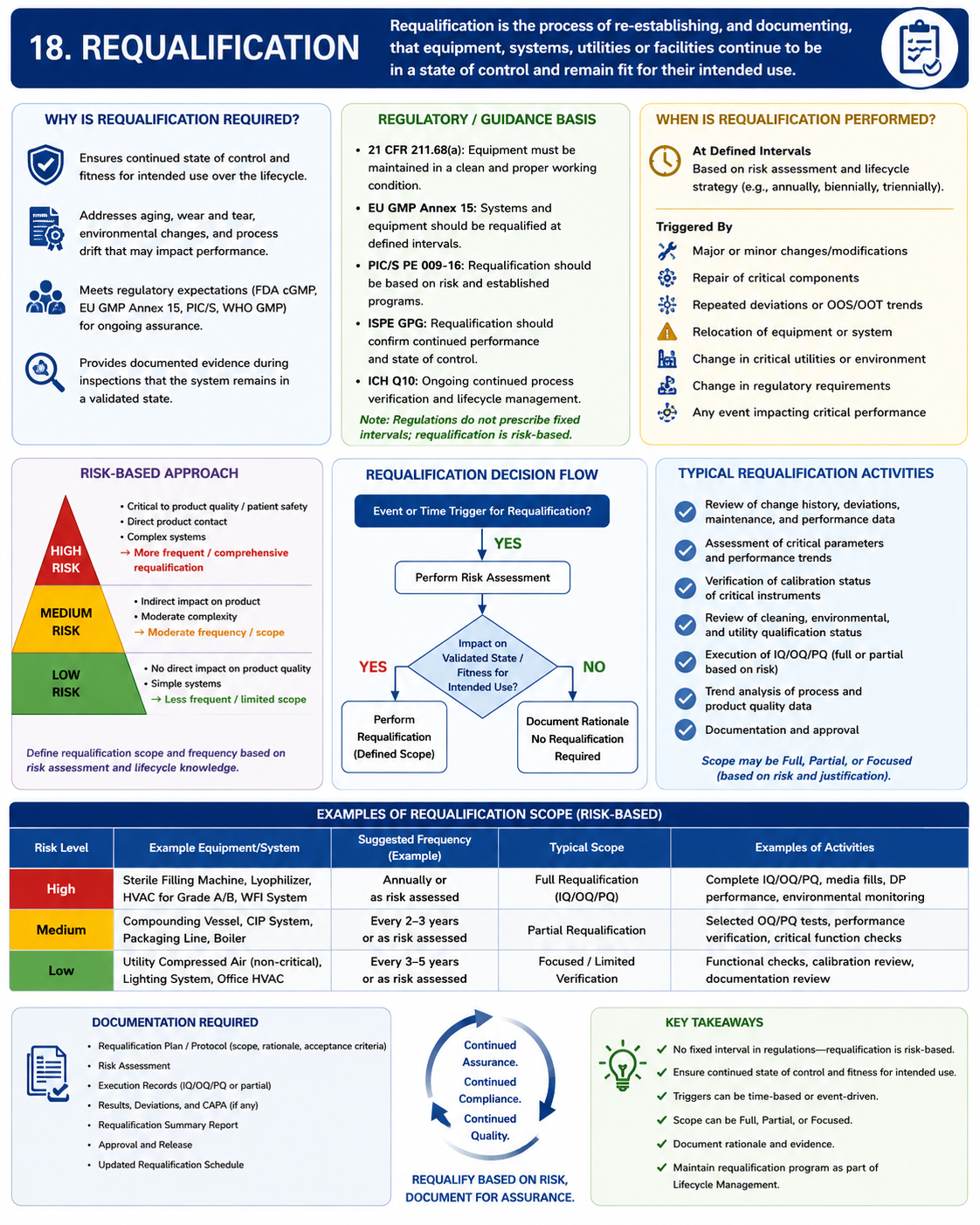
Requalification is the documented evaluation and, where justified, repeat verification of a previously qualified facility, utility, equipment, or system to demonstrate that it continues to remain suitable for its intended GMP use.
The Part 18 will address:
Periodic requalification, event-based requalification, requalification after major maintenance, relocation, software modification, critical-component replacement, repeated failures, and adverse trends.
Most importantly, the source establishes this principle:
The scope should be justified through documented risk assessment rather than automatically repeating every historical test.
18.1 What Is Requalification?
Requalification is the lifecycle activity used to determine whether previously established qualification remains valid and whether additional verification is necessary.
It should answer:
Does the available evidence continue to demonstrate that the facility, utility, equipment, or system remains fit for its intended GMP use?
Requalification does not necessarily mean repeating the original IQ, OQ and PQ package in its entirety.
Instead:
Existing Qualified State
        ↓
Periodic Requirement / Triggering Event
        ↓
Impact Assessment
        ↓
Risk Assessment
        ↓
Review Existing Qualification Evidence
        ↓
Determine Requalification Scope
        ↓
Execute Required Verification
        ↓
Assess Results / Deviations
        ↓
Update Documentation
        ↓
QA Assessment
        ↓
Continued / Revised Qualified State
18.2 Why Requalification Is Required
Initial qualification establishes suitability at a defined point in the lifecycle.
Afterward, the system may be exposed to:
- routine operation;
- wear and aging;
- preventive maintenance;
- breakdown maintenance;
- calibration;
- component replacement;
- software changes;
- process changes;
- relocation;
- repeated failures;
- environmental changes;
- utility changes;
- cumulative modifications.
Consequently, the organization needs mechanisms to determine whether the original qualification conclusion remains valid.
The master source places Periodic Review / Requalification after routine operation, change control, calibration, PM and monitoring in the complete lifecycle.
18.3 Requalification vs Initial Qualification
| Initial Qualification | Requalification |
|---|---|
| Establishes initial qualified state | Confirms/restores qualified state |
| New system/equipment | Existing qualified system |
| Broad lifecycle verification | Risk-based reassessment/reverification |
| Initial URS/design basis | Existing requirements + current state |
| Establishes baseline | Compares against baseline/current requirements |
| Usually planned during project | Periodic or event triggered |
The fundamental evidence principle remains the same:
Objective evidence must support fitness for intended use.
18.4 Requalification vs Periodic Review
These concepts should not automatically be treated as identical.
Periodic Review
Reviews accumulated lifecycle evidence to determine whether the system remains in control.
The source’s Part 19 requires periodic review of items such as:
- deviations;
- breakdown history;
- calibration;
- preventive maintenance;
- changes;
- CAPA;
- alarm trends;
- critical parameter trends;
- qualification status;
- software changes;
- data-integrity concerns;
- SOPs;
- training;
- recurring failures;
- obsolescence.
Requalification
Performs defined qualification verification/testing when required.
A periodic review may therefore conclude:
Current qualification remains adequate; no additional testing required.
or:
Targeted requalification is required.
18.5 Requalification vs Change Control
Part 17 established:
Change → GMP Impact → Risk Assessment → Qualification Impact → Required Testing → Documentation Update → Approval → Implementation → Verification → Closure.
Change control identifies the impact of a proposed modification.
Requalification may be one of the actions resulting from that assessment.
For example:
PLC Change
   ↓
Change Control
   ↓
Qualification Impact
   ↓
Partial OQ Requalification
   ↓
Regression Testing
   ↓
Change Closure
Therefore:
Change control is the assessment/control mechanism; requalification may be part of the verification response.
18.6 Major Types of Requalification
Based on your source, the principal categories are:
- Periodic requalification
- Event-based requalification
- After major maintenance
- After relocation
- After software modification
- After critical-component replacement
- After repeated failures
- Following adverse trends
Each requires a different assessment.
18.7 Periodic Requalification
Periodic requalification is performed at a defined interval where the site’s qualification strategy determines that repeat verification is appropriate.
The interval should be established through the applicable quality/qualification system.
The source does not prescribe a universal frequency such as:
“All equipment must be requalified annually.”
Therefore, a fixed frequency should not be presented as universally mandatory based on the supplied source.
18.8 Establishing Periodic Requalification Strategy
Consider:
- equipment/system criticality;
- GMP impact;
- historical performance;
- failure history;
- calibration trends;
- maintenance history;
- complexity;
- degree of automation;
- monitoring capability;
- changes;
- process risk;
- previous qualification results.
A stable system with strong continuous monitoring may justify a different strategy from a highly critical system with recurring failures.
18.9 Periodic Requalification Example
Consider a tablet compression machine.
Periodic assessment may review:
- equipment configuration;
- critical instruments;
- calibration status;
- alarms;
- interlocks;
- emergency stop;
- critical operating ranges;
- reject mechanisms;
- PLC/HMI configuration;
- user access;
- recipe controls;
- qualification history.
The exact tests should be determined by the approved strategy and risk assessment.
18.10 Periodic Requalification Does Not Mean Full Historical Repetition
Suppose original qualification included:
- 40 IQ tests;
- 65 OQ tests;
- 8 PQ tests.
A periodic requalification should not automatically reproduce all 113 tests simply because they existed historically.
Instead:
Original Qualification
        ↓
Current System Configuration
        ↓
Lifecycle History
        ↓
Current Risks
        ↓
Critical Functions
        ↓
Available Monitoring Evidence
        ↓
Requalification Scope
This directly follows the source’s requirement for documented risk-based scope.
18.11 Event-Based Requalification
Event-based requalification occurs because a specific event creates uncertainty regarding continued qualification.
Potential triggering events identified by the source include:
- major maintenance;
- relocation;
- software modification;
- critical-component replacement;
- repeated failures;
- adverse trends.
A change may also generate requalification requirements through the Part 17 change-control process.
18.12 Event-Based Decision Model
Event Occurs
     ↓
Does Event Potentially Affect
Qualified State?
   ┌──────┴──────┐
  NO            YES
   │              ↓
Document      GMP/Technical
Rationale       Impact
                  ↓
             Risk Assessment
                  ↓
           Which Qualification
           Evidence Is Affected?
                  ↓
        Define Requalification Scope
                  ↓
               Execute
                  ↓
            Assess Results
                  ↓
       Confirm Qualified State
18.13 Requalification After Major Maintenance
The source specifically requires consideration of requalification following major maintenance.
Examples may include significant work affecting:
- drive systems;
- critical control components;
- product-contact assemblies;
- PLC hardware;
- critical sensors;
- motors;
- gearboxes;
- major piping;
- utility connections.
The important question is not simply whether maintenance was called “major.”
Ask:
What qualified functions or characteristics could the maintenance have affected?
18.14 Major Maintenance Impact Assessment
Evaluate:
Installation
Was equipment dismantled or reinstalled?
Alignment
Could mechanical alignment have changed?
Instrumentation
Were critical instruments disconnected/replaced?
Calibration
Was measurement accuracy potentially affected?
Control
Were PLC/HMI/control parameters affected?
Safety
Were guards/interlocks disturbed?
Performance
Could operating performance have changed?
18.15 Example — Gearbox Replacement
A tablet compression machine gearbox is replaced.
Potential impacts:
- turret speed;
- rotation;
- vibration;
- mechanical performance;
- lubrication;
- motor loading;
- operating range.
Potential requalification:
Installation Verification → Lubrication Verification → Rotation/Speed Testing → Alarm/Safety Checks as affected → Performance Assessment
The exact scope depends on the actual change and risk.
18.16 Maintenance Does Not Automatically Require Full Requalification
Example:
A noncritical external light is replaced.
Assuming no GMP-critical functionality is affected, full IQ/OQ/PQ repetition would generally not logically follow from the source’s risk-based principle.
Conversely:
Replacement of a critical process-control assembly may require substantial requalification.
The scope follows impact, not the maintenance label alone.
18.17 Requalification After Relocation
The source explicitly identifies relocation as a requalification trigger requiring assessment.
Relocation may affect:
- equipment installation;
- leveling;
- anchoring;
- electrical supply;
- utilities;
- HVAC;
- exhaust;
- environmental conditions;
- network connections;
- interfaces;
- process flow;
- material/personnel flow.
Therefore:
Same machine + different location does not automatically equal same qualified state.
18.18 Relocation Assessment Model
Equipment Relocated
       ↓
Physical Installation Changed?
       ↓
Utilities Changed?
       ↓
Environment Changed?
       ↓
HVAC/Containment Changed?
       ↓
Network/Interfaces Changed?
       ↓
Critical Functionality Affected?
       ↓
Performance Conditions Changed?
       ↓
Define IQ/OQ/PQ Scope
18.19 Relocation — IQ Considerations
Potential IQ elements include:
- equipment identification;
- location;
- installation;
- leveling;
- anchoring;
- utilities;
- electrical supply;
- piping;
- network;
- instrumentation;
- calibration;
- updated drawings.
Part 9 of the source requires these types of installation attributes to be verified during IQ.
18.20 Relocation — OQ Considerations
Potentially repeat affected tests for:
- start/stop;
- operating sequence;
- controls;
- alarms;
- interlocks;
- safety;
- operating ranges;
- sensors;
- communication;
- power recovery.
These are among the OQ functions required by the master source.
18.21 Relocation — PQ Considerations
PQ may need reassessment if relocation could affect routine performance.
Examples:
- different environmental condition;
- changed utility performance;
- changed containment;
- changed material flow;
- changed process interface.
PQ scope should again follow risk.
18.22 Requalification After Software Modification
The source specifically identifies software modification as a requalification trigger.
Potential examples include:
- PLC logic changes;
- HMI modification;
- SCADA update;
- firmware change;
- application upgrade;
- configuration change.
The source’s computerized-system section additionally requires risk-based consideration of:
- user roles;
- access controls;
- audit trails;
- electronic records;
- interfaces;
- backup/restore;
- time synchronization;
- retention;
- archiving;
- security.
18.23 Software Modification Impact Assessment
Ask:
- What changed?
- What version changed?
- Which requirements are affected?
- Which functions are affected?
- Which interfaces are affected?
- Are GMP records affected?
- Is data integrity affected?
- Are user roles affected?
- Are audit trails affected?
- Are calculations affected?
- Are recipes affected?
- Are alarms/interlocks affected?
- Is regression testing required?
18.24 Software Requalification Principle
Avoid:
Software changed → Repeat entire IQ/OQ/PQ.
Instead:
Software Change
      ↓
Affected Requirements
      ↓
Affected Functions
      ↓
Affected Interfaces/Data
      ↓
Risk Assessment
      ↓
Regression Scope
      ↓
Targeted Requalification
18.25 Example — PLC Alarm Logic Modification
Change:
PLC alarm delay changed.
Potential affected functions:
- alarm trigger;
- alarm delay;
- alarm display;
- acknowledgment;
- associated interlock;
- event/audit record where applicable.
Requalification should address the affected functional chain.
18.26 Example — HMI Cosmetic Change
Change:
Screen background/layout changed without changing GMP functionality.
This may require limited verification rather than extensive functional requalification, provided the impact assessment supports that conclusion.
However, if the HMI change alters:
- parameter limits;
- user permissions;
- recipe controls;
- critical displays;
the scope becomes substantially greater.
18.27 Requalification After Critical-Component Replacement
The source specifically identifies critical-component replacement.
Examples may include:
- critical sensor;
- PLC CPU;
- control module;
- load cell;
- product-contact component;
- critical valve;
- critical filter;
- reject system component.
The actual criticality should be based on the system’s documented impact/risk assessment.
18.28 Like-for-Like Critical Component
Even a like-for-like replacement may require verification.
Example:
A compression-force load cell is replaced with the same model.
Potential activities:
- identification;
- installation;
- calibration;
- PLC/HMI value verification;
- alarm/control verification;
- functional performance test.
“Same part number” does not mean “no verification.”
18.29 Non-Like-for-Like Critical Component
If the replacement differs in:
- operating principle;
- range;
- accuracy;
- material;
- capacity;
- software;
- interface;
a broader assessment is required.
Potential impact can extend to:
DQ → IQ → OQ → PQ → Process Validation → Cleaning Validation
depending on the nature of the component.
18.30 Requalification After Repeated Failures
The source explicitly identifies repeated failures as a potential requalification trigger.
Repeated failures may indicate that:
- equipment condition has deteriorated;
- qualification assumptions are no longer valid;
- maintenance strategy is inadequate;
- design is unreliable;
- operating range is inappropriate;
- controls are insufficient.
A recurring failure should not be treated indefinitely as a series of unrelated maintenance events.
18.31 Repeated-Failure Example
Suppose a compression machine experiences repeated:
Tablet reject mechanism failures
Potential questions:
- Is the reject function still reliable?
- Were previous OQ assumptions valid?
- Is a component degrading?
- Is maintenance adequate?
- Is PLC logic contributing?
- Does the reject verification require requalification?
Potential lifecycle:
Repeated Failures
      ↓
Trend Identified
      ↓
Investigation
      ↓
Risk Assessment
      ↓
CAPA / Change
      ↓
Requalification
      ↓
Effectiveness Monitoring
18.32 Requalification Following Adverse Trends
The source specifically identifies adverse trends as a requalification trigger to consider.
Potential adverse trends may involve:
- calibration drift;
- increasing breakdowns;
- alarm frequency;
- critical parameter instability;
- recurring deviations;
- utility deterioration;
- environmental-control deterioration;
- repeated OOS/OOT-related equipment concerns.
Part 19 specifically requires review of alarm trends, critical parameter trends, recurring failures and qualification status.
18.33 Trend Does Not Have to Reach Complete Failure
An important lifecycle principle is:
Requalification assessment can be triggered by evidence of deterioration before complete functional failure occurs.
Example:
Critical temperature transmitter:
Calibration 1 → Small Drift
Calibration 2 → Greater Drift
Calibration 3 → Near Tolerance
Even if each individual calibration remains acceptable, the trend may warrant technical and qualification assessment.
18.34 Requalification Trigger Matrix
| Trigger | Typical Concern | Potential Response |
|---|---|---|
| Periodic interval | Continued state of control | Risk-based periodic requalification |
| Major maintenance | Function disturbed | Targeted IQ/OQ/PQ |
| Relocation | Installation/environment changed | IQ/OQ/PQ assessment |
| Software modification | Logic/data/functions changed | Regression/requalification |
| Critical-component replacement | Critical function affected | Targeted verification |
| Repeated failures | Reliability/state of control | Investigation + requalification |
| Adverse trend | Deterioration | Risk-based verification |
| Major process change | New operating condition | Qualification/PV assessment |
| Utility modification | Supply/quality changed | Utility/equipment assessment |
18.35 How to Determine Requalification Scope
This is the most important practical activity.
Start with:
Step 1 — Define the Trigger
What happened?
Step 2 — Identify Affected System Boundary
Which equipment/subsystem/function is affected?
Step 3 — Review Existing Qualification
What was originally tested?
Step 4 — Review Requirements
Which URS/critical requirements may be affected?
Step 5 — Review Risk Assessment
Which failure modes/critical aspects are affected?
Step 6 — Assess Qualification Stages
Does the event affect DQ, IQ, OQ and/or PQ?
Step 7 — Assess Related Validation
Does it affect process validation, cleaning validation or computerized controls?
Step 8 — Define Tests
Select sufficient verification to demonstrate continued suitability.
18.36 Risk-Based Requalification Scope
Trigger/Event
     ↓
System Impact
     ↓
GMP Impact
     ↓
Affected Requirements
     ↓
Affected Critical Functions
     ↓
Existing Qualification Evidence
     ↓
Current Lifecycle Evidence
     ↓
Residual Risk
     ↓
REQUALIFICATION SCOPE
This approach preserves the source’s central principle that scope should be risk justified rather than automatically reproducing historical tests.
18.37 Possible Requalification Outcomes
Following assessment, one of several outcomes may be appropriate:
Outcome 1 — No Additional Testing
Existing evidence remains adequate.
Outcome 2 — Engineering Verification
Limited technical checks sufficient.
Outcome 3 — Partial IQ
Installation-related attributes require reverification.
Outcome 4 — Partial OQ
Affected functionality requires challenge testing.
Outcome 5 — Partial PQ
Performance under routine conditions requires confirmation.
Outcome 6 — Combined IQ/OQ/PQ
Multiple qualification stages affected.
Outcome 7 — Full Requalification
Broad change or uncertainty invalidates substantial prior evidence.
These are practical outcomes rather than mandatory categories specified by the source.
18.38 When Full Requalification May Be Appropriate
Potential circumstances include:
- extensive system redesign;
- major relocation with substantial installation/environment changes;
- extensive automation replacement;
- loss of reliable qualification evidence;
- broad changes affecting critical functions;
- major configuration changes.
Even here, the decision should be documented.
18.39 When Partial Requalification May Be Appropriate
Example:
Critical temperature sensor replaced.
Potential scope:
IQ
- sensor identification;
- range;
- installation;
- calibration.
OQ
- displayed value;
- control response;
- alarm;
- recording.
PQ
May or may not be necessary depending on process impact.
This is more scientifically focused than blindly repeating unrelated tests.
18.40 When No Requalification Testing May Be Justified
A documented assessment may determine that an event does not affect qualified functions.
Example:
Replacement of a nonfunctional external identification plate without affecting equipment construction, controls or GMP operation.
Potential disposition:
No additional qualification testing required; documented rationale and verification of correct identification.
The source supports risk-based scope rather than automatic repetition.
18.41 Requalification and Traceability
Requalification should update lifecycle traceability where affected requirements are reverified.
Example:
| URS | Original Evidence | Trigger | Requalification Evidence | Final Status |
|---|---|---|---|---|
| URS-INT-005 | OQ-017 | CC-045 | RQ-OQ-003 | Verified |
| URS-DI-004 | OQ-025 | Software upgrade | RQ-OQ-010 | Verified |
The source requires traceability to show how changes affect qualification evidence.
18.42 Requalification Protocol
Where formal requalification testing is required, a protocol should be approved according to the site’s controlled procedure.
A practical structure:
- Title
- Document number
- Revision
- Equipment/system identification
- Objective
- Scope
- Requalification trigger
- Background
- References
- Responsibilities
- Risk assessment
- Qualification-impact assessment
- Prerequisites
- Test instruments
- Calibration requirements
- Test methodology
- Acceptance criteria
- Test scripts
- Data requirements
- Deviations
- Retesting
- Summary
- Approval
This is consistent with the general protocol-content expectations in Part 13.
18.43 Requalification Protocol Objective Example
The objective of this protocol is to verify the identified installation and operational functions potentially affected by relocation of the equipment and to generate documented evidence supporting assessment of its continued suitability for the defined intended use.
Avoid writing:
“The objective is to prove the equipment still passes.”
Qualification should assess evidence, not predetermine results.
18.44 Requalification Prerequisites
Before execution, verify as applicable:
- change control approved;
- maintenance complete;
- installation complete;
- drawings available;
- calibration current;
- utilities available;
- software/configuration controlled;
- risk assessment approved;
- personnel trained;
- SOPs available;
- test instruments calibrated;
- deviations from prior work assessed.
18.45 Requalification Test Script
Each test should follow the source’s standard qualification evidence structure:
Objective → Prerequisite → Test Method → Expected Result → Actual Result → Acceptance Criteria → Evidence → Pass/Fail → Executed By → Reviewed By.
Example:
Test ID
RQ-OQ-INT-001
Objective
Verify operation of the affected guard interlock following maintenance.
Prerequisite
Maintenance complete and equipment available for testing.
Test Method
Challenge the identified guard interlock under approved test conditions.
Expected Result
System responds according to approved functional requirement.
Actual Result
Evidence
Result
□ Pass
□ Fail
Executed By
Reviewed By
18.46 Acceptance Criteria
Requalification acceptance criteria should be:
- predefined;
- scientifically justified;
- linked to applicable requirements;
- measurable where appropriate;
- consistent with intended use.
Avoid weakening historical acceptance criteria merely to make requalification easier.
If requirements legitimately change, manage that through the applicable controlled change process.
18.47 Requalification Deviations
Failures during requalification should follow the same controlled deviation lifecycle established in Part 15:
Observation → Documentation → Initial Assessment → Impact Assessment → Investigation → Root Cause where required → CAPA/Correction → Re-test → QA Assessment → Closure.
Do not repeatedly execute a failed requalification test until it passes.
18.48 Failed Requalification Test
If a previously qualified critical function fails during requalification, the issue may have implications beyond the test itself.
Questions include:
- When did the failure develop?
- Could previous GMP batches be affected?
- Is retrospective impact assessment required?
- Are other functions affected?
- Is the system currently suitable for use?
- Should operation be suspended?
The supplied source does not prescribe universal answers to these questions; disposition should follow the applicable PQS and documented impact assessment.
18.49 Requalification and Historical Product Impact
A significant requalification failure can potentially raise a historical question:
Was the system in a suitable state during previous GMP operation?
Example:
A critical interlock fails during periodic requalification.
Investigation may need to establish:
- last known acceptable state;
- maintenance history;
- alarm history;
- deviations;
- previous challenge results;
- possible product/process impact.
This is an inference from the lifecycle-control principle rather than a separately stated requirement in the supplied Part 18 source.
18.50 Requalification Summary Report
After execution, a summary should assess:
- objective;
- scope;
- trigger;
- tests executed;
- acceptance criteria;
- results;
- deviations;
- retesting;
- changes;
- traceability;
- residual risks;
- conclusion;
- recommended qualification status.
The exact format may be a separate report or an approved protocol/report combination depending on company procedure.
18.51 Requalification Status
Possible practical conclusions include:
Continued Qualified State
Evidence supports continued intended use.
Qualified With Restrictions
Evidence supports defined limited use.
Additional Qualification Required
Evidence remains incomplete.
Qualified State Not Supported
Significant unresolved issues remain.
These terms should be aligned with the company’s PQS.
18.52 Requalification and Process Validation
Equipment requalification and process validation should remain conceptually distinct.
Example:
A compression machine motor is replaced.
Equipment verification may demonstrate:
Machine operates correctly.
But if the change expands the operating range or materially alters process capability, process-validation impact may also require assessment.
Therefore:
Equipment Requalification ≠ Automatically Process Revalidation
and:
Successful equipment requalification does not automatically resolve every process-validation impact.
18.53 Requalification and Cleaning Validation
Consider whether the trigger affects:
- product-contact surface;
- surface finish;
- MOC;
- equipment geometry;
- cleaning cycle;
- spray pattern;
- temperature;
- flow;
- hold conditions.
If yes, cleaning-validation impact should be separately assessed.
18.54 Requalification and Computerized Systems
For PLC/HMI/SCADA-controlled equipment, requalification should consider computerized functions proportionate to risk.
The source requires additional consideration of:
- configuration;
- user roles;
- access controls;
- audit trails;
- electronic records;
- interfaces;
- backup/restore;
- security;
- periodic review.
This does not mean every computerized feature requires identical testing after every modification.
18.55 Requalification and Calibration
Calibration evidence can support requalification but does not replace functional qualification.
Example:
A pressure transmitter is calibrated successfully.
That establishes measurement performance under calibration conditions.
It does not automatically demonstrate:
- PLC scaling;
- alarm activation;
- interlock action;
- SCADA recording;
- process response.
The source’s Part 25 specifically distinguishes calibration, instrument suitability, qualification and process control.
18.56 Requalification and Preventive Maintenance
PM history is important because it may reveal:
- recurring component replacement;
- accelerated wear;
- overdue maintenance;
- abnormal failure frequency.
This information can influence requalification scope.
A system with repeated maintenance interventions may warrant greater verification than an otherwise identical stable system.
18.57 Requalification and Change History
Before defining scope, review changes since the last qualification/requalification.
A useful table:
| Change | Description | Qualification Impact | Testing | Status |
|---|---|---|---|---|
| CC-001 | Sensor replacement | OQ | RQ-OQ-001 | Closed |
| CC-008 | HMI update | OQ/CSV | RQ-OQ-008 | Closed |
| CC-015 | Motor replacement | IQ/OQ | RQ-012 | Closed |
This helps detect cumulative impact.
18.58 Cumulative Change Assessment
Individually minor changes may collectively alter the qualification basis.
Example:
Original Qualification
      ↓
Sensor Change
      ↓
HMI Change
      ↓
PLC Modification
      ↓
Motor Replacement
      ↓
Recipe Range Expansion
A periodic review should ask:
Does the cumulative current configuration remain adequately represented by the qualification evidence?
Part 19 of the source requires review of changes and qualification status as part of maintaining the qualified state.
18.59 Requalification Risk Assessment Example
| Failure Mode | Trigger | Potential Impact | Existing Evidence | Required Action |
|---|---|---|---|---|
| Incorrect speed | Gearbox replacement | Process performance | Original OQ | Speed verification |
| Incorrect sensor value | Sensor replacement | CPP control | Calibration/OQ | Calibration + loop test |
| Interlock failure | Major maintenance | Safety/GMP | Original OQ | Interlock challenge |
| Incorrect PLC logic | Software change | Process/data | Original OQ | Regression testing |
| Utility inadequacy | Relocation | Performance | Original IQ/PQ | Utility + performance verification |
18.60 Requalification Decision Matrix
| Condition | Potential Scope |
|---|---|
| No relevant impact | Documented assessment |
| Installation affected only | Targeted IQ |
| Function affected | Targeted OQ |
| Performance affected | PQ |
| Software logic affected | OQ/regression/CSV assessment |
| Product-contact change | IQ + cleaning/product impact |
| New operating range | OQ/PQ/process assessment |
| Relocation | IQ/OQ/PQ based on impact |
| Repeated critical failures | Investigation + targeted/broad requalification |
| Extensive redesign | Potential broad/full requalification |
This matrix is illustrative; the source requires risk justification rather than fixed automatic rules.
18.61 Inspector Perspective — “How Do You Know This System Remains Qualified?”
This question is explicitly anticipated by the source’s inspection section.
A strong evidence chain could include:
Original Qualification → Changes → Maintenance → Calibration → Deviations → Monitoring/Trends → Periodic Review → Requalification where required → Current Qualified Status
The inspector is not merely asking:
“Where is the old IQ/OQ?”
The underlying question is whether qualification has been maintained throughout the lifecycle.
18.62 Inspector Perspective — “Why Was Requalification Required?”
Strong response characteristics:
- clear triggering event;
- documented impact assessment;
- affected requirements identified;
- risk-based test scope;
- approved protocol;
- traceable evidence.
Potential red flag:
“We repeat OQ every year because we have always done it.”
That may demonstrate a schedule, but not necessarily scientific rationale.
18.63 Inspector Perspective — “Why Did You Not Repeat PQ?”
A strong response should demonstrate:
Trigger → No performance impact identified → Risk assessment → Existing PQ remains applicable → Targeted IQ/OQ sufficient.
If PQ could reasonably have been affected, the justification needs to address that.
18.64 Inspector Perspective — “Why Did You Repeat Only Three OQ Tests?”
Strong evidence:
- specific change;
- affected URS requirements;
- risk assessment;
- affected functions;
- test mapping;
- regression rationale.
Weak response:
“Validation decided three tests were enough.”
18.65 Inspector Perspective — “Show Me Requalification After the Change”
The organization should be able to navigate:
Change Control
     ↓
Impact Assessment
     ↓
Risk Assessment
     ↓
Requalification Protocol
     ↓
Raw Data
     ↓
Deviations
     ↓
Summary/Approval
     ↓
Updated Traceability
     ↓
Qualified State
This supports the master source’s required defensible evidence chain.
18.66 Common Requalification Deficiencies
1. Automatic Annual IQ/OQ/PQ
No documented risk rationale.
2. No Requalification After Major Change
Existing qualification may no longer represent the system.
3. Full Historical Test Repetition
Creates unnecessary documentation without focusing on actual risk.
4. Scope Too Narrow
Affected interfaces/functions omitted.
5. No Change-History Review
Cumulative modifications overlooked.
6. No Trend Review
Recurring failures ignored.
7. Software Changes Treated as Minor Maintenance
Potential GMP/data functions not assessed.
8. Calibration Treated as Requalification
Calibration alone may not verify functional performance.
9. Relocation Without IQ/OQ Assessment
Installation/environmental changes ignored.
10. Failed Requalification Tests Repeated Without Investigation
Contradicts the source’s deviation-management principles.
18.67 Requalification RACI — Illustrative
| Activity | Production | Engineering | Validation | QA | Automation/IT | Vendor |
|---|---|---|---|---|---|---|
| Identify trigger | R/C | R | R | C | R/C | C |
| Impact assessment | C | R | R | A/C | C | C |
| Risk assessment | C | R | R | A/C | C | C |
| Define scope | C | C | R | A/C | R/C | C |
| Prepare protocol | C | C | R | C/A | C | C |
| Execute testing | C | C | R | C | R/C | C |
| Investigate failures | C | R | R | A/C | R | C |
| Review results | C | C | R | A | C | I |
| Update traceability | C | C | R | C/A | C | I |
| Final disposition | C | C | R/C | A | C | I |
R = Responsible, A = Accountable, C = Consulted, I = Informed.
Actual responsibilities depend on the company’s PQS, as required by the source.
18.68 Requalification Assessment Template
A. System Information
Equipment/System: ____________________
Equipment ID: ________________________
Location: ____________________________
Original Qualification: ______________
Last Requalification: _________________
B. Trigger
□ Periodic
□ Major maintenance
□ Relocation
□ Software modification
□ Critical-component replacement
□ Repeated failure
□ Adverse trend
□ Other controlled trigger
Description
C. GMP Impact
□ Product quality
□ CPP/CQA
□ GMP records
□ Data integrity
□ Contamination control
□ Utility
□ Safety
□ Other
Assessment
D. Qualification Impact
□ DQ
□ IQ
□ OQ
□ PQ
□ Computerized-system controls
□ Process validation
□ Cleaning validation
□ Utility qualification
E. Risk Assessment Reference
F. Existing Evidence Reviewed
G. Proposed Requalification Scope
H. Excluded Historical Tests and Justification
I. Acceptance Criteria
J. Final Conclusion
□ No additional testing required
□ Partial requalification
□ Extensive requalification
□ Full requalification
K. Approval
The source later specifically requires a Requalification Assessment template as part of Part 30.
18.69 Requalification Checklist
Trigger Assessment
- □ Trigger clearly identified
- □ System boundary defined
- □ GMP impact assessed
- □ Qualified-state impact assessed
- □ Current configuration identified
Historical Review
- □ Original qualification reviewed
- □ Previous requalification reviewed
- □ Change history reviewed
- □ Deviation history reviewed
- □ Maintenance history reviewed
- □ Calibration history reviewed
- □ Relevant trends reviewed
Risk Assessment
- □ Critical requirements identified
- □ Critical functions identified
- □ Potential failure modes assessed
- □ Existing controls considered
- □ Scope scientifically justified
Protocol
- □ Approved before execution
- □ Prerequisites defined
- □ Test instruments calibrated
- □ Acceptance criteria predefined
- □ Required tests traceable
Execution
- □ Actual results recorded
- □ Raw data retained
- □ Deviations documented
- □ Failed tests investigated
- □ Retests justified
Closure
- □ Acceptance criteria satisfied
- □ Deviations dispositioned
- □ Traceability updated
- □ Documents updated
- □ Residual risks assessed
- □ Qualification status concluded
- □ QA disposition completed
18.70 Requalification Strategy Table
A site’s qualification strategy may maintain a controlled matrix such as:
| System | Criticality | Requalification Approach | Trigger | Typical Scope Basis |
|---|---|---|---|---|
| Compression Machine | GMP critical | Periodic + event | Defined strategy/change | Critical functions/risk |
| HVAC | GMP impact dependent | Periodic/event | Monitoring/change | Classification/process risk |
| PW System | GMP critical | Continued verification + defined qualification review | Trend/change | Water quality/system risk |
| SCADA | GMP/data criticality dependent | Event/periodic review | Software/configuration change | Functional/data risk |
| Warehouse HVAC | Risk dependent | Defined strategy | Trend/change | Environmental requirements |
The exact frequencies and classifications must be site/system specific; the supplied source does not provide universal intervals.
18.71 Relationship Between Initial Qualification and Requalification
The complete lifecycle can be represented as:
URS
 ↓
Risk Assessment
 ↓
DQ
 ↓
FAT/SAT
 ↓
IQ
 ↓
OQ
 ↓
PQ
 ↓
Qualification Summary
 ↓
GMP Release
 ↓
Routine Operation
 ↓
Calibration + PM + Monitoring
 ↓
Change Control
 ↓
Periodic Review
 ↓
Requalification Assessment
 ↓
Targeted Requalification
where required
 ↓
Continued Qualified State
This is consistent with the complete qualification lifecycle required by the master source.
18.72 Golden Rule of Requalification
Requalification should demonstrate continued fitness for intended use—not mechanically recreate the original qualification package.
Therefore, the correct approach is:
Trigger → Impact → Risk → Existing Evidence → Affected Requirements → Required Verification → Results → Qualified-State Decision
rather than:
Trigger → Repeat everything.
18.73 Part 18 — Key Takeaway
Your source requires requalification to address:
Periodic requalification, event-based requalification, major maintenance, relocation, software modification, critical-component replacement, repeated failures and adverse trends.
The most important principle is explicitly stated by the source:
Requalification scope should be justified through documented risk assessment rather than automatically repeating every historical test.
A robust requalification program therefore follows:
Trigger → System/GMP Impact → Risk Assessment → Review of Existing Evidence → Affected Requirements/Critical Functions → Requalification Scope → Approved Testing → Deviations/Retesting → Traceability Update → QA Assessment → Continued Qualified State
The organization should be able to demonstrate not merely that:
“This equipment was qualified.”
but that:
“The current equipment/system configuration remains supported by appropriate qualification evidence and continues to be fit for its intended GMP use.”
Next — Part 19: Periodic Review / Maintaining the Qualified State
Part 19 requires a detailed lifecycle review covering:
Deviations → Breakdown History → Calibration History → Preventive Maintenance → Change Controls → CAPA → Alarm Trends → Critical Parameter Trends → Qualification Status → Software Changes → Audit-Trail Concerns → Data-Integrity Events → SOP Changes → Training Status → Recurring Failures → Obsolescence, together with a practical Periodic Review Checklist.
About the Author
Ramesh Palav is a pharmaceutical manufacturing professional with 21+ years of experience in Oral Solid Dosage manufacturing, production operations, GMP compliance, qualification, validation, QMS and operational excellence. Through Pharma Manufacturing Hub, he shares practical industry knowledge with pharmaceutical professionals, students and manufacturing leaders.
Published on : 02/08/2026