
Part 18 of 20
AI, Digital Twins, Industry 5.0, Autonomous Validation, and the Next Generation of Pharmaceutical Manufacturing
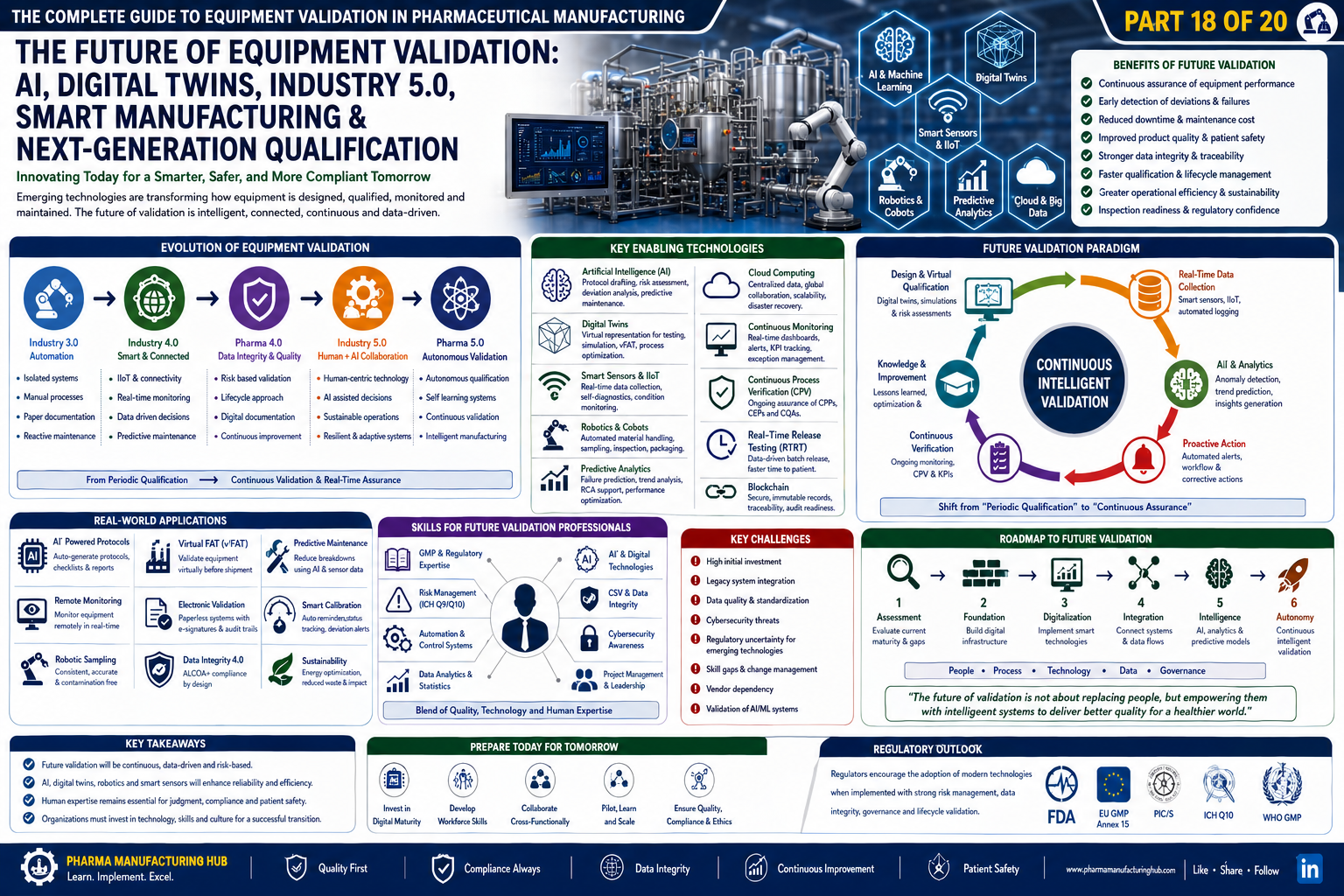
Introduction
Pharmaceutical manufacturing is entering a new era where artificial intelligence, autonomous systems, digital twins, robotics, cloud computing, predictive analytics, and real-time data are transforming the way equipment is designed, qualified, monitored, and maintained.
Historically, equipment validation relied heavily on paper documentation, manual testing, scheduled maintenance, and periodic qualification. While these practices remain fundamental to GMP compliance, they are increasingly being complemented by digital technologies that improve efficiency, strengthen data integrity, and enable proactive decision-making.
The evolution from Industry 3.0 (automation) to Industry 4.0 (connected manufacturing) and now toward Industry 5.0 (human-centric, AI-assisted manufacturing) is reshaping pharmaceutical operations. Validation engineers of the future will require expertise not only in GMP and qualification but also in data analytics, automation, cybersecurity, and intelligent manufacturing systems.
This article explores emerging technologies, future regulatory trends, and practical strategies for preparing pharmaceutical organizations for the next decade of equipment validation.
Evolution of Equipment Validation
Traditional Validation
        │
        ▼
Paper-Based Documentation
        │
        ▼
Electronic Validation
        │
        ▼
Digital Validation
        │
        ▼
AI-Assisted Validation
        │
        ▼
Autonomous Validation
        │
        ▼
Continuous Intelligent Validation
The future will focus on continuous assurance rather than isolated qualification events.
Industry 4.0 and Pharma 4.0
Industry 4.0 introduced:
- Connected equipment
- Smart sensors
- IoT-enabled manufacturing
- Real-time data collection
- Cloud computing
- Predictive maintenance
- Advanced analytics
Pharma 4.0, promoted by ISPE, adapts these concepts to regulated pharmaceutical manufacturing with an emphasis on:
- Product quality
- Patient safety
- Data integrity
- Digital maturity
- Lifecycle management
Industry 5.0
Industry 5.0 builds on Industry 4.0 by emphasizing collaboration between humans and intelligent technologies.
Key characteristics include:
- Human-centered automation
- AI-assisted decision-making
- Collaborative robots (Cobots)
- Sustainable manufacturing
- Personalized medicine
- Resilient production systems
Validation professionals will increasingly work alongside intelligent digital systems rather than replacing human expertise.
Artificial Intelligence (AI)
AI is expected to transform validation by assisting with:
- Protocol generation
- Risk assessment
- Deviation analysis
- Root cause investigation
- CAPA recommendations
- Predictive maintenance
- Document review
- Trend analysis
AI can rapidly analyze large datasets, but final validation decisions should remain under qualified human oversight.
Generative AI
Generative AI can support:
- Drafting qualification protocols
- Preparing validation reports
- Creating SOPs
- Generating traceability matrices
- Developing training materials
- Summarizing deviation investigations
All AI-generated content should be reviewed and approved by qualified personnel before GMP use.
Agentic AI
The next evolution involves AI agents capable of coordinating multiple validation tasks.
Potential applications include:
- Scheduling qualification activities
- Monitoring equipment health
- Reviewing calibration status
- Identifying overdue maintenance
- Preparing inspection packages
- Recommending validation strategies
Organizations should establish governance frameworks to oversee AI-assisted activities.
Digital Twins
A Digital Twin is a dynamic virtual model of physical equipment.
Applications include:
- Equipment design verification
- Virtual Factory Acceptance Testing (vFAT)
- Process simulation
- Capacity optimization
- Operator training
- Change impact analysis
- Predictive maintenance
Digital Twins can reduce engineering risks by allowing evaluation of proposed changes before physical implementation.
Smart Sensors
Future equipment will increasingly incorporate intelligent sensors capable of:
- Self-diagnostics
- Continuous calibration checks
- Wireless communication
- Predictive failure alerts
- Real-time condition monitoring
Examples include sensors for:
- Temperature
- Pressure
- Vibration
- Flow
- Humidity
- Motor current
- Bearing condition
These technologies support condition-based maintenance and improved process understanding.
Robotics and Cobots
Robotics will continue to expand in pharmaceutical manufacturing.
Applications include:
- Material transfer
- Automated cleaning
- Sampling
- Packaging
- Sterile filling support
- Visual inspection
- Warehouse automation
Collaborative robots (Cobots) can safely assist operators with repetitive or ergonomically challenging tasks while remaining subject to appropriate qualification and validation.
Predictive Analytics
Traditional maintenance schedules rely on fixed intervals.
Predictive analytics uses:
- Historical performance data
- Sensor inputs
- Machine learning
- Statistical modeling
to estimate the likelihood of equipment failure before it occurs.
Potential benefits include:
- Reduced downtime
- Improved equipment availability
- Lower maintenance costs
- Better resource planning
Continuous Validation
Future validation strategies are expected to place greater emphasis on continuous validation.
Instead of relying solely on periodic requalification, organizations may use continuous monitoring to demonstrate that equipment remains within its validated operating range.
Continuous validation may incorporate:
- Real-time monitoring
- Statistical trend analysis
- Automated alerts
- Digital dashboards
- Risk-based review
Periodic review and regulatory oversight will remain essential.
Continuous Process Verification (CPV)
CPV integrates:
- Critical Process Parameters (CPPs)
- Critical Equipment Parameters (CEPs)
- Critical Quality Attributes (CQAs)
using continuous data collection and analysis.
Benefits include:
- Earlier detection of process drift
- Improved process understanding
- Reduced variability
- Enhanced lifecycle management
Real-Time Release Testing (RTRT)
RTRT uses real-time process and quality data to support product release decisions.
Potential advantages include:
- Reduced laboratory testing
- Faster batch release
- Improved process control
- Enhanced manufacturing efficiency
Implementation requires robust process understanding, validated analytical methods, and regulatory acceptance.
Cloud-Based Validation
Future validation systems are expected to make greater use of secure cloud technologies.
Potential benefits include:
- Global collaboration
- Centralized documentation
- Automated workflows
- Electronic approvals
- Improved disaster recovery
- Scalable infrastructure
Organizations should ensure that cloud solutions meet applicable GMP, data integrity, and cybersecurity requirements.
Blockchain
Blockchain technology has been proposed for applications such as:
- Document integrity
- Supply chain traceability
- Equipment history records
- Calibration certificates
- Validation documentation
While still emerging in pharmaceutical manufacturing, blockchain may offer additional assurance that records have not been altered.
Paperless Validation
Paperless validation systems replace manual documentation with electronic workflows.
Typical features include:
- Electronic protocols
- Digital signatures
- Automated approvals
- Audit trails
- Version control
- Dashboard reporting
Benefits include improved efficiency, traceability, and document control, provided systems are appropriately validated.
Sustainability and Green Validation
Future validation programs will increasingly support sustainability initiatives by:
- Reducing paper usage
- Optimizing utility consumption
- Improving equipment efficiency
- Extending equipment life
- Minimizing waste
- Supporting energy-efficient operations
Environmental considerations are becoming an important aspect of modern pharmaceutical engineering.
Skills for the Future Validation Engineer
Future validation professionals should develop expertise in:
- GMP and global regulations
- Quality Risk Management
- Automation systems
- PLC, SCADA, and MES
- Computerized System Validation (CSV)
- Data Integrity
- Cybersecurity awareness
- Artificial Intelligence fundamentals
- Data analytics
- Digital transformation
- Project management
- Cross-functional collaboration
Continuous learning will be essential as technologies evolve.
Future Regulatory Trends
Regulatory authorities are expected to continue emphasizing:
- Lifecycle validation
- Quality Risk Management
- Data Integrity
- Computerized System Validation
- Cybersecurity
- Continuous Process Verification
- Digital documentation
- Knowledge management
- Quality culture
Although technologies will evolve, the core principles of patient safety, product quality, and documented evidence are expected to remain unchanged.
Implementation Roadmap
Organizations preparing for the future may consider the following phased approach:
Phase 1 – Digital Foundation
- Standardize validation documentation
- Implement electronic document management
- Strengthen data integrity controls
- Enhance cybersecurity
Phase 2 – Smart Manufacturing
- Deploy IIoT sensors
- Introduce predictive maintenance
- Implement digital dashboards
- Integrate equipment data
Phase 3 – Intelligent Validation
- Evaluate AI-assisted analytics
- Develop Digital Twin capabilities
- Expand continuous monitoring
- Enhance lifecycle performance management
Each phase should include appropriate risk assessments, validation activities, and change management.
Challenges
Organizations may encounter:
- Legacy equipment integration
- Data quality issues
- Cybersecurity threats
- Skills shortages
- High implementation costs
- Regulatory uncertainty for emerging technologies
- Organizational resistance to change
Addressing these challenges requires careful planning, executive support, and ongoing training.
Inspector’s Perspective
Inspectors are increasingly interested in how organizations govern emerging technologies.
Key focus areas include:
- Validation of computerized systems
- Data integrity controls
- AI governance and oversight
- Cybersecurity management
- Audit trails
- Change control
- Periodic review
- Documentation of digital systems
Organizations should be able to demonstrate that new technologies enhance compliance rather than compromise it.
Expert Tips
Expert Tip 1: Treat AI and digital technologies as tools that support qualified personnel. Maintain human review, approval, and accountability for GMP-critical decisions.
Expert Tip 2: Introduce emerging technologies through well-defined pilot projects. Measure benefits, assess risks, and expand implementation only after demonstrating reliable performance.
Expert Tip 3: Invest in workforce development. Training validation engineers in automation, data analytics, and digital systems will be as important as investing in new technologies.
Common Pitfalls
Avoid these common mistakes:
- Assuming digital transformation eliminates validation requirements.
- Implementing AI without documented governance.
- Neglecting cybersecurity during system upgrades.
- Poor integration of legacy equipment.
- Insufficient user training.
- Inadequate change control for digital initiatives.
- Failing to validate cloud-based systems.
- Overreliance on automated recommendations without human review.
Frequently Asked Questions (FAQs)
1. Will AI replace validation engineers?
No. AI is expected to augment the work of validation professionals by supporting data analysis, documentation, and predictive insights. Human expertise, quality oversight, and regulatory judgment remain essential.
2. What is a Digital Twin?
A Digital Twin is a virtual representation of physical equipment used for simulation, optimization, training, and engineering analysis.
3. What is continuous validation?
Continuous validation uses ongoing monitoring, trend analysis, and risk-based review to demonstrate that equipment remains in a validated state throughout its lifecycle.
4. Are paperless validation systems acceptable?
Yes, provided they comply with applicable electronic record, electronic signature, and data integrity requirements.
5. How do smart sensors improve validation?
Smart sensors provide continuous equipment condition data, enabling earlier detection of performance changes and supporting predictive maintenance.
6. What skills will future validation engineers need?
In addition to GMP and validation expertise, professionals will benefit from knowledge of automation, data analytics, AI fundamentals, cybersecurity, and digital manufacturing systems.
7. Can blockchain replace validation documentation?
Blockchain may enhance record integrity and traceability in some applications, but it does not eliminate the need for validated processes, controlled documentation, and quality oversight.
8. What is the biggest challenge in digital transformation?
Successfully integrating new technologies with existing GMP systems while maintaining data integrity, regulatory compliance, and effective change management.
Key Takeaways
- The future of equipment validation will be driven by AI, Digital Twins, Industry 5.0, predictive analytics, smart sensors, and continuous validation, supported by robust GMP and Quality Risk Management principles.
- Emerging technologies offer significant opportunities to improve efficiency, equipment reliability, and process understanding, but they must be implemented with appropriate validation, governance, and cybersecurity controls.
- Human expertise will remain central to decision-making, ensuring that technology enhances rather than replaces quality and regulatory compliance.
- Organizations that invest in digital maturity, workforce development, and lifecycle validation strategies will be well positioned for the next generation of pharmaceutical manufacturing.
Coming Up in Part 19
Comprehensive Equipment Validation Toolkit: SOP Templates, Protocol Formats, Traceability Matrices, Validation Master Plan, Audit Readiness Package, and Regulatory Compliance Resources
In Part 19, we will provide a complete Equipment Validation Toolkit, including ready-to-use SOP templates, IQ/OQ/PQ protocol formats, Validation Master Plan (VMP) structure, URS templates, Risk Assessment templates, Traceability Matrix examples, CAPA forms, Change Control templates, Equipment History File format, Audit Readiness checklists, Validation Summary Report templates, and documentation packages that can be adapted for pharmaceutical manufacturing facilities following global GMP requirements.
Pingback: Building a World-Class Equipment Validation Program. |