
A Real-World Pharmaceutical Equipment Qualification Project from URS to Commercial Release
Series: Part 16 of 20
Introduction
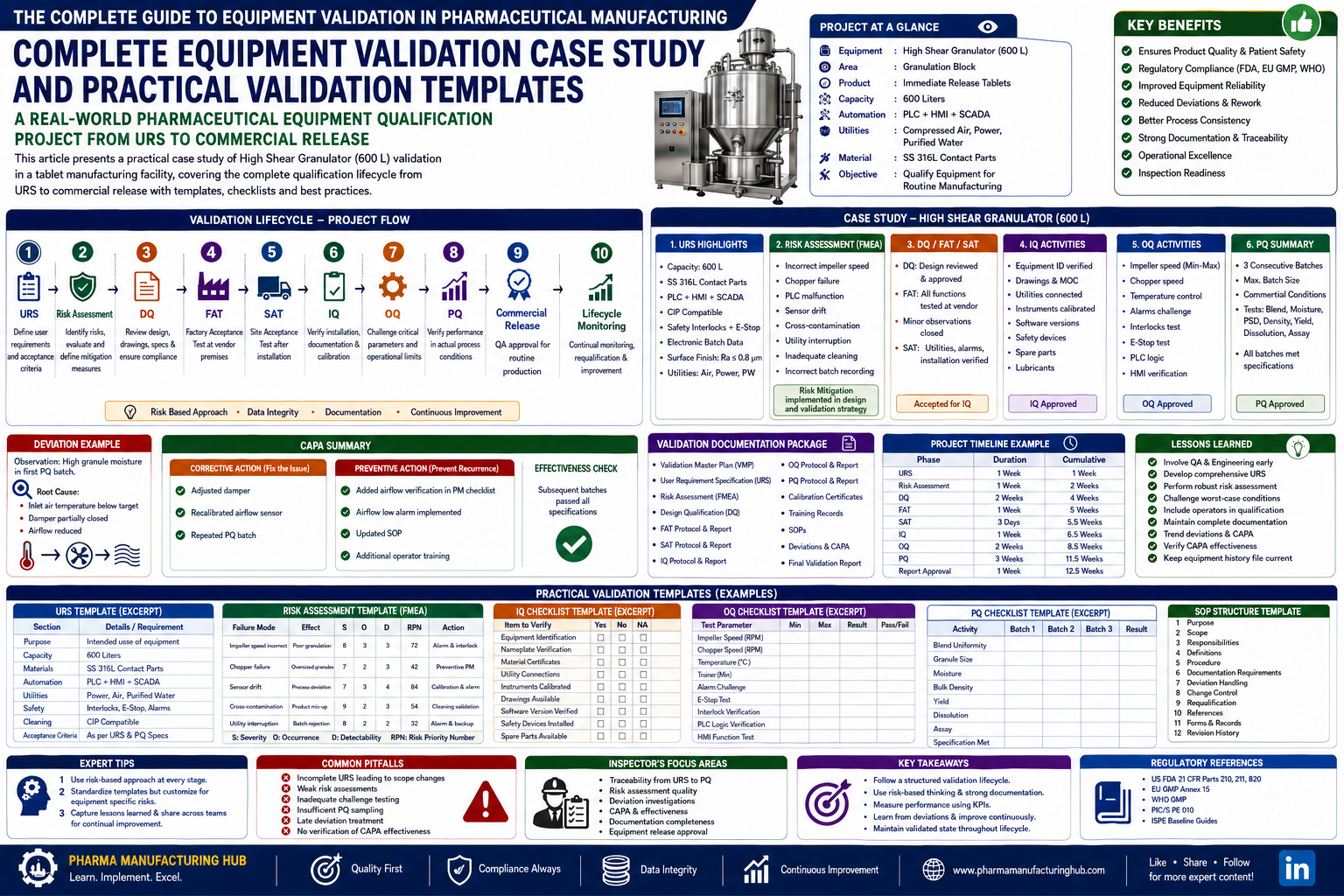
After understanding the principles of Equipment Validation, IQ, OQ, PQ, Risk Assessment, Change Control, Data Integrity, and Digital Validation, the next step is learning how these concepts are applied in a real pharmaceutical manufacturing project.
This article presents a practical case study based on a High Shear Granulator (HSG) used in oral solid dosage (OSD) manufacturing. While the case study is representative, it reflects globally accepted GMP practices and follows the qualification lifecycle recommended by FDA, EU GMP Annex 15, WHO GMP, PIC/S, ISPE Baseline Guides, ASTM, ICH Q9(R1), and ICH Q10.
The objective is to demonstrate how a pharmaceutical organization can successfully qualify new equipment—from User Requirement Specification (URS) through commercial production—using a risk-based and lifecycle approach.
Project Background
Equipment
High Shear Granulator (600 L)
Manufacturing Area
Oral Solid Dosage (Tablet Manufacturing)
Product
Immediate Release Tablets
Capacity
600 Liters
Vendor
Qualified GMP Equipment Manufacturer
Automation
PLC + HMI + SCADA Integration
Installation Site
Granulation Block – GMP Production Area
Validation Lifecycle Overview
URS
 │
 ▼
Risk Assessment
 │
 ▼
Design Qualification (DQ)
 │
 ▼
Factory Acceptance Test (FAT)
 │
 ▼
Site Acceptance Test (SAT)
 │
 ▼
Installation Qualification (IQ)
 │
 ▼
Operational Qualification (OQ)
 │
 ▼
Performance Qualification (PQ)
 │
 ▼
Commercial Release
 │
 ▼
Lifecycle Monitoring
Step 1 – User Requirement Specification (URS)
The project begins with preparation and approval of the URS.
Example URS Requirements
| Requirement | Description |
|---|---|
| Capacity | 600 L |
| Product Contact Material | SS 316L |
| Surface Finish | Ra ≤ 0.8 µm |
| Automation | PLC + HMI |
| Batch Data | Electronic recording |
| Cleaning | CIP compatible |
| Safety | Door interlocks & emergency stop |
| Utilities | Compressed air, power, purified water |
Step 2 – Quality Risk Assessment
A multidisciplinary team performed an FMEA before procurement.
Identified Critical Risks
- Incorrect impeller speed
- Chopper failure
- PLC malfunction
- Temperature sensor drift
- Cross-contamination
- Utility interruption
- Inadequate cleaning
- Incorrect batch recording
Mitigation measures were incorporated into the qualification strategy.
Step 3 – Design Qualification (DQ)
Engineering and QA reviewed:
- Vendor drawings
- Material certificates
- GMP design
- Utility requirements
- Automation architecture
- Cleaning design
- Safety features
- Spare parts
- Software design
Outcome:
Design approved
Step 4 – Factory Acceptance Test (FAT)
Performed at the vendor’s manufacturing facility.
FAT Activities
- Mechanical inspection
- PLC verification
- HMI testing
- Alarm testing
- Impeller rotation
- Chopper verification
- Emergency stop testing
- Documentation review
Result
Minor observations corrected before shipment.
Step 5 – Site Acceptance Test (SAT)
Performed after installation.
Verified:
- Utilities
- Power supply
- Compressed air
- Equipment alignment
- Software installation
- Calibration status
- Safety systems
Outcome
Equipment accepted for IQ.
Step 6 – Installation Qualification (IQ)
IQ Verification
Completed verification of:
✔ Equipment identification
✔ Nameplate
✔ Material certificates
✔ Utility connections
✔ Instrument calibration
✔ Drawings
✔ Spare parts
✔ Lubricants
✔ Software versions
✔ Safety labels
IQ Outcome
Successfully Approved
Step 7 – Operational Qualification (OQ)
Critical operating parameters were challenged.
Tested Parameters
| Parameter | Test |
|---|---|
| Impeller Speed | Min–Nominal–Max |
| Chopper Speed | Operating range |
| Timer | Functional verification |
| Temperature | Sensor verification |
| Alarms | Challenge testing |
| Emergency Stop | Functional test |
| PLC Logic | Verified |
| HMI | Screen verification |
Worst-case operating conditions were included.
OQ Outcome
Approved
Step 8 – Performance Qualification (PQ)
Commercial placebo and product batches were manufactured.
PQ Strategy
Three consecutive batches
Maximum batch size
Routine operators
Commercial manufacturing conditions
Product Testing
- Blend Uniformity
- Granule Size
- Moisture
- Density
- Yield
- Tablet Dissolution
- Assay
All batches met approved specifications.
PQ Outcome
Equipment qualified for routine production.
Example Deviation During Qualification
Observation
High granule moisture observed during first PQ batch.
Investigation
Root Cause Analysis determined:
- Inlet air temperature below target.
- Damper partially closed.
- Airflow reduced.
Corrective Action
- Adjust damper.
- Recalibrate airflow sensor.
- Repeat qualification batch.
Preventive Action
- Add airflow verification to PM checklist.
- Introduce alarm for low airflow.
- Update operator SOP.
CAPA Summary
| CAPA | Action |
|---|---|
| Corrective | Repeat PQ batch |
| Preventive | SOP updated |
| Preventive | Additional operator training |
| Preventive | Maintenance checklist revised |
| Preventive | Airflow alarm implemented |
Effectiveness was confirmed during subsequent batches.
Commercial Release
Following successful completion of IQ, OQ, PQ, deviation closure, and CAPA verification:
✔ Final Validation Report approved
✔ QA released equipment
✔ Equipment added to validated equipment list
✔ Commercial production initiated
Validation Documentation Package
The project generated the following controlled documents:
- Validation Master Plan (VMP)
- User Requirement Specification (URS)
- Risk Assessment (FMEA)
- Design Qualification (DQ)
- FAT Protocol & Report
- SAT Protocol & Report
- IQ Protocol & Report
- OQ Protocol & Report
- PQ Protocol & Report
- Calibration Certificates
- Training Records
- SOPs
- Deviations
- CAPA Records
- Final Validation Summary Report
Practical Validation Templates
URS Template
| Section | Description |
|---|---|
| Purpose | Intended use |
| Capacity | Required output |
| Materials | Contact materials |
| Utilities | Electrical, air, water |
| Automation | PLC/SCADA requirements |
| Safety | Interlocks, E-stop |
| Cleaning | CIP/SIP requirements |
| Acceptance Criteria | Performance expectations |
Risk Assessment Template
| Failure Mode | Effect | Severity | Probability | Detectability | Risk Level | Action |
|---|
IQ Checklist Template
- Equipment identification
- Nameplate verification
- Drawings available
- Utilities connected
- Calibration completed
- Safety labels installed
- Instrument tags verified
- Material certificates reviewed
- Documentation approved
OQ Checklist Template
- Operating ranges tested
- Alarms challenged
- Interlocks verified
- PLC functions verified
- HMI verified
- Emergency stop tested
- Sensors calibrated
- Acceptance criteria achieved
PQ Checklist Template
- Approved protocol
- Commercial product
- Consecutive batches
- Sampling completed
- Laboratory results acceptable
- Statistical review completed
- Deviations closed
- QA approval obtained
Example SOP Structure
A validation SOP should include:
- Purpose
- Scope
- Responsibilities
- Definitions
- Qualification Process
- Documentation Requirements
- Deviation Handling
- Change Control
- Requalification
- References
- Forms
- Revision History
Validation Timeline Example
| Phase | Duration |
|---|---|
| URS | 1 Week |
| Risk Assessment | 1 Week |
| DQ | 2 Weeks |
| FAT | 1 Week |
| SAT | 3 Days |
| IQ | 1 Week |
| OQ | 2 Weeks |
| PQ | 3 Weeks |
| Report Approval | 1 Week |
Total Project Duration: Approximately 12 Weeks (actual timelines depend on equipment complexity, procurement, and organizational processes).
Lessons Learned
Key lessons from the project:
- Involve QA and Engineering early.
- Develop a comprehensive URS.
- Perform robust risk assessment.
- Challenge worst-case operating conditions.
- Include operators in qualification activities.
- Maintain complete documentation.
- Trend deviations.
- Verify CAPA effectiveness.
- Keep the equipment history file current.
Inspector’s Perspective
During inspections, regulators are likely to review:
- The rationale for qualification strategy.
- Traceability from URS to PQ.
- Risk assessment documentation.
- Deviation investigations.
- CAPA effectiveness.
- Validation reports.
- Equipment release approval.
- Lifecycle management records.
A well-documented case study with complete traceability demonstrates effective implementation of GMP and Quality Risk Management principles.
Expert Tips
Expert Tip 1: Treat qualification as a multidisciplinary project. Collaboration between Engineering, Validation, QA, Production, Automation, and Maintenance improves both technical quality and regulatory compliance.
Expert Tip 2: Use standardized templates for URS, protocols, reports, and checklists, but customize them to reflect equipment-specific risks and operational requirements.
Expert Tip 3: Capture lessons learned from every validation project and incorporate them into future qualification plans, SOPs, and training programs to drive continual improvement.
Common Pitfalls
Avoid these common mistakes:
- Incomplete URS leading to scope changes.
- Weak risk assessments.
- Poor traceability between qualification stages.
- Inadequate challenge testing during OQ.
- Insufficient sampling during PQ.
- Delayed investigation of deviations.
- Failure to verify CAPA effectiveness.
- Incomplete final validation reports.
Frequently Asked Questions (FAQs)
1. Why are case studies valuable in equipment validation?
They demonstrate how validation principles are applied in practical GMP environments and help teams understand the complete qualification lifecycle.
2. Why is a multidisciplinary team important?
Different functions contribute expertise in engineering, quality, production, automation, maintenance, and regulatory compliance, leading to more robust qualification.
3. Can templates be reused?
Yes, provided they are reviewed, updated, and customized to the specific equipment, process, and risk profile.
4. Why are three consecutive PQ batches commonly performed?
They provide evidence of consistent equipment and process performance under routine manufacturing conditions, although the approach should be justified based on product and process knowledge.
5. What is the purpose of the Final Validation Report?
It summarizes all qualification activities, results, deviations, CAPA, conclusions, and recommendations, supporting QA approval for routine production.
6. How should lessons learned be managed?
They should be documented, shared across validation teams, and incorporated into SOPs, training programs, and future qualification projects.
7. What role does QA play in commercial release?
QA reviews the complete validation package, confirms acceptance criteria have been met, and authorizes equipment release for routine manufacturing.
8. What happens after commercial release?
The equipment enters lifecycle management, including calibration, preventive maintenance, change control, periodic review, requalification (when required), and continual performance monitoring.
Key Takeaways
- A successful equipment validation project follows a structured lifecycle from URS through commercial release, supported by risk assessment, qualification, documentation, and continual improvement.
- Standardized templates and practical checklists improve consistency, efficiency, and regulatory compliance.
- Effective deviation management, CAPA, and lessons learned strengthen future validation activities.
- Case-study-based learning bridges the gap between regulatory requirements and real-world pharmaceutical manufacturing practice.
Coming Up in Part 17
Practical Validation Checklists, 50 Interview Questions with Expert Answers, 50 Global Best Practices, and 30 Common Equipment Validation Mistakes
In Part 17, we will provide ready-to-use IQ, OQ, PQ, FAT, SAT, Calibration, Maintenance, Vendor Audit, and Periodic Review checklists, followed by 50 pharmaceutical equipment validation interview questions with detailed answers, 50 best practices adopted by leading global pharmaceutical companies, and 30 common mistakes with practical strategies to prevent them. This comprehensive article is designed to serve as a valuable reference for Validation Engineers, QA professionals, Engineering Managers, auditors, consultants, and freshers preparing for interviews and regulatory inspections.
About the Author
Ramesh Palav is a pharmaceutical professional with 20+ years of industry experience in manufacturing, GMP, quality systems, validation, compliance, and operational excellence. Through Pharma Manufacturing Hub, he shares practical insights on pharmaceutical careers, manufacturing, quality, validation, Pharma 4.0, AI, and professional development.
His goal is to help students, freshers, experienced professionals, and career-break professionals build the knowledge and skills needed to succeed in the pharmaceutical industry.