
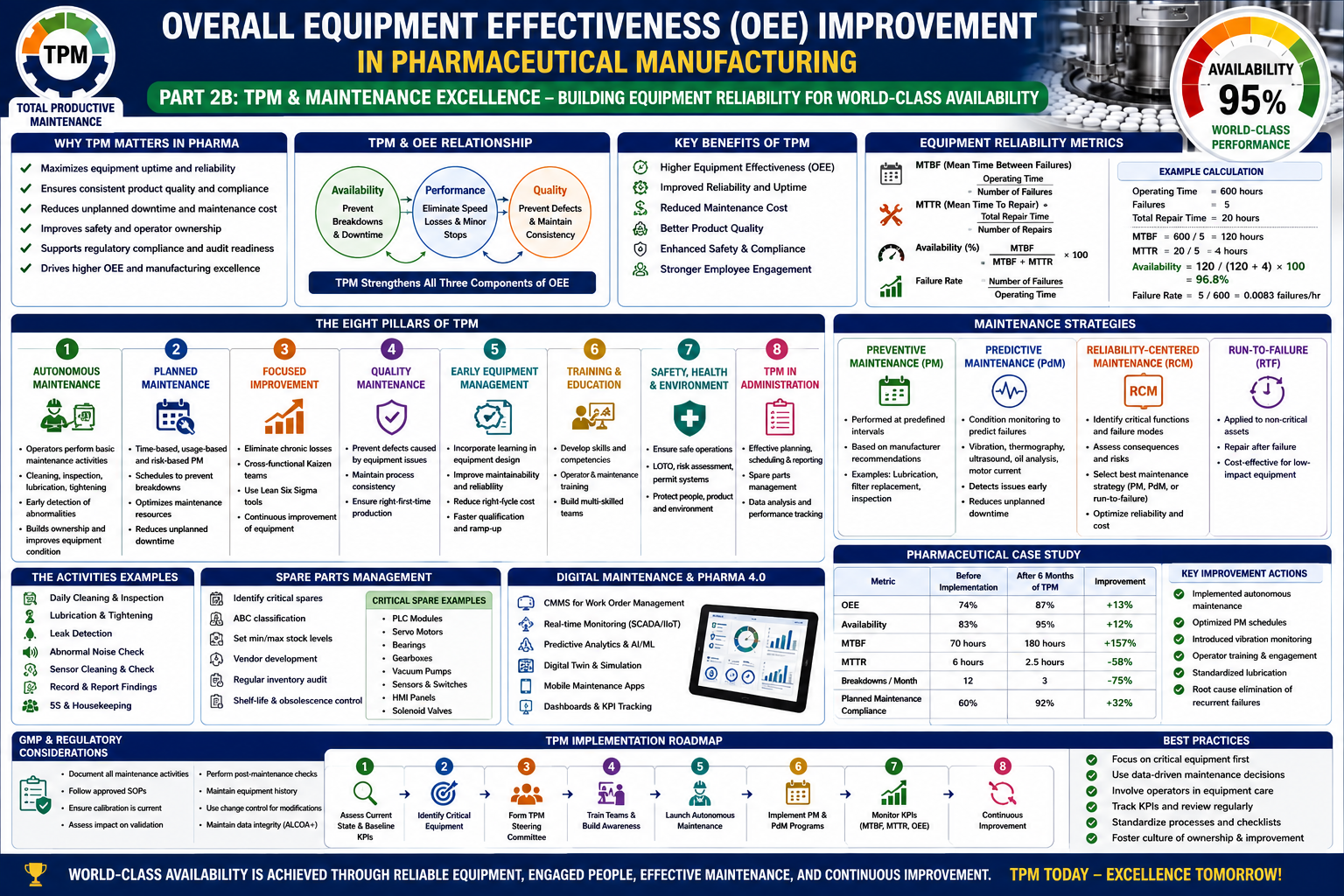
Part 2B: TPM & Maintenance Excellence – Building Equipment Reliability for World-Class Availability
A Professional Guide for Pharmaceutical Manufacturing Excellence
Table of Contents
- Introduction to Total Productive Maintenance (TPM)
- Why TPM Matters in Pharmaceutical Manufacturing
- Relationship Between TPM and OEE
- The Eight Pillars of TPM
- Autonomous Maintenance (Jishu Hozen)
- Planned & Preventive Maintenance
- Predictive Maintenance (PdM)
- Reliability-Centered Maintenance (RCM)
- Maintenance Planning & Scheduling
- Critical Spare Parts Management
- Equipment Reliability Metrics (MTBF, MTTR, Failure Rate)
- Digital Maintenance & Pharma 4.0
- Pharmaceutical Case Study
- GMP & Regulatory Considerations
- TPM Implementation Roadmap
- Best Practices
- Key Takeaways
1. Introduction to Total Productive Maintenance (TPM)
In pharmaceutical manufacturing, equipment reliability is directly linked to product quality, regulatory compliance, patient safety, and operational efficiency. Unexpected equipment failures can interrupt production, delay batch release, increase investigation workload, and jeopardize supply commitments.
Total Productive Maintenance (TPM) is a comprehensive maintenance philosophy that involves every employee—from operators to senior management—in maximizing equipment effectiveness throughout its lifecycle.
Unlike traditional maintenance approaches that rely on repairing equipment after failure, TPM emphasizes proactive prevention, operator ownership, continuous improvement, and lifecycle asset management.
When implemented effectively, TPM significantly improves:
- Overall Equipment Effectiveness (OEE)
- Equipment availability
- Reliability and uptime
- Product quality
- Safety performance
- Maintenance cost efficiency
- Regulatory compliance
2. Why TPM Matters in Pharmaceutical Manufacturing
Pharmaceutical manufacturing presents unique challenges:
- Complex production equipment
- Strict validation requirements
- Frequent product changeovers
- High cleaning standards
- Regulatory inspections
- Tight production schedules
- High product value
Equipment failures in these environments can result in:
- Batch rejection
- Production delays
- Deviation investigations
- CAPA initiation
- Increased maintenance costs
- Supply chain disruptions
TPM minimizes these risks by fostering a culture of shared responsibility for equipment health.
3. Relationship Between TPM and OEE
TPM directly addresses the three components of OEE:
| OEE Component | TPM Contribution |
|---|---|
| Availability | Prevents breakdowns and reduces downtime |
| Performance | Eliminates speed losses and minor stoppages |
| Quality | Maintains process consistency and reduces defects |
By strengthening equipment reliability, TPM enhances all three dimensions of equipment effectiveness.
4. The Eight Pillars of TPM
A successful TPM program is built upon eight interconnected pillars:
4.1 Autonomous Maintenance (Jishu Hozen)
Operators perform routine maintenance tasks such as:
- Cleaning
- Inspection
- Lubrication
- Tightening
- Basic adjustments
This promotes early detection of abnormalities and reduces dependence on maintenance personnel.
4.2 Planned Maintenance
Maintenance activities are scheduled based on:
- Time intervals
- Equipment usage
- Manufacturer recommendations
- Risk assessments
- Historical failure data
Objective:
Reduce unplanned downtime while optimizing maintenance resources.
4.3 Focused Improvement (Kaizen)
Cross-functional teams identify chronic equipment losses and implement systematic improvements using Lean and Six Sigma tools.
4.4 Quality Maintenance
Focuses on preventing defects caused by equipment deterioration.
Examples include:
- Compression force verification
- Coating spray pattern validation
- Vision inspection calibration
- Temperature control verification
4.5 Early Equipment Management
Lessons learned from existing equipment are incorporated into the design and procurement of new assets.
Benefits include:
- Improved maintainability
- Faster qualification
- Reduced lifecycle costs
- Enhanced reliability
4.6 Training and Education
Competency development ensures:
- Skilled operators
- Qualified maintenance personnel
- Effective troubleshooting
- Standardized maintenance practices
4.7 Safety, Health & Environment (SHE)
Maintenance must support:
- Personnel safety
- Product protection
- Environmental compliance
- GMP requirements
Examples:
- Lockout/Tagout (LOTO)
- Hazardous energy isolation
- Safe confined space entry
- Dust explosion prevention
4.8 TPM in Administrative Functions
Support departments also contribute through:
- Efficient spare parts procurement
- Maintenance planning
- Documentation management
- Vendor coordination
- Data analysis
5. Autonomous Maintenance (Jishu Hozen)
Autonomous Maintenance empowers operators to become the first line of defense against equipment deterioration.
Typical Activities
Daily:
- Equipment cleaning
- Visual inspection
- Leak detection
- Lubrication checks
- Abnormal noise identification
Weekly:
- Fastener inspection
- Sensor cleaning
- Belt inspection
- Pressure verification
Monthly:
- Calibration verification (where applicable)
- Functional testing
- Condition reporting
Benefits
- Early failure detection
- Reduced breakdown frequency
- Improved operator ownership
- Enhanced equipment reliability
- Better housekeeping (5S)
- Improved safety
6. Planned & Preventive Maintenance
Preventive maintenance (PM) consists of scheduled activities designed to prevent equipment failures before they occur.
Types of PM
Time-Based Maintenance
Examples:
- Lubrication every month
- Filter replacement every three months
- Bearing inspection every six months
Usage-Based Maintenance
Maintenance triggered by:
- Operating hours
- Production cycles
- Number of batches
- Equipment starts/stops
Risk-Based Maintenance
Maintenance frequency determined by:
- Equipment criticality
- Failure history
- Patient risk
- Business impact
7. Predictive Maintenance (PdM)
Predictive maintenance uses condition-monitoring technologies to detect equipment degradation before failure.
Common Techniques
Vibration Analysis
Detects:
- Bearing wear
- Shaft misalignment
- Rotor imbalance
- Mechanical looseness
Infrared Thermography
Identifies:
- Electrical hotspots
- Overheated motors
- Loose electrical connections
- Insulation degradation
Ultrasonic Inspection
Used for:
- Air leaks
- Steam leaks
- Vacuum leaks
- Bearing lubrication assessment
Oil Analysis
Evaluates:
- Wear particles
- Lubricant contamination
- Moisture content
- Lubricant degradation
Motor Current Analysis
Detects:
- Rotor defects
- Electrical imbalance
- Overloading
- Power quality issues
8. Reliability-Centered Maintenance (RCM)
RCM is a structured methodology that determines the most effective maintenance strategy for each asset based on its function, failure modes, and consequences.
RCM Process
- Define equipment functions.
- Identify functional failures.
- Determine failure modes.
- Assess consequences.
- Select appropriate maintenance strategy.
- Monitor effectiveness.
Maintenance Options
- Preventive Maintenance
- Predictive Maintenance
- Condition Monitoring
- Failure Finding
- Design Improvement
- Run-to-Failure (for non-critical assets)
9. Maintenance Planning & Scheduling
Effective planning minimizes maintenance-related downtime.
Weekly Maintenance Planning
Include:
- Work orders
- Resource allocation
- Spare parts availability
- Permit requirements
- Equipment isolation plans
- Calibration needs
Shutdown Planning
For major maintenance:
- Define scope
- Prepare materials
- Assign responsibilities
- Coordinate with production
- Validate post-maintenance readiness
10. Critical Spare Parts Management
Poor spare parts management is a common cause of prolonged downtime.
Critical Spare Examples
- PLC modules
- Servo motors
- Bearings
- Gearboxes
- Vacuum pumps
- Sensors
- HMI panels
- Solenoid valves
Best Practices
- ABC inventory classification
- Minimum stock levels
- Vendor agreements
- Shelf-life monitoring
- Periodic inventory audits
11. Equipment Reliability Metrics
Mean Time Between Failures (MTBF)
Formula:
MTBF = Operating Time ÷ Number of Failures
Example
Operating Time = 600 hours
Failures = 5
MTBF = 600 ÷ 5 = 120 hours
A higher MTBF indicates better reliability.
Mean Time to Repair (MTTR)
Formula:
MTTR = Total Repair Time ÷ Number of Repairs
Example:
Repair Time = 20 hours
Repairs = 5
MTTR = 20 ÷ 5 = 4 hours
A lower MTTR indicates more efficient maintenance.
Failure Rate
Formula:
Failure Rate = Number of Failures ÷ Operating Time
Example:
5 failures over 600 hours
Failure Rate = 0.0083 failures/hour
Equipment Availability
Availability = MTBF ÷ (MTBF + MTTR)
Example:
MTBF = 120 hours
MTTR = 4 hours
Availability = 120 ÷ (120 + 4)
= 96.8%
12. Digital Maintenance & Pharma 4.0
Modern pharmaceutical facilities leverage digital technologies to enhance maintenance effectiveness.
Integrated Systems
- Manufacturing Execution System (MES)
- Computerized Maintenance Management System (CMMS)
- SCADA
- PLC Diagnostics
- Industrial Internet of Things (IIoT)
- Digital Twin technology
- AI-driven analytics
Benefits
- Real-time equipment monitoring
- Automated work order generation
- Predictive failure alerts
- Maintenance history tracking
- Spare parts optimization
- Improved audit readiness
13. Pharmaceutical Case Study
Scenario
A blister packaging line experienced frequent servo motor failures.
Initial Performance
| Metric | Value |
|---|---|
| OEE | 74% |
| Availability | 83% |
| MTBF | 70 hours |
| MTTR | 6 hours |
| Monthly Breakdowns | 12 |
Root Causes
- Misaligned drive system
- Inadequate lubrication
- Delayed preventive maintenance
- Operator unfamiliarity with early warning signs
Improvement Actions
- Implemented autonomous maintenance.
- Revised PM schedule.
- Introduced vibration monitoring.
- Conducted operator training.
- Standardized lubrication procedures.
Results After Six Months
| Metric | Before | After |
|---|---|---|
| OEE | 74% | 87% |
| Availability | 83% | 95% |
| MTBF | 70 h | 180 h |
| MTTR | 6 h | 2.5 h |
| Breakdowns | 12 | 3 |
14. GMP & Regulatory Considerations
Maintenance activities must comply with GMP and support validated operations.
Key requirements include:
- Document all maintenance activities.
- Use approved procedures.
- Verify calibration status before production.
- Assess maintenance impact on validation.
- Complete post-maintenance functional checks.
- Manage changes through formal change control.
- Maintain complete equipment history.
- Ensure electronic records comply with ALCOA+ principles.
Proper documentation demonstrates control during regulatory inspections.
15. TPM Implementation Roadmap
| Phase | Key Activities |
|---|---|
| 1 | Assess current maintenance performance and baseline KPIs |
| 2 | Identify critical equipment using risk assessment |
| 3 | Establish TPM steering committee |
| 4 | Train operators and maintenance teams |
| 5 | Launch autonomous maintenance program |
| 6 | Optimize preventive maintenance schedules |
| 7 | Implement predictive maintenance technologies |
| 8 | Monitor MTBF, MTTR, OEE, and maintenance KPIs |
| 9 | Conduct periodic audits and continuous improvement reviews |
16. Best Practices
- Align maintenance strategy with equipment criticality.
- Standardize maintenance procedures and checklists.
- Use CMMS for work order management.
- Integrate maintenance data with MES and SCADA.
- Perform routine reliability reviews.
- Encourage operator involvement through autonomous maintenance.
- Analyze recurring failures using Root Cause Analysis (RCA).
- Maintain a robust spare parts strategy.
- Review KPIs monthly and implement corrective actions.
- Foster a culture of continuous improvement.
17. Key Takeaways
- TPM is a cornerstone of manufacturing excellence and directly improves OEE by enhancing equipment reliability.
- The Eight Pillars of TPM create a structured framework for sustainable maintenance practices.
- Preventive, predictive, and reliability-centered maintenance strategies reduce breakdowns and extend equipment life.
- Metrics such as MTBF, MTTR, and equipment availability provide objective measures of maintenance effectiveness.
- Digital technologies—including MES, CMMS, SCADA, IIoT, and AI—enable predictive maintenance and real-time asset management.
- In pharmaceutical manufacturing, all maintenance activities must be executed within a GMP-compliant framework to preserve equipment qualification, product quality, and regulatory compliance.
Coming in Part 2C: Root Cause Analysis & Changeover Optimization
The final section of Part 2 will focus on eliminating recurring equipment losses through systematic problem-solving and process optimization. Topics will include:
- Advanced Root Cause Analysis (5 Whys, Fishbone Diagram, Fault Tree Analysis)
- Failure Mode and Effects Analysis (FMEA)
- Statistical analysis of recurring downtime
- Single-Minute Exchange of Dies (SMED) for rapid and compliant changeovers
- Pharmaceutical cleaning and line clearance optimization
- Practical case studies from tablet compression, coating, and packaging operations
- Standardized RCA templates, FMEA worksheets, SMED checklists, and implementation roadmap to achieve world-class equipment availability and operational excellence.
About the Author
Ramesh Palav is a seasoned professional in GxP Quality, Computer System Validation (CSV), Data Integrity, and Pharmaceutical IT Compliance. He has extensive experience in implementing and managing GxP computerized systems, risk-based validation, audit trails, data integrity, and regulatory compliance. Through his articles and professional insights, he aims to share practical knowledge and help pharmaceutical and life-sciences professionals strengthen quality, compliance, and data integrity.