
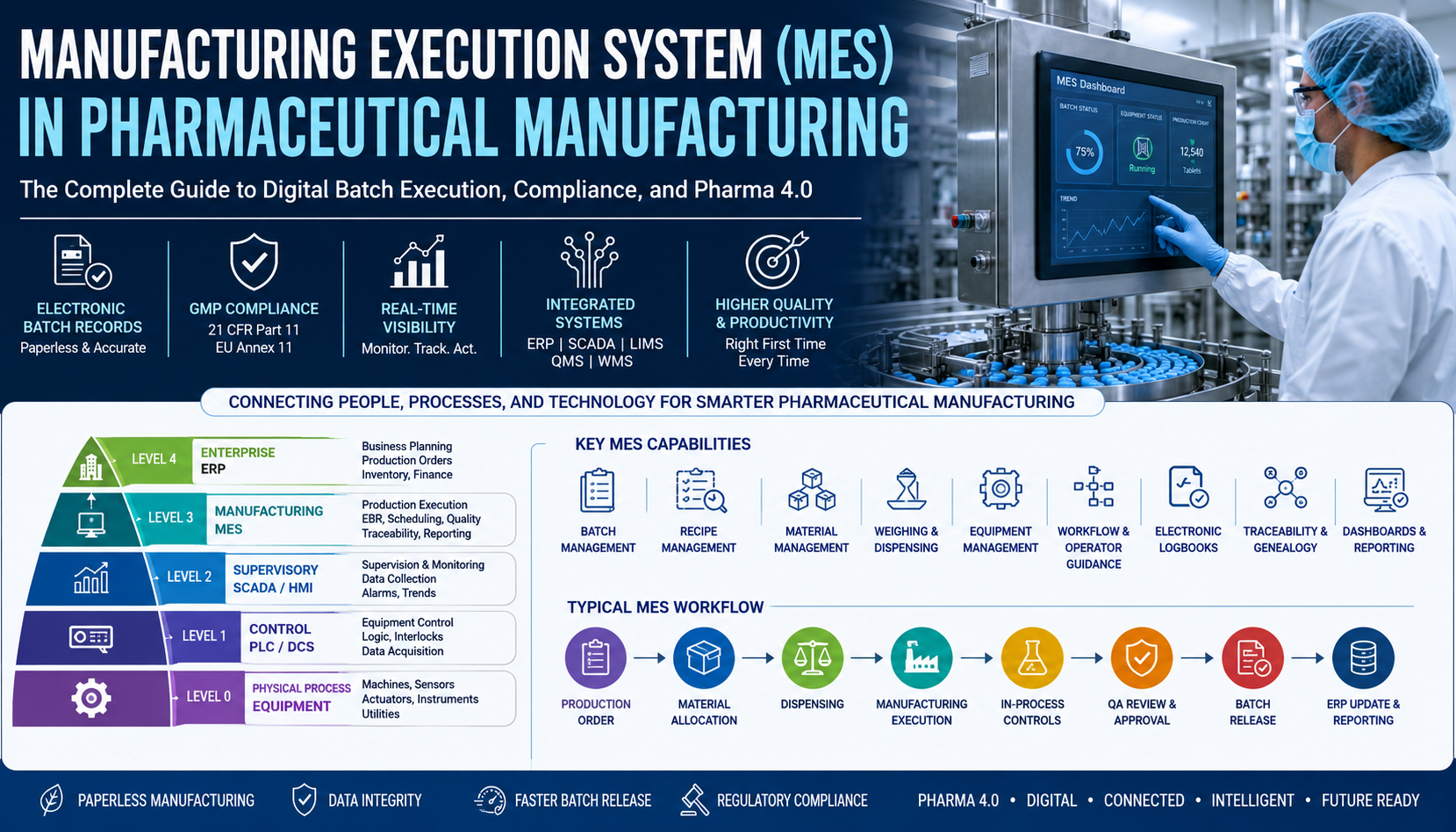
Part 1: Introduction, MES Fundamentals, and ISA-95 Architecture
Executive Summary
The pharmaceutical industry is undergoing one of its most significant digital transformations since the introduction of Good Manufacturing Practices (GMP). Increasing regulatory expectations, rising production complexity, growing demands for data integrity, and the need for faster product release have made traditional paper-based manufacturing increasingly inefficient.
A Manufacturing Execution System (MES) bridges the gap between enterprise planning systems and shop-floor automation, enabling paperless manufacturing, electronic batch records (EBR), real-time production monitoring, enhanced traceability, and regulatory compliance. As a foundational technology for Pharma 4.0, MES empowers pharmaceutical manufacturers to improve quality, productivity, operational excellence, and inspection readiness while reducing human error and accelerating batch release.
This guide explores the core concepts, architecture, and business value of MES in pharmaceutical manufacturing, providing practical insights for production professionals, quality teams, automation engineers, validation specialists, and digital transformation leaders.
Table of Contents (Part 1)
- Introduction
- Evolution of Pharmaceutical Manufacturing
- What is a Manufacturing Execution System (MES)?
- Objectives of MES
- Core Functions of MES
- MES as the Foundation of Pharma 4.0
- Electronic Batch Records (EBR)
- Manufacturing Intelligence
- ISA-95 Architecture
- MES Data Flow
- Benefits of ISA-95 Standardization
- Key Takeaways
1. Introduction
For decades, pharmaceutical manufacturing relied heavily on paper-based batch manufacturing records (BMRs), manual equipment logbooks, handwritten calculations, and physical signatures. While these practices satisfied regulatory requirements, they introduced significant operational challenges, including:
- Manual transcription errors
- Delayed batch reviews
- Incomplete documentation
- Limited production visibility
- Slow deviation investigations
- Increased compliance risk
- High documentation costs
- Lengthy batch release cycles
As global regulatory agencies increased their focus on electronic records, data integrity, and lifecycle management, pharmaceutical manufacturers began adopting digital manufacturing technologies to improve operational control and ensure compliance.
Today, the Manufacturing Execution System (MES) is recognized as the digital backbone of modern pharmaceutical production, connecting business systems with manufacturing operations to enable real-time execution, monitoring, and control.
Why MES is Essential in Pharmaceutical Manufacturing
Modern pharmaceutical facilities operate in a highly regulated environment where every manufacturing activity must be documented, verified, and traceable.
Key industry drivers include:
- Regulatory compliance
- Data Integrity (ALCOA+)
- Product quality
- Patient safety
- Operational excellence
- Reduced manufacturing costs
- Paperless manufacturing
- Real-time production monitoring
- Faster batch release
- Continuous process improvement
- Digital transformation initiatives
MES directly addresses these needs by digitizing manufacturing workflows and ensuring that every production step is executed according to approved procedures.
Evolution of Pharmaceutical Manufacturing
Generation 1 – Paper-Based Manufacturing
Characteristics:
- Paper Batch Records
- Manual signatures
- Physical logbooks
- Manual calculations
- Spreadsheet tracking
- Delayed reporting
Challenges:
- Human errors
- Missing documentation
- Long review times
- Slow investigations
- Poor traceability
Generation 2 – Automated Equipment
Characteristics:
- PLC-controlled machines
- SCADA systems
- Standalone automation
- Local HMIs
Limitations:
- No centralized manufacturing control
- Isolated data silos
- Manual record compilation
Generation 3 – MES-Driven Manufacturing
Characteristics:
- Electronic Batch Records
- Digital workflows
- Automated calculations
- Equipment integration
- Barcode verification
- Electronic signatures
- Real-time monitoring
Benefits:
- Reduced human intervention
- Improved compliance
- Enhanced traceability
- Faster batch release
Generation 4 – Pharma 4.0 Smart Manufacturing
Characteristics:
- Artificial Intelligence
- Machine Learning
- Industrial IoT
- Predictive Analytics
- Digital Twins
- Cloud Manufacturing
- Autonomous Decision Support
This evolution positions MES as the central orchestration layer that connects enterprise systems with intelligent manufacturing technologies.
2. What is a Manufacturing Execution System (MES)?
A Manufacturing Execution System (MES) is a computerized system that manages, monitors, controls, documents, and optimizes manufacturing operations in real time. It acts as the operational layer between enterprise business systems (such as ERP) and shop-floor automation systems (such as SCADA and PLCs).
MES ensures that manufacturing activities are executed exactly as defined in approved procedures while capturing accurate production data to support quality, compliance, and continuous improvement.
Simple Definition
MES is the digital operating system of a pharmaceutical manufacturing plant. It ensures the right materials, equipment, procedures, and personnel are used to manufacture the right product in the right way, every time.
Primary Objectives of MES
An MES is designed to achieve several strategic and operational objectives:
| Objective | Business Value |
|---|---|
| Digital batch execution | Eliminates paper records |
| Standardized manufacturing | Reduces process variability |
| Real-time monitoring | Improves operational visibility |
| Regulatory compliance | Supports GMP and electronic records requirements |
| Data integrity | Ensures accurate, complete, and traceable records |
| Productivity improvement | Reduces downtime and manual effort |
| Faster batch release | Minimizes review cycles |
| End-to-end traceability | Supports investigations and recalls |
| Manufacturing intelligence | Enables data-driven decision-making |
Core Functions of MES
A modern pharmaceutical MES typically provides:
- Electronic Batch Records (EBR)
- Batch execution management
- Recipe management
- Material management
- Weighing and dispensing
- Equipment status monitoring
- Workflow automation
- Electronic logbooks
- Operator guidance
- Production scheduling
- KPI dashboards
- Quality checks
- Genealogy and traceability
- Label management
- Reporting and analytics
Each of these functions contributes to a controlled, compliant, and efficient manufacturing environment.
How MES Works
Production Order
        │
        ▼
MES Receives Order from ERP
        │
        ▼
Material Verification
        │
        ▼
Equipment Verification
        │
        ▼
Operator Authentication
        │
        ▼
Electronic Batch Execution
        │
        ▼
Real-Time Data Collection
        │
        ▼
Quality Verification
        │
        ▼
Electronic Batch Record Completion
        │
        ▼
ERP Inventory Update
This workflow ensures that each manufacturing step is executed according to predefined procedures, with all critical data captured electronically.
Digital Manufacturing Concept
Digital manufacturing integrates people, processes, equipment, and information systems into a unified ecosystem. Instead of relying on manual documentation and disconnected systems, MES enables seamless communication across the manufacturing lifecycle.
Key Components
- Automated data capture
- Real-time process monitoring
- Electronic workflows
- Integrated quality checks
- Centralized data management
- Decision support dashboards
The result is a manufacturing environment that is more efficient, transparent, and compliant.
Manufacturing Intelligence
Manufacturing intelligence refers to the ability to transform raw production data into actionable insights. MES collects data from equipment, operators, materials, and quality systems, enabling manufacturers to monitor performance, identify trends, and drive continuous improvement.
Examples include:
- Overall Equipment Effectiveness (OEE)
- Right First Time (RFT)
- Batch cycle time
- Yield analysis
- Downtime analysis
- Material consumption
- Operator performance
- Deviation trends
These insights support proactive decision-making and operational excellence.
Electronic Batch Record (EBR)
An Electronic Batch Record is a digital version of the traditional paper Batch Manufacturing Record (BMR). It captures all manufacturing activities electronically, ensuring accuracy, completeness, and traceability.
Typical Information Captured
- Production order details
- Product and batch information
- Material consumption
- Equipment used
- Operator actions
- Process parameters
- In-process checks
- Electronic signatures
- Deviations and comments
- Quality approvals
Advantages of EBR
- Eliminates manual transcription
- Reduces documentation errors
- Accelerates batch review
- Supports review by exception
- Enhances data integrity
- Improves regulatory compliance
MES and Pharma 4.0
Pharma 4.0 is a framework that leverages digital technologies to create intelligent, connected, and data-driven pharmaceutical manufacturing operations. MES serves as the operational core of this framework by integrating enterprise systems, automation, and analytics.
MES Enables Pharma 4.0 Through:
- Paperless manufacturing
- Real-time production visibility
- Connected equipment
- Automated workflows
- Predictive maintenance
- AI-driven analytics
- Digital quality management
- End-to-end traceability
As organizations advance toward smart factories, MES becomes indispensable for orchestrating digital manufacturing processes.
3. ISA-95 Architecture
The ISA-95 standard provides a framework for integrating enterprise and control systems. It defines five hierarchical levels that facilitate standardized communication between business systems and manufacturing operations.
ISA-95 Hierarchy
LEVEL 4
Enterprise Planning
ERP (SAP, Oracle)
Production Planning
Procurement
Finance
Inventory
────────────────────────────────────

LEVEL 3
Manufacturing Execution System (MES)
Batch Management
Electronic Batch Records
Scheduling
Quality
Traceability
Reporting
────────────────────────────────────

LEVEL 2
SCADA / HMI
Supervisory Control
Data Acquisition
Visualization
Alarm Management
────────────────────────────────────

LEVEL 1
PLC / DCS
Equipment Automation
Machine Control
Sensors
Actuators
────────────────────────────────────

LEVEL 0
Physical Process
Mixers
Granulators
Compressors
Coating Pans
Packaging Lines
Utilities
Understanding Each ISA-95 Level
Level 4 – Enterprise Planning (ERP)
Responsible for:
- Production planning
- Material requirement planning (MRP)
- Inventory management
- Procurement
- Sales orders
- Financial management
ERP answers the question:
“What should be produced and when?”
Level 3 – Manufacturing Execution System (MES)
Responsible for:
- Executing production orders
- Managing recipes
- Enforcing workflows
- Recording manufacturing data
- Managing electronic batch records
- Monitoring production progress
- Ensuring compliance
MES answers the question:
“How should production be executed?”
Level 2 – SCADA / HMI
Responsible for:
- Supervising equipment
- Collecting process data
- Displaying alarms
- Monitoring process parameters
- Visualizing production status
SCADA answers the question:
“What is happening on the shop floor right now?”
Level 1 – PLC / DCS
Responsible for:
- Machine automation
- Valve control
- Motor control
- Temperature regulation
- Pressure control
- Interlocks
PLCs answer the question:
“How should individual machines operate?”
Level 0 – Physical Process
This level includes the actual manufacturing equipment and physical processes where pharmaceutical products are produced.
Examples:
- Fluid bed dryers
- Rapid mixer granulators
- Tablet presses
- Coating machines
- Blister packaging lines
- Environmental monitoring sensors
MES Data Flow Across ISA-95 Levels
ERP
 │
 │ Production Orders
 ▼
MES
 │
 │ Batch Instructions
 ▼
SCADA
 │
 │ Commands
 ▼
PLC
 │
 │ Control Signals
 ▼
Equipment

▲
│ Real-Time Process Data
│
PLC
▲
│
SCADA
▲
│
MES
▲
│
ERP Reports
Information Flow
- ERP sends production orders to MES.
- MES verifies materials, equipment, and personnel before execution.
- MES dispatches process instructions to SCADA.
- SCADA communicates with PLCs to control equipment.
- PLCs execute control logic and return process data.
- SCADA aggregates operational data.
- MES compiles production information into the Electronic Batch Record.
- ERP receives production confirmations, inventory updates, and batch status.
This closed-loop information flow enables synchronized planning, execution, monitoring, and reporting across the manufacturing enterprise.
Benefits of ISA-95 Standardization
Implementing MES within the ISA-95 framework offers significant advantages:
- Standardized system integration
- Improved interoperability between vendors
- Reduced custom interface development
- Consistent data structures
- Faster implementation
- Easier scalability
- Enhanced compliance
- Better lifecycle management
- Simplified maintenance
- Foundation for Pharma 4.0 initiatives
Key Takeaways
- A Manufacturing Execution System (MES) is the operational core of digital pharmaceutical manufacturing.
- MES replaces paper-based processes with controlled, electronic workflows that improve compliance and efficiency.
- Electronic Batch Records (EBR) enable accurate, complete, and reviewable production documentation.
- MES bridges enterprise planning (ERP) and shop-floor automation (SCADA/PLC) using the ISA-95 framework.
- Real-time data collection and manufacturing intelligence support operational excellence, data integrity, and faster batch release.
- MES is a foundational technology for Pharma 4.0, enabling connected, intelligent, and future-ready manufacturing environments.
About the Author
Ramesh Palav is a seasoned professional in GxP Quality, Computer System Validation (CSV), Data Integrity, and Pharmaceutical IT Compliance. He has extensive experience in implementing and managing GxP computerized systems, risk-based validation, audit trails, data integrity, and regulatory compliance. Through his articles and professional insights, he aims to share practical knowledge and help pharmaceutical and life-sciences professionals strengthen quality, compliance, and data integrity.