
Introduction
The pharmaceutical industry manufactures medicines that directly impact human lives. A single mistake during manufacturing can result in ineffective, contaminated, or unsafe medicines reaching patients.
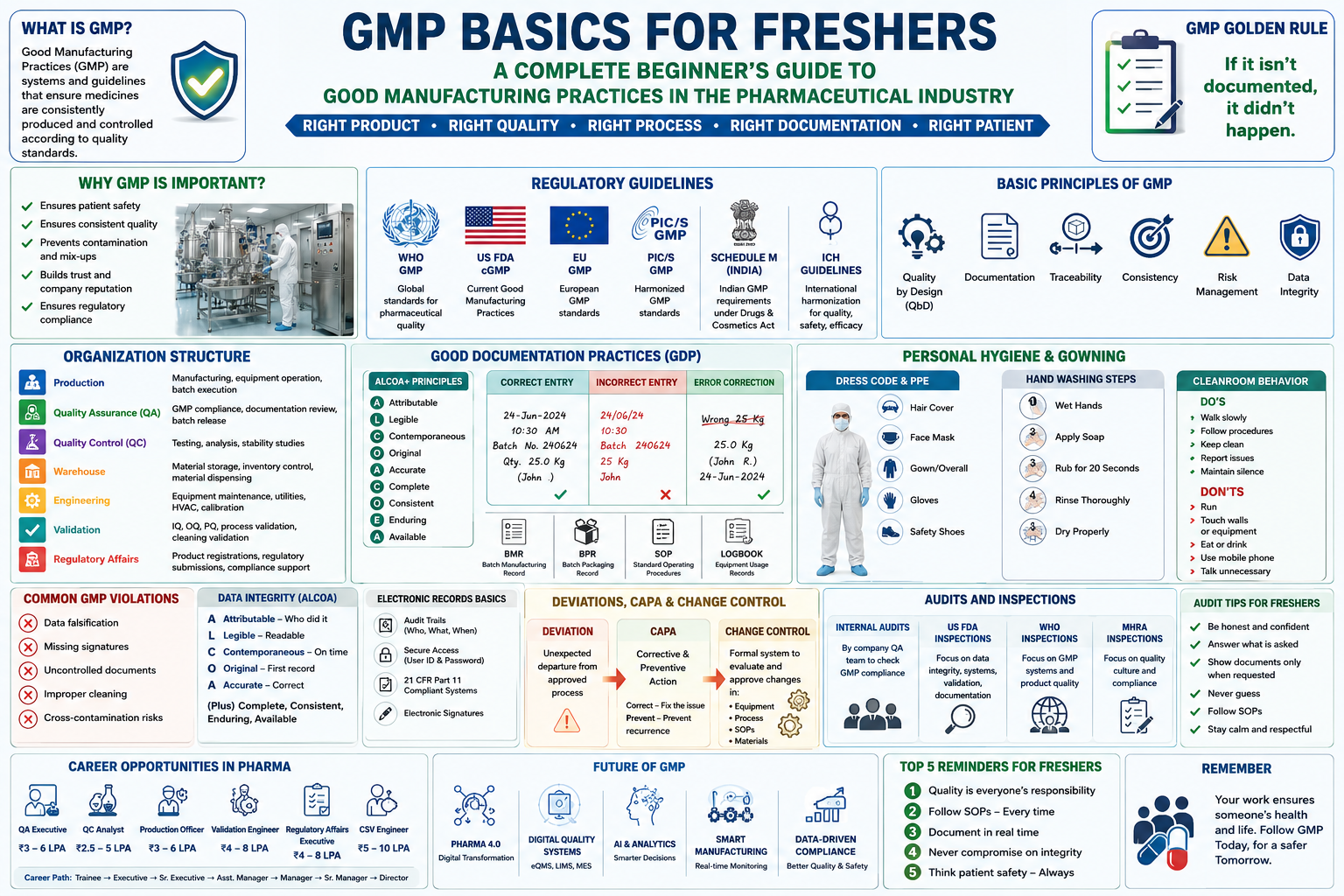
This is why the pharmaceutical industry follows Good Manufacturing Practices (GMP)—a globally accepted system that ensures medicines are consistently produced and controlled according to quality standards.
Whether you are a B.Pharm graduate, Diploma Pharmacy student, science graduate, or a fresher entering pharmaceutical manufacturing, understanding GMP is the foundation of a successful pharmaceutical career.
1. Introduction to GMP
What is GMP?
Good Manufacturing Practices (GMP) are a set of regulations, guidelines, and procedures that ensure pharmaceutical products are:
✓ Safe
✓ Effective
✓ Consistent
✓ High Quality
Simple Definition
GMP means doing the right thing, the right way, every time, and documenting it.
Why GMP is Important
Without GMP:
- Medicines may contain contamination
- Wrong ingredients may be used
- Incorrect dosage may be produced
- Patients may suffer adverse effects
Real Example
A tablet labeled as 500 mg should always contain exactly 500 mg of the active ingredient within specified limits.
GMP ensures this consistency.
History of GMP
1937 Sulfanilamide Disaster
Over 100 patients died after consuming contaminated medicine in the United States.
This led to stricter pharmaceutical regulations.
Evolution
- 1963 → US FDA GMP regulations
- 1969 → WHO GMP Guidelines
- 1990s → EU GMP expansion
- 2000s → Risk-based GMP
- Today → Pharma 4.0 and Digital GMP
GMP and Patient Safety
Patient safety is the primary goal of GMP.
GMP Protects Patients From:
- Contamination
- Mix-ups
- Incorrect labeling
- Sub-potent medicines
- Counterfeit products
2. GMP Regulations and Guidelines
| Guideline | Purpose |
|---|---|
| WHO GMP | Global pharmaceutical standards |
| US FDA cGMP | Compliance for US market |
| EU GMP | European pharmaceutical regulations |
| PIC/S GMP | Harmonized inspection standards |
| Schedule M | Indian GMP regulations |
| ICH Guidelines | International quality standards |
WHO GMP
Focuses on:
- Manufacturing controls
- Quality systems
- Documentation
- Validation
US FDA cGMP
Current Good Manufacturing Practices emphasize:
- Quality systems
- Data integrity
- Electronic records
- Risk management
EU GMP
Contains detailed annexes covering:
- Sterile manufacturing
- Computerized systems
- Validation
Schedule M (India)
Mandatory GMP requirements under Indian Drugs & Cosmetics Act.
3. Basic Principles of GMP
Quality by Design (QbD)
Quality should be built into the process rather than tested at the end.
Example
Instead of only testing finished tablets, manufacturers design robust granulation, compression, and coating processes.
Documentation
Golden Rule:
“If it is not documented, it never happened.”
Traceability
Every activity must be traceable.
Example:
Raw Material → Manufacturing → Packaging → Distribution
Consistency
Every batch should produce the same quality product.
Risk Management
Identify potential risks before they become problems.
Data Integrity
Data must be:
- Accurate
- Complete
- Reliable
- Traceable
4. Pharmaceutical Organization Structure
Production Department
Responsibilities:
- Manufacturing
- Equipment operation
- Batch execution
Quality Assurance (QA)
Responsibilities:
- GMP compliance
- Documentation review
- Batch release
Quality Control (QC)
Responsibilities:
- Testing
- Analysis
- Stability studies
Warehouse
Responsibilities:
- Material storage
- Inventory control
- Material dispensing
Engineering
Responsibilities:
- HVAC
- Utilities
- Maintenance
Validation
Responsibilities:
- IQ
- OQ
- PQ
- Process Validation
- Cleaning Validation
Regulatory Affairs
Responsibilities:
- Product registrations
- Regulatory submissions
- Compliance support
5. Good Documentation Practices (GDP)
ALCOA+
| Principle | Meaning |
|---|---|
| Attributable | Who performed activity |
| Legible | Easy to read |
| Contemporaneous | Recorded immediately |
| Original | First recorded data |
| Accurate | Correct information |
| Complete | No missing information |
| Consistent | Logical sequence |
| Enduring | Permanent record |
| Available | Accessible when needed |
Correct Entry Example
✓ 24-Jun-2026
✓ Signed
✓ Blue ink
Incorrect Entry Example
✗ Pencil
✗ White-out correction
✗ Backdated entry
Error Correction
Wrong:
500
Correct:
500 450
(Sign & Date)
Single line strike-through.
Important GMP Documents
Batch Manufacturing Record (BMR)
Manufacturing activities.
Batch Packaging Record (BPR)
Packaging activities.
SOP
Instructions for performing tasks.
Logbooks
Equipment usage records.
6. Personal Hygiene and Gowning
Personal Hygiene Requirements
- Daily bathing
- Clean uniforms
- Short nails
- No jewelry
PPE Requirements
- Hair cover
- Beard cover
- Gloves
- Safety shoes
- Face mask
Hand Washing Procedure
- Wet hands
- Apply soap
- Rub 20 seconds
- Rinse
- Dry properly
Cleanroom Behavior
Do:
✓ Walk slowly
✓ Follow procedures
Don’t:
✗ Run
✗ Touch walls
✗ Talk unnecessarily
7. Cleanroom Basics
What is a Cleanroom?
A controlled environment with regulated:
- Particles
- Temperature
- Humidity
- Microorganisms
Cleanroom Classification
| Grade | Application |
|---|---|
| A | Critical operations |
| B | Sterile background |
| C | Less critical sterile areas |
| D | Basic clean areas |
Environmental Monitoring
Includes:
- Air sampling
- Surface monitoring
- Settle plates
8. SOPs (Standard Operating Procedures)
Purpose
SOPs ensure consistency.
Example
Machine cleaning SOP.
Every operator follows the same steps.
Consequences of Non-Compliance
- Deviations
- Product rejection
- Regulatory observations
9. Common GMP Violations
Data Falsification
Recording data that was never generated.
Missing Signatures
Activity performed but not signed.
Uncontrolled Documents
Using outdated SOPs.
Improper Cleaning
Residue left on equipment.
Cross-Contamination
Mixing different products unintentionally.
10. Data Integrity Basics
ALCOA Principles
Critical regulatory expectation.
Electronic Records
Examples:
- SCADA
- MES
- LIMS
- eQMS
Audit Trails
Record:
- Who changed data
- What changed
- When changed
21 CFR Part 11 Basics
Requirements for:
- Electronic records
- Electronic signatures
11. Deviations, CAPA and Change Control
Deviation
Unexpected event.
Example:
Compression machine breakdown during batch.
CAPA
Corrective and Preventive Action.
Corrective
Fix current issue.
Preventive
Prevent recurrence.
Change Control
Formal process for:
- Equipment changes
- SOP changes
- Process modifications
12. Audits and Inspections
Internal Audits
Conducted by company QA.
USFDA Inspection
Focus areas:
- Data integrity
- Documentation
- Validation
WHO Inspection
Focus areas:
- GMP systems
- Product quality
MHRA Inspection
Strong emphasis on quality culture.
Audit Tips for Freshers
✓ Answer honestly
✓ Show documents only when requested
✓ Never guess
✓ Follow SOPs
✓ Stay calm
13. Top 25 GMP Interview Questions
1. What is GMP?
GMP ensures medicines are consistently produced and controlled according to quality standards.
2. What is ALCOA+?
Data Integrity principles ensuring reliable data.
3. What is SOP?
Documented procedure describing how a task should be performed.
4. Difference Between QA and QC?
QA = System assurance
QC = Testing
5. What is BMR?
Batch Manufacturing Record.
6. What is BPR?
Batch Packaging Record.
7. What is Deviation?
Unexpected departure from approved process.
8. What is CAPA?
Corrective and Preventive Action.
9. What is Change Control?
Controlled evaluation of changes.
10. Why Documentation is Important?
Evidence of compliance.
11–25 Additional Questions
- What is validation?
- What is contamination?
- What is cross-contamination?
- What is data integrity?
- What is cleanroom?
- What is qualification?
- What is OOS?
- What is OOT?
- What is line clearance?
- What is calibration?
- What is risk assessment?
- What is audit trail?
- What is GDP?
- What is Schedule M?
- What is 21 CFR Part 11?
14. Real-Life GMP Case Studies
Case Study 1: Data Integrity Failure
Observation:
Analytical results manipulated.
Outcome:
Regulatory warning letter.
Lesson:
Never modify original data.
Case Study 2: Cross Contamination
Improper equipment cleaning caused contamination.
Outcome:
Batch recall.
Lesson:
Follow cleaning SOPs.
Case Study 3: Missing Documentation
Activities performed but not documented.
Outcome:
Inspection observations.
Lesson:
Document immediately.
15. GMP Do’s and Don’ts
Top 20 Do’s
- Follow SOPs
- Record data immediately
- Maintain hygiene
- Report deviations
- Use approved documents
- Wear PPE
- Follow GDP
- Attend training
- Verify labels
- Maintain cleanliness
- Follow line clearance
- Respect quality systems
- Ask questions
- Be honest
- Review entries
- Follow procedures
- Report incidents
- Protect data
- Maintain traceability
- Focus on patient safety
Top 20 Don’ts
- Never falsify data
- Never backdate records
- Never skip signatures
- Never use correction fluid
- Never ignore deviations
- Never use obsolete SOPs
- Never bypass procedures
- Never share passwords
- Never hide mistakes
- Never enter unauthorized areas
- Never skip training
- Never overwrite entries
- Never rush documentation
- Never remove labels
- Never ignore alarms
- Never guess answers
- Never compromise quality
- Never use damaged PPE
- Never bypass cleaning
- Never forget patient safety
16. Career Opportunities Under GMP
| Position | Salary (India) |
|---|---|
| QA Executive | ₹3–6 LPA |
| QC Analyst | ₹2.5–5 LPA |
| Production Officer | ₹3–6 LPA |
| Validation Engineer | ₹4–8 LPA |
| Regulatory Affairs Executive | ₹4–8 LPA |
| CSV Engineer | ₹5–10 LPA |
Career Path
Trainee → Executive → Senior Executive → Assistant Manager → Manager → Senior Manager → Director
17. Future of GMP
Pharma 4.0
Digital transformation of pharmaceutical manufacturing.
Digital Quality Systems
- eQMS
- eDMS
- LIMS
- MES
Artificial Intelligence
Applications:
- Predictive maintenance
- Deviation investigation
- APQR generation
- Process optimization
Smart Manufacturing
Connected equipment and real-time monitoring.
Data-Driven Compliance
Future inspections will increasingly focus on electronic records and analytics.
18. Final Freshers Success Checklist
GMP Readiness Checklist
□ Understand GMP basics
□ Learn ALCOA+
□ Read SOPs
□ Understand documentation
□ Learn deviations
□ Learn CAPA
□ Understand audits
□ Know cleanroom practices
First Day in Pharma Checklist
□ Report on time
□ Complete induction
□ Obtain PPE
□ Understand department workflow
□ Read SOPs
□ Meet supervisor
□ Understand safety procedures
First 90 Days Learning Plan
Days 1–30
- GMP Fundamentals
- GDP
- SOP Training
Days 31–60
- Department Operations
- Documentation Practice
- Equipment Understanding
Days 61–90
- Deviations
- CAPA
- Audit Readiness
- Independent Responsibilities
Frequently Asked Questions (FAQs)
- What is GMP?
- Why is GMP important?
- Who regulates GMP?
- What is GDP?
- What is ALCOA+?
- What is a BMR?
- What is a BPR?
- What is a deviation?
- What is CAPA?
- What is Change Control?
- What is Data Integrity?
- What is a Cleanroom?
- What is Validation?
- What is 21 CFR Part 11?
- How can freshers prepare for GMP interviews?
About the Author
Ramesh Palav is a seasoned professional in GxP Quality, Computer System Validation (CSV), Data Integrity, and Pharmaceutical IT Compliance. He has extensive experience in implementing and managing GxP computerized systems, risk-based validation, audit trails, data integrity, and regulatory compliance. Through his articles and professional insights, he aims to share practical knowledge and help pharmaceutical and life-sciences professionals strengthen quality, compliance, and data integrity.