
1. Introduction
In pharmaceutical manufacturing, quality often receives the spotlight, while production planning and scheduling quietly operate behind the scenes. However, even the most advanced manufacturing facility cannot achieve operational excellence without an effective planning and scheduling system.
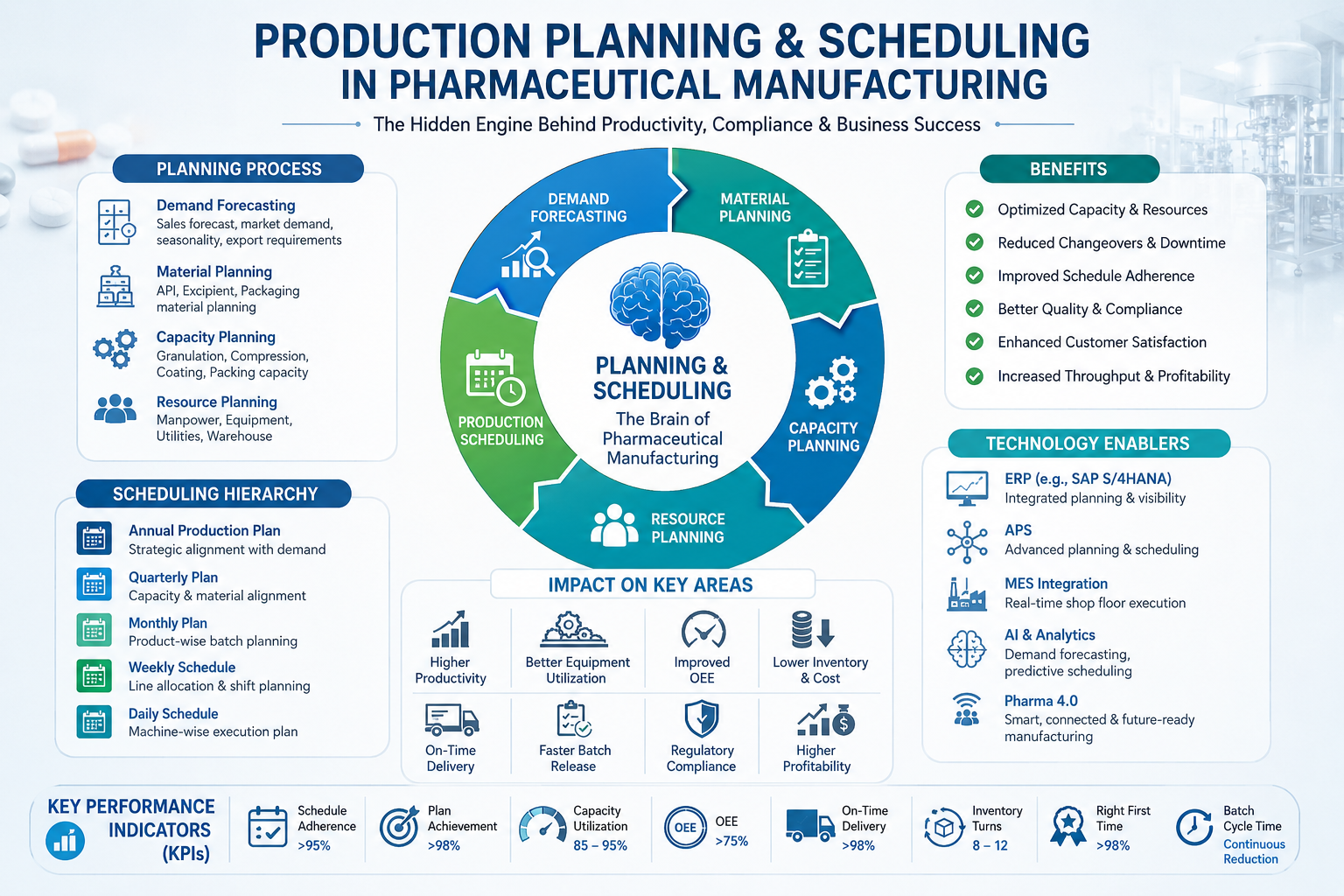
Production Planning and Scheduling serve as the central nervous system of pharmaceutical operations, ensuring that materials, manpower, equipment, and customer demands are aligned to produce the right product, at the right time, in the right quantity, and at the lowest possible cost while maintaining full GMP compliance.
What is Production Planning?
Production Planning is the strategic process of determining:
- What products need to be manufactured
- How much quantity is required
- When products should be produced
- What resources are needed
It transforms market demand into a structured manufacturing plan.
What is Production Scheduling?
Production Scheduling is the execution-level activity that determines:
- Which product will run on which equipment
- Start and completion dates
- Resource allocation
- Daily operational sequence
Scheduling converts planning into actionable manufacturing activities.
Difference Between Planning and Scheduling
| Production Planning | Production Scheduling |
|---|---|
| Strategic | Operational |
| Long-term | Short-term |
| Determines “What” and “How Much” | Determines “When” and “Where” |
| Capacity-focused | Execution-focused |
| Monthly/Quarterly/Annual | Daily/Weekly |
Why Planning & Scheduling Are the Brain of Pharmaceutical Manufacturing
Without planning:
- Materials are unavailable
- Equipment remains idle
- Customer orders are delayed
- Inventory increases
- Costs escalate
Without scheduling:
- Production bottlenecks occur
- Frequent changeovers reduce efficiency
- OEE declines
- GMP risks increase
Effective planning and scheduling synchronize the entire value chain.
2. Importance of Production Planning & Scheduling in Pharma
A. Production Productivity
Well-planned manufacturing minimizes waiting time and improves output.
Example:
Plant Capacity:
- 500 million tablets/month
Without Planning:
- Actual Output = 380 million tablets
With Effective Planning:
- Actual Output = 470 million tablets
Productivity Improvement:
- +23.7%
B. Equipment Utilization
Proper scheduling reduces idle machine hours.
Example:
Compression Machine Availability:
- 720 hours/month
Poor Scheduling:
- Running = 480 hours
Good Scheduling:
- Running = 650 hours
Utilization Improvement:
- 33%
C. Capacity Optimization
Planning ensures balanced utilization across:
- Granulation
- Compression
- Coating
- Packing
This prevents bottlenecks.
D. OEE Improvement
Planning directly influences:
Availability
Less waiting for materials and manpower.
Performance
Fewer interruptions and optimized run rates.
Quality
Reduced changeovers lower contamination risks.
E. Inventory Management
Proper planning reduces:
- Excess inventory
- Expired materials
- Warehouse congestion
Benefits:
- Lower carrying costs
- Improved cash flow
F. Customer Service Levels
Timely production ensures:
- On-time deliveries
- Better customer satisfaction
- Stronger market reputation
G. Batch Release Timelines
Coordinated planning between:
- Production
- QA
- QC
reduces batch release delays.
H. Regulatory Compliance
Effective scheduling allows time for:
- Cleaning validation
- Equipment qualification
- Calibration
- Preventive maintenance
Ensuring continuous GMP compliance.
I. Supply Chain Efficiency
Improved synchronization among:
- Procurement
- Warehouse
- Manufacturing
- Quality
- Logistics
J. Cost Reduction
Savings achieved through:
- Reduced overtime
- Lower inventory
- Fewer expedited shipments
- Better machine utilization
K. Profitability
A 1% OEE improvement can often translate into millions of rupees in annual savings for large pharmaceutical plants.
3. Production Planning Process in Pharma
Step 1: Demand Forecasting
Planning begins with market demand.
Sources include:
Sales Forecast
- Historical sales
- Customer commitments
Market Demand
- New launches
- Product growth
Seasonal Products
Examples:
- Antipyretics during monsoon
- Anti-allergy products during spring
Export Requirements
Consider:
- Lead times
- Country-specific registrations
- Regulatory commitments
Step 2: Material Planning
API Planning
Ensuring:
- Adequate stock
- Approved suppliers
- Lead-time management
Excipient Planning
Including:
- Lactose
- MCC
- Starch
- Magnesium stearate
Packaging Material Planning
Includes:
- Blisters
- Cartons
- Labels
- Inserts
Step 3: Capacity Planning
Granulation Capacity
Example:
16 Granulation Lines
Capacity:
- 800 batches/month
Compression Capacity
14 Compression Machines
Capacity:
- 1.2 billion tablets/month
Coating Capacity
9 Coating Machines
Capacity:
- 700 batches/month
Packing Capacity
15 Packaging Lines
Capacity:
- 50 million packs/month
Step 4: Resource Planning
Manpower Planning
- Operators
- Supervisors
- QA personnel
Equipment Planning
- Availability
- Maintenance windows
Utility Planning
- HVAC
- Purified Water
- Compressed Air
Warehouse Planning
- Raw material storage
- Quarantine areas
- FG storage
4. Production Scheduling Process
Annual Production Plan
Focuses on:
- Sales forecast
- Strategic capacity
Quarterly Plan
Aligns:
- Material procurement
- Resource allocation
Monthly Production Plan
Specifies:
- Product-wise batches
- Manufacturing priorities
Weekly Schedule
Defines:
- Line assignments
- Shift planning
Daily Schedule
Provides:
- Machine-wise activity
- Batch sequence
- Resource deployment
Example of Multi-Product Scheduling
| Stage | Product A | Product B | Product C |
|---|---|---|---|
| Granulation | Day 1 | Day 2 | Day 3 |
| Compression | Day 4 | Day 5 | Day 6 |
| Coating | Day 7 | Day 8 | Day 9 |
| Packing | Day 10 | Day 11 | Day 12 |
This ensures continuous workflow without bottlenecks.
5. How Good Scheduling Improves Productivity
Reduction in Changeover Time
Poor Scheduling:
- 10 changeovers/week
- 4 hours each
Loss:
40 hours
Campaign Scheduling:
- 4 changeovers/week
Loss:
16 hours
Gain:
24 productive hours
Campaign Manufacturing
Manufacturing similar products together.
Benefits:
- Reduced cleaning time
- Reduced setup time
- Higher throughput
Product Family Scheduling
Example:
Schedule all Paracetamol strengths sequentially.
Advantages:
- Minimal cleaning
- Faster startup
Numerical Example
Before Scheduling Optimization:
- Output = 100 batches/month
After Optimization:
- Output = 120 batches/month
Improvement:
20%
Additional Benefits
- Better machine utilization
- Lower downtime
- Improved yields
- Faster market supply
6. Impact on OEE Improvement
OEE Formula
OEE = Availability × Performance × Quality
Before Planning Improvement
Availability = 75%
Performance = 80%
Quality = 95%
OEE = 57%
After Planning Improvement
Availability = 88%
Performance = 90%
Quality = 98%
OEE = 77.6%
Improvement:
20.6 percentage points
This improvement often creates “hidden capacity” without purchasing new equipment.
7. Planning & Scheduling Challenges in Pharmaceutical Manufacturing
Material Shortages
Causes
- Supplier delays
- Forecast errors
Mitigation
- Safety stock
- Alternate vendors
Machine Breakdowns
Mitigation
- Preventive maintenance
- Predictive maintenance
Deviation Investigations
Impact
Batch hold and schedule disruption.
Mitigation
- Fast-track investigations
- Risk-based decision making
Quality Rejections
Mitigation:
- Process capability monitoring
- Root cause elimination
Regulatory Commitments
Prioritize:
- Export markets
- Tender products
- Critical customer orders
Change Controls
Plan implementation windows carefully.
Validation Activities
Reserve dedicated equipment capacity.
Utility Failures
Maintain contingency plans for:
- HVAC
- PW
- Compressed air
Unplanned Demand Increase
Solutions:
- Overtime
- Additional shifts
- Outsourcing
- Schedule re-prioritization
8. Key Performance Indicators (KPIs)
| KPI | Benchmark |
|---|---|
| Schedule Adherence | >95% |
| Plan Achievement | >98% |
| Capacity Utilization | 85–95% |
| OEE | >75% |
| On-Time Delivery | >98% |
| Inventory Turns | 8–12 |
| Batch Cycle Time | Continuous Reduction |
| Right First Time | >98% |
These KPIs provide a comprehensive picture of planning effectiveness.
9. Digital Transformation in Planning & Scheduling
ERP Systems
Modern ERP platforms integrate:
- Sales
- Procurement
- Inventory
- Production
Example
SAP S/4HANA enables real-time planning and material visibility.
Advanced Planning Systems (APS)
APS solutions perform:
- Finite capacity planning
- Constraint-based scheduling
- Scenario simulation
MES Integration
Manufacturing Execution System integration enables real-time production visibility.
AI-Based Demand Forecasting
AI analyzes:
- Historical demand
- Seasonality
- Market trends
- Customer behavior
Result:
Forecast accuracy can improve significantly compared with manual forecasting.
Predictive Scheduling
AI predicts:
- Machine failures
- Material shortages
- Capacity constraints
before they occur.
Pharma 4.0 Applications
Key technologies:
- IoT
- AI
- Cloud Computing
- Digital Twins
- Advanced Analytics
How AI Will Transform Planning by 2030
By 2030, AI systems will:
- Auto-generate production schedules
- Optimize campaign manufacturing
- Predict bottlenecks
- Dynamically allocate resources
- Recommend recovery plans
- Continuously optimize OEE
Schedulers will increasingly become decision-makers and exception managers rather than manual planners.
10. Role of a Production Manager in Planning & Scheduling
A Production Manager must:
Capacity Assessment
Evaluate equipment and manpower availability.
Resource Allocation
Optimize utilization.
Risk Identification
Identify:
- Material risks
- Equipment risks
- Quality risks
Cross-Functional Coordination
Collaborate with:
- Supply Chain
- QA
- QC
- Engineering
- Warehouse
Daily Review Meetings
Review:
- Schedule adherence
- Downtime
- Deviations
Schedule Recovery Plans
Develop actions when production falls behind.
Performance Monitoring
Track KPIs continuously.
11. Real-Life Case Study
Before Effective Planning
Challenges:
- OEE = 58%
- Schedule Adherence = 72%
- Inventory = 120 days
- Frequent stock-outs
- Customer complaints increasing
Root Causes
- Poor forecasting
- Frequent product switching
- Material shortages
- Lack of capacity visibility
Improvement Actions
- Implemented monthly S&OP process
- Introduced campaign manufacturing
- Improved material planning
- Digitized scheduling process
- Daily performance reviews
After Effective Planning
Results:
| KPI | Before | After |
|---|---|---|
| OEE | 58% | 79% |
| Schedule Adherence | 72% | 96% |
| Inventory Days | 120 | 75 |
| On-Time Delivery | 81% | 99% |
| Throughput | +0% | +22% |
| Profitability | Baseline | +14% |
The plant achieved growth without adding new manufacturing equipment.
12. Common Interview Questions & Answers
Q1. How do you manage production planning and scheduling?
Answer:
“I follow a structured approach starting with demand forecasting, material availability review, capacity assessment, and resource planning. Based on customer priorities and inventory requirements, I develop monthly, weekly, and daily production schedules. I conduct daily review meetings to monitor schedule adherence, identify risks such as material shortages or equipment downtime, and implement recovery actions. My objective is to achieve maximum capacity utilization while maintaining GMP compliance, product quality, and on-time delivery.”
Q2. How do you prioritize products?
Answer:
Priority is based on:
- Customer commitments
- Regulatory obligations
- Export requirements
- Inventory levels
- Product criticality
- Capacity constraints
Q3. What actions do you take when production falls behind schedule?
Answer:
I first identify the root cause, assess the impact, and implement recovery actions such as rescheduling, reallocating resources, extending shifts, reducing non-essential activities, prioritizing critical products, and coordinating with supply chain and quality teams to restore schedule adherence.
Q4. How do you improve schedule adherence?
Answer:
- Daily monitoring
- Real-time issue escalation
- Material readiness checks
- Preventive maintenance
- Campaign scheduling
- Cross-functional communication
Q5. How do you balance capacity and customer demand?
Answer:
I compare forecasted demand against available capacity, identify constraints, optimize product sequencing, adjust production frequency, and, when necessary, use overtime, additional shifts, or external manufacturing support.
Q6. How do you manage material shortages?
Answer:
I maintain safety stocks, monitor supplier performance, develop alternate sources, prioritize critical products, and proactively coordinate with procurement teams to mitigate supply risks before they impact production.
13. Future of Production Planning in Pharma 2030
AI-Driven Scheduling
Schedules generated automatically based on live plant data.
Digital Twins
Virtual replicas of manufacturing facilities enabling simulation before execution.
Autonomous Planning Systems
Self-learning planning engines continuously optimize production plans.
Predictive Manufacturing
Issues identified before they impact production.
Real-Time Capacity Management
Live dashboards providing:
- Equipment status
- Material availability
- Workforce allocation
- OEE forecasts
Decision-making will become proactive rather than reactive.
Conclusion
Production Planning & Scheduling is far more than an administrative function. It is the strategic engine that connects market demand with manufacturing execution. Effective planning drives higher productivity, improved OEE, optimized inventory, faster batch release, stronger GMP compliance, enhanced customer satisfaction, and increased profitability.
In today’s competitive pharmaceutical environment—and even more so in the AI-driven Pharma 4.0 era—organizations that excel in planning and scheduling will consistently outperform those that rely on reactive manufacturing practices. The future belongs to pharmaceutical companies that transform planning and scheduling into a data-driven, digitally enabled, and strategically managed business capability.
Simply put: Quality ensures products are safe, but Planning & Scheduling ensure the business survives, grows, and remains profitable.
About the Author
Ramesh Palav is a GxP Compliance and Computer System Validation (CSV) professional with experience in pharmaceutical manufacturing, quality systems, data integrity, and digital transformation. He is passionate about helping organizations adopt compliant, efficient, and practical digital solutions while maintaining regulatory expectations and patient safety.