
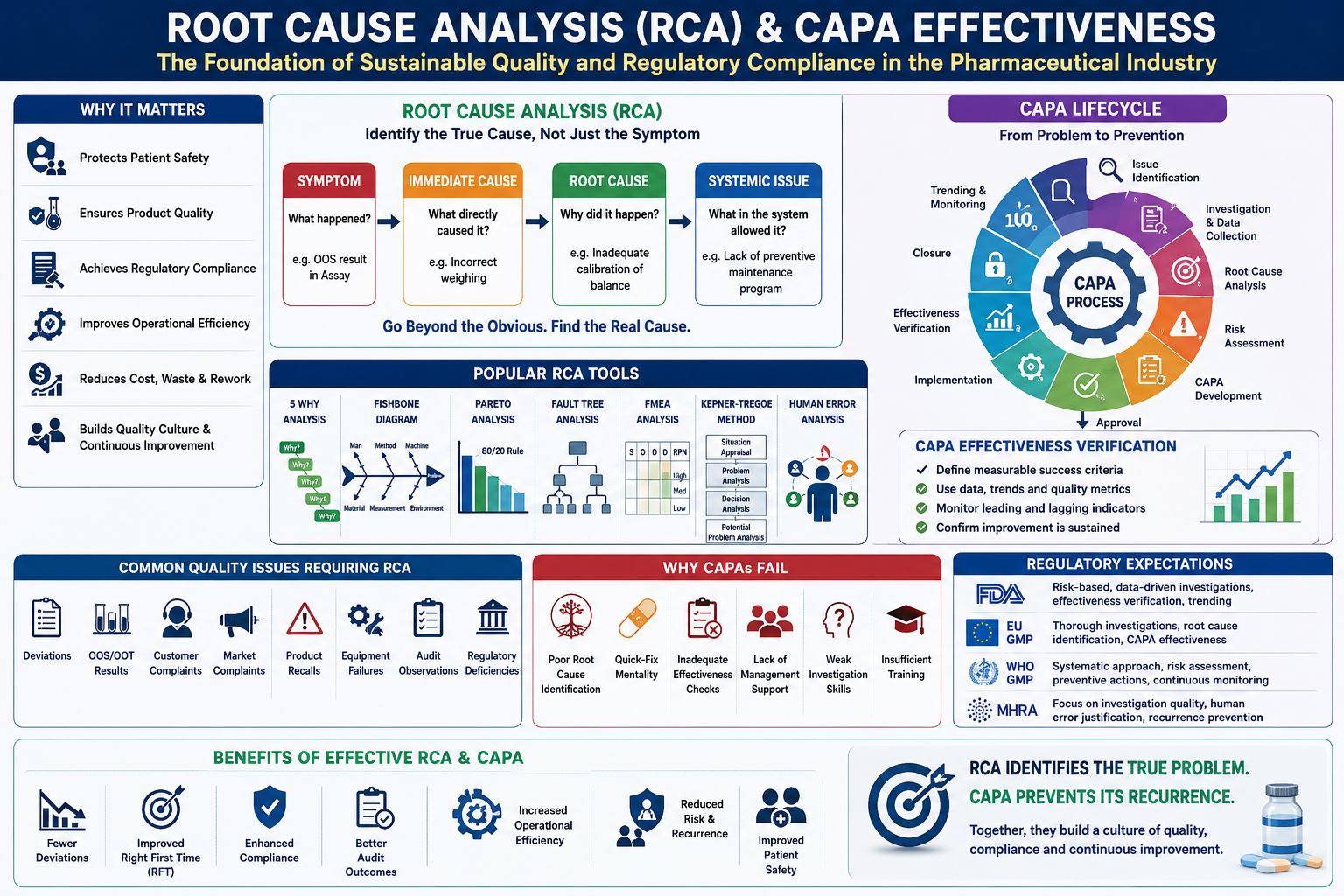
Introduction
In today’s highly regulated pharmaceutical environment, product quality, patient safety, data integrity, and regulatory compliance are non-negotiable. Despite advanced manufacturing technologies, validated processes, and robust Quality Management Systems (QMS), quality issues such as deviations, Out-of-Specification (OOS) results, equipment failures, complaints, and audit observations continue to occur.
What differentiates world-class pharmaceutical organizations from average performers is not the absence of problems—it is their ability to investigate issues effectively, identify the true root causes, and implement sustainable corrective and preventive actions that prevent recurrence.
This is where Root Cause Analysis (RCA) and Corrective and Preventive Action (CAPA) systems become critical.
A strong RCA and CAPA framework serves as the backbone of continuous improvement, regulatory compliance, operational excellence, and patient protection.
Importance of RCA and CAPA in Pharmaceutical Manufacturing
The pharmaceutical industry operates under stringent GMP regulations where every quality issue must be thoroughly investigated and resolved.
Effective RCA and CAPA help organizations:
- Eliminate recurring deviations
- Improve process robustness
- Strengthen product quality
- Enhance patient safety
- Improve Right First Time (RFT) performance
- Reduce waste and rework
- Prevent regulatory actions
- Build a culture of continuous improvement
Organizations that consistently perform high-quality investigations and implement effective CAPAs experience fewer quality events, stronger compliance records, and improved business performance.
Regulatory Expectations from Global Agencies
Global regulatory agencies expect pharmaceutical companies to establish systematic investigation and CAPA processes.
Key expectations include:
FDA (United States)
The FDA expects:
- Scientifically sound investigations
- Identification of true root causes
- Risk-based CAPAs
- Evidence of effectiveness verification
- Trending of recurring issues
The FDA frequently cites firms for inadequate investigations and ineffective CAPAs during inspections.
EU GMP
EU GMP requires:
- Thorough investigation of deviations
- Identification of root causes
- Appropriate CAPA implementation
- Effectiveness checks
- Continuous quality improvement
WHO GMP
WHO GMP emphasizes:
- Systematic investigations
- Risk assessment
- Preventive action implementation
- Continuous monitoring of CAPA effectiveness
MHRA (United Kingdom)
MHRA inspectors focus heavily on:
- Investigation quality
- Human error justification
- Recurrence management
- CAPA sustainability
- Data integrity considerations
Impact on Product Quality, Patient Safety, and Business Performance
Poor investigations can lead to:
- Defective products
- Regulatory observations
- Product recalls
- Market complaints
- Supply disruptions
- Loss of customer confidence
Conversely, robust RCA and CAPA systems contribute to:
- Improved product consistency
- Increased customer trust
- Reduced compliance risk
- Enhanced operational efficiency
- Better financial performance
Ultimately, patients benefit from safer and more reliable medicines.
Understanding Root Cause Analysis (RCA)
Definition
Root Cause Analysis (RCA) is a structured problem-solving methodology used to identify the fundamental cause of a problem rather than merely addressing its symptoms.
The objective is to eliminate the underlying cause so that the problem does not recur.
Symptoms vs Immediate Causes vs Root Causes
Symptom
What happened?
Example:
“Tablet weight variation exceeded specification.”
Immediate Cause
What directly caused the event?
Example:
“Compression machine feeder speed fluctuated.”
Root Cause
Why did it happen?
Example:
“Preventive maintenance frequency was inadequate, leading to feeder wear and inconsistent performance.”
Addressing symptoms provides temporary relief.
Addressing root causes provides permanent solutions.
Why Superficial Investigations Fail
Many investigations stop at:
- Operator error
- Human mistake
- Equipment malfunction
- Procedural non-compliance
These are often immediate causes rather than true root causes.
As a result:
- Deviations recur
- CAPAs fail
- Audit findings increase
- Regulatory confidence decreases
Effective investigations must go deeper.
Common Quality Issues Requiring RCA
Deviations
Unexpected events that depart from approved procedures or specifications.
OOS (Out of Specification) Results
Laboratory results that fall outside established acceptance criteria.
OOT (Out of Trend) Results
Results showing unusual trends despite remaining within specification.
Customer Complaints
Product-related concerns reported by customers or healthcare providers.
Market Complaints
Quality issues identified after product distribution.
Product Recalls
Serious quality failures requiring market withdrawal.
Equipment Failures
Breakdowns affecting product quality or process reliability.
Audit Observations
Internal and external audit findings.
Regulatory Deficiencies
FDA, MHRA, WHO, and EU GMP observations requiring corrective action.
Popular RCA Tools Used in Pharma
1. 5 Why Analysis
A simple but powerful technique that repeatedly asks “Why?” until the root cause is identified.
Example:
Deviation → Why?
Machine stopped.
Why?
Sensor failed.
Why?
Sensor was contaminated.
Why?
Cleaning frequency inadequate.
Why?
Preventive maintenance program incomplete.
Root Cause Identified.
2. Fishbone (Ishikawa) Diagram
Analyzes potential causes under categories such as:
- Man
- Machine
- Method
- Material
- Measurement
- Environment
Useful for complex investigations.
3. Fault Tree Analysis (FTA)
A logical approach using cause-and-effect relationships to identify contributing factors.
Frequently used for critical failures.
4. Pareto Analysis
Based on the 80/20 principle.
Helps identify the few causes responsible for most problems.
5. Kepner-Tregoe Method
A structured analytical approach focused on:
- Problem definition
- Cause evaluation
- Decision analysis
- Risk assessment
6. Failure Mode and Effects Analysis (FMEA)
Proactively evaluates:
- Potential failure modes
- Severity
- Occurrence probability
- Detectability
Widely used for risk management.
7. Human Error Analysis
Assesses:
- Training effectiveness
- Procedure clarity
- Workload factors
- Ergonomic considerations
- Human-machine interactions
CAPA (Corrective and Preventive Action) System
Definition
CAPA is a systematic approach for addressing identified problems and preventing recurrence.
It converts investigation findings into sustainable improvements.
Corrective Action vs Preventive Action
Corrective Action
Eliminates the cause of an existing problem.
Example:
Replacing a defective sensor causing batch failures.
Preventive Action
Eliminates the cause of a potential future problem.
Example:
Updating preventive maintenance schedules across similar equipment.
CAPA Lifecycle and Workflow
A robust CAPA process typically includes:
- Issue Identification
- Investigation
- Root Cause Analysis
- Risk Assessment
- CAPA Development
- Approval
- Implementation
- Effectiveness Verification
- Closure
- Trending and Monitoring
Risk-Based CAPA Management
Not all CAPAs require equal effort.
CAPAs should be prioritized based on:
- Patient impact
- Product quality risk
- Regulatory risk
- Business impact
- Recurrence potential
High-risk issues demand stronger controls and verification.
Characteristics of Effective CAPA
Scientific and Data-Driven
Decisions should be supported by evidence rather than assumptions.
Measurable Outcomes
Success criteria must be clearly defined.
Sustainable Solutions
CAPAs should prevent recurrence long term.
Ownership and Accountability
Clear responsibility must be assigned.
Timely Implementation
Delays increase compliance risk.
Cross-Functional Collaboration
Quality issues often require involvement from:
- QA
- QC
- Production
- Engineering
- Validation
- Regulatory Affairs
Why CAPAs Fail
Many CAPAs fail because organizations focus on symptoms rather than causes.
Common reasons include:
Poor Root Cause Identification
Incorrect RCA leads to ineffective solutions.
Quick-Fix Mentality
Temporary fixes do not address systemic weaknesses.
Inadequate Effectiveness Checks
CAPAs are closed without verifying results.
Lack of Management Support
Resources and leadership commitment are insufficient.
Weak Investigation Skills
Investigators lack RCA competency.
Insufficient Employee Training
Employees are unaware of revised processes.
CAPA Effectiveness Verification
Effectiveness verification is one of the most critical steps in the CAPA process.
A CAPA should never be considered successful simply because it has been implemented.
It must demonstrate measurable improvement.
How to Verify Effectiveness
Organizations should evaluate:
- Recurrence rates
- Trend analysis
- Process capability
- Complaint trends
- Audit outcomes
- OOS frequency
- Deviation frequency
Leading Quality Indicators
Predict future performance.
Examples:
- Training completion rates
- Preventive maintenance compliance
- Audit closure timelines
- Process monitoring data
Lagging Quality Indicators
Measure historical performance.
Examples:
- Deviations
- Complaints
- Recalls
- OOS investigations
Trending and Monitoring Techniques
Effective monitoring includes:
- Monthly trend analysis
- Statistical process control
- Quality dashboards
- KPI reviews
- Management review meetings
Statistical Tools for Effectiveness Evaluation
Useful tools include:
- Control Charts
- Run Charts
- Pareto Charts
- Trend Analysis
- Process Capability Analysis
- Statistical Significance Testing
These tools provide objective evidence of improvement.
Regulatory Expectations for RCA and CAPA
Inspectors frequently assess:
- Investigation quality
- Root cause justification
- CAPA appropriateness
- Timeliness
- Effectiveness verification
- Recurrence management
Common Regulatory Observations Related to RCA and CAPA
Frequently cited deficiencies include:
- Repeated deviations without effective CAPA
- Root cause not scientifically justified
- Human error used without evidence
- CAPAs closed prematurely
- Lack of effectiveness checks
- Poor trend analysis
- Weak documentation
These findings often lead to warning letters and inspection observations.
Real-Life Pharmaceutical Case Examples
Example 1: Ineffective CAPA Leading to Repeat Deviation
Issue
Repeated tablet weight variation failures.
Investigation Conclusion
Operator error.
CAPA
Retraining conducted.
Outcome
Deviation recurred three months later.
Actual Root Cause
Inadequate feeder preventive maintenance.
Lesson
Training was not the true solution.
Example 2: Successful RCA Eliminating Recurring Quality Issues
Issue
Repeated vial stopper defects.
RCA Findings
Supplier material variation affecting stopper dimensions.
CAPA
- Supplier qualification enhancement
- Incoming inspection strengthening
- Supplier quality agreement revision
Outcome
Defect recurrence eliminated.
Lesson
True root causes drive sustainable improvements.
Building a Strong RCA & CAPA Culture
Quality Culture Principles
Organizations should encourage:
- Transparency
- Learning from mistakes
- Fact-based decision making
- Continuous improvement
Employee Competency Development
Employees should receive training in:
- Investigation techniques
- RCA tools
- Risk assessment
- GMP requirements
- Data analysis
Competent investigators produce stronger CAPAs.
Data Integrity Considerations
Reliable RCA depends on reliable data.
Organizations must ensure:
- Accurate documentation
- Complete records
- ALCOA+ principles
- Traceable investigation evidence
Management Commitment
Leadership must:
- Allocate resources
- Remove barriers
- Promote accountability
- Review effectiveness metrics
Quality culture begins at the top.
Continuous Improvement Mindset
Organizations should view every deviation as an opportunity to:
- Learn
- Improve
- Strengthen systems
- Reduce future risk
Benefits of Effective RCA & CAPA
Organizations implementing robust RCA and CAPA systems achieve:
Reduction in Deviations
Fewer recurring quality events.
Improved Right First Time (RFT)
Higher manufacturing success rates.
Enhanced Compliance
Stronger inspection readiness.
Better Audit Outcomes
Reduced observations and findings.
Increased Operational Efficiency
Lower waste, rework, and downtime.
Improved Patient Safety
Higher confidence in product quality.
Key Takeaways for Pharma Professionals
✓ Never stop investigations at the symptom level.
✓ Distinguish between immediate causes and true root causes.
✓ Use structured RCA tools consistently.
✓ Develop risk-based CAPAs.
✓ Verify effectiveness using objective data.
✓ Trend quality metrics continuously.
✓ Build investigator competency.
✓ Promote a culture of continuous improvement.
✓ Ensure management commitment and accountability.
✓ Remember that sustainable compliance depends on effective RCA and CAPA systems.
Conclusion
Root Cause Analysis and CAPA effectiveness are among the most critical pillars of pharmaceutical Quality Management Systems.
While RCA identifies the true source of quality problems, CAPA ensures that those problems do not recur. Together, they transform deviations, complaints, audit observations, and failures into opportunities for continuous improvement.
Organizations that invest in robust investigations, scientific decision-making, risk-based CAPAs, and effective verification processes consistently achieve higher levels of compliance, operational excellence, and patient protection.
In today’s regulatory environment, sustainable quality is not achieved through corrective actions alone—it is achieved through effective investigations, robust CAPAs, verified effectiveness, and a culture committed to continuous improvement.
The most successful pharmaceutical organizations do not merely fix problems; they eliminate the causes
of problems and prevent them from returning.
About the Author
Ramesh Palav is a pharmaceutical manufacturing professional with 21+ years of experience in Oral Solid Dosage manufacturing, production operations, GMP compliance, qualification, validation, QMS and operational excellence. Through Pharma Manufacturing Hub, he shares practical industry knowledge with pharmaceutical professionals, students and manufacturing leaders.
Published on : 23/06/2026