
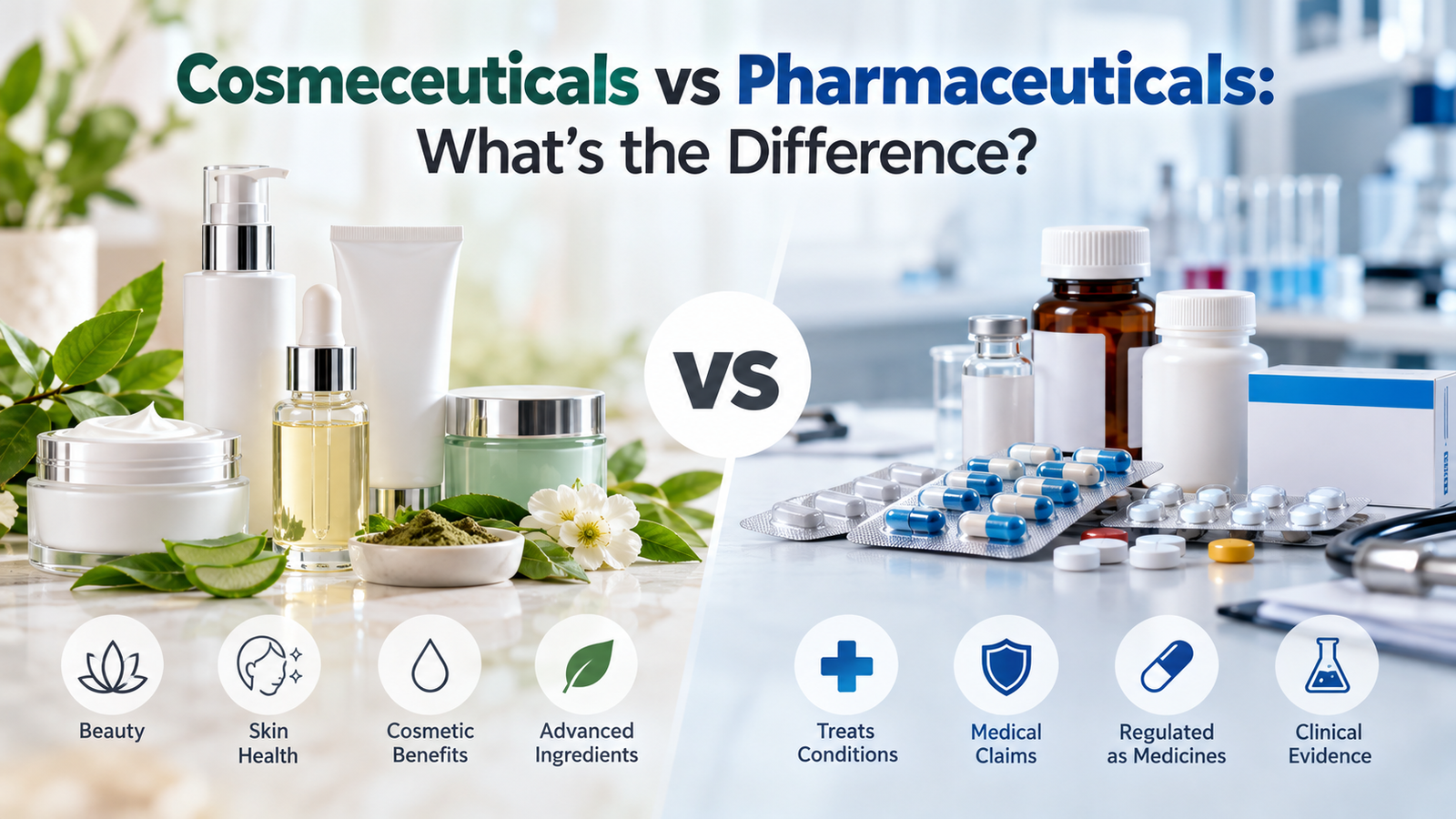
Cosmeceuticals vs Pharmaceuticals is a topic that often creates confusion among consumers, pharmacy students, cosmetic professionals and even people working in the healthcare industry.
Walk into a pharmacy or a skincare store and you may find moisturizers, anti-aging creams, retinol products, sunscreens, acne preparations and medicated topical products displayed close to each other. Some products make cosmetic claims, while others make claims that relate to treatment or prevention of a condition.
The terminology can become confusing very quickly.
One term that sits in the middle of this discussion is cosmeceutical. It is commonly used by the cosmetic and personal-care industry to describe products that are positioned as having benefits beyond basic cleansing or beautifying. However, the word does not represent a universally recognized legal product category. In the United States, for example, the FDA specifically states that “cosmeceutical” has no meaning under the law.
So, what actually separates a cosmetic, a cosmeceutical and a pharmaceutical?
The answer is more complicated than simply saying that pharmaceuticals are “stronger” products. Intended use, claims, formulation, ingredients, evidence, safety requirements and the applicable regulatory framework all matter.
What Are Pharmaceuticals?
Pharmaceutical products are developed and manufactured for defined medical purposes. Depending on the product and regulatory framework, they may be intended to diagnose, prevent, treat, mitigate or manage disease, or to produce a defined pharmacological or physiological effect.
A pharmaceutical formulation may contain one or more active pharmaceutical ingredients (APIs) together with excipients that provide functions such as binding, disintegration, preservation, lubrication, viscosity control or stabilization.
The finished product is expected to meet predefined quality requirements.
From a manufacturing perspective, this means much more than simply mixing ingredients and filling them into a container. Pharmaceutical manufacturing involves controlled processes, qualified equipment, trained personnel, documented procedures, in-process controls, laboratory testing, environmental controls where applicable, stability studies, change control, deviation management and other elements of the applicable pharmaceutical quality system.
The regulatory expectations depend on the product and market, but the fundamental objective remains the same: the product must consistently meet established requirements for quality and, where applicable, safety and efficacy.
For example, a topical pharmaceutical product intended to treat a skin disease is fundamentally different from a moisturizer whose purpose is to maintain the skin in good condition.
What Are Cosmetics?
Cosmetics are generally intended for purposes such as cleansing, beautifying, protecting, conditioning or altering appearance.
Examples include:
- Moisturizers
- Cleansers
- Shampoos
- Lipsticks
- Foundations
- Perfumes
- Body lotions
- Hair-care products
- Certain facial creams
The exact legal definition depends on the jurisdiction.
In the European Union, Regulation (EC) No. 1223/2009 defines a cosmetic product in terms of its intended contact with external body parts, teeth or oral mucosa and purposes such as cleaning, perfuming, changing appearance, protecting, maintaining in good condition or correcting body odours.
India also has a statutory definition of cosmetics under the Drugs and Cosmetics Act, 1940. CDSCO describes cosmetics as products intended for purposes including cleansing, beautifying, promoting attractiveness or altering appearance.
The important point is that cosmetics are not simply “non-medical products.” They still require appropriate attention to safety, quality, composition, manufacturing and labeling.
For example, a moisturizer marketed to help keep the skin hydrated is different from a product marketed as treating a dermatological disease.
What Are Cosmeceuticals?
The word cosmeceutical combines “cosmetic” and “pharmaceutical.”
It is commonly used to describe cosmetic or personal-care products that contain ingredients associated with biological or skin-related benefits beyond basic cleansing or appearance.
Examples frequently associated with the term include products containing:
- Retinol or retinoid-related ingredients
- Alpha hydroxy acids (Alas)
- Beta hydroxy acids (BHAs)
- Niacinamide
- Peptides
- Antioxidants
- Botanical extracts
- Certain skin-conditioning or brightening ingredients
But there is an important qualification.
Not every product containing one of these ingredients is automatically a cosmeceutical, and the term itself does not determine regulatory classification.
The U.S. FDA explicitly states that the FD&C Act does not recognize “cosmeceuticals” as a separate category. A product may be a cosmetic, a drug, or both depending on factors including intended use and claims.
This is one of the most important points to understand when discussing cosmeceuticals.
Cosmeceuticals vs Pharmaceuticals: Key Differences
| Aspect | Cosmeceuticals | Pharmaceuticals |
|---|---|---|
| Common purpose | Cosmetic appearance, skin/hair condition and associated cosmetic benefits | Prevention, diagnosis, treatment or management of disease, or other regulated medicinal purposes |
| Regulatory status | No universal legal category | Defined and regulated as medicines/drugs under applicable laws |
| Claims | Generally cosmetic or appearance-related claims | Therapeutic/medicinal claims may be permitted subject to applicable requirements |
| Active ingredients | May contain biologically active or functional cosmetic ingredients | Contains APIs or other active substances appropriate to the medicinal product |
| Evidence | Depends on product, claims and jurisdiction | Generally subject to defined requirements for quality, safety and efficacy |
| Manufacturing controls | Applicable cosmetic quality and regulatory requirements | Pharmaceutical GMP and applicable medicinal-product requirements |
| Quality control | Required according to applicable requirements | Extensive specifications and testing appropriate to the pharmaceutical product |
| Stability | Important for product quality and safety | Critical for maintaining pharmaceutical quality throughout shelf life |
| Labeling | Cosmetic claims and required information | Medicinal labeling and regulatory requirements |
| Regulatory oversight | Depends on jurisdiction and classification | Generally subject to pharmaceutical/drug regulatory authorities |
| Examples | Certain advanced skincare products marketed for cosmetic benefits | Antibiotics, antihypertensives, prescription dermatological medicines and other medicinal products |
The table should not be interpreted as meaning that every product marketed as a “cosmeceutical” automatically falls into one regulatory category. The regulatory classification must be assessed according to the laws applicable to the product and market.
Why Regulatory Classification Depends on the Country
A product that is considered a cosmetic in one market may not necessarily have the same regulatory status in another.
This is particularly important for companies developing products for international markets.
United States
The U.S. FDA does not recognize “cosmeceutical” as a legal category.
Under U.S. law, the intended use of a product is central to determining whether it is a cosmetic, a drug or both. Claims appearing on labeling, advertising, websites and promotional material can contribute to establishing intended use.
For example, a moisturizer marketed simply for moisturizing is generally a cosmetic. But a product marketed with a claim that it treats or prevents disease, or affects the structure or function of the body, can fall within the drug definition.
Some products can legally fall into both categories. FDA gives examples such as anti-dandruff shampoos, antiperspirant-deodorants and certain moisturizers or makeup products carrying sun-protection claims.
This demonstrates why the word printed on the front of a package is not necessarily what determines the legal classification.
European Union
The European Union regulates cosmetic products under Regulation (EC) No. 1223/2009.
The regulation establishes requirements for cosmetic products placed on the EU market and includes requirements relating to safety, ingredients, labeling and other aspects of product compliance.
The EU framework also contains requirements concerning the justification of cosmetic claims. The European Commission identifies Regulation (EU) No. 655/2013 as establishing common criteria for the justification of claims used in relation to cosmetic products.
The EU system also requires a Cosmetic Product Safety Report, covering areas such as composition, physical and chemical characteristics, stability, microbiological quality, impurities, packaging, normal use and exposure.
Therefore, calling a product a “cosmeceutical” does not remove the need to comply with the applicable EU cosmetic requirements.
India
In India, cosmetics are regulated within the framework of the Drugs and Cosmetics Act, 1940 and the Cosmetics Rules, 2020, among other applicable requirements.
CDSCO provides the current official Cosmetics Rules, 2020 and related regulatory material.
CDSCO also explains that cosmetic manufacturing is regulated through inspection and licensing arrangements involving State Licensing Authorities, while imported cosmetics are subject to registration requirements administered through the Central Licensing Authority framework.
For pharmaceutical products, the applicable drug provisions and requirements are different.
This distinction is particularly important for Indian manufacturers developing products for export because a product’s formulation and claims may need to be evaluated against the requirements of every target market.
Product Claims Can Change the Regulatory Picture
One of the most underestimated aspects of product development is the language used to describe what a product does.
Consider the following examples.
Example 1: “Helps moisturize dry skin.”
This is an appearance/conditioning-oriented claim and would generally fit within a cosmetic context, subject to the applicable jurisdiction and product presentation.
Example 2: “Helps reduce the appearance of fine lines.”
This is generally different from claiming that a product changes the biological structure of the skin.
The distinction can become important depending on the exact wording and supporting evidence.
Example 3: “Treats acne.”
Now the claim is directed toward a medical condition.
In the United States, FDA identifies acne treatments among products that may be regulated as drugs because of their intended use.
Example 4: “Prevents or treats a disease.”
This is clearly moving into therapeutic territory and can trigger drug-related regulatory requirements depending on the jurisdiction.
This is why regulatory affairs teams review not only formulations but also labeling, promotional material, websites and other product claims.
Ingredients: Where the Confusion Begins
The same ingredient can sometimes appear in both cosmetic and pharmaceutical products.
That does not mean the products are automatically equivalent.
Consider a skincare ingredient used in two different formulations.
The following may be different:
- Concentration
- Grade and specification
- Formulation
- Delivery system
- Intended use
- Product claims
- Route of administration
- Supporting evidence
- Manufacturing controls
- Regulatory classification
Therefore, it is too simplistic to say:
“If an ingredient is active, the product is pharmaceutical.”
That is not how regulatory classification works in every jurisdiction.
Likewise, saying that a product is “cosmeceutical” does not automatically establish its legal status.
The whole product and its intended use have to be considered.
Manufacturing and Quality Considerations
This is where the distinction becomes particularly interesting from a pharmaceutical manufacturing perspective.
Whether the product is a cosmetic or pharmaceutical, the manufacturing organization needs control over its process and materials.
Raw Material Control
Raw materials should be appropriately specified, sourced and controlled. Supplier qualification and incoming-material controls are important components of a reliable manufacturing system.
Manufacturing Process
A well-designed manufacturing process should have defined operating parameters and appropriate in-process controls.
For pharmaceutical manufacturing, these controls are normally embedded within a formal pharmaceutical GMP framework. Cosmetic manufacturing also requires appropriate quality and safety controls according to the applicable regulatory requirements.
Microbiological Quality
Microbiological control is particularly important for products containing water or intended for application to the skin.
Poor microbial control can compromise product quality and consumer safety.
Stability
A product should remain within its established quality requirements throughout its intended shelf life under defined storage conditions.
Stability considerations can include:
- Physical appearance
- pH
- Viscosity
- Assay where applicable
- Degradation
- Microbiological quality
- Packaging compatibility
- Preservative performance where relevant
The exact testing program depends on the product.
Packaging Compatibility
The container is not merely a marketing component.
Interaction between the formulation and packaging material can affect product quality. Migration, adsorption, leaching, permeability and compatibility can all become relevant depending on the formulation and packaging system.
Documentation and Traceability
Good documentation remains fundamental.
Batch records, specifications, analytical results, deviations, change controls, complaints and other quality records provide the traceability needed to understand what happened during manufacture and throughout the product lifecycle.
From a practical manufacturing viewpoint, a good product is not created by formulation alone. It is created through control of the entire process.
Quality and Safety: Why Consumers Should Care
Consumers often focus on the ingredient list, brand reputation or marketing claims.
Those factors can be useful, but they do not tell the complete quality story.
A properly controlled product should also consider:
- Raw-material quality
- Microbiological control
- Stability
- Packaging suitability
- Manufacturing hygiene
- Storage conditions
- Labeling
- Appropriate product claims
- Consumer directions for use
The European Union’s cosmetic safety framework, for example, specifically addresses composition, stability, microbiological quality, impurities, packaging and exposure within its cosmetic safety assessment requirements.
The broader lesson is simple: cosmetic does not mean uncontrolled.
5 Common Misconceptions About Cosmeceuticals
1. “Cosmeceutical is a legally recognized category everywhere.”
No.
The term is widely used commercially, but its legal meaning differs by jurisdiction. In the United States, FDA explicitly states that the term has no meaning under the law.
2. “All cosmeceuticals are drugs.”
Not necessarily.
A product described commercially as a cosmeceutical may remain a cosmetic under the applicable regulatory framework. Its classification depends on factors such as intended use and claims.
3. “A higher concentration automatically makes a product pharmaceutical.”
Not by itself.
Concentration can be relevant, but regulatory classification can also depend on intended use, claims, formulation, ingredients and jurisdiction.
4. “Natural ingredients are always safer.”
Natural origin does not automatically guarantee safety.
A natural substance can have toxicological, allergenic, microbiological or other safety considerations. Safety must be evaluated based on the substance, exposure and intended use.
5. “Cosmetic products do not require quality control.”
This is also incorrect.
Cosmetic products require appropriate controls for safety and quality. For example, EU cosmetic requirements include detailed safety assessment considerations, while U.S. law places responsibility on cosmetic firms for product safety and proper labeling.
Practical Examples
Moisturizer
A moisturizer intended to hydrate and condition the skin is generally a cosmetic-type product.
The situation can change if therapeutic claims are added.
Sunscreen
Sunscreen is an excellent example of why classification cannot be generalized across countries.
In the United States, sunscreen products are regulated as drugs when they make the applicable sun-protection claims.
In the European Union, sunscreen products are regulated as cosmetics under the EU Cosmetics Regulation, with specific expectations around efficacy and consumer information.
Same broad product category. Different regulatory approach.
Retinol Product
A skincare product containing retinol may be marketed for cosmetic purposes, but the regulatory position depends on the formulation, claims, concentration and jurisdiction.
The presence of retinol alone does not establish a universal “cosmeceutical” or pharmaceutical classification.
Anti-Acne Product
A product marketed to treat acne is moving toward therapeutic territory because acne is a disease/medical condition.
In the United States, FDA specifically lists acne treatments among personal-care products that can be regulated as drugs.
Anti-Aging Cream
A cream marketed to moisturize the skin and make fine lines appear less noticeable can be treated differently from one claiming to alter the structure or biological function of skin.
FDA provides this distinction in its discussion of wrinkle and anti-aging products.
Medicated Topical Product
A topical product intended to treat a defined medical condition is generally evaluated under the applicable medicinal/drug framework rather than simply being considered an advanced cosmetic.
Career Opportunities in Cosmetics and Pharmaceuticals
For pharmaceutical professionals, the cosmetics industry can offer a surprisingly broad range of opportunities.
Relevant functions include:
- Manufacturing
- Quality Assurance
- Quality Control
- Formulation development
- Research and Development
- Regulatory Affairs
- Microbiology
- Validation
- Packaging development
- Supply-chain quality
- Product development
- Technical operations
Many manufacturing fundamentals are transferable.
Process understanding, documentation, root-cause analysis, deviation investigation, CAPA, change control, validation principles, laboratory controls and quality systems are valuable across regulated manufacturing environments.
The regulatory framework may be different, but the underlying discipline of process control and consistent product quality remains important.
So, What Is the Real Difference?
The easiest mistake is to think of the relationship as:
Cosmetics → Cosmeceuticals → Pharmaceuticals
as though these were three universally defined steps on a single regulatory ladder.
They are not.
“Cosmeceutical” is primarily an industry term, and its legal significance varies. In the United States, it is not a separate legal category.
The more useful way to look at a product is to ask:
What is the product intended to do?
Then consider:
- What ingredients does it contain?
- How is it formulated?
- What claims are being made?
- What is the intended use?
- What evidence supports those claims?
- How is the product manufactured?
- What quality controls are applied?
- Which country or regulatory market is involved?
That approach gives a much clearer picture than simply asking whether something is a cosmetic, cosmeceutical or pharmaceutical.
Conclusion
The difference between cosmeceuticals and pharmaceuticals is not simply a question of whether one product is “stronger” than another.
A product’s classification can depend on its intended purpose, claims, formulation, ingredients, evidence, route of use and applicable regulatory framework.
Cosmeceutical is a useful industry term for discussing advanced cosmetic and personal-care products, but it should not be treated as a universal legal classification.
For pharmaceutical and cosmetic manufacturers, this distinction has practical consequences. It affects formulation development, product claims, quality systems, documentation, regulatory strategy, manufacturing controls and market authorization requirements.
For consumers, the lesson is equally useful: don’t judge a product only by words such as advanced, clinical, cosmeceutical or pharmaceutical-grade. Look at what the product is actually intended to do, what claims are being made and what regulatory framework applies.
That is where the real difference begins.
Frequently Asked Questions
1. What is the difference between a cosmeceutical and a pharmaceutical?
A cosmeceutical is a commonly used industry term for certain cosmetic products positioned as providing more advanced biological or skin-related benefits. A pharmaceutical is a regulated medicinal product intended for purposes such as preventing, treating, diagnosing or managing disease, depending on the applicable legal framework.
2. Are cosmeceuticals drugs?
Not automatically.
The word “cosmeceutical” does not itself determine whether a product is legally a drug. Regulatory classification depends on the applicable jurisdiction, product formulation, intended use and claims.
3. Is “cosmeceutical” a legal regulatory category?
Not universally. The U.S. FDA specifically states that “cosmeceutical” has no meaning under the Federal Food, Drug, and Cosmetic Act.
4. Are cosmeceuticals safer than pharmaceuticals?
It would be incorrect to make a blanket statement that one category is safer than the other. Safety depends on the particular product, ingredients, dose or exposure, formulation, manufacturing controls and intended use.
5. Can the same ingredient be used in cosmetics and pharmaceuticals?
Yes. The presence of an ingredient does not by itself determine the legal category of the finished product. Formulation, concentration, intended use, claims and jurisdiction can all be relevant.
6. Does ingredient concentration alone determine whether a product is a drug?
No. Concentration can be relevant in some circumstances, but classification is not determined by concentration alone.
7. How are cosmetics regulated in India?
India regulates cosmetics under the Drugs and Cosmetics Act, 1940 and the Cosmetics Rules, 2020, along with applicable regulatory requirements. CDSCO publishes the relevant legislation and rules.
8. What are examples commonly described as cosmeceuticals?
Products marketed for advanced skincare purposes may be described commercially as cosmeceuticals, including some products containing retinol, Alas, antioxidants, peptides or niacinamide. However, the commercial term should not be confused with a universal regulatory classification.
References
U.S. FDA guidance on cosmeceuticals and cosmetic/drug classification,
FDA guidance on cosmetic labeling claims,
EU Cosmetic Products Regulation 1223/2009,
CDSCO’s Cosmetics Rules, 2020.
About the Author
Ramesh Palav is a pharmaceutical manufacturing professional with over 21 years of experience in OSD manufacturing, GMP, quality systems, validation, qualification, compliance, and operational excellence. Through Pharma Manufacturing Hub, he shares practical insights on pharmaceutical manufacturing, quality, regulatory compliance, technology, and industry trends for professionals and students.