
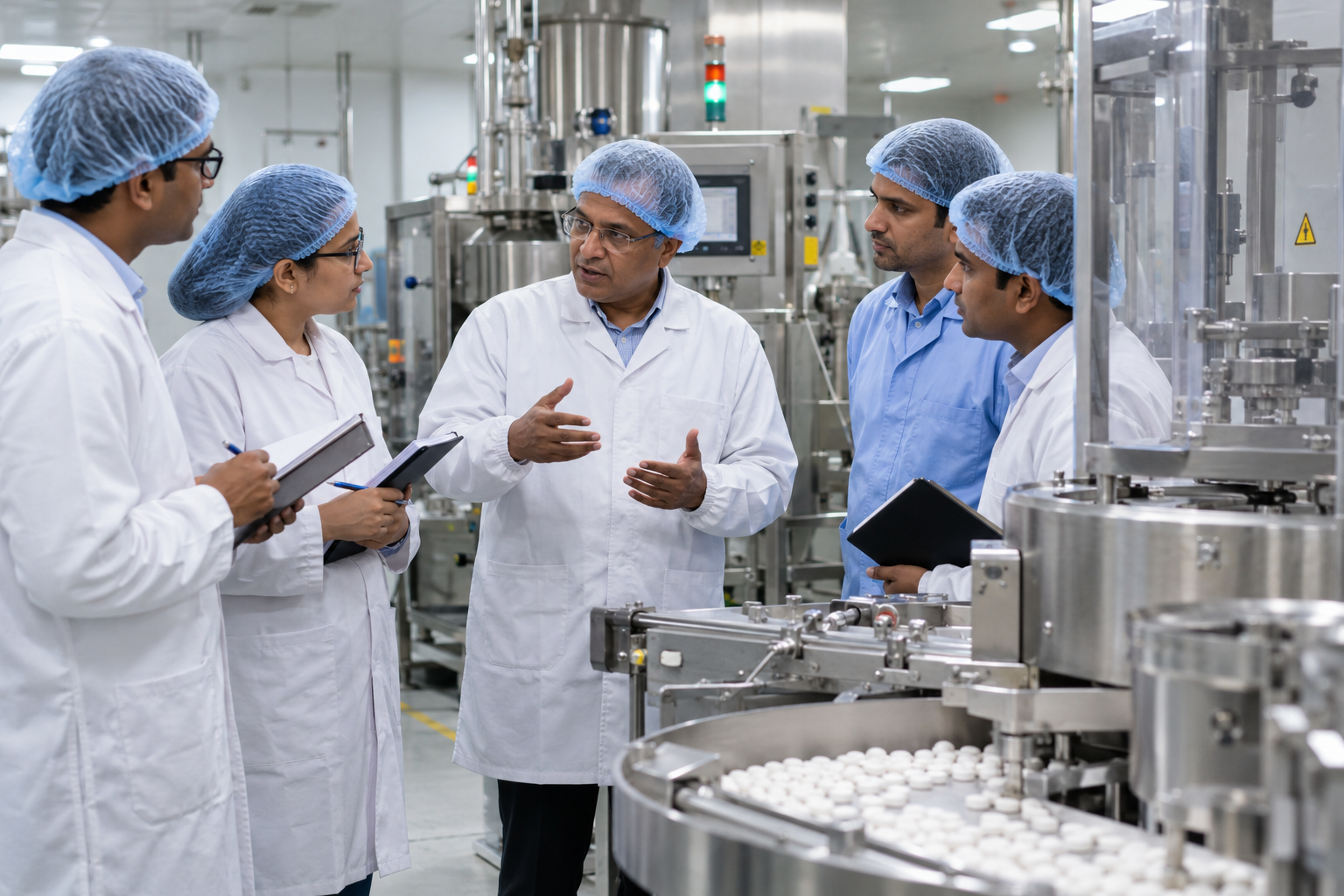
Leadership in pharmaceutical industry is tested most clearly when everything does not go according to plan.
A production target may be missed because of equipment downtime. A batch may be delayed because of an unexpected deviation. A compression machine may start showing repeated stoppages. A coating process may produce an unexpected defect. An audit may raise a question that nobody was expecting.
These situations are normal realities of pharmaceutical manufacturing.
What matters is how the leader responds.
After more than two decades in pharmaceutical manufacturing, particularly in Oral Solid Dosage (OSD) operations involving granulation, compression and coating, I have come to believe that leadership in pharma is much more than managing people or achieving monthly production targets. A pharmaceutical leader has to manage a much larger responsibility: people, product, process, compliance and ultimately the patient.
Production performance matters. Cost matters. Delivery matters. Productivity matters.
But none of these can come at the expense of product quality or GMP compliance.
That is what makes pharmaceutical leadership different.
What Does Leadership Really Mean in the Pharmaceutical Industry?
There is a significant difference between being a manager and being a leader.
A manager can assign work, review performance, monitor production numbers and ensure that procedures are followed. Those responsibilities are necessary.
Leadership goes further.
A leader has to create an environment in which people understand why the work matters.
Consider a manufacturing operator who notices an unusual machine sound during compression. In a weak culture, the operator may continue running the machine because production is already behind schedule.
In a strong culture, the operator feels comfortable reporting the observation immediately.
That difference is not created by an SOP alone. It is created by leadership.
A leader builds the confidence to say:
“Something doesn’t look right. We should check it before continuing.”
That simple behaviour can prevent a much larger problem.
Good pharmaceutical leadership therefore involves influence, judgment, technical understanding and trust. Authority may tell someone what to do. Leadership helps people make the right decision when the situation is not straightforward.
There is another important difference.
A manager may ask, “Who made the mistake?”
A leader is more likely to ask, “Why did the system allow this mistake to happen, and what should we change?”
That does not mean individual accountability is unimportant. It means accountability should be combined with a genuine search for the underlying cause.
Leadership in Pharmaceutical Industry and Patient Safety
It is easy to think of pharmaceutical manufacturing in terms of batches, machines, manpower and production schedules.
At the end of that chain, however, there is a patient.
WHO describes GMP as part of the quality assurance system intended to ensure that medicines are consistently produced and controlled to appropriate quality standards. Its guidance also emphasizes that manufacturers have responsibility for ensuring products are fit for their intended use and do not place patients at risk.
This is where leadership becomes particularly important.
A production manager may be under pressure to recover lost production hours. A batch may be running late. Management may be asking for additional output.
Those pressures are real.
But the response cannot be to bypass a required check, ignore a deviation, accept incomplete documentation or continue an activity without understanding a potential quality impact.
A strong leader understands that production targets are important, but they are not independent of quality requirements.
Quality has to be built into the manufacturing process.
That means leaders need to understand the practical implications of:
- GMP and cGMP
- Deviations
- CAPA
- Change Control
- Qualification
- Process Validation
- Equipment performance
- Training
- Documentation
- Data Integrity
- Risk Management
Leadership is therefore closely connected to the quality culture of the site.
Leading People on the Pharmaceutical Shop Floor
Managing a pharmaceutical manufacturing team is not the same as managing a team that works from a common office environment.
Manufacturing operates through shifts.
Different people work different hours. Experience levels vary. One shift may have highly experienced operators, while another may contain several relatively new employees.
The leader has to create consistency despite these differences.
A production department may include operators, technicians, officers, supervisors, engineers and managers, while successful manufacturing also depends heavily on coordination with QA, QC, engineering, maintenance, warehouse and other functions.
This is where communication becomes critical.
A good shift handover is not merely an exchange of production numbers.
It should communicate what happened, what remains open, what needs attention and whether there are any quality or equipment concerns.
One of the most valuable habits a leader can develop is to listen before giving instructions.
Operators often notice small changes before they become visible in production reports.
A machine that has started vibrating slightly differently.
A recurring minor stoppage.
A powder flow problem.
A recurring issue during cleaning.
A particular step in an SOP that creates confusion.
These observations can be valuable early-warning signals.
If employees believe that management does not listen, they eventually stop raising such observations.
That is how small problems become large problems.
What Happens When Production Goes Wrong?
Leadership is often easiest to judge when production is running smoothly.
The real test comes during a problem.
Imagine a compression machine experiencing repeated stoppages.
The immediate reaction may be to ask maintenance to restore the machine and restart production.
That may solve the immediate problem.
But an experienced leader asks additional questions:
- Why are the stoppages occurring?
- Is this a new problem or a recurring one?
- Is there a relationship with a particular product or tooling set?
- What does the historical data show?
- Has preventive maintenance been effective?
- Are operating parameters within the expected range?
- Is there an operator-related factor?
- Is there a mechanical issue?
- Is there a procedural issue?
- Could the problem affect product quality?
- Do we need a deviation or other formal assessment?
The sequence I find useful is:
Stop → Understand → Assess Risk → Investigate → Decide → Act → Prevent Recurrence
The important word is understand.
Manufacturing sometimes creates a temptation to solve the visible symptom quickly. But repeated temporary fixes eventually consume more time than a proper investigation.
The same principle applies to granulation and coating.
A variation in granulation can affect downstream compression behaviour. Compression problems can influence tablet quality. Coating problems may have several possible causes involving formulation, process parameters, equipment condition, spray system performance or environmental conditions.
A leader does not immediately jump to a conclusion.
The leader brings the right people together, examines the evidence and makes a controlled decision.
Leadership During Deviations and CAPA
A deviation is not simply a document that needs to be closed.
It is an opportunity to understand what happened and whether the existing system is capable of preventing recurrence.
The quality of an investigation often reflects the quality of the leadership behind it.
Consider a hypothetical example.
An operator enters a manufacturing record incorrectly.
The easiest conclusion is:
“Operator error. Retrain the operator.”
But that may not be the real root cause.
A stronger investigation would ask:
- Was the instruction clear?
- Was the procedure easy to follow?
- Was the operator adequately trained?
- Was the training effective?
- Was the documentation format confusing?
- Was the information entered at the appropriate time?
- Was there an environmental distraction?
- Was the same error made by others?
- Has this occurred previously?
- Did the system encourage or allow the error?
Root cause analysis tools such as 5 Why, Fishbone/Ishikawa analysis and FMEA can help structure the investigation.
The objective should not be to create an impressive investigation report.
The objective should be to understand the failure well enough to reduce the possibility of recurrence.
CAPA should follow the same philosophy.
A corrective action that only treats the immediate symptom may close a record, but it does not necessarily strengthen the system.
Leadership During Regulatory Audits
Regulatory inspections can expose the maturity of an organization’s leadership culture.
Preparing for an inspection should not mean spending a few weeks before the audit cleaning documents, arranging records and reminding employees what they should say.
That approach creates unnecessary anxiety.
A stronger approach is to maintain inspection readiness as part of normal operations.
This includes:
- Current and effective SOPs
- Properly maintained records
- Appropriate training
- Qualification and validation documentation
- Effective deviation management
- CAPA effectiveness
- Change-control discipline
- Data integrity controls
- Shop-floor compliance
WHO GMP principles emphasize clearly defined and documented processes, appropriate personnel, investigation of deviations and systems for controlled changes affecting product quality.
The leader’s responsibility is not to train employees to “pass the audit.”
It is to ensure that employees understand the processes they perform every day.
If an operator is asked during an inspection why a particular check is performed, the best answer should come from understanding—not memorization.
That is a sign of a healthy quality culture.
Leadership in Pharmaceutical Industry and Data Integrity
Data integrity has become one of the most important areas of pharmaceutical leadership.
FDA guidance states that data generated under CGMP should be reliable and accurate and emphasizes risk-based strategies for preventing and detecting data-integrity problems.
Technology can help, but technology alone cannot create data integrity.
A site may have electronic systems, audit trails, access controls and computerized systems, yet still have weaknesses if people do not understand why data integrity matters.
Leaders therefore have an important cultural responsibility.
Employees should know that correcting an honest mistake through the approved process is very different from concealing information or manipulating records.
A healthy environment encourages employees to report problems.
A fearful environment encourages people to hide them.
That distinction matters enormously.
Leadership should reinforce principles such as:
- Accurate recording
- Contemporaneous documentation
- Traceability
- Appropriate access control
- Audit-trail review where applicable
- Good Documentation Practices
- Controlled electronic records
- Appropriate computerized-system controls
Concepts such as 21 CFR Part 11 and EU GMP Annex 11 are not merely IT topics. They have implications for how pharmaceutical organizations manage electronic records and computerized processes.
The leader needs enough understanding to ask the right questions and involve the appropriate technical and quality specialists.
Developing the Next Generation of Pharma Leaders
One of the responsibilities of an experienced manager is to make themselves less indispensable over time.
That may sound unusual, but it is important.
If every decision has to come back to one person, the department has not really developed leadership capability.
Future leaders should gradually receive opportunities to:
- Lead meetings
- Investigate deviations
- Participate in audits
- Coordinate cross-functional activities
- Handle production problems
- Lead improvement projects
- Present data
- Make decisions within their authority
- Coach junior employees
Delegation is not simply transferring work.
It is transferring responsibility with appropriate guidance.
A young supervisor who makes a reasonable mistake while learning may actually be developing faster than someone who is never allowed to make a decision.
Of course, pharmaceutical manufacturing cannot become a training ground for uncontrolled experimentation. Decisions affecting quality and compliance must remain within established systems.
But within those boundaries, people need opportunities to grow.
The strongest leaders I have observed are often those who spend considerable time developing the people around them.
Leadership in Pharmaceutical Industry and Continuous Improvement
Continuous improvement is another area where leadership makes a major difference.
Most pharmaceutical manufacturing sites have opportunities to improve:
- OEE
- Yield
- Productivity
- Equipment availability
- Changeover time
- Rejection
- Downtime
- Material movement
- Documentation flow
- Cleaning activities
- Line clearance
- Process reliability
Tools such as 5S, Kaizen and Lean methodologies can support improvement.
But improvement does not become sustainable simply because a project has been completed.
Suppose an initiative reduces equipment downtime for three months.
The next question should be:
What has changed that will prevent the old condition from returning?
Preventive maintenance was improved.
A recurring mechanical issue was eliminated.
Operators were trained differently.
A parameter was better controlled.
Perhaps the equipment condition is now monitored more effectively.
The leader has to ensure that the improvement becomes part of the system rather than remaining dependent on one enthusiastic individual.
Leadership in Pharmaceutical Industry During Change
Pharmaceutical manufacturing is changing rapidly.
New equipment, automation, SCADA/HMI systems, MES, electronic documentation, digital quality systems and advanced analytics are becoming increasingly relevant to manufacturing operations.
Change, however, is rarely just a technical exercise.
People are affected by change.
An operator who has worked with a manual process for years may initially be uncomfortable with a new electronic system.
A supervisor may be concerned about additional responsibilities.
An engineer may have questions about system reliability.
QA may have concerns about compliance.
These concerns should not simply be dismissed as resistance.
A leader should understand them.
When implementing a new system, employees need to understand:
What is changing?
Why is it changing?
What will be expected from me and what training will I receive?
What happens if something goes wrong?
Who will support me?
Good change leadership therefore combines technical implementation with communication and training.
The same principle applies when implementing new SOPs, equipment, processes or organizational structures.
Emotional Intelligence on the Shop Floor
Pharmaceutical leadership is technical, but it is also deeply human.
People do not leave their emotions outside the manufacturing area.
A supervisor may be dealing with a difficult personal situation. An operator may be frustrated after repeated machine problems. Two departments may disagree about the cause of a deviation.
A leader who reacts emotionally to every difficult situation can unintentionally make problems worse.
Emotional intelligence does not mean avoiding difficult conversations.
Sometimes a leader has to say:
“This is not acceptable, and we need to correct it.”
But the message can be delivered firmly without humiliating the person.
There is a major difference between discipline and disrespect.
Good leaders know when to listen, when to challenge, when to coach and when to make a firm decision.
They also understand that respect must work in both directions.
Common Leadership Mistakes in Pharmaceutical Manufacturing
Some leadership mistakes are surprisingly common.
Managing through fear
Employees may comply when they are afraid, but fear does not necessarily produce good decisions.
In a fearful environment, people may hesitate to report problems.
Focusing only on production numbers
Production numbers are important, but they cannot tell the complete story.
A good production report should be considered alongside quality, safety, compliance, downtime, yield and people-related factors.
Blaming operators too quickly
The operator may have made the immediate error, but the system may have contributed to it.
Investigation should come before conclusion.
Ignoring small recurring problems
Repeated minor stoppages, documentation issues or process abnormalities often deserve attention before they become major events.
Micromanaging
When managers control every small decision, supervisors never develop.
Treating QA as an obstacle
Production and Quality may have different responsibilities, but they ultimately support the same objective: compliant production of quality medicines.
A productive relationship between the functions is essential.
Temporary problem-solving
If the same problem appears repeatedly, repeatedly applying the same temporary fix is not continuous improvement.
It is repetition.
What Makes an Effective Pharmaceutical Leader?
There is no single leadership personality that works in every pharmaceutical organization.
However, several characteristics are particularly valuable.
Integrity means doing the right thing even when nobody is watching.
Accountability means accepting responsibility instead of immediately looking for someone else to blame.
Technical understanding enables a leader to ask meaningful questions.
GMP mindset ensures that compliance is integrated into everyday decisions.
Communication keeps different shifts and functions aligned.
Coaching develops future capability.
Fairness builds trust.
Decision-making becomes especially important when production, quality and delivery pressures compete.
And perhaps most importantly, a pharmaceutical leader needs the courage to stop or question an activity when there is a genuine quality or compliance concern.
Leadership sometimes means saying:
“We need to stop and understand this before we continue.”
That may be uncomfortable in the moment.
It can nevertheless be the responsible decision.
Practical Leadership Lessons From the Shop Floor
After years of working around pharmaceutical manufacturing operations, there are several lessons that stand out.
1. The shop floor usually knows where the problems are
Reports may confirm the problem, but employees often see the early warning signs first.
Listen to them.
2. A production number is a result, not an explanation
If yield has decreased, the number tells you what happened.
It does not tell you why.
3. Never make compliance dependent on who is watching
An SOP should be followed whether an auditor is present or not.
4. Small abnormalities deserve attention
Today’s small recurring problem can become tomorrow’s major deviation.
5. Good leaders ask questions before giving answers
The first explanation is not always the correct explanation.
6. Training is not the same as competence
Signing a training record does not automatically mean the person can perform the task effectively.
7. Cross-functional problems need cross-functional thinking
Manufacturing problems rarely respect departmental boundaries.
8. A good CAPA should make the system stronger
If nothing meaningful changes after a recurring problem, the CAPA may not have addressed the real issue.
9. Employees should feel safe reporting problems
A problem reported early is usually easier to manage than a problem discovered later.
10. Develop people, not dependency
If everything depends on one manager, the department has a leadership-development problem.
11. Audit readiness should be normal work
The best preparation for an audit is consistent compliance every day.
12. Never forget who ultimately depends on the work
Behind every batch number is a patient who expects the medicine to be safe and effective.
The Future of Leadership in Pharma Manufacturing
The pharmaceutical manufacturing leader of the future will need a broader skill set.
Technical knowledge will remain important, but it will increasingly need to be combined with digital understanding.
Leaders may need to work with:
- MES
- SCADA/HMI
- Electronic Batch Records
- LIMS
- eQMS
- Data analytics
- Computerized systems
- AI-enabled applications
- Digital manufacturing
- Pharma 4.0 concepts
But technology should not replace leadership.
A dashboard can show that OEE has decreased.
Analytics may identify a pattern.
An AI system may help identify potential causes.
The leader still has to ask:
What does this information mean for the process, the people and the product?
This is why future pharmaceutical leaders will need to combine manufacturing knowledge with digital awareness.
They will need to understand data without losing sight of people.
They will need to understand automation without losing sight of GMP.
And they will need to understand efficiency without losing sight of quality.
Final Thoughts
Leadership in pharmaceutical manufacturing is not measured only by how many batches were produced or whether a monthly target was achieved.
Those numbers matter, but they tell only part of the story.
The deeper measure is what happens when the target is under pressure.
Does the team continue to follow GMP?
Do employees report problems honestly?
Does the manager investigate rather than blame?
Does Quality get involved at the right time?
Are recurring problems actually eliminated?
Are people being developed for greater responsibility?
Does the organization learn from its mistakes?
These are leadership questions.
After spending many years in pharmaceutical manufacturing, I believe the most valuable leaders are not necessarily the people who always have the quickest answer. They are the people who create teams capable of asking the right questions, making sound decisions and doing the right thing consistently.
A pharmaceutical leader carries responsibility for much more than production.
People. Product. Process. Compliance. Patient.
When these five remain connected in everyday decision-making, leadership becomes more than management. It becomes part of the quality system itself.
And that, in my view, is where effective pharmaceutical leadership begins.
References
https://picscheme.org/en/publications?utm_source=chatgpt.com
https://www.who.int/publications/i/item/9789240086081?utm_source=chatgpt.com
About the Author
Ramesh Palav is a pharmaceutical manufacturing professional with 21+ years of experience in OSD manufacturing, specializing in Granulation, Compression, Coating, GMP, QMS, Validation, CAPA, Deviations, Audits and Continuous Improvement. He is the founder of Pharma Manufacturing Hub, where he shares practical insights on pharmaceutical manufacturing, quality, compliance, technology and industry leadership.