
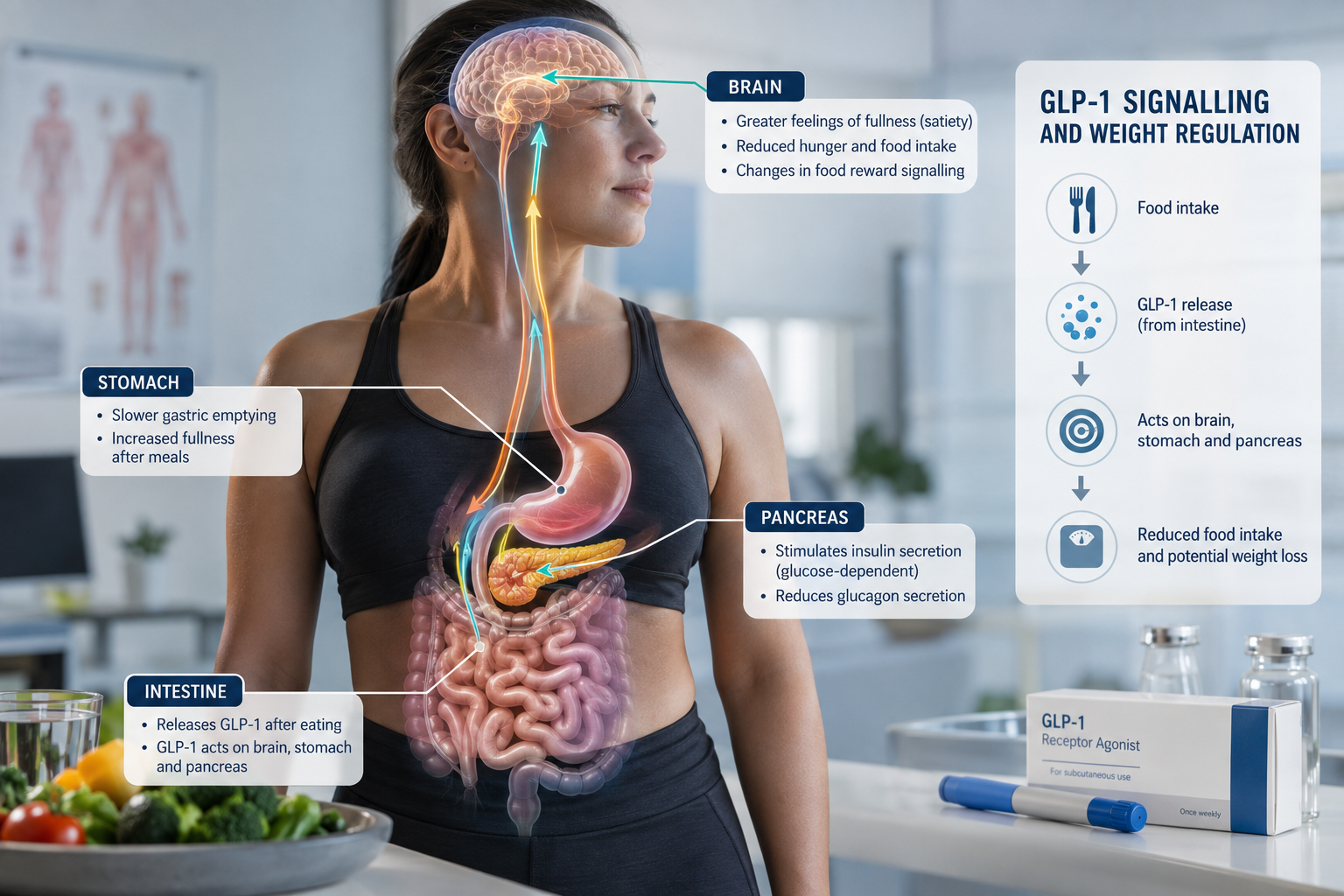
GLP-1 drugs explained: These medicines have moved from being primarily associated with diabetes treatment to becoming one of the most discussed developments in modern obesity medicine. But how exactly does a GLP-1 medicine cause weight loss?
The answer is more interesting than simply saying that these medicines “reduce appetite.”
GLP-1-based medicines influence several physiological processes involving the brain, digestive system and pancreas. They can increase feelings of fullness, reduce hunger and food intake, affect gastric emptying, and improve glucose regulation. The combined effect can produce clinically meaningful weight loss in appropriate patients.
But GLP-1 medicines do not simply “burn fat,” and they are not a shortcut around human biology. Their effects involve complex hormonal and metabolic signalling—and their benefits, risks and appropriate use need to be understood in that context.
This article explains how GLP-1 drugs work, why they can cause weight loss, what happens to body fat and appetite, how semaglutide differs from tirzepatide, and what the development of these medicines means for the pharmaceutical industry and India.
What Are GLP-1 Drugs?
GLP-1 stands for glucagon-like peptide-1, a naturally occurring hormone involved in regulating blood glucose and energy intake.
After food is consumed, specialised cells in the intestine release GLP-1. The hormone acts on several organs and tissues, including the pancreas and areas of the brain involved in appetite regulation.
Among its physiological effects, GLP-1 can:
- Stimulate insulin secretion when blood glucose is elevated
- Reduce glucagon secretion in a glucose-dependent manner
- Influence gastric emptying
- Increase feelings of fullness or satiety
- Influence appetite and food intake
- Contribute to regulation of blood glucose
The natural hormone itself is relatively short-lived because it is rapidly broken down in the body.
This is where pharmaceutical development becomes important.
Natural GLP-1 vs GLP-1 receptor agonists
Natural GLP-1 is a hormone produced by the body. GLP-1 receptor agonists are medicines designed to activate the GLP-1 receptor and reproduce important effects of the natural hormone for a much longer period.
Examples include medicines based on semaglutide, liraglutide and dulaglutide.
Not every medicine in this class has the same approved indications, dosing schedule or clinical profile.
There is also a newer category of medicines that acts on more than one metabolic pathway.
The best-known example is tirzepatide, which activates both the GIP and GLP-1 receptors.
How Do GLP-1 Drugs Cause Weight Loss?
To understand how GLP-1 drugs cause weight loss, it helps to look at what happens in different parts of the body.
A simplified pathway looks like this:
GLP-1 signalling → appetite and satiety effects → reduced food intake + metabolic effects → sustained energy deficit → reduction in body weight
However, the biology is more complicated than this simplified diagram suggests.
Let’s break it down.
Step 1: GLP-1 and the Brain — Why Does Appetite Decrease?
One of the most important aspects of GLP-1-based weight loss is its effect on appetite regulation.
The brain continuously receives signals about hunger, satiety, energy availability and food intake. GLP-1 signalling is part of this network.
When GLP-1 receptor pathways are activated, appetite-related signalling can change. Many patients receiving GLP-1-based medicines report:
- Feeling full sooner
- Feeling less hungry between meals
- Eating smaller portions
- Reduced interest in food
- Changes in cravings or food preferences
It is therefore more accurate to say that these medicines modify appetite and satiety signalling than to say they simply “switch off hunger.”
This distinction matters.
Eating behaviour is controlled by a network of hormones, neural pathways, environmental factors, emotions, habits and metabolic signals. GLP-1 is one important component of that system—not the entire system.
Step 2: The Stomach — Why Can You Feel Full for Longer?
GLP-1 signalling can also influence gastric emptying, meaning the rate at which food moves from the stomach into the small intestine.
Slower gastric emptying can contribute to a feeling of fullness after eating.
For someone who previously felt hungry soon after a meal, this change can affect meal size and eating frequency.
However, gastric-emptying effects are not the entire explanation for weight loss.
They can also vary between individuals and may change during treatment. For this reason, it would be inaccurate to describe GLP-1 weight loss as simply the result of food “staying in the stomach.”
The broader effect involves appetite, satiety, food intake and metabolic regulation.
Step 3: The Pancreas — What Happens to Insulin and Glucagon?
GLP-1 has an important role in glucose regulation.
When blood glucose is elevated, GLP-1 signalling can increase insulin secretion from pancreatic beta cells.
At the same time, GLP-1 signalling can reduce glucagon secretion under appropriate glucose conditions.
This is important because insulin and glucagon have opposing roles in maintaining blood-glucose levels.
In simple terms:
Higher blood glucose → GLP-1 signalling → increased glucose-dependent insulin response
and
GLP-1 signalling → reduced inappropriate glucagon secretion
These effects help explain why GLP-1-based medicines became important in the treatment of type 2 diabetes.
But there is an important distinction:
Better glucose control is not the same thing as weight loss.
Weight loss associated with GLP-1-based therapies involves multiple mechanisms, particularly changes in appetite, satiety and food intake.
Step 4: The Result — People Often Eat Less
This is where the different mechanisms come together.
If a person:
- feels less hungry,
- becomes full sooner,
- experiences smaller appetite signals,
- eats smaller portions,
- and has reduced food intake over time,
their overall energy intake may decrease.
When energy intake remains below energy expenditure over time, body weight generally declines.
This does not mean GLP-1 medicines simply “force people to eat less.”
They influence the biological systems that help regulate when, how much and how strongly a person wants to eat.
That is an important difference.
Why Can GLP-1 Drugs Produce Significant Weight Loss?
Weight regulation is not simply a matter of willpower.
The human body has powerful biological mechanisms designed to defend energy stores. When someone loses weight through dieting, changes in hunger and satiety signals can make continued weight loss and weight maintenance difficult.
This is one reason obesity is increasingly understood as a chronic, complex disease involving biological, environmental, behavioural and metabolic factors.
GLP-1-based medicines can modify some of those biological signals.
The overall picture can be represented as:
Reduced hunger
↓
Earlier satiety
↓
Reduced food intake
↓
Lower energy intake
↓
Progressive weight reduction
At the same time, improvements in glucose regulation and other metabolic effects can contribute to broader cardiometabolic benefits in appropriate patients.
GLP-1 vs GLP-1/GIP Medicines
Not all modern incretin medicines work through exactly the same pathway.
Traditional GLP-1 receptor agonists primarily activate the GLP-1 receptor.
Tirzepatide is different because it activates both the GIP receptor and GLP-1 receptor.
GIP stands for glucose-dependent insulinotropic polypeptide.
This has created significant interest in so-called dual incretin therapies.
| Feature | GLP-1 receptor agonists | GLP-1/GIP medicines |
|---|---|---|
| Main pathways | GLP-1 receptor | GLP-1 + GIP receptors |
| Example | Semaglutide | Tirzepatide |
| Appetite effects | Important | Important |
| Glucose regulation | Important | Important |
| Weight-management role | Established for certain medicines/indications | Established for certain medicines/indications |
| Mechanism | Primarily GLP-1 signalling | Combined incretin signalling |
It is tempting to ask which class is “better.”
The more scientifically appropriate question is:
Which medicine is appropriate for which patient, indication and clinical situation?
Clinical efficacy, tolerability, contraindications, comorbidities, regulatory approval and patient-specific factors all matter.
Semaglutide and Tirzepatide: What’s the Difference?
Semaglutide
Semaglutide is a long-acting GLP-1 receptor agonist.
Different semaglutide products and formulations have different approved uses and dosing regimens. Some are associated with type 2 diabetes treatment, while specific formulations have indications related to chronic weight management.
Semaglutide effects include:
- GLP-1 receptor activation
- Increased glucose-dependent insulin secretion
- Reduced glucagon signalling when appropriate
- Appetite and satiety effects
- Effects on gastric emptying
- Reduced food intake
Tirzepatide
Tirzepatide is a dual GIP/GLP-1 receptor agonist.
Its mechanism combines activity at two incretin pathways rather than relying exclusively on GLP-1 receptor activation.
Clinical trials have demonstrated substantial effects on body weight in people with obesity or overweight under studied conditions.
However, trial results should not be interpreted as a guarantee of a particular amount of weight loss for an individual patient.
GLP-1 Drugs and Body Fat: What Actually Happens?
A common misconception is that GLP-1 medicines directly “melt fat.”
That is not an accurate description.
Weight reduction can involve reductions in both fat mass and lean mass, with the exact composition varying between individuals and depending on the intervention and circumstances.
From a health perspective, losing excess adipose tissue can be beneficial, but preserving functional lean tissue—particularly muscle—is also important.
This is why nutrition, adequate protein intake where appropriate, resistance exercise and medical supervision can be important components of comprehensive weight management.
The goal should not simply be:
“Lose as much weight as possible.”
A better goal is:
“Improve health while achieving sustainable and clinically appropriate weight management.”
What Happens to Appetite and Food Cravings?
The experience differs from person to person.
Some people receiving GLP-1-based medicines report that food becomes less dominant in their daily thinking.
Others describe:
- Less hunger
- Smaller meals
- Earlier fullness
- Fewer cravings
- Less interest in highly palatable foods
Research into the effects of GLP-1 signalling on reward-related eating behaviour is continuing.
It is important not to overstate this science. Not every reported change in food preference can be attributed to one simple mechanism.
Common GLP-1 Drug Side Effects
The same biological mechanisms that can produce therapeutic effects can also contribute to unwanted effects.
Common gastrointestinal adverse effects reported with GLP-1-based medicines can include:
- Nausea
- Vomiting
- Diarrhea
- Constipation
- Abdominal discomfort
- Reduced appetite
These effects can be particularly noticeable during dose escalation.
Serious adverse reactions and contraindications also exist for specific medicines.
For this reason, GLP-1-based medicines should be used according to the approved prescribing information and under appropriate healthcare supervision.
People should not start, stop or change prescription treatment solely on the basis of information found online.
Why Do Some People Lose More Weight Than Others?
Clinical trials provide average results, but individuals do not respond identically.
Differences can arise from:
- The medicine and dose used
- Treatment duration
- Baseline body weight
- Adherence
- Diet
- Physical activity
- Metabolic health
- Other medicines
- Genetics
- Underlying medical conditions
- Individual biological response
This is why a clinical-trial average should never be interpreted as a personal prediction.
A person may experience substantially more or less weight loss than the average reported in a study.
What Happens When Someone Stops Taking a GLP-1 Drug?
This is one of the most important questions surrounding obesity medicines.
Weight management does not necessarily end when a person reaches a target weight.
When treatment is discontinued, biological signals that promote appetite and weight regain can return. Clinical research has demonstrated that weight regain can occur after discontinuation of semaglutide and other anti-obesity therapies.
This does not mean everyone regains all of the weight they lost.
Rather, it demonstrates an important principle:
Obesity treatment often needs to be considered as long-term disease management rather than a short-term weight-loss program.
The decision to continue or discontinue therapy should be made with an appropriate healthcare professional.
Are GLP-1 Drugs a “Magic Weight-Loss Injection”?
No.
The phrase “magic injection” may be useful for social-media headlines, but it is a poor description of pharmacology.
GLP-1-based medicines are pharmacological interventions that modify specific physiological pathways.
They can be highly effective for appropriate patients, but they also have:
- Indications
- Contraindications
- Adverse effects
- Dosing requirements
- Monitoring considerations
- Cost and access considerations
- Regulatory restrictions
They are not suitable for everyone.
Nor should prescription medicines be used simply because they are popular on social media.
GLP-1 Drugs and the Pharmaceutical Industry
The rise of GLP-1-based obesity medicines is more than a clinical development.
It is creating a major pharmaceutical-development opportunity.
The industry is working across several areas, including:
1. Oral formulations
Oral alternatives could potentially expand convenience and accessibility compared with injectable products, depending on the medicine and indication.
2. Longer-acting formulations
Drug developers are investigating ways to extend dosing intervals and improve treatment convenience.
3. Combination therapies
The success of multi-pathway approaches such as GLP-1/GIP therapy has increased interest in additional combinations.
4. Drug-device development
Injectable therapies require reliable delivery systems, creating opportunities in:
- Autoinjectors
- Prefilled devices
- Pen injectors
- Dose-delivery systems
5. Manufacturing
Large-scale production of peptide-based medicines creates challenges involving:
- Process development
- Scale-up
- Purification
- Analytical testing
- Sterile manufacturing where applicable
- Fill-finish
- Device assembly
- Supply-chain management
6. Pharmacovigilance
As exposure to these medicines increases, robust adverse-event monitoring and signal detection become increasingly important.
7. Regulatory science
Manufacturers must demonstrate quality, safety and efficacy while navigating increasingly complex regulatory requirements.
What Could Be Next for GLP-1 Medicines?
The next stage of obesity-drug development is unlikely to involve only another version of the same injection.
Research is moving into areas such as:
- Oral incretin therapies
- Longer-acting formulations
- Multi-receptor agonists
- Combination therapies
- Improved tolerability
- Treatments designed to address body composition
- Muscle-preservation strategies
- Cardiometabolic applications
- New approaches to obesity and metabolic disease
Some of these approaches remain investigational.
That distinction is important.
A medicine being studied in a clinical trial does not mean it is an approved treatment.
What Does the GLP-1 Boom Mean for India?
India presents an especially interesting environment for obesity medicines.
The country has a large pharmaceutical manufacturing base, a substantial generic-drug industry and growing capabilities in complex formulations, biologics and specialty medicines.
The expanding interest in GLP-1 therapies could therefore create opportunities across:
- Pharmaceutical formulation development
- Peptide manufacturing
- Complex generics
- Device-enabled drug delivery
- Clinical development
- Regulatory affairs
- Pharmacovigilance
- Analytical development
- Contract manufacturing
- Pharmaceutical packaging
However, access and affordability remain important considerations.
Another concern is the increasing availability of health information through social media, where prescription medicines can sometimes be discussed without adequate medical context.
The popularity of GLP-1 medicines should therefore be accompanied by responsible patient education, appropriate prescribing, pharmacovigilance and regulatory oversight.
A note on Indian approvals
Regulatory approval is country-specific.
A GLP-1 or related medicine being approved for obesity in the United States or Europe does not automatically mean that the same product, formulation, indication or brand has the same approval status in India.
The Bigger Lesson: GLP-1 Is Changing How We Think About Obesity
Perhaps the most important development is not a particular brand or molecule.
It is the growing recognition that obesity involves biology.
Hunger, satiety, hormonal signalling, metabolism, genetics, environment and behaviour all interact.
GLP-1-based medicines provide one way of modifying part of this complex system.
That does not make lifestyle factors irrelevant.
It means that for some patients, pharmacological treatment can become another component of comprehensive obesity management—alongside appropriate nutrition, physical activity, behavioural support and medical care.
GLP-1 Drugs Explained: Key Takeaways
- GLP-1 is a naturally occurring hormone involved in glucose and appetite regulation.
- GLP-1 receptor agonists activate the GLP-1 receptor for much longer than natural GLP-1 remains active in the body.
- GLP-1-based medicines can influence appetite, satiety, gastric emptying and glucose regulation.
- A major contributor to weight loss is reduced food intake resulting from changes in hunger and fullness signals.
- GLP-1 medicines do not simply “burn fat.” Weight reduction involves changes in overall energy balance and body composition.
- Semaglutide and tirzepatide are not identical medicines. Tirzepatide acts through both GIP and GLP-1 receptors.
- Side effects—particularly gastrointestinal effects—are an important consideration.
- Stopping treatment can be followed by weight regain in some people, reinforcing the importance of long-term obesity management.
- The GLP-1 field is rapidly expanding beyond today’s medicines, with oral, longer-acting and multi-pathway approaches under development.
- For the pharmaceutical industry, GLP-1 medicines represent an important opportunity across drug development, manufacturing, devices, regulatory affairs and pharmacovigilance.
Frequently Asked Questions
1. What are GLP-1 drugs?
GLP-1 drugs are medicines that activate the GLP-1 receptor or, in the case of certain newer medicines, act on the GLP-1 pathway together with another metabolic pathway. They can influence blood glucose, appetite, satiety and other physiological processes.
2. How do GLP-1 drugs cause weight loss?
They can reduce hunger and increase feelings of fullness, leading many people to consume less food. They can also influence gastric emptying and glucose regulation. Together, these effects can contribute to sustained weight loss.
3. Do GLP-1 drugs burn fat directly?
No. It is misleading to describe them as medicines that directly “burn” or “melt” fat. Their weight-loss effects are primarily related to changes in appetite, satiety, food intake and metabolic regulation.
4. How does semaglutide cause weight loss?
Semaglutide activates the GLP-1 receptor. This can influence appetite and satiety, reduce food intake and affect glucose regulation. These combined effects can lead to clinically meaningful weight loss in appropriately selected patients.
5. What is the difference between semaglutide and tirzepatide?
Semaglutide is a GLP-1 receptor agonist. Tirzepatide activates both GIP and GLP-1 receptors. They therefore have overlapping but not identical mechanisms.
6. Do GLP-1 drugs reduce appetite?
Yes, appetite reduction is an important component of the effects of GLP-1-based medicines. Many patients report less hunger, earlier fullness and smaller food intake.
7. What are the common side effects of GLP-1 drugs?
Gastrointestinal effects such as nausea, vomiting, diarrhea, constipation and abdominal discomfort are among the commonly reported adverse effects. The exact safety profile varies by medicine.
8. What happens when you stop taking GLP-1 drugs?
Some people regain weight after stopping treatment. This is consistent with the biological tendency of obesity to recur and with the return of appetite and weight-regulation signals after treatment ends.
9. Are GLP-1 drugs suitable for everyone?
No. Eligibility depends on the specific medicine, approved indication, medical history, contraindications, other medications and individual circumstances. Treatment should be determined by a qualified healthcare professional.
10. Are GLP-1 drugs available in India?
Availability and approved indications vary by product and can change over time. Indian readers should verify the latest status through official Indian regulatory and prescribing-information sources rather than relying on social-media claims.
11. Can GLP-1 drugs be used without a prescription?
Prescription status and legal requirements depend on the specific medicine and jurisdiction. People should not obtain or use prescription GLP-1 medicines without appropriate medical evaluation and supervision.
12. Are GLP-1 drugs only for people with diabetes?
No. Certain GLP-1-based medicines have approved indications for chronic weight management in appropriately selected people with overweight or obesity, depending on the product and country. Diabetes and obesity indications should not be assumed to be interchangeable.
Conclusion
The simplest answer to “How do GLP-1 drugs cause weight loss?” is that they change the biological signals involved in hunger, fullness, food intake and metabolic regulation.
But the real story is more complex.
GLP-1 signalling connects the gut, pancreas and brain, influencing appetite and satiety while also affecting glucose regulation and, for some medicines, gastric emptying. The resulting reduction in food intake can contribute substantially to weight loss.
The emergence of semaglutide, tirzepatide and other incretin-based therapies is also changing the pharmaceutical landscape. Drug developers are now exploring oral formulations, longer-acting medicines, combination therapies and new approaches to obesity and metabolic disease.
For India, the opportunity extends beyond the medicines themselves. It includes formulation development, manufacturing, analytical science, drug delivery, regulatory affairs, clinical research and pharmacovigilance.
The important point is to look beyond the social-media label of a “weight-loss injection.”
GLP-1 medicines are a significant development in modern metabolic medicine—but understanding their biology, evidence, limitations and appropriate use is just as important as understanding their weight-loss potential.
Medical Disclaimer
This article is intended for educational and informational purposes only. It does not constitute medical advice, diagnosis or treatment. GLP-1-based medicines are prescription therapies with specific indications, contraindications, warnings and potential adverse effects. Anyone considering treatment should consult a qualified healthcare professional and refer to the current official prescribing information applicable in their country.
Authoritative References & Further Reading
For publication, the article should be supported primarily by authoritative regulatory sources and peer-reviewed literature, including:
- U.S. Food and Drug Administration (FDA) — official prescribing information and regulatory communications for relevant semaglutide and tirzepatide products.
- European Medicines Agency (EMA) — European product information and regulatory assessments.
- World Health Organization (WHO) — obesity and health-related guidance.
- India’s Central Drugs Standard Control Organisation (CDSCO) — Indian regulatory information and approved-product status.
- STEP clinical-trial programme — clinical evidence concerning semaglutide and weight management.
- SURMOUNT clinical-trial programme — clinical evidence concerning tirzepatide and weight management.
- Peer-reviewed literature covering GLP-1 physiology, appetite regulation, gastric emptying, body composition and long-term weight management.
About the Author
Ramesh Palav is a pharmaceutical industry professional with experience in pharma manufacturing, quality systems, GxP compliance and digital transformation. He writes practical, industry-focused content to help pharmaceutical professionals understand emerging technologies, regulatory developments and manufacturing trends.