
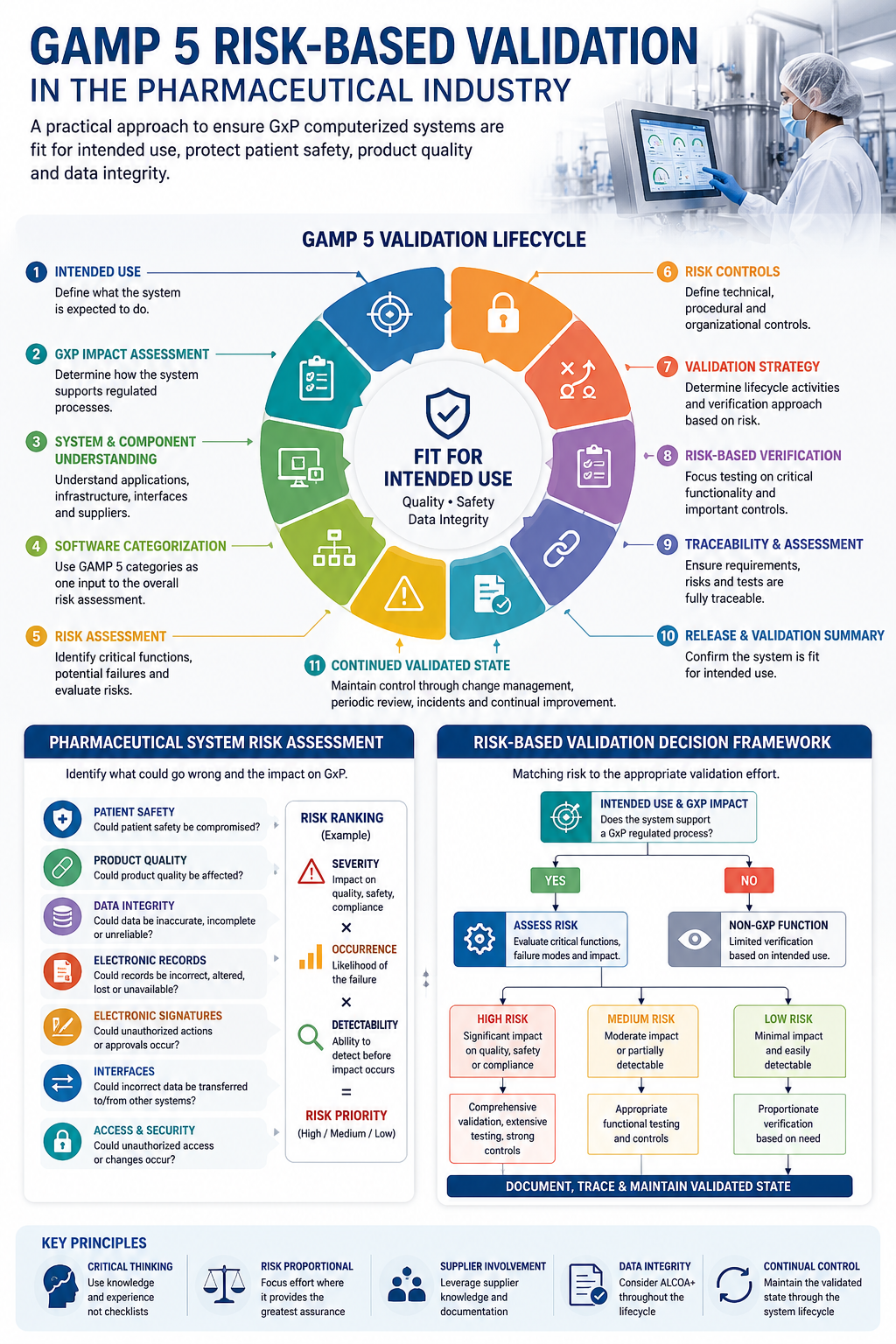
When a pharmaceutical company implements a new LIMS, MES, ERP module, electronic document management system or cloud application, one question usually comes up very early in the project:
“How much validation do we actually need?”
It sounds like a simple question, but the answer is rarely “validate everything” or “validate only the critical functions.”
A well-designed validation approach starts by understanding what the computerized system is actually being used for, what could go wrong, and what the impact would be on patient safety, product quality, data integrity and regulatory compliance.
This is where GAMP 5 risk based validation becomes particularly useful.
GAMP 5 provides a practical framework for applying a lifecycle and risk-based approach to GxP computerized systems. It is not intended to be a rigid checklist or a prescription that every pharmaceutical company must follow in exactly the same way. ISPE describes GAMP as practical guidance rather than a prescriptive standard, with the objective of helping organizations achieve computerized systems that are fit for intended use while protecting patient safety, product quality and data integrity.
The second edition of GAMP 5, published in 2022, puts additional emphasis on critical thinking, supplier involvement, cloud and SaaS solutions, evolving software development methods, automation, data integrity and newer technologies.
The real value of GAMP 5 is therefore not simply knowing which software category a system belongs to. The value comes from using the available information to make a sensible decision about where validation effort is actually needed.
What Is GAMP 5?
GAMP stands for Good Automated Manufacturing Practice and is an ISPE community of practice focused on computerized systems used in regulated life-science environments.
The GAMP 5 guidance supports a lifecycle approach for computerized systems and provides a common framework for activities such as planning, requirements definition, risk management, specification, verification, operation, maintenance and retirement.
One important point should be made clear:
GAMP 5 is guidance, not a regulation.
Regulatory requirements come from applicable laws, regulations and regulatory expectations. GAMP 5 helps organizations interpret and implement appropriate controls around computerized systems.
The approach is based on several important ideas:
- The system should be fit for its intended use.
- Validation effort should be proportionate to risk.
- Patient safety and product quality should remain central considerations.
- Data integrity should be considered throughout the lifecycle.
- Supplier knowledge and documentation should be used where appropriate.
- Verification activities should focus on areas where failure could have meaningful consequences.
- The validated state should be maintained throughout operation.
GAMP 5 also recognizes that modern computerized systems are rarely simple standalone applications. A typical pharmaceutical system may include application software, databases, operating systems, interfaces, cloud infrastructure, configurable components, custom code and external services.
That makes a purely “system category = validation approach” model difficult to apply.
What Does Risk-Based Validation Mean?
Risk-based validation means that validation activities are scaled according to the risk associated with the intended use of the computerized system.
The basic thinking is straightforward:
Higher GxP risk should receive greater validation attention and stronger controls.
This does not mean that low-risk systems can simply be ignored.
Instead, the objective is to avoid spending the same amount of effort testing a low-impact dashboard and a system that controls critical manufacturing parameters or generates the official electronic batch record.
Consider two examples.
A production dashboard that displays already-approved information may have limited GxP impact.
An MES application that determines whether a manufacturing step can proceed, records critical process parameters and creates the electronic batch record has a very different risk profile.
Both are computerized systems, but the validation strategy should not treat them as equivalent.
GAMP 5 encourages this type of critical thinking rather than a purely checklist-based approach. ISPE specifically notes that software categorization is only one factor and that lifecycle activities should be scaled according to overall GxP impact, complexity and novelty.
Why Is Risk Assessment So Important?
A computerized system can contain hundreds or even thousands of functions.
Testing every function with exactly the same level of rigor can consume significant time without necessarily improving assurance.
The more useful question is:
Which failures could actually affect the regulated process?
Risk assessment helps answer that question.
Typical risk considerations include:
- Patient safety
- Product quality
- Data integrity
- Regulatory compliance
- Critical process parameters
- Critical quality attributes
- Electronic records
- Electronic signatures
- Automated calculations
- Manufacturing decisions
- Laboratory results
- Interfaces
- Access control
- Audit trails
- Data retention
- Backup and recovery
- Business continuity
The risk assessment should ultimately lead to practical decisions.
For example:
High-risk function → detailed requirements + strong controls + comprehensive testing
Medium-risk function → appropriate functional testing and controls
Low-risk function → proportionate verification
The important point is that the risk assessment should change what you do.
If the risk assessment is completed but the same validation package would have been produced regardless of the result, then the risk assessment has probably become a documentation exercise rather than a decision-making tool.
How to Perform a GAMP 5 Risk Assessment
A practical GAMP 5 risk based validation approach can be organized into several steps.
Step 1 – Define the Intended Use
Before talking about test scripts, first define what the system is intended to do.
For example:
“The MES will be used to execute and electronically document manufacturing operations for commercial batches, including material verification, dispensing, process execution, electronic signatures, exception handling and batch record review.”
That statement tells us much more than simply saying:
“MES system for manufacturing.”
The intended use establishes the foundation for the subsequent GxP impact and risk assessment.
A common mistake is to begin validation before the business process has been properly understood.
From a validation perspective, process understanding should come before test-script writing.
Step 2 – Determine GxP Impact
The next question is whether the computerized system supports a GxP-regulated process.
Ask questions such as:
- Does the system generate GxP records?
- Does it maintain data used to make quality decisions?
- Does it control or monitor a critical manufacturing process?
- Does it support laboratory testing?
- Does it manage approved specifications?
- Does it execute quality workflows?
- Does it generate electronic signatures?
- Does it calculate or determine acceptance criteria?
- Does it maintain data required for regulatory submissions?
- Does it directly or indirectly affect product quality?
A system can also have both GxP and non-GxP functions.
For example, an ERP system may contain financial functions that are not GxP while also managing material master data used by a regulated manufacturing process.
Therefore, the entire system should not automatically be treated as having one identical risk level.
Step 3 – Identify Critical Functions
Once the GxP impact is understood, identify the functions that are genuinely important from a quality, patient safety or data integrity perspective.
For a LIMS, examples may include:
- Sample login
- Test assignment
- Specification management
- Result entry
- Instrument interfaces
- Calculations
- Result approval
- Electronic signatures
- Audit trails
- Certificate generation
For an MES/eBR system, examples may include:
- Recipe management
- Material verification
- Dispensing
- Weighing
- Process parameter entry
- Automated calculations
- Electronic signatures
- Batch review
- Exception handling
- ERP interfaces
- Equipment interfaces
- Audit trails
Not every screen deserves the same validation effort.
For example, changing a user-interface theme normally does not present the same GxP risk as changing a batch calculation.
That difference should be reflected in the validation strategy.
Step 4 – Identify Potential Failure Modes
For each important function, ask:
What could go wrong?
Consider examples such as:
- Incorrect calculation
- Incorrect material identification
- Wrong recipe version
- Unauthorized user access
- Missing audit trail
- Incorrect electronic signature
- Incorrect master data
- Interface failure
- Data loss
- Duplicate records
- Incorrect workflow routing
- Incorrect status change
- Inadequate segregation of duties
- Incorrect report output
- Failure to retain required records
The risk assessment becomes much more useful when it describes an actual failure scenario rather than simply assigning a generic “high/medium/low” rating.
Step 5 – Evaluate the Risk
Organizations often use a risk-ranking model such as:
Severity × Occurrence × Detectability
However, the scoring methodology should be defined within the organization’s approved quality risk-management procedure.
There is no universal requirement that every pharmaceutical organization must use the same numerical scoring system.
A simple illustrative model could look like this:
| Score | Severity | Occurrence | Detectability |
|---|---|---|---|
| 1 | Minimal impact | Rare | Easily detected |
| 2 | Moderate impact | Possible | Moderately detectable |
| 3 | Significant impact | Likely | Difficult to detect |
For illustration, suppose a system calculates the quantity of an active ingredient during dispensing.
If the calculation is incorrect:
- Severity may be high because product composition could be affected.
- Occurrence depends on the likelihood of the failure.
- Detectability depends on whether another control would detect the incorrect quantity before product release.
The resulting risk may therefore justify detailed testing of the calculation, including boundary conditions, invalid inputs, decimal handling and error handling.
The exact scoring thresholds should come from the site’s approved risk methodology rather than being copied from another company.
Step 6 – Define Risk Controls
Once the risks are understood, determine how they will be controlled.
Controls may include:
- Functional controls
- Role-based access
- Segregation of duties
- Electronic signatures
- Audit trails
- Automated calculations
- Input validation
- Workflow controls
- Approval workflows
- SOPs
- Training
- Review processes
- Backup and recovery
- Monitoring
- Periodic review
- Change control
A strong validation approach does not rely on testing alone.
For example, an electronic-signature risk may require a combination of:
Authentication + authorization + signature meaning + audit trail + procedural controls + testing
This provides a stronger control environment than simply adding one test case called “Verify electronic signature.”
Step 7 – Convert Risk into Testing
This is where the risk assessment should have a visible impact.
High-risk functions may require:
- Detailed functional testing
- Positive testing
- Negative testing
- Boundary testing
- Calculation verification
- Security testing
- Data integrity testing
- Interface testing
- Audit trail verification
- Error handling
- Regression testing
Medium-risk functions may require appropriate functional verification.
Low-risk functions may require limited verification depending on the intended use and controls.
A useful principle is:
Risk assessment should drive testing—not simply justify testing that has already been planned.
This is one of the most important practical differences between a meaningful risk-based validation approach and a traditional “test everything equally” approach.
GAMP 5 Software Categories and Validation
Software categorization is useful, but it should not become the validation strategy by itself.
The GAMP 5 Second Edition updated the categorization approach and emphasizes that computerized systems generally contain components from different categories. It also describes categories as a continuum rather than a simple label for an entire system.
The current approach includes categories such as:
| GAMP 5 Category | Typical Example | Practical Consideration |
|---|---|---|
| Category 1 | Infrastructure software | Focus on infrastructure suitability, qualification and management |
| Category 3 | Standard/non-configured components | Focus on intended use and appropriate verification |
| Category 4 | Configured components | Strong focus on configuration, requirements and process functionality |
| Category 5 | Custom applications/components | Greater focus on development, requirements, design and verification |
The terminology and application should always be interpreted using the applicable edition of the GAMP 5 guidance and the organization’s procedures.
One important clarification
A Category 5 application does not automatically mean “high validation risk.”
Similarly, a Category 4 application does not automatically mean “low risk.”
A highly complex configuration of a commercial application can introduce substantial risk.
ISPE’s recent discussion of categorization makes this point particularly clearly: categorization can help assess the likelihood of failure, but critical thinking, risk assessment and supplier assessment are needed to determine the appropriate lifecycle activities.
So the better question is not:
“What category is the system?”
It is:
“What is the GxP impact, how complex and novel is the solution, what are the risks, and what controls and verification are appropriate?”
How Risk Assessment Determines Validation Documentation
The risk assessment should influence the validation documentation and not simply sit as an independent document in the validation package.
Typical deliverables may include:
- Validation Plan
- User Requirements Specification
- Functional Specification
- Configuration Specification
- Risk Assessment
- Supplier Assessment
- Data Integrity Assessment
- Part 11 assessment, where applicable
- Security Assessment
- Interface Assessment
- Test Specifications
- Test Scripts or automated verification
- Traceability
- Validation Summary Report
- Periodic Review documentation
However, the depth of these documents should be proportionate.
For a relatively simple configured application, a highly detailed software-development lifecycle package may not add meaningful assurance.
For a complex custom application supporting a critical manufacturing process, considerably more detailed specification, development and verification evidence may be justified.
The objective is not to maximize the number of documents.
The objective is to create enough objective evidence to demonstrate that the system is fit for its intended use and that important risks are controlled.
Example: Risk-Based Validation of an MES/eBR System
Consider a pharmaceutical manufacturer implementing an MES system for electronic batch record execution.
The system will support:
- Material dispensing
- Weighing
- Recipe execution
- Manufacturing instructions
- Process parameter recording
- Electronic signatures
- Batch review
- Exception handling
- Equipment interfaces
- ERP integration
- Audit trails
A practical risk assessment could identify the following:
| Function | GxP Impact | Example Risk | Validation Focus |
|---|---|---|---|
| Electronic batch record | High | Incorrect or incomplete batch record | Detailed functional and negative testing |
| Electronic signature | High | Unauthorized approval | Authentication, authorization and audit-trail testing |
| Batch calculation | High | Incorrect quantity or result | Calculation and boundary testing |
| Material verification | High | Wrong material used | Barcode/master-data and exception testing |
| ERP interface | High | Incorrect material or batch information | Interface and reconciliation testing |
| Audit trail | High | Changes cannot be reconstructed | Audit-trail and data-integrity verification |
| User dashboard | Low | Display issue | Proportionate functional verification |
| Non-GxP report | Low | Incorrect management information | Limited verification based on intended use |
This is a much more useful validation strategy than simply saying:
“MES is Category 4, therefore execute OQ.”
The category provides context. The process, intended use and risks determine where the validation effort should go.
What About Vendor Documentation?
Modern pharmaceutical applications are increasingly dependent on suppliers.
This is particularly true for:
- SaaS
- Cloud applications
- Commercial LIMS
- MES platforms
- ERP systems
- Laboratory instruments
- Infrastructure services
- Managed IT services
GAMP 5 Second Edition places greater emphasis on supplier involvement and encourages regulated companies to leverage supplier knowledge, experience and documentation where appropriate.
This can be a major advantage.
For example, a supplier may already have:
- Software specifications
- Development documentation
- Factory testing
- Automated test evidence
- Release documentation
- Configuration guidance
- Security documentation
- Validation packages
- Infrastructure information
But supplier documentation should not simply be accepted without assessment.
The regulated company still needs to understand:
What was tested?
How was it tested?
What version was tested?
What configuration was used?
Does the evidence cover our intended use?
Are the test results traceable?
Are there gaps that require additional verification?
The objective is not to repeat every supplier test.
The objective is to determine whether supplier evidence can be appropriately leveraged and where additional testing is required.
Applying GAMP 5 Risk-Based Validation to Cloud and SaaS
Cloud and SaaS systems have changed the way validation projects are performed.
With a traditional on-premise system, the company may control much of the infrastructure.
With SaaS, several responsibilities may sit with the supplier.
This introduces additional considerations such as:
- Supplier qualification
- Cloud provider assessment
- Data ownership
- Data location
- Security
- Access management
- Backup and recovery
- Business continuity
- Disaster recovery
- Release management
- Configuration management
- Data migration
- Interfaces
- Supplier change notifications
- Periodic review
The validation strategy therefore needs to consider the shared responsibility model.
For example, the SaaS provider may be responsible for the underlying infrastructure and platform, while the pharmaceutical company remains responsible for appropriate configuration, intended use, user access, business processes, records and quality oversight.
This does not mean that every cloud layer needs to be independently validated by the pharmaceutical company.
Instead, responsibilities should be understood, assessed and controlled.
GAMP 5, Risk-Based Validation and Data Integrity
Data integrity should not be treated as an activity that begins after functional testing is complete.
It should be considered during the initial risk assessment.
The FDA states that data should be reliable and accurate and recognizes the use of meaningful, effective and risk-based strategies to prevent and detect data-integrity issues.
Consider a laboratory system.
The validation team should ask:
- Who can enter results?
- Can users change results?
- Is the original result retained?
- Is the reason for modification recorded?
- Is the user uniquely identified?
- Are audit trails available?
- Are audit trails reviewed appropriately?
- Can records be deleted?
- Are electronic signatures controlled?
- How are data backed up?
- How are records restored?
- How long are records retained?
These are not merely IT questions.
They are part of the overall GxP control strategy.
The same thinking applies to MES, ERP, DMS, LMS and other computerized systems.
ALCOA+ and Risk Assessment
Data integrity assessments commonly consider principles associated with ALCOA+, including data being attributable, legible, contemporaneous, original, accurate, complete, consistent, enduring and available.
The practical question is:
What could prevent the data from meeting these expectations?
For example:
Risk: Users share accounts.
Potential impact: User accountability is lost.
Control: Unique user IDs and controlled authentication.
Verification: Test that users cannot perform regulated activities using another person’s credentials.
Another example:
Risk: A laboratory result can be overwritten without retaining the original value.
Potential impact: The data history may not be reconstructable.
Control: Controlled result modification with audit trail and reason-for-change.
Verification: Test original value, changed value, user, date/time and reason-for-change.
This is how data integrity becomes part of risk-based validation rather than a separate checkbox.
How Risk-Based Validation Fits with CSA
Risk-based validation is also closely related to the industry’s movement toward Computer Software Assurance (CSA) concepts.
The underlying idea is to focus assurance activities on establishing confidence in software that matters, rather than generating large volumes of documentation or testing with little connection to risk.
The FDA’s current CSA guidance for production and quality-management-system software describes a risk-based approach for determining where additional rigor may be appropriate and discusses different assurance methods and testing activities.
For pharmaceutical organizations, the practical lesson is useful:
Do not confuse documentation volume with assurance.
A short, well-designed test that directly challenges a critical control can provide more meaningful assurance than a long script that merely confirms that every button on a screen can be clicked.
Ten Common Mistakes in GAMP 5 Risk-Based Validation
1. Treating GAMP 5 Category as the Risk Assessment
A category provides useful information, but it is not a substitute for risk assessment.
2. Testing Everything Equally
A low-risk display function should not necessarily receive the same testing effort as a critical calculation.
3. Starting with Test Scripts
If the intended use and process are not understood, testing may be disconnected from actual business risk.
4. Writing Generic URS Requirements
Requirements such as “System shall be user-friendly” provide limited validation value.
Requirements should be specific enough to support meaningful verification.
5. Ignoring Interfaces
A system can work perfectly in isolation and still fail because an interface transfers incorrect or incomplete information.
6. Treating Data Integrity as a Separate Activity
Data integrity risks should be identified while requirements, design and controls are being evaluated.
7. Blindly Accepting Supplier Documentation
Vendor evidence is valuable, but it must be assessed for relevance, scope, version and applicability.
8. Performing Risk Assessment After Testing Is Already Defined
When the testing strategy has already been fixed, risk assessment can become a justification exercise.
9. Failing to Link Risk to Tests
If a critical risk is identified, the validation package should provide evidence that the corresponding control has been verified.
10. Forgetting the System After Go-Live
Validation does not end when the system is released.
Changes, incidents, upgrades, security events, new interfaces and changes in intended use can affect the validated state.
What Auditors Typically Want to Understand
During an inspection or audit, the discussion may not be limited to:
“Show me your validation report.”
An auditor may want to understand the reasoning behind the validation approach.
Typical questions could include:
- Why is this system GxP?
- What is the intended use?
- How was the validation scope determined?
- How was risk assessed?
- Which functions were identified as critical?
- Why were these functions tested?
- Why were some functions not tested to the same depth?
- How was data integrity assessed?
- How were electronic records controlled?
- How were electronic signatures assessed?
- How was supplier documentation used?
- How were deviations evaluated?
- How are changes controlled?
- How is the validated state maintained?
- How is periodic review performed?
A strong validation package should allow the organization to tell a consistent story:
Intended Use → GxP Impact → Risk → Controls → Requirements → Verification → Traceability → Approval → Continued Validated State
If those connections are clear, the validation strategy becomes much easier to defend.
Practical GAMP 5 Risk-Based Validation Framework
A simple way to visualize the approach is:
1. Intended Use
↓
Define what the system is actually expected to do.
2. GxP Impact Assessment
↓
Determine whether and how the system supports regulated activities.
3. System and Component Understanding
↓
Understand applications, infrastructure, configuration, interfaces, custom components and suppliers.
4. Software Categorization
↓
Use categorization as one input into the overall assessment.
5. Risk Assessment
↓
Identify critical functions and potential failure scenarios.
6. Risk Controls
↓
Define technical, procedural and organizational controls.
7. Validation Strategy
↓
Determine appropriate lifecycle activities and evidence.
8. Risk-Based Verification
↓
Focus testing on critical functionality and controls.
9. Traceability and Assessment
↓
Demonstrate that important requirements and risks have appropriate evidence.
10. Release and Validation Summary
↓
Confirm that the system is fit for intended use.
11. Continued Validated State
↓
Maintain control through change management, incident management, periodic review and other lifecycle processes.
GAMP 5 Risk-Based Validation Checklist
Before approving a validation package, consider whether the following questions have been addressed:
☐ Intended use is clearly documented
☐ GxP impact has been assessed
☐ System boundaries are defined
☐ Interfaces have been identified
☐ Software components have been understood and appropriately categorized
☐ Supplier involvement has been assessed
☐ Critical functions have been identified
☐ Data integrity risks have been assessed
☐ Electronic records have been considered
☐ Electronic signatures have been assessed where applicable
☐ Risk assessment has been approved
☐ Risk controls are defined
☐ Validation strategy reflects the identified risks
☐ Requirements are sufficiently specific
☐ Critical requirements are traceable to verification evidence
☐ High-risk functions receive appropriate testing
☐ Negative and boundary testing has been considered where relevant
☐ Interface risks have been addressed
☐ Deviations have been assessed and resolved appropriately
☐ Validation summary confirms suitability for intended use
☐ Change control is established
☐ Periodic review requirements are defined
GAMP 5 Risk-Based Validation for Different Pharmaceutical Systems
The same principles can be applied across different computerized systems.
LIMS
Focus on:
- Sample management
- Test execution
- Calculations
- Specifications
- Instrument interfaces
- Result approval
- Electronic signatures
- Audit trails
- Data integrity
MES/eBR
Focus on:
- Recipe management
- Material verification
- Batch execution
- Critical process parameters
- Calculations
- Electronic signatures
- Exceptions
- Batch review
- Equipment interfaces
ERP
Focus on GxP-relevant modules and processes rather than automatically treating the complete ERP as one validation scope.
DMS/EDMS
Focus on:
- Document approval
- Version control
- Effective dates
- Electronic signatures
- Access control
- Audit trail
- Document lifecycle
- Retention
LMS
Focus on:
- Training assignment
- Training completion
- Qualification status
- Curriculum
- Approval workflows
- Training records
- Electronic signatures
SCADA/EMS/BMS
Focus on:
- Critical process parameters
- Alarm management
- Data acquisition
- Sensor interfaces
- Control functions
- Historian data
- Critical environmental conditions
Cloud/SaaS Applications
Focus on:
- Intended use
- Supplier assessment
- Configuration
- Data integrity
- Security
- Interfaces
- Release management
- Backup/recovery
- Business continuity
- Change management
The same GAMP 5 philosophy can therefore be applied across very different technologies.
What Good Risk-Based Validation Looks Like
A mature validation approach usually has a few characteristics in common.
The team understands the business process before writing the validation strategy.
The quality team, system owner, IT team, process SME and validation professional are involved early.
Risk assessment is performed with sufficient knowledge of the actual process and system.
Critical functions are identified rather than simply assuming that every function has the same importance.
Supplier documentation is assessed and leveraged where appropriate.
Testing is designed to challenge important controls.
Data integrity is considered from the beginning.
Documentation is scaled according to risk rather than created simply because “that is how the previous project was done.”
And perhaps most importantly, the team can explain why it made its validation decisions.
That last point is often overlooked.
A risk-based approach is not about having fewer documents or fewer tests for the sake of reducing effort.
It is about making sure the effort is directed where it provides the greatest assurance.
Conclusion
GAMP 5 risk based validation is not about doing less validation. It is about doing the right validation in the right areas.
The starting point should always be the intended use of the computerized system and the process it supports.
From there, the organization can determine GxP impact, understand the system and its components, identify critical functions, evaluate risks, establish controls and design appropriate verification activities.
Software categorization can help with this assessment, but it should not become a substitute for critical thinking. The GAMP 5 Second Edition specifically reinforces the need to consider factors such as GxP impact, complexity, novelty and supplier involvement when scaling lifecycle activities.
The strongest validation strategy is therefore not necessarily the one with the most documents or the largest number of test scripts.
It is the one where the organization can clearly demonstrate:
What the system is intended to do → what could go wrong → how the risks are controlled → how those controls were verified → and how the validated state will be maintained.
That is the practical value of applying GAMP 5 to risk-based validation.
Frequently Asked Questions
1. What is GAMP 5 in pharmaceutical validation?
GAMP 5 is ISPE guidance that provides a practical framework for managing GxP computerized systems through a lifecycle and risk-based approach. It supports the goal of achieving systems that are fit for intended use while protecting patient safety, product quality and data integrity.
2. Is GAMP 5 a regulatory requirement?
No. GAMP 5 is industry guidance, not a regulation. Organizations use it to help establish appropriate computerized-system controls and validation practices in conjunction with applicable regulatory requirements.
3. How does GAMP 5 support risk-based validation?
It provides a framework for applying critical thinking, risk management, lifecycle principles and appropriate verification to computerized systems. The amount and type of validation activity can therefore be scaled according to the actual risk.
4. What are the GAMP 5 software categories?
GAMP 5 Second Edition uses categories for different types of software components, including infrastructure software, standard components, configured components and custom applications/components, with other categories covering tools and IT services. The categories should be used as an input to the overall risk assessment rather than as an automatic validation checklist.
5. Does Category 5 always require more validation?
Not necessarily. Custom software can have a greater likelihood of residual defects, but the actual validation effort also depends on the system’s GxP impact, complexity, novelty and intended use.
6. Can supplier testing be used for validation?
Yes, supplier documentation and testing can potentially be leveraged when its suitability, scope, version, methodology and applicability have been appropriately assessed. GAMP 5 Second Edition places increased emphasis on supplier involvement.
7. How does risk assessment determine test coverage?
Critical functions and high-risk failure scenarios generally receive greater testing attention, including appropriate negative, boundary, calculation, security, interface and data-integrity testing.
8. Is GAMP 5 applicable to SaaS systems?
Yes. The second edition specifically addresses modern technologies and increased involvement of service providers, including cloud and SaaS solutions.
9. How does GAMP 5 support data integrity?
It encourages consideration of data integrity throughout the computerized-system lifecycle. Risks associated with access, audit trails, electronic records, signatures, data modification, interfaces, backup and retention can be incorporated into the risk assessment and verification strategy.
10. What is the difference between GAMP 5 and CSV?
CSV, or Computerized System Validation, describes the broader practice of demonstrating that a computerized system is fit for its intended use and meets applicable requirements. GAMP 5 is an industry guidance framework that provides practical approaches for implementing compliant computerized-system lifecycle and validation activities.
Key Takeaway
Do not start with “How many tests should we execute?” Start with “What could go wrong, what would the impact be, and what evidence do we need to demonstrate that the risk is adequately controlled?”
External References
ISPE – GAMP® Guidance:
ISPE GAMP® guidance
ISPE – GAMP® 5 Guide, Second Edition:
GAMP® 5 Guide, Second Edition
FDA – Data Integrity and Compliance With Drug CGMP:
FDA Data Integrity Guidance
FDA – Computer Software Assurance Guidance:
FDA Computer Software Assurance Guidance
About the Author
Ramesh Palav is a pharmaceutical GxP professional with experience in Computerized System Validation (CSV), Computer Software Assurance (CSA), GAMP 5, data integrity, and digital transformation. His work focuses on applying practical, risk-based approaches to computerized systems across pharmaceutical manufacturing and quality operations. Through his articles, he shares industry-focused insights to help validation, QA, IT, engineering, and manufacturing professionals better understand GxP compliance and modern validation practices.