
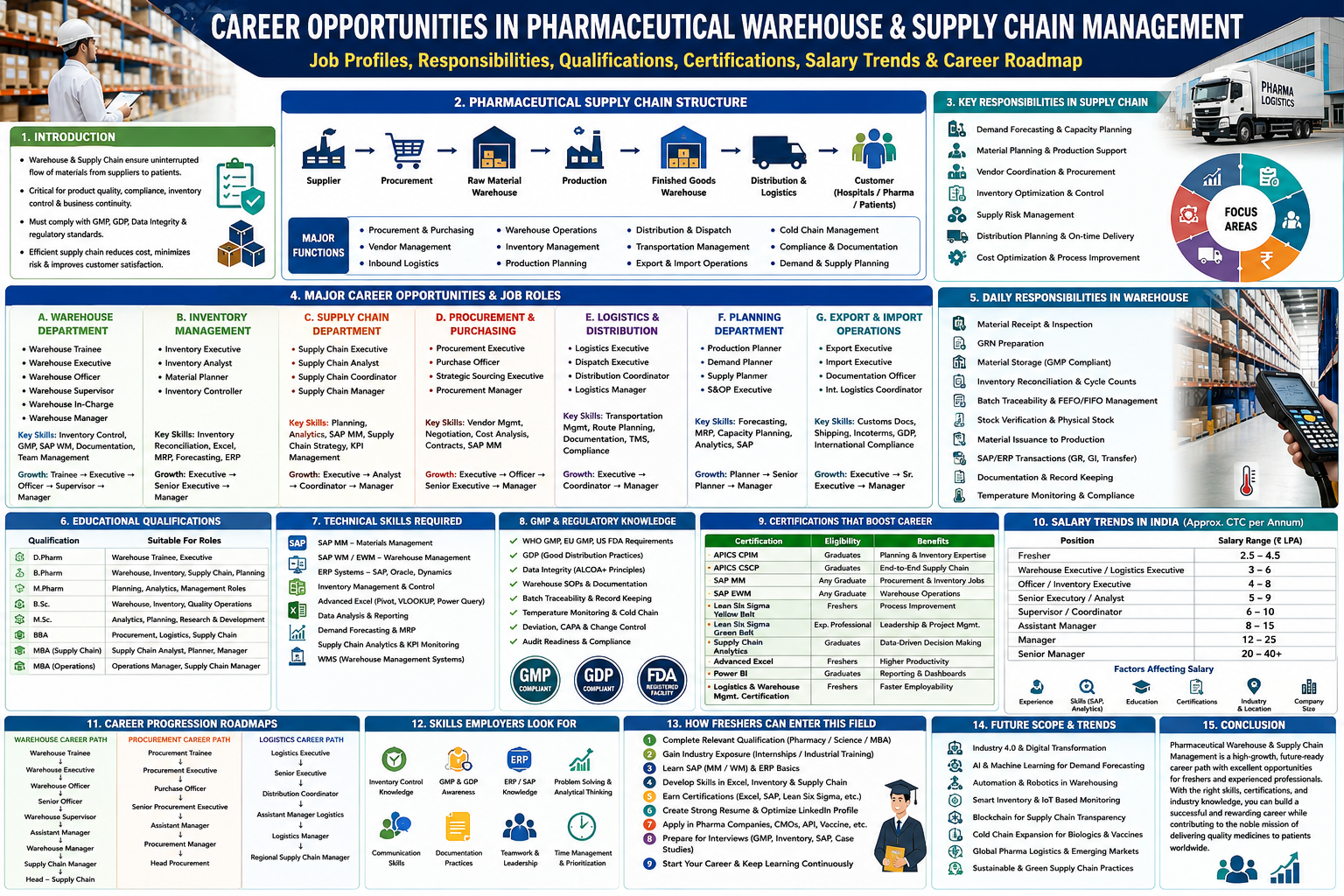
Introduction
The pharmaceutical industry is one of the most highly regulated and quality-driven sectors globally. While research, manufacturing, quality control, and regulatory affairs often receive significant attention, the success of pharmaceutical operations largely depends on efficient Warehouse & Supply Chain Management.
Every medicine manufactured must reach patients safely, efficiently, and on time. This is only possible through robust warehouse operations, inventory management, procurement systems, logistics networks, and supply chain planning.
As pharmaceutical manufacturing expands globally, the demand for skilled professionals in Pharmaceutical Warehouse Jobs, Supply Chain Careers, Pharma Logistics Jobs, Inventory Management Jobs, Procurement Careers, and Warehouse Operations Pharma is increasing rapidly.
This field offers excellent career opportunities for:
- B.Pharm Graduates
- D.Pharm Holders
- M.Pharm Students
- B.Sc. Graduates
- M.Sc. Graduates
- BBA Graduates
- MBA (Operations/Supply Chain) Professionals
- Experienced professionals seeking career transitions
Why Warehouse & Supply Chain is Critical in Pharmaceutical Manufacturing
Unlike many industries, pharmaceutical products directly impact patient health. Any disruption in material availability, storage conditions, or distribution can lead to:
- Manufacturing delays
- Product shortages
- Regulatory observations
- Product recalls
- Financial losses
- Patient safety risks
Warehouse and Supply Chain functions ensure:
✅ Continuous availability of raw materials
✅ Proper storage conditions
✅ Inventory optimization
✅ GMP compliance
✅ Product traceability
✅ Timely dispatch of finished products
✅ Cold chain maintenance
✅ Business continuity
Structure of Pharmaceutical Supply Chain
The pharmaceutical supply chain involves multiple interconnected functions.
Major Functions
1. Procurement & Purchasing
Responsible for:
- Vendor identification
- Supplier qualification
- Purchase order generation
- Material sourcing
- Cost negotiations
2. Vendor Management
Activities include:
- Supplier audits
- Performance evaluation
- Quality agreements
- Risk assessment
3. Inbound Logistics
Handles transportation of:
- Raw materials
- Packaging materials
- Consumables
4. Warehouse Operations
Responsible for:
- Material receipt
- Storage
- Inventory management
- Material issuance
5. Inventory Management
Focuses on:
- Stock optimization
- Inventory accuracy
- Safety stock management
6. Production Planning
Ensures material availability for manufacturing schedules.
7. Distribution & Dispatch
Coordinates:
- Finished goods movement
- Order fulfillment
- Customer deliveries
8. Transportation Management
Manages:
- Route planning
- Freight costs
- Logistics partners
9. Export & Import Operations
Handles:
- Customs documentation
- International logistics
- Regulatory compliance
10. Cold Chain Management
Maintains temperature-sensitive products such as:
- Vaccines
- Biologics
- Insulin products
Pharmaceutical Supply Chain Flowchart
Supplier
   ↓
Procurement
   ↓
Raw Material Warehouse
   ↓
Production
   ↓
Finished Goods Warehouse
   ↓
Distribution & Logistics
   ↓
Wholesalers / Hospitals / Pharmacies
   ↓
Patients
Major Career Opportunities in Pharmaceutical Warehouse & Supply Chain
A. Warehouse Department Careers
Warehouse Trainee
Responsibilities
- Material receiving
- Stock entry
- Documentation support
- Warehouse housekeeping
Skills Required
- GMP awareness
- Basic Excel
- Documentation
Entry Requirement
- D.Pharm
- B.Pharm
- B.Sc.
Career Growth
Warehouse Trainee → Executive → Officer
Warehouse Executive
Responsibilities
- Material storage
- Inventory transactions
- Batch management
- ERP updates
Skills Required
- SAP knowledge
- Inventory control
- Documentation
Career Growth
Executive → Senior Executive → Officer
Warehouse Officer
Responsibilities
- Inventory management
- Team coordination
- Compliance activities
- Audit support
Skills Required
- ERP systems
- GMP documentation
- Leadership
Warehouse Supervisor
Responsibilities
- Workforce management
- Warehouse operations monitoring
- Productivity improvement
Career Growth
Supervisor → Assistant Manager
Warehouse In-Charge
Responsible for:
- Entire warehouse operations
- Inventory accuracy
- Compliance oversight
Warehouse Manager
Responsibilities
- Warehouse strategy
- Resource planning
- Budget management
- Audit readiness
Career Growth
Warehouse Manager → Senior Manager → Head Supply Chain
B. Inventory Management Careers
Inventory Executive
Responsibilities
- Stock monitoring
- Inventory reconciliation
- Reporting
Skills
- Excel
- ERP
- Inventory control
Inventory Analyst
Responsibilities
- Inventory data analysis
- Demand forecasting
- Stock optimization
Preferred Qualification
- MBA Supply Chain
- B.Pharm
- B.Sc.
Material Planner
Responsibilities
- Material requirement planning
- Production support
Skills
- MRP
- Forecasting
- Analytics
Inventory Controller
Responsible for:
- Inventory governance
- Cycle counts
- Compliance
C. Supply Chain Department Careers
Supply Chain Executive
Responsibilities
- Planning support
- Vendor coordination
- Inventory tracking
Supply Chain Analyst
Responsibilities
- Data analysis
- KPI monitoring
- Forecasting
Key Skills
- Power BI
- Excel
- Analytics
Supply Chain Coordinator
Responsible for:
- Cross-functional coordination
- Procurement follow-up
- Logistics tracking
Supply Chain Manager
Responsibilities
- End-to-end supply chain management
- Cost optimization
- Demand planning
D. Procurement & Purchasing Careers
Procurement Executive
Responsibilities
- RFQs
- Vendor communication
- Purchase orders
Purchase Officer
Responsible for:
- Material sourcing
- Price negotiations
- Supplier coordination
Strategic Sourcing Executive
Focuses on:
- Vendor development
- Cost reduction
- Risk management
Procurement Manager
Responsible for:
- Supplier strategy
- Procurement budgets
- Contract management
E. Logistics & Distribution Careers
Logistics Executive
Responsibilities
- Shipment planning
- Vehicle coordination
- Dispatch scheduling
Dispatch Executive
Handles:
- Finished goods dispatch
- Documentation
- Transportation coordination
Distribution Coordinator
Responsible for:
- Delivery planning
- Distributor communication
Logistics Manager
Leads:
- National distribution network
- Freight optimization
- Transportation compliance
F. Planning Department Careers
Production Planner
Ensures:
- Manufacturing schedules
- Material availability
Demand Planner
Focuses on:
- Sales forecasts
- Market demand analysis
Supply Planner
Responsible for balancing:
- Demand
- Inventory
- Production capacity
S&OP Executive
Supports:
Sales & Operations Planning processes.
G. Export & Import Operations Careers
Export Executive
Responsible for:
- Export documentation
- International shipments
Import Executive
Handles:
- Customs clearance
- Import permits
Documentation Officer
Maintains:
- Shipping documents
- Regulatory records
International Logistics Coordinator
Coordinates:
- Global supply chain movements
- Freight partners
- International compliance
Daily Responsibilities in Pharmaceutical Warehouse Operations
A typical warehouse professional performs:
Material Receipt
- Verification of materials
- Quantity checking
- Vendor documentation review
GRN Preparation
Goods Receipt Note generation after verification.
Material Storage
Following:
- GMP requirements
- Segregation practices
- Temperature controls
Inventory Reconciliation
Comparing:
- Physical stock
- ERP records
Batch Traceability
Tracking materials throughout their lifecycle.
FEFO/FIFO Management
FIFO
First In First Out
FEFO
First Expiry First Out
Critical for pharmaceutical inventory management.
Stock Verification
- Cycle counts
- Annual stock audits
Material Issuance
Providing materials to production.
SAP/ERP Transactions
- Goods receipt
- Goods issue
- Inventory transfer
Compliance Activities
- Temperature monitoring
- Cleaning verification
- Documentation review
Key Responsibilities in Pharmaceutical Supply Chain
Demand Forecasting
Predicting future market requirements.
Capacity Planning
Aligning manufacturing capabilities with demand.
Material Planning
Ensuring material availability.
Vendor Coordination
Maintaining supplier relationships.
Inventory Optimization
Reducing excess inventory while avoiding stockouts.
Supply Risk Management
Mitigating risks from:
- Supplier failures
- Transportation disruptions
Distribution Planning
Ensuring timely product deliveries.
Cost Optimization
Improving efficiency and reducing operational costs.
Educational Qualifications Required
| Qualification | Suitable Roles |
|---|---|
| D.Pharm | Warehouse Trainee, Warehouse Executive |
| B.Pharm | Warehouse, Inventory, Supply Chain |
| M.Pharm | Planning, Analytics, Management |
| B.Sc. | Warehouse Operations, Inventory |
| M.Sc. | Planning, Analytics |
| BBA | Procurement, Logistics |
| MBA Supply Chain | Supply Chain Analyst, Planner |
| MBA Operations | Management Roles |
Technical Skills Required
SAP MM
Materials Management module.
Used for:
- Procurement
- Inventory control
SAP WM
Warehouse Management.
Supports:
- Stock movement
- Bin management
SAP EWM
Extended Warehouse Management.
Used in advanced warehouses.
ERP Systems
Examples:
- SAP
- Oracle
- Microsoft Dynamics
Inventory Management
Knowledge of:
- Safety stock
- Reorder levels
- Inventory KPIs
Warehouse Management Systems (WMS)
Used for:
- Real-time stock tracking
- Warehouse optimization
Advanced Excel
Important functions:
- Pivot Tables
- VLOOKUP
- XLOOKUP
- Power Query
Data Analysis
Critical for inventory and planning roles.
Demand Forecasting
Supports production planning.
MRP (Material Requirement Planning)
Ensures uninterrupted manufacturing.
Supply Chain Analytics
Increasingly important in modern pharmaceutical operations.
GMP and Regulatory Knowledge Required
Professionals should understand:
WHO GMP
Good Manufacturing Practices.
EU GMP
European compliance requirements.
US FDA Regulations
Global pharmaceutical standards.
GDP
Good Distribution Practices.
Data Integrity
ALCOA+ principles.
Warehouse Documentation
- SOPs
- Logs
- Records
Temperature Monitoring
Storage condition compliance.
Cold Chain Compliance
Essential for biologics and vaccines.
Certifications That Improve Employability
| Certification | Eligibility | Career Impact |
|---|---|---|
| APICS CPIM | Graduates | Planning & Inventory Careers |
| APICS CSCP | Graduates | End-to-End Supply Chain Roles |
| SAP MM | Any Graduate | Procurement & Inventory Jobs |
| SAP EWM | Any Graduate | Warehouse Operations |
| Lean Six Sigma Yellow Belt | Freshers | Process Improvement |
| Lean Six Sigma Green Belt | Experienced Professionals | Leadership Opportunities |
| Supply Chain Analytics | Graduates | Data-Driven Roles |
| Advanced Excel | Freshers | Entry-Level Advantage |
| Power BI | Graduates | Analyst Roles |
| Logistics & Warehouse Certification | Freshers | Faster Employability |
Salary Trends in India (2025–2026)
| Position | Approximate Annual Salary |
|---|---|
| Fresher | ₹2.5–4.5 LPA |
| Warehouse Executive | ₹3–6 LPA |
| Officer | ₹4–8 LPA |
| Senior Executive | ₹5–9 LPA |
| Supervisor | ₹6–10 LPA |
| Assistant Manager | ₹8–15 LPA |
| Manager | ₹12–25 LPA |
| Senior Manager | ₹20–40+ LPA |
Factors Affecting Salary Growth
- Educational qualifications
- SAP expertise
- Industry experience
- Company size
- Location
- Certifications
- Leadership skills
Career Progression Roadmap
Warehouse Career Path
Warehouse Trainee
      ↓
Warehouse Executive
      ↓
Warehouse Officer
      ↓
Senior Officer
      ↓
Warehouse Supervisor
      ↓
Assistant Manager
      ↓
Warehouse Manager
      ↓
Supply Chain Manager
      ↓
Head – Supply Chain
Procurement Career Path
Procurement Trainee
      ↓
Procurement Executive
      ↓
Purchase Officer
      ↓
Senior Procurement Executive
      ↓
Assistant Manager
      ↓
Procurement Manager
      ↓
Head Procurement
Logistics Career Path
Logistics Executive
      ↓
Senior Executive
      ↓
Distribution Coordinator
      ↓
Assistant Manager Logistics
      ↓
Logistics Manager
      ↓
Regional Supply Chain Manager
Skills Employers Look for During Interviews
Employers commonly assess:
Technical Skills
- Inventory control
- ERP knowledge
- GMP awareness
- Warehouse documentation
Behavioral Skills
- Communication
- Teamwork
- Time management
- Leadership
Analytical Skills
- Root cause analysis
- Problem solving
- Data interpretation
How Freshers Can Enter Pharmaceutical Warehouse & Supply Chain
Step 1: Complete Relevant Qualification
Preferred:
- B.Pharm
- D.Pharm
- B.Sc.
- BBA
- MBA Supply Chain
Step 2: Gain Industry Exposure
Seek:
- Internships
- Industrial training
- Apprenticeships
Step 3: Learn SAP
Recommended modules:
- SAP MM
- SAP WM
- SAP EWM
Step 4: Build Technical Skills
Focus on:
- Excel
- Inventory management
- Supply chain basics
Step 5: Earn Certifications
Start with:
- Advanced Excel
- Lean Six Sigma Yellow Belt
- SAP MM
Step 6: Create a Strong Resume
Highlight:
- Academic projects
- Certifications
- Internships
Step 7: Optimize LinkedIn Profile
Include:
- Industry keywords
- Professional headline
- Certifications
Step 8: Apply Strategically
Target:
- Pharmaceutical manufacturers
- Contract manufacturing organizations (CMOs)
- CDMOs
- Vaccine manufacturers
- API manufacturers
Step 9: Prepare for Interviews
Study:
- GMP
- Warehouse operations
- Inventory concepts
- SAP basics
Future Scope of Pharmaceutical Supply Chain Careers
The future of Pharma Supply Chain Jobs is extremely promising.
Industry 4.0
Digital manufacturing integration.
Digital Warehousing
Paperless warehouse operations.
AI-Based Demand Forecasting
Improved planning accuracy.
Automation
Automated storage and retrieval systems.
Robotics
Material handling automation.
Smart Inventory Systems
Real-time inventory visibility.
Blockchain Technology
Enhanced traceability and transparency.
Cold Chain Expansion
Growing demand due to biologics and vaccines.
Global Pharmaceutical Logistics
Increasing international supply chain opportunities.
Conclusion
Pharmaceutical Warehouse & Supply Chain Management has evolved into one of the most strategic and high-growth functions in the pharmaceutical industry. From Warehouse Executive and Inventory Management Jobs to Procurement Careers, Pharma Logistics Jobs, Supply Chain Management roles, and senior leadership positions, the sector offers excellent opportunities for both freshers and experienced professionals.
With growing global demand for medicines, biologics, vaccines, and specialty products, companies increasingly seek professionals who combine GMP knowledge, inventory management expertise, ERP/SAP skills, analytics capabilities, and supply chain understanding.
For freshers, a combination of relevant qualifications, industry exposure, SAP learning, certifications, and strong documentation skills can open doors to rewarding careers. For experienced professionals, the pathway toward Warehouse Manager, Supply Chain Manager, Procurement Manager, and Head – Supply Chain roles offers substantial career growth, leadership opportunities, and attractive compensation.
Warehouse and Supply Chain functions are no longer support departments—they are strategic business drivers that directly influence operational excellence, regulatory compliance, customer satisfaction, and patient access to life-saving medicines. Those who invest in digital skills, analytics, automation technologies, and continuous learning will be best positioned to thrive in the future of pharmaceutical supply chain management.
About the Author
Ramesh Palav is a GxP Compliance and Computer System Validation (CSV) professional with experience in pharmaceutical manufacturing, quality systems, data integrity, and digital transformation. He is passionate about helping organizations adopt compliant, efficient, and practical digital solutions while maintaining regulatory expectations and patient safety.