
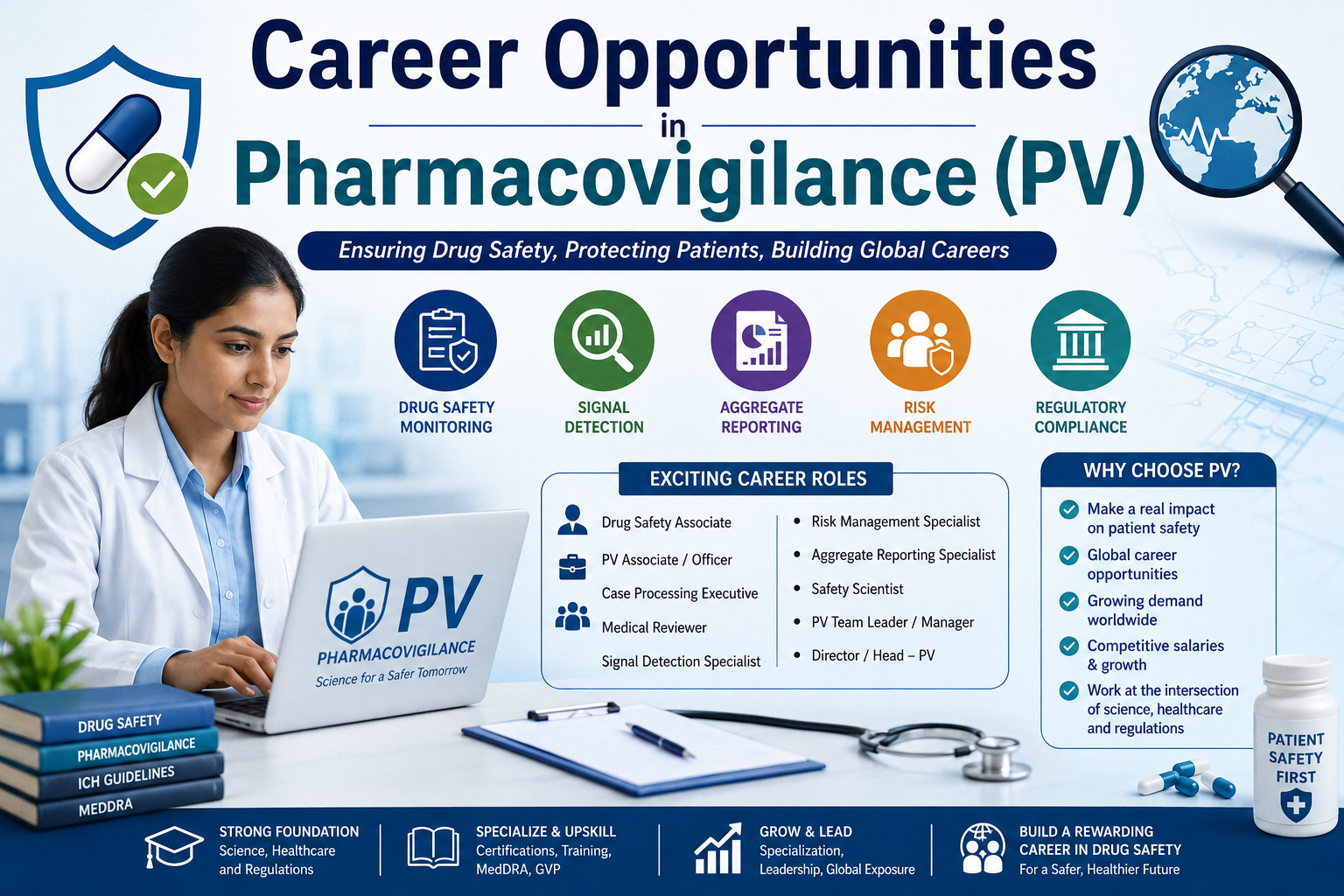
Introduction to Pharmacovigilance
The pharmaceutical industry is built on a single objective: ensuring that medicines are safe, effective, and beneficial for patients. While clinical trials help establish the safety profile of a drug before approval, the real-world use of medicines among millions of patients can reveal additional safety concerns. This is where Pharmacovigilance (PV) plays a critical role.
What is Pharmacovigilance?
According to the World Health Organization (WHO), Pharmacovigilance is the science and activities related to the detection, assessment, understanding, and prevention of adverse effects or any other drug-related problems.
In simple terms, Pharmacovigilance focuses on monitoring the safety of medicines throughout their lifecycle and ensuring that any risks associated with their use are identified, evaluated, and communicated appropriately.
Importance of Drug Safety Monitoring
Drug safety monitoring is essential because:
- Clinical trials involve limited patient populations.
- Rare adverse effects may not be detected before approval.
- Long-term safety data become available only after commercialization.
- Different patient populations may react differently to medications.
Role of Pharmacovigilance in Patient Safety
Pharmacovigilance helps:
- Protect patient health
- Detect unexpected adverse reactions
- Support benefit-risk assessments
- Improve regulatory compliance
- Enhance public confidence in medicines
Why Pharmacovigilance is Growing Globally
Several factors are driving the rapid growth of Pharmacovigilance:
- Increase in global drug development
- Expansion of biotechnology products
- Growing regulatory scrutiny
- Rising number of clinical trials
- Increased patient awareness
- Adoption of digital safety systems
As pharmaceutical companies expand globally, the demand for skilled Pharmacovigilance professionals continues to rise.
What Does a Pharmacovigilance Professional Do?
A Pharmacovigilance professional is responsible for ensuring that drug safety information is collected, analyzed, reported, and monitored according to global regulations.
Key Responsibilities
| Activity | Purpose |
|---|---|
| Adverse Event Monitoring | Track safety-related events |
| ADR Reporting | Document adverse drug reactions |
| Signal Detection | Identify new safety concerns |
| Risk Management | Minimize drug-related risks |
| Medical Review | Assess clinical significance |
| Aggregate Reporting | Prepare periodic safety reports |
| Database Management | Maintain safety data |
| Regulatory Compliance | Meet global requirements |
Adverse Event (AE) Monitoring
Monitoring and documenting any undesirable medical occurrence experienced by patients.
Adverse Drug Reaction (ADR) Reporting
Collection and submission of suspected drug-related adverse reactions to regulatory authorities.
Signal Detection
Identifying patterns in safety data that may indicate new risks associated with a drug.
Risk Management
Developing strategies to reduce potential risks and improve patient safety.
Medical Review
Medical assessment of reported cases by qualified healthcare professionals.
Aggregate Reporting
Preparation of reports such as:
- PSUR
- PURER
- DSUR
- Annual Safety Reports
Safety Database Management
Managing drug safety databases and ensuring data integrity.
Regulatory Compliance
Ensuring adherence to FDA, EMA, MHRA, CDSCO, and ICH requirements.
Structure of a Pharmacovigilance Department
A typical Pharmacovigilance department consists of several specialized functions.
1. Case Processing
Responsible for:
- Case intake
- Data entry
- MedDRA coding
- Narrative writing
- Regulatory submissions
2. Literature Surveillance
Monitoring scientific literature for safety-related information.
3. Signal Detection
Analyzing trends and identifying emerging safety concerns.
4. Medical Review
Clinical evaluation of safety cases.
5. Aggregate Reporting
Preparation of periodic safety reports.
6. Risk Management
Development of Risk Management Plans (RMPs).
7. Safety Writing
Creation of safety narratives, reports, and regulatory documents.
8. PV Compliance
Ensuring compliance with global Pharmacovigilance regulations.
9. Safety Data Management
Managing safety databases and workflows.
10. Regulatory Pharmacovigilance
Handling interactions with health authorities.
Career Opportunities in Pharmacovigilance
Entry-Level Positions
1. Drug Safety Associate
Responsibilities
- Case processing
- ADR assessment
- MedDRA coding
- Narrative preparation
Required Skills
- Medical terminology
- Attention to detail
- Regulatory awareness
Qualifications
- B.Pharm
- M.Pharm
- Pharm.D
- Life Sciences
Career Progression
Drug Safety Associate → Senior Associate → Safety Specialist
2. PV Associate
Handles adverse event processing and regulatory submissions.
3. Safety Data Associate
Responsible for safety database entry and maintenance.
4. Case Processing Executive
Focuses on case triage and data quality review.
5. Pharmacovigilance Officer
Supports safety operations and compliance activities.
6. Medical Reviewer (Entry Level)
Performs medical assessment of safety cases.
Mid-Level Positions
Senior PV Associate
- Case quality review
- Team mentoring
- Regulatory compliance support
Drug Safety Specialist
- Complex case handling
- Signal evaluation
- Safety trend analysis
Signal Detection Specialist
- Data mining
- Signal validation
- Risk assessment
Risk Management Specialist
- Risk mitigation strategies
- Safety monitoring plans
Aggregate Reporting Specialist
- PSUR preparation
- PURER writing
- Regulatory submissions
Safety Scientist
- Benefit-risk evaluation
- Scientific analysis
- Safety strategy development
Leadership Positions
Team Leader – Pharmacovigilance
Leads case processing teams and performance management.
Manager – Drug Safety
Responsible for operational delivery and compliance.
Associate Director – PV
Oversees multiple Pharmacovigilance functions.
Director – Pharmacovigilance
Provides strategic leadership and regulatory oversight.
Head – Drug Safety & PV
Responsible for global drug safety operations.
Educational Qualifications Required
B.Pharm Graduates
Strong eligibility for entry-level Pharmacovigilance jobs.
M.Pharm Graduates
Preferred for scientific and advanced safety roles.
Pharm.D Graduates
Highly preferred due to clinical and patient-care knowledge.
B.Sc. Life Sciences
Eligible for case processing and safety operations roles.
M.Sc. Life Sciences
Can enter safety operations, signal detection, and regulatory functions.
Biotechnology Graduates
Suitable for biologics and advanced therapy safety monitoring.
Clinical Research Professionals
Can transition easily into Pharmacovigilance.
Medical Professionals
Including:
- MBBS
- BDS
- BAMS
- BHMS
Often recruited for medical review and safety physician positions.
Essential Technical Skills for Pharmacovigilance
A successful Pharmacovigilance professional should develop the following skills:
| Skill | Importance |
|---|---|
| ADR Assessment | Critical |
| MedDRA Coding | Essential |
| WHO Drug Dictionary | Essential |
| Case Processing | Essential |
| Narrative Writing | Essential |
| Signal Management | Advanced |
| Regulatory Reporting | Critical |
| Data Analysis | High |
| Medical Terminology | Essential |
| Clinical Knowledge | High |
Additional Skills
- Communication
- Analytical thinking
- Attention to detail
- Scientific writing
- Database navigation
Important Regulatory Guidelines
ICH Guidelines
The International Council for Harmonisation (ICH) establishes global standards.
ICH E2A
Clinical safety data management and expedited reporting.
ICH E2B(R3)
Electronic transmission of safety reports.
ICH E2D
Post-marketing safety reporting.
ICH E2E
Pharmacovigilance planning.
US FDA Requirements
- FARES reporting
- Post-marketing surveillance
- REMS programs
EMA Requirements
- EudraVigilance
- Risk Management Plans
- PSUR submissions
Good Pharmacovigilance Practice (GVP)
European guidance covering:
- Signal management
- Risk management
- Inspections
- Audits
CDSCO Requirements
Indian Pharmacovigilance regulations and reporting obligations.
PvPI
The Pharmacovigilance Programme of India collects and monitors ADR reports nationwide.
Certifications That Improve Employability
Professional certifications significantly improve job prospects.
Pharmacovigilance Certification Programs
Benefits
- Industry knowledge
- Interview preparation
- Practical exposure
Duration
1–6 months
Career Impact
Improves employability for freshers.
Clinical Research Certifications
Useful for professionals transitioning into PV.
Drug Safety Certification Courses
Focused training on:
- Case processing
- Signal detection
- Regulatory reporting
MedDRA Training
Enhances coding expertise.
Regulatory Affairs Courses
Improve understanding of compliance requirements.
Signal Detection Training
Useful for advanced PV roles.
GVP Training
Essential for regulatory compliance.
Medical Writing Certifications
Support aggregate reporting and safety writing careers.
Pharmacovigilance Software and Databases
Modern Pharmacovigilance operations rely heavily on specialized software.
Argus Safety
One of the most widely used global safety databases.
Uses
- Case processing
- Reporting
- Workflow management
ARISg
Supports safety case management and compliance activities.
Veeva Vault Safety
Cloud-based Pharmacovigilance platform.
Advantages
- Automation
- Scalability
- Global compliance
Oracle Safety
Comprehensive safety management system.
MedDRA
Medical Dictionary for Regulatory Activities.
Used For
- Coding adverse events
- Standardized reporting
WHO Drug Dictionary
Used for drug coding and identification.
Salary Trends in Pharmacovigilance
India Salary Trends
| Experience | Estimated Annual Salary |
|---|---|
| Fresher | ₹3.0–6.0 LPA |
| 2–5 Years | ₹6–12 LPA |
| 5–10 Years | ₹12–25 LPA |
| Manager | ₹20–40 LPA |
| Senior Leadership | ₹40 LPA–1 Crore+ |
Factors Affecting Salary
- Qualification
- Certifications
- Software expertise
- Regulatory knowledge
- Company type
Global Opportunities
Countries with strong demand include:
- United States
- United Kingdom
- Germany
- Ireland
- Canada
- Singapore
- Australia
Global salaries are significantly higher for experienced professionals.
Top Companies Hiring Pharmacovigilance Professionals
Multinational Pharmaceutical Companies
- Pfizer
- Novartis
- Roche
- Sanofi
- AstraZeneca
- Merck
- GSK
CROs
- IQVIA
- Parexel
- Syneos Health
- ICON
- Labcorp
Global Capability Centers (GCCs)
- Accenture
- Tatami Consultancy Services (TCS)
- Cognizant
- Wipro
- Infosys
Biotech Companies
- Biocon
- Amgen
- Moderna
- Regeneron
Step-by-Step Career Roadmap for Freshers
Phase 1 – Graduation
Build Fundamentals
Learn:
- Pharmacology
- Drug development
- Clinical research
- Pharmacovigilance basics
Medical Terminology
Understand disease conditions and medical language.
Drug Safety Concepts
Learn:
- AE
- ADR
- SAE
- SUGAR
Phase 2 – Skill Development
Pharmacovigilance Training
Complete industry-oriented training programs.
Regulatory Knowledge
Study:
- ICH Guidelines
- GVP
- FDA regulations
MedDRA Learning
Practice adverse event coding.
Phase 3 – Certification
Recommended certifications:
- Pharmacovigilance Certification
- MedDRA Training
- GVP Training
- Clinical Research Certification
Hands-On Projects
Practice:
- Case processing
- Narrative writing
- Signal review exercises
Phase 4 – Job Search
Resume Building
Highlight:
- Certifications
- Internships
- Projects
LinkedIn Optimization
- Professional headline
- Skills section
- Networking with recruiters
Interview Preparation
Prepare common Pharmacovigilance interview questions.
Phase 5 – Career Growth
Specialization Areas
- Signal Detection
- Medical Review
- Aggregate Reporting
- Safety Writing
- Risk Management
Leadership Development
Develop:
- Team management
- Project management
- Strategic thinking
Common Interview Questions in Pharmacovigilance
1. What is Pharmacovigilance?
Pharmacovigilance is the science of detecting, assessing, understanding, and preventing adverse effects of medicines.
2. What is an Adverse Event?
Any undesirable medical occurrence after drug administration.
3. What is an ADR?
A harmful and unintended response to a medicinal product.
4. Difference between AE and ADR?
AE may not be related to the drug; ADR is suspected to be drug-related.
5. What is a Serious Adverse Event?
An event causing death, hospitalization, disability, congenital anomaly, or life-threatening condition.
6. What is MedDRA?
A standardized medical terminology used for coding adverse events.
7. What is Signal Detection?
Identification of potential new safety concerns.
8. What is a SUGAR?
Suspected Unexpected Serious Adverse Reaction.
9. What is Case Processing?
Collection, evaluation, coding, and reporting of safety cases.
10. What is Narrative Writing?
Preparation of a medically coherent case summary.
11. What are the four minimum criteria for a valid case?
- Identifiable patient
- Identifiable reporter
- Suspect drug
- Adverse event
12. What is causality assessment?
Evaluation of drug-event relationship.
13. What is WHO-UMC scale?
A causality assessment method.
14. What is E2B(R3)?
Electronic format for safety report transmission.
15. What is a PSUR?
Periodic Safety Update Report.
16. What is a PURER?
Periodic Benefit-Risk Evaluation Report.
17. What is GVP?
Good Pharmacovigilance Practice.
18. What is a Risk Management Plan?
A document describing safety risks and mitigation measures.
19. Why do you want a career in Pharmacovigilance?
It combines healthcare knowledge, patient safety, and scientific analysis.
20. What are your strengths for PV?
Attention to detail, analytical skills, communication, and scientific knowledge.
Future Scope of Pharmacovigilance
The future of Pharmacovigilance is highly promising.
Artificial Intelligence in Drug Safety
AI is being used for:
- Case triage
- Signal detection
- Literature screening
- Data mining
Automation
Automation reduces manual effort and improves compliance.
Real-World Evidence
Increasing use of:
- Electronic health records
- Patient registries
- Healthcare databases
Global Drug Safety Trends
Growing regulatory expectations are increasing demand for qualified professionals.
Emerging Career Opportunities
Future roles include:
- Safety Data Scientist
- AI-Driven Signal Analyst
- Real-World Evidence Specialist
- Digital Pharmacovigilance Expert
- Safety Automation Consultant
Conclusion
A career in Pharmacovigilance offers an excellent opportunity for pharmacy, life science, biotechnology, and clinical research professionals to enter the pharmaceutical industry and contribute directly to patient safety.
With increasing global regulatory requirements, expanding drug development pipelines, and growing adoption of advanced safety technologies, the demand for Pharmacovigilance professionals continues to rise across pharmaceutical companies, CROs, and global capability centers.
For freshers, the recommended action plan is simple:
- Build strong drug safety fundamentals.
- Learn medical terminology and regulatory guidelines.
- Complete Pharmacovigilance certifications.
- Gain practical exposure through projects and training.
- Optimize your resume and LinkedIn profile.
- Prepare thoroughly for Pharmacovigilance interviews.
- Continue learning and specialize in high-demand areas.
For those seeking a stable, globally recognized, and rewarding pharmaceutical career, Pharmacovigilance remains one of the most promising career paths in the life sciences industry.
About the Author
Ramesh Palav is a GxP Compliance and Computer System Validation (CSV) professional with experience in pharmaceutical manufacturing, quality systems, data integrity, and digital transformation. He is passionate about helping organizations adopt compliant, efficient, and practical digital solutions while maintaining regulatory expectations and patient safety.